
How Gamified Productivity Tools Solve Task Fatigue (and Keep Teams Engaged)
You’re already buried every Monday with deadlines, messages, meetings, and a dozen priorities fighting for attention. And then you’re expected to wrestle with a complex productivity tool just to figure out what to do first. It doesn’t take long before the tool designed to “help” becomes another thing draining your energy. That’s task fatigue.
Gamified productivity turns progress into something you can feel. Wins become visible. Small steps get rewarded. Momentum actually builds. And that’s what keeps people engaged.
In this blog, we’ll break down how task fatigue works, why traditional tools can’t stop it, and how gamified platforms like MagicTask keep teams motivated long-term, not just for the first week.
What Is Task Fatigue in Productivity Tools?
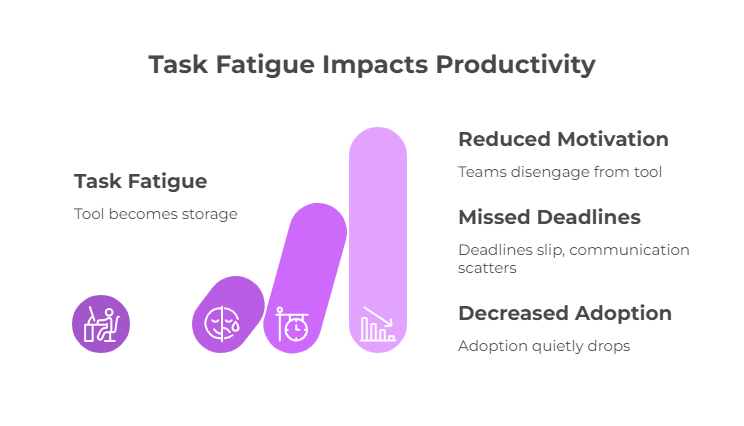
Task fatigue is what happens when a productivity tool becomes a place to store work instead of a place that helps you move work forward. The list gets longer, the checkboxes feel endless, and progress becomes invisible. At first, people try to keep up. Then they avoid the tool. And eventually, they stop using it altogether.
You can spot task fatigue in teams when:
- The task list feels overwhelming instead of clarifying
- People complete work but forget to mark it in the tool
- Tasks pile up without being prioritized
- Progress feels flat
- Adoption quietly drops week after week
Task fatigue kills motivation and productivity. When teams disengage from the tool, deadlines slip, communication scatters, and accountability disappears. Organizations end up paying for software no one actually uses while going back to spreadsheets, sticky notes, or “just ping me on Slack.”
Task fatigue is the silent churn engine behind most productivity platforms. Understanding it is the key to choosing a tool teams won’t abandon.
Why Traditional Productivity Tools Fail Against Task Fatigue
Traditional productivity platforms are great at storing work, but not at sustaining motivation. They rely on the assumption that organization alone drives action. If the list exists, people will follow it. But humans don’t operate on logic alone. We move when progress feels rewarding, visible, and emotionally satisfying. When a tool ignores that, task fatigue sets in fast.
1. Checklist Overload Creates Mental Exhaustion
Traditional task tools tend to show everything that needs to be done. It displays every task, every deadline, and every overdue item all at once.
At first, it feels productive, like you “have a plan.” But with time, that long list becomes a source of pressure rather than clarity. There’s no sense of momentum, no feeling of “I’m getting somewhere.” Add new tasks faster than old ones get completed, and the list starts to feel bottomless.
The harder you try to get ahead, the more it feels like you’re falling behind. Even high performers end up procrastinating, not because they can’t handle the work, but because the interface triggers a feeling of heaviness instead of progress.
2. No Recognition Means Effort Feels Invisible
In most productivity tools, you complete a task, check a box… and it disappears. That’s it. No acknowledgment of the effort it required, no record of how far you’ve come, no emotional payoff. You just move to the next box, and the next, and the next. Over time, work becomes transactional and mechanical.
Humans aren’t wired to stay motivated without feedback. Effort needs reinforcement to stay consistent. In fact, 80% of employees who say they have received meaningful feedback are fully engaged.
When the tool doesn’t provide that reinforcement, the brain stops associating task completion with satisfaction. As a result, people start doing the bare minimum inside the tool, or skip updating it entirely, because there’s no internal reward attached to using it.
3. There’s No Built-In Reason to Come Back
Reminders and notifications can force attention temporarily, but they can’t build desire. If the tool doesn’t feel good to use, adoption inevitably declines. Traditional productivity platforms rely on willpower. Users must show up out of discipline alone. But willpower isn’t renewable, especially in fast-moving work environments.
When your tool never gives anything back, it becomes easy to ignore. Eventually, updating tasks feels like extra work rather than support for the work. That’s how adoption quietly drops over time: not in a dramatic moment, but through a series of small, “I’ll update it later” decisions that turn into abandonment.
Gamified Productivity Tools: The Antidote to Task Fatigue
If task fatigue forms when work feels endless and unrewarding, then the antidote is simple: make progress feel worth it again. That’s exactly what gamified productivity tools do. They transform routine tasks into meaningful micro-wins, so teams stop working until they’re exhausted and start working until they’re satisfied.
Gamification brings motivation back into the workflow by turning everyday tasks into progress that’s visible, rewarding, and emotionally satisfying. Levels, streaks, achievements, and leaderboards are feedback mechanisms. They communicate: “you’re moving forward,” “your effort matters,” “you’re getting better.”
Gamified productivity tools create that feeling through motivation loops:
- Streaks reward consistency and make people want to keep their momentum alive.
- Levels show long-term growth and build a sense of identity around improvement.
- Achievements mark milestones that would normally go unnoticed in traditional tools.
- Leaderboards and shared progress introduce friendly accountability and team energy.
The difference is subtle but powerful because your work doesn’t get recognized.
When teams feel rewarded for showing up, they show up more often. When progress is visible, people want to keep progressing. Gamification creates an environment where engagement becomes the natural response.
How MagicTask Solves Task Fatigue and Improves Engagement
MagicTask was built to make work feel rewarding. Every part of the platform is intentionally designed to fight task fatigue by giving users what traditional tools don’t: visible progress, emotional payoff, and momentum that builds automatically.
Here’s how MagicTask keeps motivation alive long after the onboarding buzz wears off:
Streaks Turn Consistency Into Something People Want to Protect
Streaks are one of the simplest motivation mechanics and one of the most powerful. When people complete tasks day after day and watch their streak grow, they begin to take pride in showing up. It’s no longer “I have to do this task”. It becomes “I don’t want to break my streak.” That subtle shift turns discipline into desire.
What streaks do inside MagicTask:
- Create positive pressure instead of stressful pressure
- Turn daily task completion into a satisfying routine
- Make progress feel personal
- Encourage users to return even on low-motivation days
- Reduce the emotional friction of starting work
A streak becomes proof that you are consistent, committed, and improving. When progress is visible and cumulative, task fatigue loses its power.
Themes and Animations Reward Effort Visually
Humans respond to visuals. It’s why finishing a level in a video game feels exciting, not because the level is over, but because the screen shows you that you’ve won. MagicTask brings that same emotional payoff into everyday work.
Instead of checking a task off and watching it disappear, the interface reacts to progress. Themes evolve. Animations celebrate milestones. The workspace feels alive, and the brain registers effort as achievement rather than obligation.
Here’s what visual reinforcement does inside MagicTask:
- Makes each completed task feel satisfying rather than forgettable
- Replaces “relief that it’s done” with “pride that it counted”
- Refreshes motivation by making progress visible instead of invisible
- Builds an emotional connection between the user and their workspace
- Prevents burnout by creating moments of joy, not just effort
Think about the last time you cleaned up your desktop and changed your wallpaper. Nothing in your job technically changed, yet the space felt fresh and motivating, like a reset. You wanted to sit down and get things done again. MagicTask creates that feeling on purpose, not once a year, but every time you complete work.
Visual reinforcement may sound small, but it’s not. It tells the brain: “What you just did mattered.”
Traditional tools record tasks. MagicTask rewards them. And that difference keeps energy and engagement alive.
Task Sizes Remove Overwhelm Before It Starts
Overwhelm happens because tasks are unclear. When everything on a list looks equally important, equally big, and equally urgent, the brain freezes. MagicTask eliminates that friction by assigning every task a size (S, M, L, or XL), so users instantly understand effort before they begin.
Instead of staring at a wall of to-dos, people can scan, choose, and start.
Here’s how task sizing breaks big goals down into achievable actions:
| Task Size | Effort Level | Use | Psychological Benefit |
|---|---|---|---|
| S | 5–10 minutes | Quick wins, low-effort tasks | Builds momentum and confidence |
| M | 20–40 minutes | Focus tasks requiring moderate effort | Keeps productivity flowing without burnout |
| L | 60–120 minutes | Deep-work milestones | Helps plan focused time without anxiety |
| XL | Multi-step / multi-day | Major deliverables or goals | Makes big projects feel structured and doable |
Task sizes replace ambiguity with clarity. Instead of asking, “Where do I even start?” users think, “I’ll knock out two S tasks and then tackle that M task.” The mental barrier falls instantly.
When the path is clear, motivation has room to show up. And when the brain sees progress early in the day, momentum takes care of the rest.
Shared Boards Turn Work Into a Group Win
Nothing drains engagement faster than feeling like you’re working alone — especially on a team. Traditional productivity tools isolate progress: everyone completes tasks in their own corner, and no one sees the bigger movement happening. MagicTask flips that dynamic by making progress visible across the whole team, so every win sparks momentum for everyone.
Shared boards highlight who’s moving tasks forward and what progress the group has made, not in a micromanaging way, but in a way we're doing this together. Motivation becomes shared. Accountability becomes natural. Teams stop grinding in silence and start celebrating forward motion as a unit.
Here’s how shared boards support consistent engagement:
- Progress is visible to everyone, not buried in dashboards
- Wins feel collective instead of isolated
- Team confidence rises when movement is obvious
- One person’s productivity helps spark momentum for the whole group
- Collaboration feels fun, almost like a co-op game, not an obligation
When the workspace itself says “we’re moving forward,” people want to be part of that movement. The tool becomes a hub of shared progress rather than a list of individual chores.
That’s why MagicTask helps teams feel connected, supported, and aligned. Because when work feels like a shared win, teams don’t just show up… they thrive.
Conclusion: From Fatigue to Focus with Gamified Productivity
Traditional productivity tools don’t fail because they’re missing features. They fail because they unintentionally create task fatigue. The longer teams use them, the heavier work starts to feel, motivation drops, adoption fades, and another tool gets abandoned.
Gamified productivity changes the equation. Instead of making work something to endure, it makes progress visible, rewarding, and emotionally satisfying. Streaks, levels, themes, task sizes, and shared boards keep teams engaged because they make momentum felt, not assumed.
When work feels motivating, tools don’t get forgotten. When progress is visible, people keep coming back. That’s how engagement becomes the norm instead of the struggle.
If your team is tired of switching platforms and tired of feeling tired, it might be time to experience a different kind of productivity, one built on motivation, energy, and genuine progress.
Explore MagicTask and see how it turns everyday work into a motivating experience.
Similar Blogs
The Dopamine Trap: Why Some Gamified Apps Fail Users (and What Actually Works)
Gamified apps promise motivation. They promise streaks, badges, XP, and momentum. At first, it fe
The Productivity Reset Ritual: A 10-Minute Daily Routine to Stay Organized and Motivated
Have you ever ended a day feeling exhausted… but not accomplished? You answered emails. You jumpe
Why Gamification Works for Productivity in Modern Workflows
Gamification is often misunderstood. For many people, it brings to mind flashy rewards or surface
FAQS?Have questions? Look here
Task fatigue happens when a productivity tool feels overwhelming instead of helpful. Long task lists, unclear priorities, and invisible progress reduce motivation, causing teams to disengage and stop using the platform consistently.
Traditional productivity tools focus on organizing tasks but often ignore motivation. Without visible progress, feedback, or rewards, work feels repetitive and draining, which leads to lower engagement and declining adoption over time.
Gamified productivity tools reduce task fatigue by making progress visible and rewarding. Features like streaks, achievements, levels, and shared boards create positive reinforcement, helping teams stay motivated and consistent.
Examples of gamification in workplace productivity include: Daily streaks for consistent task completion Achievement badges for milestones Progress levels that show growth Leaderboards that encourage friendly competition Visual celebrations for completed tasks These elements turn routine work into engaging micro-wins.
Yes. Gamification improves employee engagement by providing instant feedback, recognition, and momentum. When effort feels acknowledged and progress is visible, employees are more likely to stay committed and productive long term.

Make Work Feel Like Play
Follow Us


