Change Realm Skip to main content

Why Small, Visible Wins Keep People Engaged After Motivation Fades

Motivation often feels powerful at the beginning of something new. A fresh project, a new productivity system, or a habit meant to improve daily life usually begins with strong energy. People feel focused and optimistic. Tasks seem manageable, and progress appears exciting.

During this early phase, productivity often feels effortless. Plans come together quickly. Goals feel achievable. The sense of possibility makes work enjoyable and engaging.

Then something slowly changes.

The excitement that fueled the beginning begins to fade. Tasks that once felt easy now require more effort. The project still matters, yet the emotional drive that helped you start begins to weaken.

This experience happens to almost everyone. Many people assume the issue lies in discipline. They believe they simply need stronger willpower or better habits to continue.

However, motivation rarely remains constant over long periods. Human behavior does not run on endless enthusiasm.

Long-term engagement depends on something more stable. People stay consistent when progress feels visible and achievable. Small wins provide reinforcement that motivation alone cannot sustain.

When progress becomes easy to see, effort begins to feel meaningful again. Even on slower days, completing small actions creates a sense of movement. Over time, those small steps build momentum and help people stay connected to their work.

Understanding the role of small, visible wins can change how individuals and teams approach productivity. Instead of chasing constant motivation, they build systems that reinforce progress every day.

Why Motivation Naturally Fades Over Time

Motivation usually begins with excitement. Starting something new creates curiosity and anticipation. The brain responds strongly to novelty, which produces emotional energy that makes early effort feel lighter.

At the beginning of a project or productivity system, several positive effects often appear.

  • Novelty effect: New systems feel exciting because they break routine and stimulate curiosity.
  • Initial optimism: People often believe progress will come quickly, which increases confidence and energy.
  • Clear direction: Goals and plans feel fresh, making it easier to take action.
  • Emotional momentum: Early progress produces enthusiasm that encourages further work.

During this stage, productivity systems often appear extremely effective. People organize tasks, create ambitious plans, and move quickly through their work.

However, novelty does not last forever.

Once routine replaces excitement, the brain stops producing the same emotional boost. Tasks become familiar. Effort begins to feel heavier. The project still matters, yet the emotional reward becomes weaker. This shift reflects how human psychology works rather than a failure of discipline.

Research published in Harvard Business Review explains that people feel most motivated when they experience consistent progress in meaningful work. When progress becomes difficult to recognize, motivation declines even if the work itself remains important.

When effort continues without visible signals of advancement, people begin to question their productivity system.

Several patterns usually appear during this stage.

  • Growing procrastination: Tasks feel harder to start because the emotional reward of progress becomes less visible.
  • Increased mental resistance: Work that once felt manageable begins to feel heavier and more demanding.
  • Reduced engagement: People start disconnecting emotionally from projects that previously felt exciting.
  • System abandonment: Productivity systems often get replaced because they no longer feel motivating.

Many productivity approaches struggle because they depend heavily on motivation. Emotional energy can help people start something new, yet it rarely sustains long periods of consistent effort.

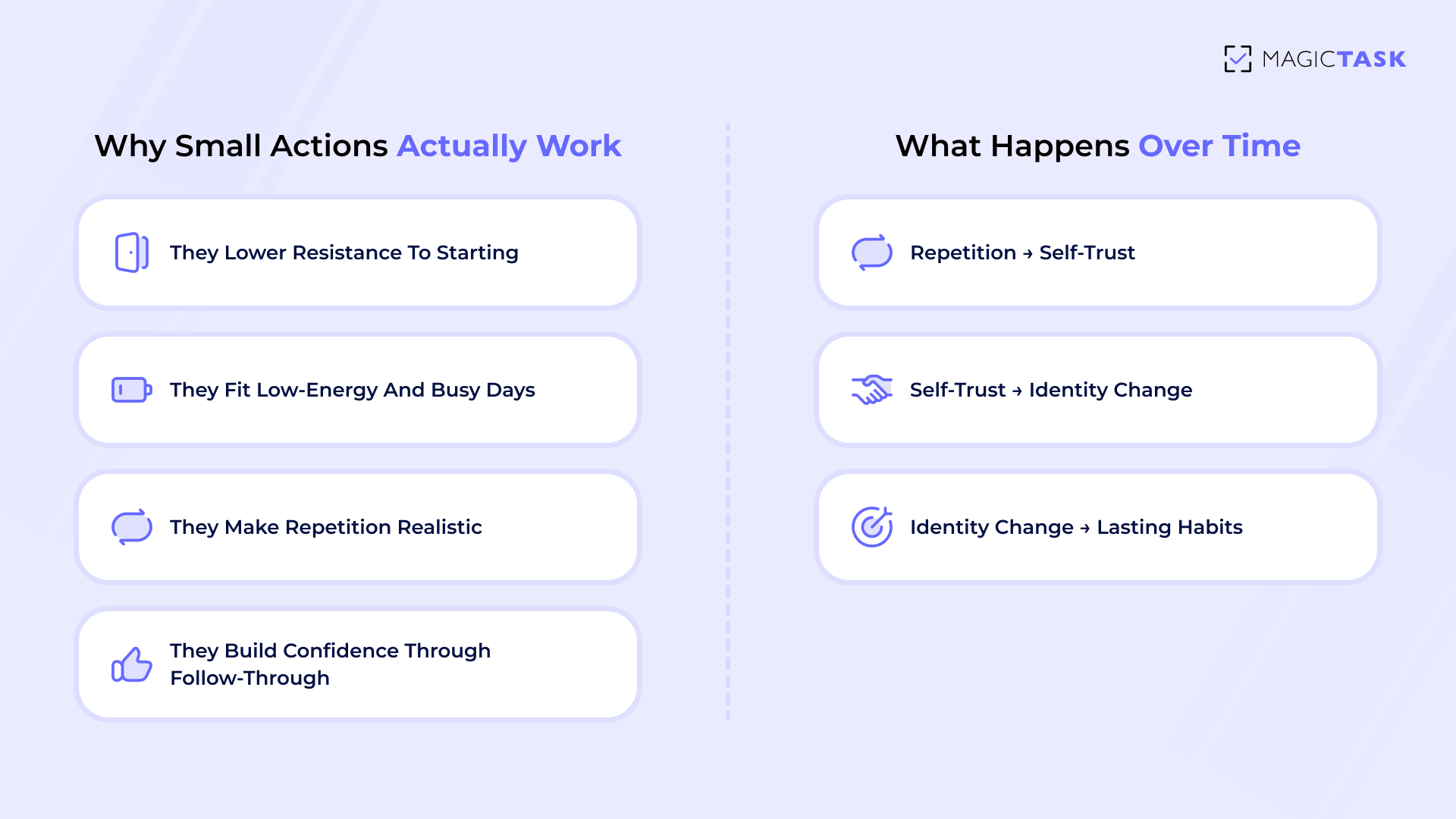
Consistency requires reinforcement. People continue showing up when their effort produces visible evidence that progress is happening. Small wins provide that reinforcement.

The Psychology Behind Small Wins

Small wins influence behavior because they shorten the distance between effort and reward. Large goals often feel distant and overwhelming. When people focus only on the final outcome, the brain struggles to stay engaged because the reward feels too far away. Small wins solve this problem by creating frequent signals of progress.

Each completed action tells the brain that effort is working. That signal produces a small sense of satisfaction, which increases confidence and encourages repetition. Over time, this process creates a progress loop that strengthens engagement.

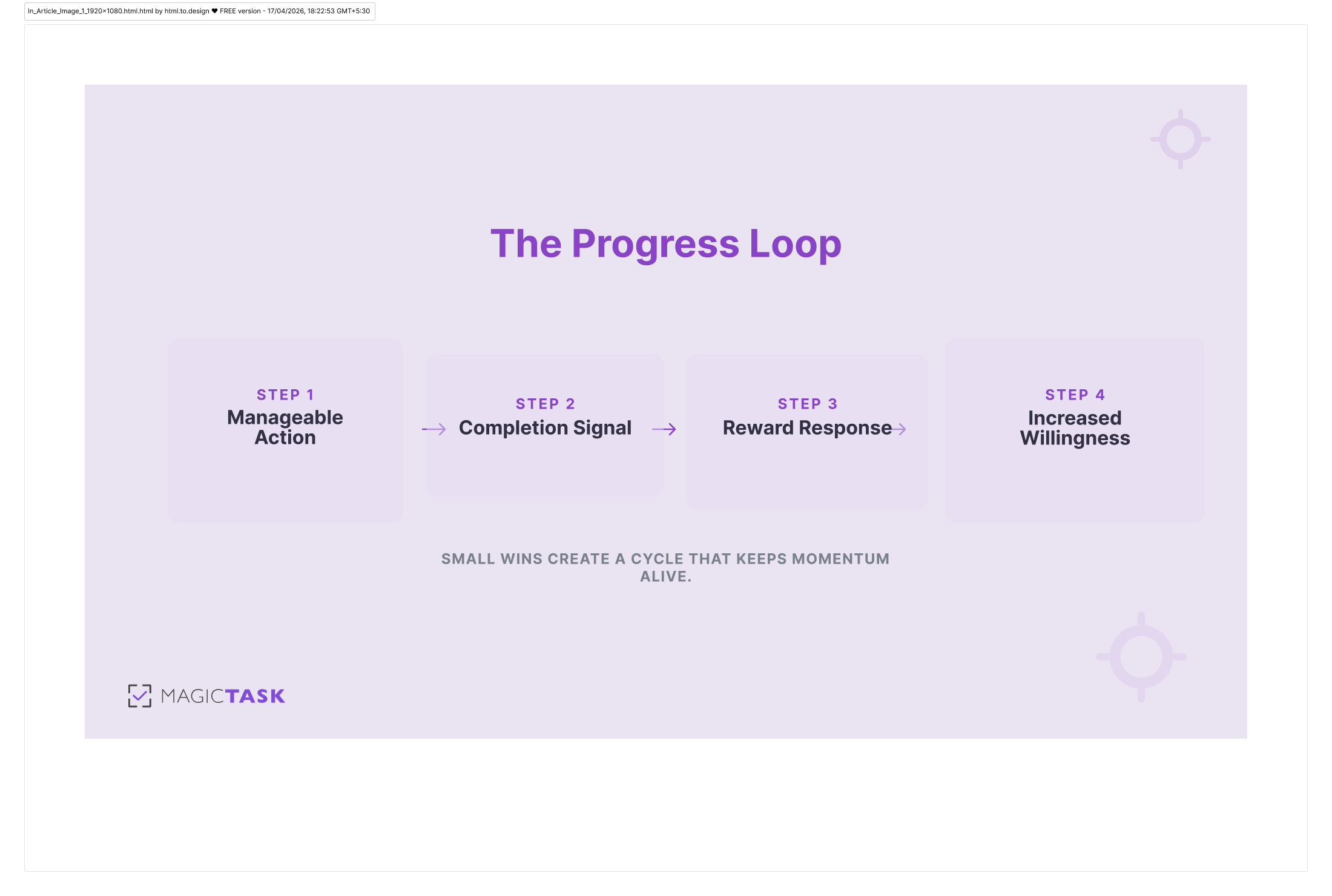
The Progress Loop

A typical progress loop follows a simple pattern.

  • Manageable action: A task small enough to complete without significant resistance.
  • Completion signal: The brain recognizes that progress has occurred.
  • Reward response: A small feeling of accomplishment reinforces the action.
  • Increased willingness: Starting the next task becomes easier because confidence grows.

Research by Teresa Amabile and Steven Kramer explored this idea through thousands of workplace diary entries. Their findings showed that progress in meaningful work was the strongest factor influencing positive emotions and engagement at work.

Even small steps forward produced measurable improvements in motivation. This insight changes how productivity should be understood. Many people assume motivation creates progress. In reality, progress often creates motivation.

When people see that their effort leads to results, they feel encouraged to continue.

Small wins also reduce psychological resistance. A large project may appear intimidating when viewed as a single objective. Breaking that project into smaller actions changes the experience completely.

Examples of small wins may include:

  • Task completion: Finishing one clearly defined task within a larger project.
  • Section progress: Completing a specific section of a report, presentation, or design.
  • Communication progress: Sending important emails or messages that move work forward.
  • Organizational progress: Sorting tasks, updating plans, or reviewing priorities.
  • Progress review: Recognizing completed work during a daily or weekly review.

These actions may appear simple, yet they create reinforcement that keeps people engaged.

Small wins also help people remain productive on low-energy days. Motivation naturally rises and falls, and no one operates at peak energy every day. When tasks remain manageable, people can still move forward even when they feel tired or distracted.

Instead of waiting for motivation to return, they rely on little progress to rebuild momentum.

Why Visibility of Progress Changes Behavior

Progress only influences behavior when people can clearly see it. Invisible effort often feels unrewarded. Someone may work for hours yet remain uncertain about how much progress has actually occurred.

When this situation repeats over time, motivation begins to fade.

Visible progress changes this experience in a powerful way. Clear signals allow the brain to connect effort with results. Each completed action produces visual confirmation that advancement has occurred.

Several types of visual signals reinforce engagement.

  • Completed tasks: Finished items remain visible so people can see accumulated progress.
  • Visual boards: Tasks move across stages such as pending, active, and completed.
  • Progress indicators: Visual markers show advancement toward a goal or milestone.
  • Consistency tracking: Streak counters highlight repeated actions over time.
  • Milestone recognition: Larger accomplishments become visible checkpoints within longer projects.

These signals turn abstract effort into something tangible.

Instead of feeling like work disappears into the background, people can observe the accumulation of completed actions. Each visible signal reinforces the idea that effort leads to progress.

Psychological research supports the importance of feedback in maintaining engagement. A report by ScienceDirect explains that immediate feedback improves performance and motivation because people can clearly see how their actions influence outcomes.

Feedback works as reinforcement. When someone finishes a task and sees visible confirmation, the brain registers completion as a reward.

Without that signal, effort can feel disconnected from progress.

Signs That Progress Is Too Invisible

Many productivity systems struggle because progress remains difficult to see. Work happens, yet the system provides little reinforcement.

Several warning signs indicate that progress may be too hidden.

  • Large undefined tasks: Work remains grouped into broad goals that feel overwhelming.
  • Delayed results: Progress becomes visible only after long periods of effort.
  • Disappearing achievements: Completed work quickly disappears without recognition.
  • Lack of feedback: People receive little confirmation that their actions create progress.

When progress remains invisible, motivation gradually declines even if people continue working hard.

Making progress visible solves this problem by reinforcing effort consistently.

Designing Systems That Reinforce Small Wins

Productivity systems become more effective when they reinforce progress regularly. Instead of relying on motivation alone, they create structures that make advancement visible and achievable.

Several principles help build these systems.

Break Work Into Manageable Actions

Large projects often appear overwhelming when viewed as single objectives. Breaking work into smaller steps makes progress easier to achieve.

For example:

  • Large project goal: Launch a new product.
  • Research stage: Collect user insights and define requirements.
  • Planning stage: Create feature outlines and development priorities.
  • Development stage: Complete individual tasks related to product functionality.
  • Review stage: Evaluate progress and refine the launch plan.

Each completed action becomes a small win that builds momentum.

Make Progress Easy to Track

People remain engaged when they can clearly see what has been accomplished. Systems should allow progress to remain visible instead of disappearing.

Helpful tracking methods include:

  • Task boards: Visual structures that display tasks across different stages of completion.
  • Completion sections: Dedicated areas where finished tasks remain visible.
  • Daily reviews: Short reflections that highlight progress made during the day.
  • Milestone markers: Clear checkpoints that represent meaningful progress.

Visible progress reinforces the sense that effort produces results.

Reinforce Consistency Instead of Perfection

Many people lose momentum because they believe productivity requires perfect performance. Missing a single day or falling behind schedule often creates discouragement.

Systems that reward consistency prevent this problem.

  • Consistency recognition: Systems highlight repeated actions rather than isolated achievements.
  • Small progress tracking: Even minor steps count as meaningful advancement.
  • Flexible expectations: Progress remains possible even during busy periods.

This approach helps people stay engaged even when energy levels fluctuate.

Keep Tasks Achievable on Low Energy Days

Productivity systems often assume people operate at peak energy every day. In reality, energy levels change constantly.

Smaller actions allow people to continue making progress even when energy is limited.

  • Low effort tasks: Simple actions that move work forward during slower days.
  • Progress continuation: Completing one small step helps restore momentum.
  • Momentum recovery: Small wins help people return to productive flow.

When tasks remain achievable, consistency becomes easier to maintain.

Conclusion

Motivation often sparks the beginning of a new project, habit, or productivity system. The excitement of starting something new creates the energy needed to take the first steps.

However, motivation rarely lasts forever.

Emotional energy naturally rises and falls. When productivity depends entirely on motivation, engagement eventually begins to fade.

Small wins provide a more reliable foundation for sustained progress.

Each completed action creates visible evidence that advancement is happening. These signals reinforce effort, strengthen confidence, and encourage consistency.

When systems reinforce small wins and make progress easy to see, people remain engaged with their work long after the initial motivation fades.

Gamified Productivity: Supporting Mental Well-Being Without Burnout

The Dopamine Trap

You don’t clock out of your mind when you log into work. Your mental health walks right in with you into meetings, into deadlines, into that ever-growing task list. And yet, most productivity systems behave as if none of that exists. They treat people like machines. Just input, output, repeat. So what happens next? Output goes up. Expectations quietly climb. And somewhere along the way, the human side of work gets pushed aside. And that’s affecting businesses all over the world.

According to the World Health Organization, 12 billion workdays are lost every year due to depression and anxiety, costing businesses more than US $1 trillion in lost productivity. Work has started to feel heavier than it should. This is something many people feel but don’t always say out loud. 

And here’s the part we don’t talk about enough. Productivity systems often add to that weight. They focus on output but do not consider how it feels to move through the work itself and how much pressure that creates on one’s mental health.

So the question is how to make productivity feel sustainable.

Work can feel structured, manageable, and even engaging when systems support mental well-being. Gamified productivity builds on that idea. It introduces a different way to approach progress, using reinforcement and visible progress to make small steps feel meaningful and worth continuing.

Why Traditional Productivity Systems Lead to Burnout

We didn’t always think productivity systems were a problem. At one point, they actually felt like the solution that helped you make a list, set deadlines, stay disciplined, and stick to the plan. It sounds simple, and honestly, it works for a while. You feel organized, in control, maybe even a little ahead of things.

Then the list gets longer, and you see deadlines popping up one by one. You finish one thing, and instead of feeling done, your brain immediately jumps to what’s still pending. You’re wondering why this feels harder than it should. Why does getting things done feel draining?

Most productivity systems keep you going without accounting for how that feels over time. So you end up stuck in this quiet loop. 

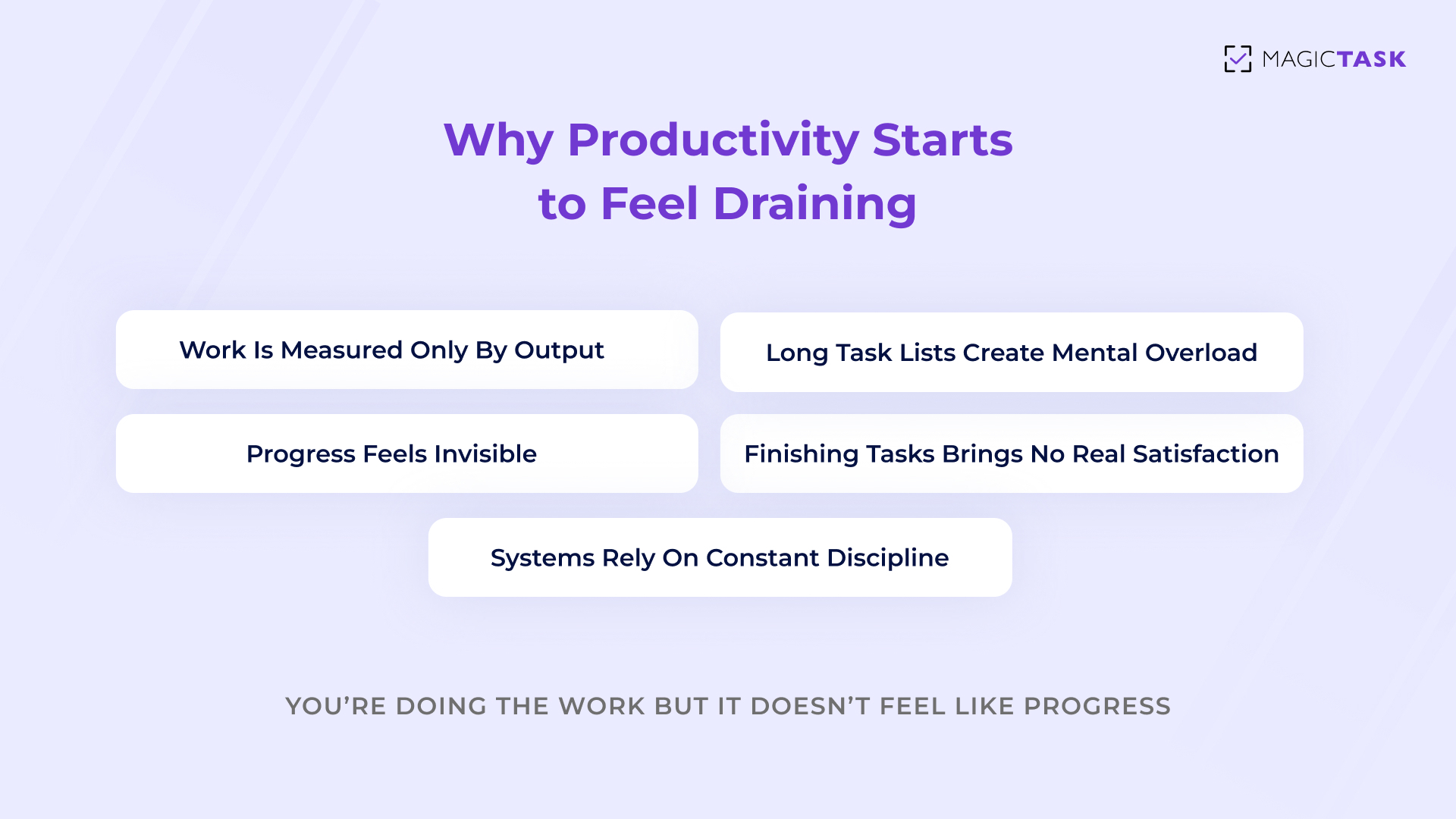
Why productivity starts to feel draining

Overemphasis On Output and Deadlines

Do you know the feeling when you finish something and instead of feeling relieved, your mind immediately jumps to what’s next?

You close one task, and before you even register that it’s done, you’re already thinking about the next deadline, the next item, the next thing waiting for you.

That’s how most productivity systems are set up. They focus heavily on output. 

  • How much did you get done? 
  • How quickly did you do it? 
  • What’s still pending?


It creates this quiet pressure to keep moving, even when you’ve already done enough for the day. It feels like there’s no real finish line.

The pressure builds on:

  • Output focus: Your day starts getting measured by how much you completed, not how manageable or sustainable it felt.
  • Deadline pressure: Tasks begin to feel urgent all the time, even when they don’t actually need to be.
  • Sense of completion: Finishing something doesn’t feel satisfying because your attention shifts immediately to what’s next.

When everything is about keeping up, it becomes hard to feel like you’re actually making progress. Instead, it starts to feel like you’re constantly catching up.

Long Task Lists Create Overwhelm

Do you know that moment when you open your task list and just stare at it for a few seconds? Everything is written down. It’s all organized. And somehow, it still feels like too much.

Nothing has even started yet, but you already feel a bit drained just looking at it. Long lists tend to do that to people. In fact, three in five people say they’ve taken on more tasks than they can realistically complete

When too many tasks sit in front of you at once, your brain doesn’t see structure. It sees pressure and starts trying to process everything at the same time. So instead of starting, you hesitate. And before you know it, you’ve spent more time looking at the work than actually doing it.

That results in:

  • Task overload: Seeing too many items at once makes the work feel bigger than it actually is.
  • Mental clutter: Your attention keeps jumping between tasks instead of settling on one.
  • Slow starts: When everything feels important, it becomes harder to begin anything.

What’s meant to help you move forward ends up creating friction. And the more often that happens, the easier it becomes to avoid the list altogether, even when you know exactly what needs to get done.

Lack of Positive Feedback or Reinforcement

Have you ever finished a task… and then just moved on like it didn’t really count?

You tick it off, maybe feel a brief second of relief, and then your attention goes straight back to everything that’s still left. No pause. No real sense of “I did something.”

That’s how most productivity systems are set up. They’re great at showing you what’s pending. They’re not great at showing you what you’ve already done. So even when you’re making progress, it doesn’t always feel like it.

Over time, that starts to wear you down. When effort doesn’t get acknowledged, your brain doesn’t get that small reward signal that says, “this is working.” And without that, it becomes harder to stay engaged.

  • Invisible progress: Completed tasks fade quickly as your focus shifts to what’s still pending.
  • No reward signal: Your brain doesn’t register progress in a meaningful way, so motivation starts to drop.
  • Emotional disconnect: Work begins to feel repetitive because nothing feels finished or recognized.

You’re still doing the work. You’re still moving forward. But it doesn’t feel satisfying.

Systems Rely Heavily on Discipline and Pressure

Every night I end up saying, “I just need to be more disciplined”. But the minute I wake up the next morning, I fall back on when things start slipping. If we’re not keeping up, the assumption is to try harder. And to be fair, discipline does help getting things started. It helps you show up even when you don’t feel like it.

But most productivity systems don’t just rely on discipline. They lean on it heavily.

They assume you’ll have the same level of focus every day. The same energy. The same ability to push through, no matter what else is going on. Real life doesn’t work like that.

Some days feel lighter. Some days feel heavier. Focus comes and goes. Energy shifts. And when a system doesn’t account for that, it starts to feel rigid.

You end up with:

  • High expectations: You feel like you should perform the same way every day, regardless of how you feel.
  • Low flexibility: The system doesn’t adjust when your energy, workload, or mental state changes.
  • Pressure build-up: Falling behind starts to feel like failure instead of something normal.

So what do most people do? They double down on the same system that’s already draining them.

And that’s where it starts to backfire. Instead of supporting your work, the system turns into something you’re constantly trying to keep up with.

How Gamification Can Support Mental Well-Being

Traditional productivity systems often make work feel like something you have to push through. Gamification shifts that experience in a subtle but powerful way.

Instead of looking at everything you need to do and feeling pressure, your focus narrows down to one simple question.

What’s the next small step I can complete?

That shift reduces resistance. Work starts to feel more approachable, and progress becomes easier to build.

Gamification is not about turning work into a game for the sake of it. It’s about adding structure that helps your brain stay engaged. When progress is visible and actions feel achievable, you don’t have to rely on willpower alone.

  • Smaller actions: Tasks are broken into steps that feel easier to begin and complete.
  • Visible progress: You can clearly see movement instead of wondering if you’re getting anywhere.
  • Positive reinforcement: Completing something gives you a sense of progress that feels real.
  • Lower mental friction: Starting feels lighter, which makes it easier to continue.

When work feels manageable, consistency becomes natural instead of forced.

A Simple Daily Reset You Can Try

Start your day without looking at your full task list.
Pick just three small tasks that you know you can complete without stress.
Finish those first before moving on to anything else.

This creates early momentum. Instead of starting your day feeling behind,
you start with progress. That shift alone can change how the rest of your day unfolds.

The Difference Between Healthy and Unhealthy Gamification

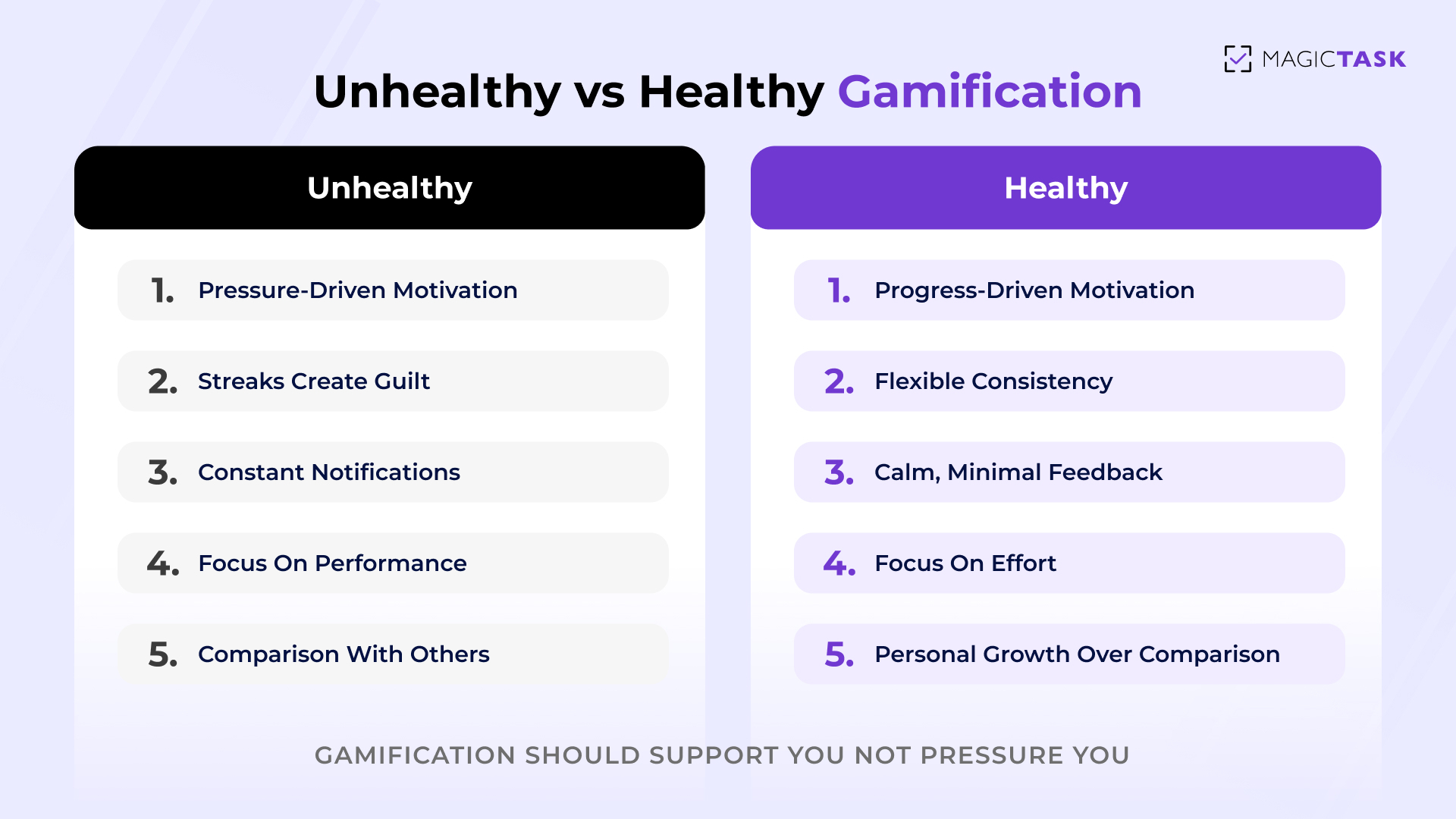
Gamification can either support you or add more pressure. The difference lies in how it’s designed.

Some systems use gamification in a way that increases stress. They push streaks, constant notifications, and comparison with others. It may look engaging, but it often creates anxiety.

Aspect Unhealthy Gamification Healthy Gamification
Motivation style Relies on pressure and urgency to push action Encourages progress through positive reinforcement
Streaks Creates guilt when you miss a day Allows breaks without losing your sense of progress
Focus Performance and outcomes Effort and consistency
Comparison Encourages competition with others Keeps attention on personal progress
Notifications Uses frequent alerts that interrupt and overwhelm Provides feedback without constant interruption
Progress tracking Highlights what’s missing or incomplete Shows what has been achieved clearly
Emotional impact Increases stress and pressure over time Supports a calmer, more sustainable workflow
Flexibility Rigid structure with little room for off days Adapts to changing energy and workload

Designing Systems That Balance Productivity and Well-Being

Unhealthy vs healthy gamification

Once you start looking at productivity through this lens, it becomes clear that the system matters more than the effort.

You don’t need to do less work. You need a system that makes it easier to stay consistent without feeling drained.

That starts with how your work is structured.

Break Work Into Small, Achievable Steps

Large tasks often create hesitation. Smaller steps create movement.

When work is broken down properly, it becomes easier to start and easier to continue.

Take something simple like “finish a presentation.”

That sounds straightforward, but when you actually sit down to do it, it feels like a lot. Where do you even begin?

Now compare that to breaking it down:

  • Open slides and write the title
  • Outline the main points
  • Add content to the first slide

Suddenly, starting feels easier. You’re not trying to “finish everything.” You’re just taking the first step.

Reward Effort

Most systems only acknowledge finished work. That creates pressure to perform at a high level all the time.

Effort deserves recognition too.

  • Effort recognition: Progress counts even if the task is not fully complete.
  • Consistency support: Regular small actions are valued more than occasional bursts.
  • Reduced pressure: Work feels lighter when perfection is not the only measure.

This helps you stay engaged even on days when energy is low.

Make progress visible without pressure

Seeing progress helps you stay motivated. Feeling pressured by it does the opposite.

The goal is to make progress clear without turning it into something stressful.

  • Visible tracking: Completed work remains visible so you can see what you’ve done.
  • Gentle feedback: Progress is shown without creating urgency.
  • Momentum awareness: You can see consistency building over time.

This creates encouragement instead of pressure.

Allow Flexibility for Real-life Energy Levels

Energy is not the same every day. Some days feel focused. Some days feel slower.

A system that works with you adapts to that.

  • Flexible pacing: You can adjust your workload based on your energy.
  • No penalty for breaks: Missing a day doesn’t undo your progress.
  • Sustainable rhythm: Work fits into your life instead of taking it over.

This is what makes productivity feel sustainable over time.

A Simple End-of-day Practice That Changes Everything

Before you end your day, take two minutes to write down three things you completed.
Only completed tasks. Nothing pending.

This small habit shifts your focus. Instead of ending the day thinking about what’s left,
you end it seeing what you actually got done. Over time, this builds a stronger sense of
progress and reduces mental fatigue.

Conclusion

Productivity should not come at the cost of mental well-being. A system that helps you get things done should also support how you feel while doing the work. When that balance is missing, even the most organized setup can start to feel exhausting over time.

Gamification offers a different approach. When used thoughtfully, it brings structure, visibility, and reinforcement into your workflow in a way that feels lighter. It helps you focus on progress instead of pressure, and consistency instead of perfection.

Over time, that changes your relationship with work. It becomes something you can stay connected to without feeling drained. You need to keep going in a way that feels sustainable.

If your current system feels overwhelming, it might be worth stepping back and asking a simple question: Does this help me move forward, or does it make the process harder than it needs to be?

Choose systems that make progress feel clear, manageable, and worth continuing.

The Gap Between Planning and Doing: Why Tasks Don’t Get Finished

You’ve been there. You open your planner, load up your to-dos, and feel confident you’re finally getting organized. Hours later, the list barely budges, and that sense of productivity you expected feels flat.

This is a widely observed phenomenon in how people work. Research shows that even when people plan realistically, they often underestimate how long tasks will take and overestimate how much they’ll accomplish. In one classic experiment, only around 13 % of participants completed their projects by the time they estimated a 50 % likelihood of finishing, and even at a 99 % estimated probability, fewer than half were done on time.

That gap between planning and doing, where intentions fail to translate into action, is a behavioral pattern rooted in how our minds forecast effort and manage execution. Understanding this breakdown is the first step toward closing it.

What Is the “Planning vs Doing Gap”?

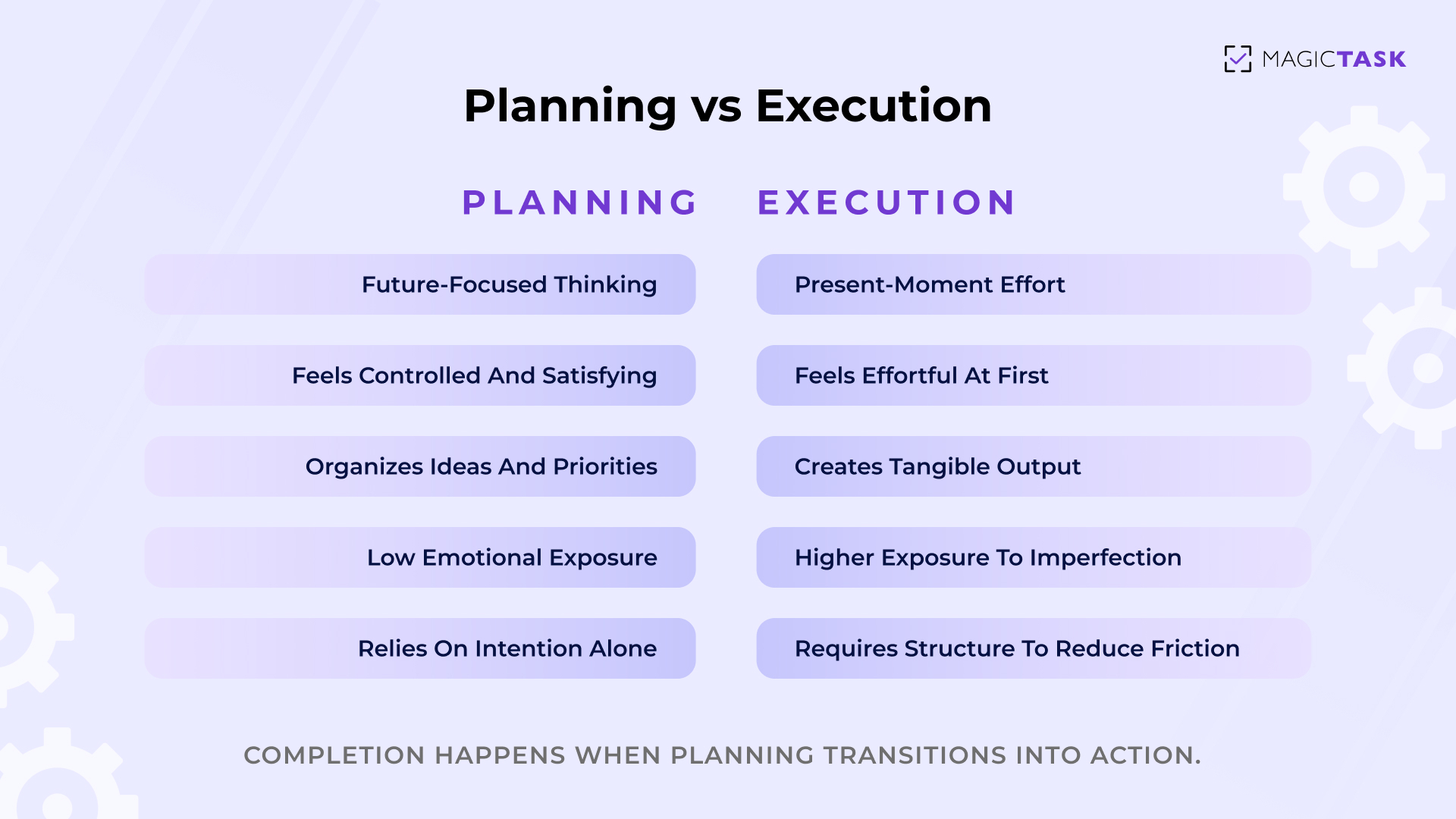
Planning vs Execution Gap

The gap between planning and execution is the breakdown that occurs when
intentions are organized but not translated into consistent, physical action.

Planning feels productive because it gives you structure. You sort tasks, prioritize them, and maybe even color-code your week. Your brain experiences a sense of control and clarity. That feeling can mimic progress, even when no real output has happened yet.

Execution is different. Execution requires:

  • A defined next action
  • Energy in the present moment
  • A decision to start
  • Sustained attention until completion

Planning operates in the realm of ideas. Execution operates in the realm of effort. That distinction matters.

When you plan, you’re imagining the work. You’re mapping it out, visualizing how it will unfold. That mental simulation can create a subtle illusion of movement. The list looks organized. The calendar looks full. The system feels complete.

But thinking about work is not the same as advancing it.

The planning vs doing gap appears when:

  • Tasks are defined at a high level but not broken into actions
  • Lists grow longer, but output stays flat
  • Time is spent organizing instead of executing

It’s the difference between “Work on marketing,” and“Draft the first three headlines for the landing page.”

One lives in abstraction. The other lives in motion.

The gap isn’t a failure of ambition. It’s a mismatch between intention and structure. Without a system that converts ideas into clear, executable steps, planning can quietly become a substitute for progress rather than a pathway to it.

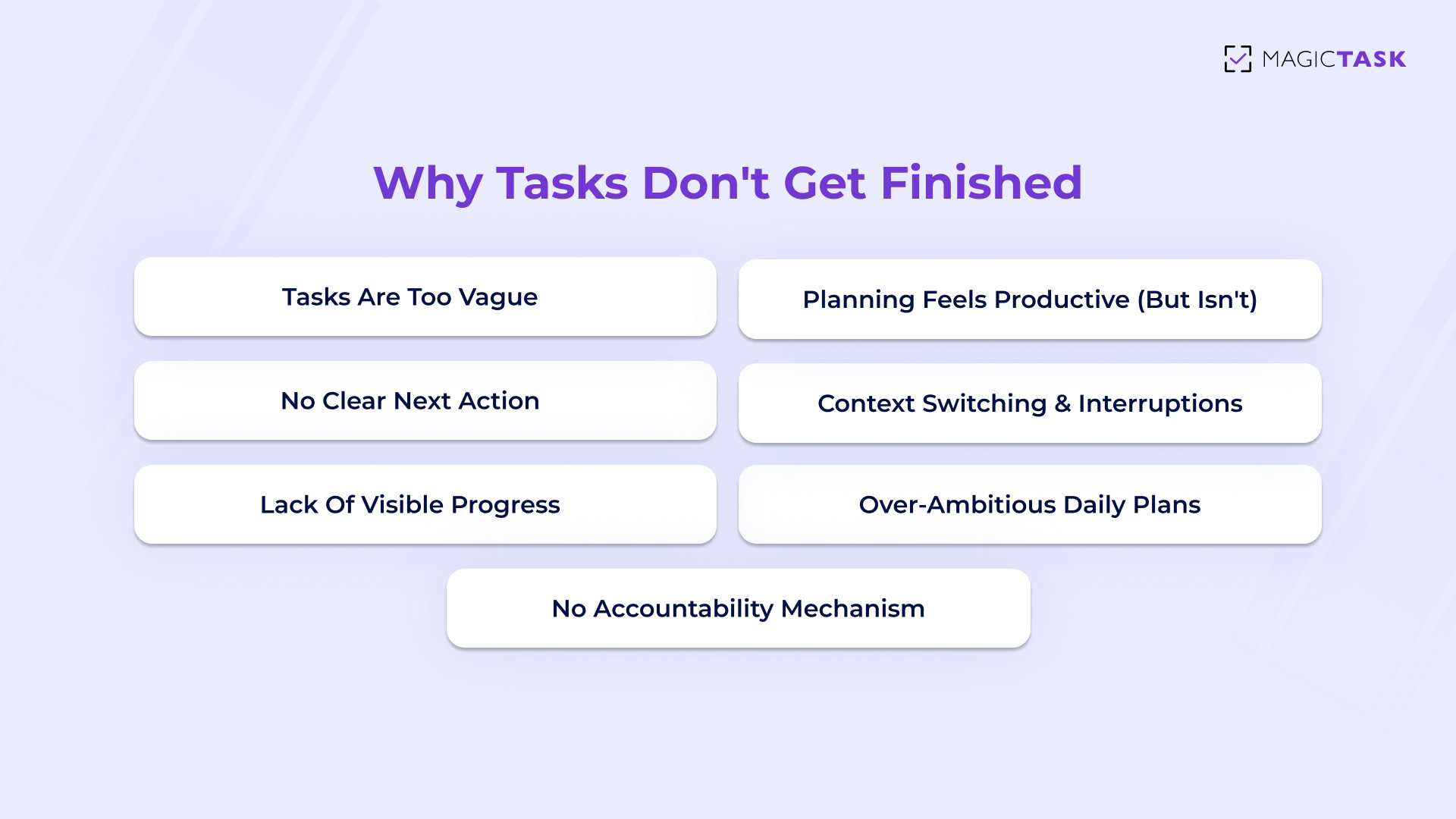
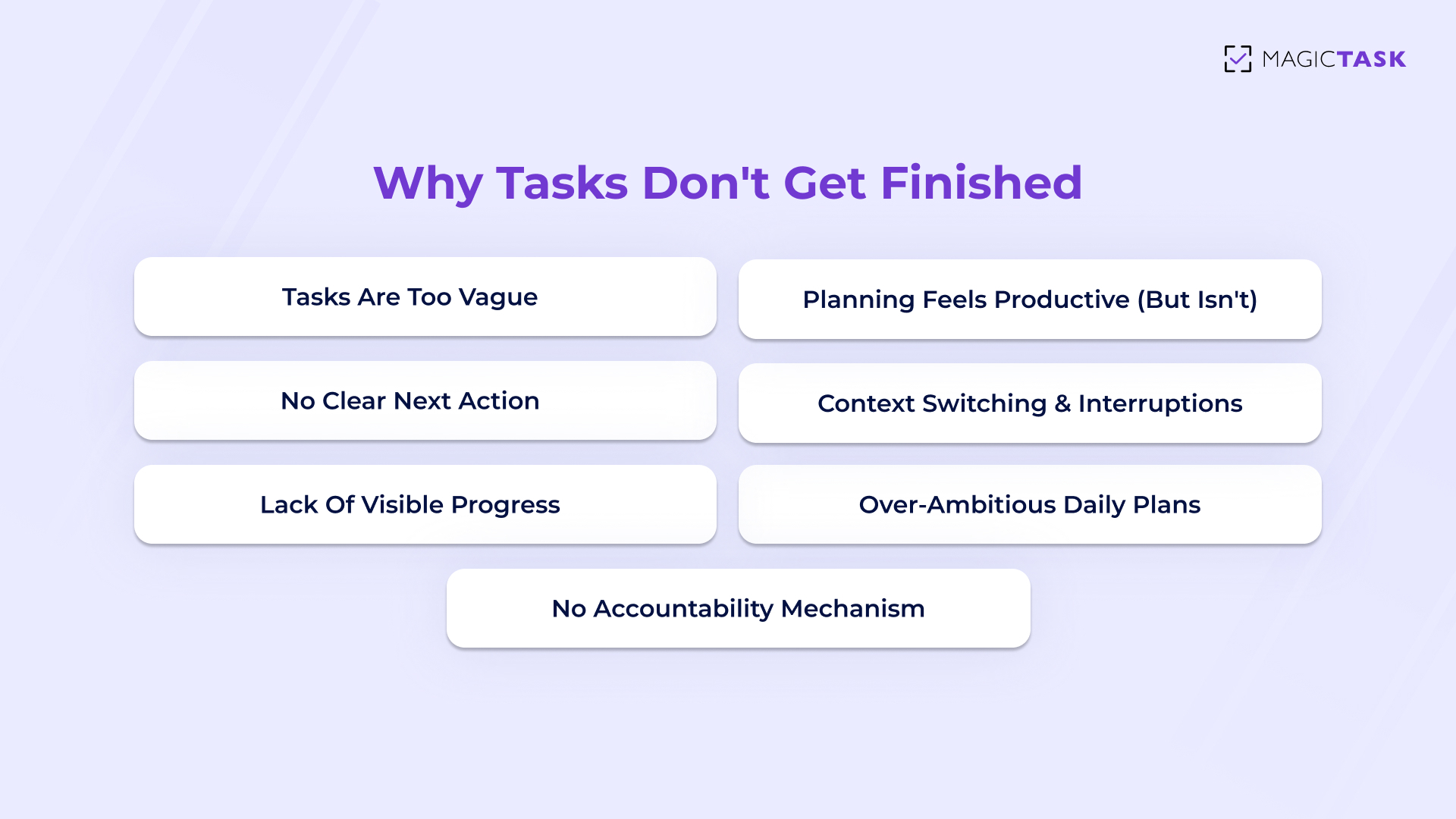
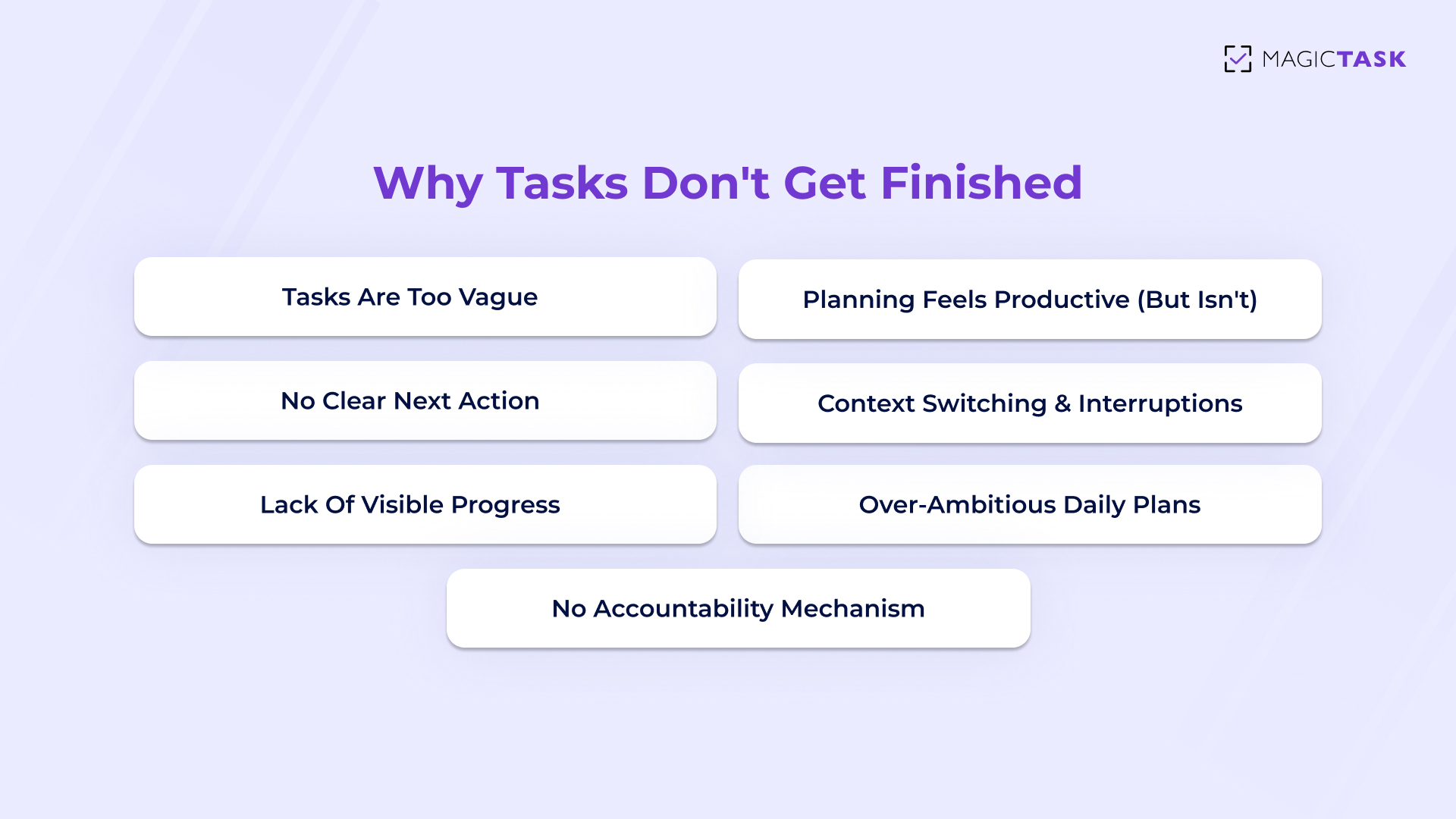
The 7 Most Common Reasons Tasks Don’t Get Finished

Illustration showing common reasons tasks don’t get finished, including vague tasks, lack of clear next action, interruptions, lack of progress, over-ambitious plans, and no accountability.

Most unfinished tasks stall because something in the structure breaks down. A task looks simple on paper, but once the moment to act arrives, friction appears.

The reasons are rarely dramatic. They’re small, repeatable blockers that quietly drain momentum. Understanding them makes it easier to spot where execution is slipping and why a full plan doesn’t always turn into finished work.

1. Tasks Are Too Vague

A task can sit on your list all week simply because it isn’t actionable.

When something says “Improve onboarding” or “Get finances in order,” your brain doesn’t see a clear starting line. It sees a cloud. And clouds are easy to postpone.

Vague tasks create hidden decision points. The moment you try to begin, you’re forced to define the scope, choose a direction, estimate the effort, and decide what “done” even means. That thinking phase feels heavier than the task might actually be.

So you delay it.

Specific tasks remove that mental negotiation. Compare:

  • “Update client strategy”
  • “Outline three bullet points for Q1 client strategy revision”

The second one lowers the activation energy. You know what to open. You know what to type. You know when you’re finished.

Execution depends on clarity at the moment of action. When tasks are defined at the outcome level instead of the action level, they create friction disguised as ambition. And friction, even small amounts, is often enough to keep something perpetually unfinished.

2. Planning Feels Productive (But Isn’t)

Planning delivers a subtle emotional reward. You sort tasks. You reorganize your week. You clean up your dashboard. Everything looks aligned. For a moment, you feel ahead. That feeling is real, but it isn’t the same as output.

Organizing activates the brain’s reward system because it creates order and perceived control. You experience a small dopamine lift simply from structuring your work. The list looks sharper. The calendar looks intentional. The system feels optimized. Nothing has actually moved forward.

This is where false progress creeps in. Planning can mimic productivity because it reduces uncertainty. It gives closure to open loops at a cognitive level, even though the physical work remains untouched.

Execution requires effort and sustained attention. Planning requires arrangement. Both feel active. Only one creates results.

3. No Clear Next Action

Even well-defined tasks can stall when the very first step isn’t obvious. Execution depends on immediacy. If you sit down and still have to figure out how to begin, your brain experiences friction, and friction quietly kills momentum.

That hesitation might only last a few seconds, but it creates just enough resistance to push you toward something easier. Email. Slack. A “quick” scroll. Momentum disappears before it starts.

Common signs that a task has no clear next action:

  • Multiple decisions required: You must choose a direction before you can begin, which delays starting.
  • Unspecified materials: You need files, data, or resources but haven’t defined exactly what to gather.
  • Undefined finish line: You’re unsure what “done” actually looks like, so beginning feels risky.
  • Re-orientation time: You have to reread notes or reconstruct context just to restart the work.
  • Ambiguous first move: The task describes an outcome, not the first physical action.

When the next step is visible and concrete, action feels automatic. When it isn’t, your brain defaults to avoidance. Clarity at the starting point is often the difference between momentum and another unfinished task lingering on tomorrow’s list.

4. Context Switching and Interruptions

Every time you jump between tasks, like replying to a message, checking email, and attending a quick meeting, your brain has to reorient. That reset isn’t instant. Cognitive research shows attention residue lingers, meaning part of your focus stays attached to the previous task even after you’ve moved on.

Shallow work thrives in this environment.

Quick replies, minor updates, and small administrative tasks feel manageable and satisfying because they resolve fast. You can complete them in minutes. They offer immediate closure. Deep tasks don’t.

Meaningful work often requires:

  • Rebuilding context
  • Holding multiple variables in working memory
  • Tolerating temporary uncertainty
  • Staying with discomfort before clarity emerges

When interruptions dominate the day, shallow tasks crowd out deeper execution. You remain busy, but large, important tasks sit untouched because they demand uninterrupted time blocks.

The result isn’t laziness. It’s fragmentation.

Execution struggles not because you lack intention, but because attention keeps getting sliced into pieces too small to carry complex work forward.

5. Lack of Visible Progress

Humans need evidence that movement is happening. When progress is invisible, motivation fades. You might be working hard, but if there’s no clear signal that effort is accumulating, your brain struggles to justify continuing. Feedback loops are what sustain behavior. Without them, momentum feels abstract.

Visible progress creates reinforcement.

That reinforcement can take many forms:

  • A checklist shrinking
  • A milestone reached
  • A streak continuing
  • A measurable indicator moving forward

Without these signals, effort feels like it’s disappearing into a void. Large projects are especially vulnerable to this. You invest time, but the finish line still looks distant. The brain interprets that distance as stagnation.

Progress doesn’t have to be dramatic. It simply has to be seen. When the system makes advancement visible, even small steps feel meaningful. When progress stays hidden, tasks begin to feel endless, and endless tasks rarely get finished.

6. Over-Ambitious Daily Plans

Daily plans often reflect ideal conditions: perfect focus, uninterrupted hours, high energy. Real days rarely look like that. Meetings run long. Energy dips mid-afternoon. Unexpected requests appear.

When a schedule assumes optimal performance all day, it quietly sets you up for carry-over.

Common patterns include:

  • Stacking multiple high-effort tasks in one day
  • Ignoring transition time between activities
  • Underestimating how long deep work actually takes
  • Planning with morning energy in mind but executing in afternoon reality

An overloaded list creates pressure instead of clarity. Once it becomes obvious that everything won’t get done, motivation drops across the board.

Completion thrives on constraint. Fewer commitments increase follow-through. Planning for realistic capacity is what keeps tasks moving to “done” instead of rolling forward indefinitely.

7. No Accountability Mechanism

“I’ll remember” feels reassuring in the moment. It rarely works.

Without some form of external visibility or tracking, tasks rely entirely on internal memory and fluctuating motivation. That’s fragile.

Accountability doesn’t have to mean public pressure. It simply means the task exists somewhere outside your head, in a form that invites follow-through.

When there’s no accountability:

  • Tasks get mentally postponed
  • Deadlines become flexible
  • Priorities shift quietly
  • Important items sink under urgent ones

The human brain is designed to conserve energy. If no system is prompting, tracking, or reflecting your commitments back to you, avoidance becomes easy.

Lightweight accountability, even simple tracking, creates gentle tension. It keeps tasks present. It increases the likelihood that intention turns into action.

Without it, plans stay private. And private plans are the easiest ones to abandon.

The Psychology Behind Not Taking Action

Planning often acts as a form of anxiety avoidance. Organizing tasks, outlining projects, and refining systems create a sense of control. That control feels productive because it reduces discomfort. Starting the actual task, however, introduces exposure. Your work becomes visible. It might be imperfect. It might require revision. The brain subtly prefers preparation because it feels safer than performance.

Fear of imperfection reinforces this delay. Large tasks carry imagined standards. You picture the finished result before typing the first sentence. That gap between expectation and current ability can make beginning feel risky. Waiting for the “right” time or energy becomes a protective strategy. Smaller, contained actions lower that barrier because they shift the focus from delivering excellence to simply moving forward.

Decision fatigue adds another layer. Every task requires choices: where to start, how to approach it, and how long to spend on it. As the day progresses, cognitive energy declines. When mental bandwidth is low, the brain gravitates toward easier, shallower activities that provide quick resolution. Complex tasks remain untouched because they demand sustained attention and multiple decisions.

Unfinished tasks also linger in memory due to what psychologists call the Zeigarnik Effect, the tendency for incomplete work to stay mentally active. Open loops create background tension. A few unfinished items can motivate action. Too many create overwhelm. That overwhelm often pushes people back toward planning and organizing as a way to manage stress instead of completing the task itself.

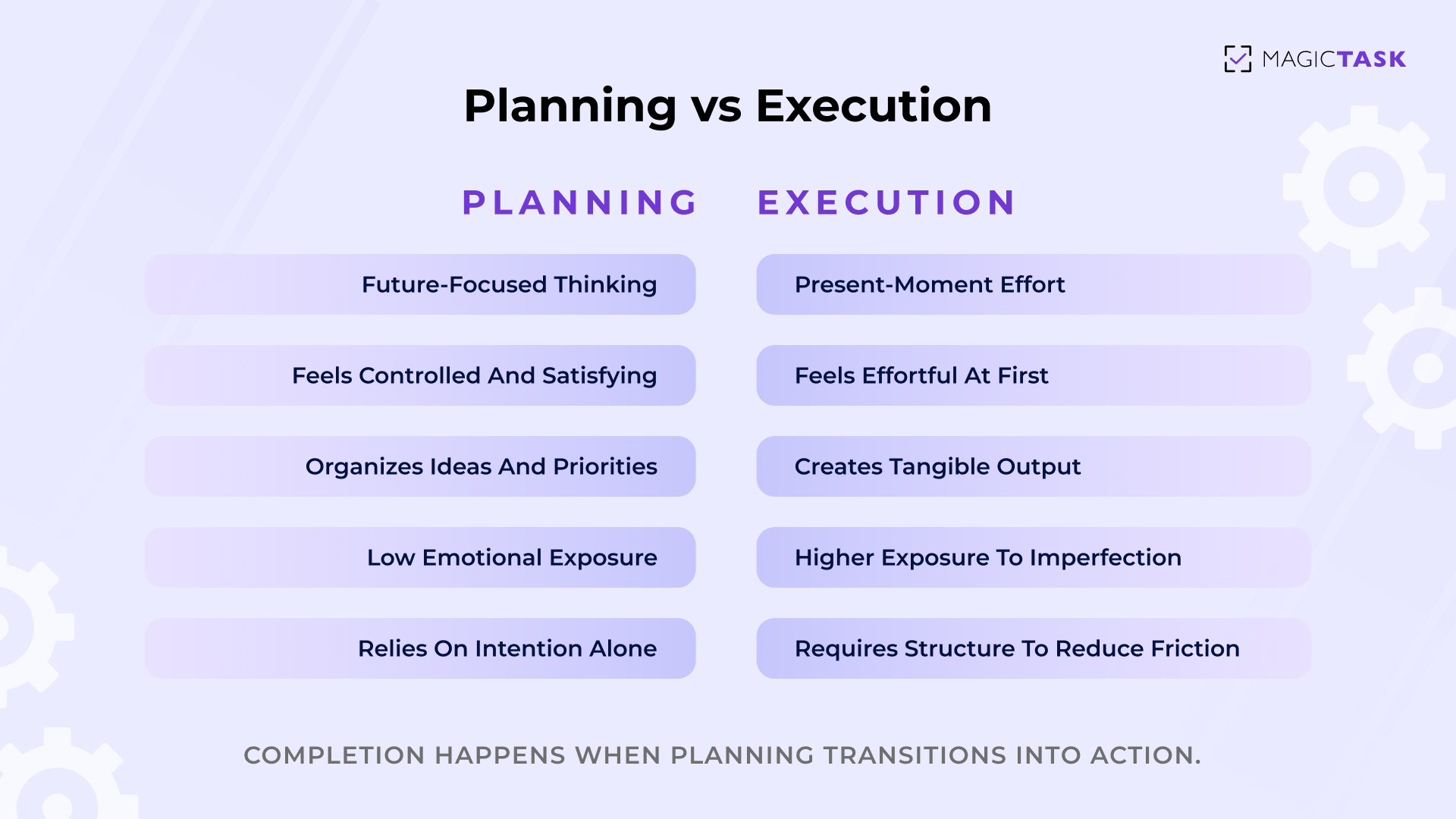
Planning vs Execution: What Actually Drives Completion

Planning and execution are often treated as two stages of the same process. In reality, they operate on different psychological mechanics.

Planning organizes intention. Execution converts intention into completed action. The gap appears when the structure ends at the planning phase and never extends into behavior.

Here’s how they differ:

Aspect Planning Execution
Primary Focus Organizing ideas and priorities Taking concrete, physical action
Time Orientation Future-focused thinking Present-moment effort
Emotional Experience Feels controlled and satisfying Often feels effortful at first
Cognitive Demand Strategy and decision-making Sustained attention and follow-through
Output Clarity about what should happen Tangible progress and completed work
Motivation Source Boost from organizing and structuring Momentum from visible progress
Risk Level Low emotional exposure Higher exposure to imperfection
Dependency Can rely on intention alone Requires structure to reduce friction
Energy Pattern Can be done in short bursts Requires sustained energy blocks

Execution answers: What am I doing right now?

Completion depends on designing work so that the transition from thought to action is smooth. When structure supports sustained attention and reduces starting friction, execution becomes consistent rather than occasional.

How to Close the Gap Between Planning and Doing

Closing the execution gap isn’t about trying harder. It’s about reducing friction at the moment of action. When tasks are structured to be clear, finite, and visible, completion becomes far more predictable.

Here’s how to design your workflow for follow-through.

Step 1: Convert Every Task Into a Physical Action

If a task can’t be done in one focused sitting, it is a project.

Projects create hesitation because they contain multiple hidden steps. The brain resists starting something undefined. Converting each item into a single, observable action lowers the barrier to entry.

Instead of listing outcomes, define movements:

  • Open the document and draft the outline
  • Review slides 1–5 for clarity
  • Send follow-up email to client

Physical actions create immediacy. When the next step is concrete, starting feels automatic rather than negotiable.

Step 2: Make Progress Visible

Humans continue behaviors that provide feedback.

If effort disappears into a void, motivation fades. Visible progress, no matter how small, reinforces continuation. That visibility can come in many forms:

  • Checklists that shrink
  • Streak counters that track consistency
  • Points or progress indicators
  • Milestones that mark advancement

The goal is feedback. When the brain sees advancement, it’s more willing to keep going. Invisible effort rarely sustains momentum.

Step 3: Limit Daily Commitments

Overloading a day guarantees carry-over.

Planning for ideal energy levels leads to unfinished lists. Completion rates increase when daily commitments decrease. Fewer tasks create focus. Focus increases follow-through.

A simple rule: prioritize what must move forward today, not everything that could move forward.

When the list is shorter, the finish line feels reachable. That psychological shift alone increases the likelihood of completion.

Step 4: Add Time Boundaries

Open-ended tasks expand. Time-bound tasks move.

Without a defined time container, work stretches indefinitely or gets postponed. Time-boxing assigns a start and end window, reducing ambiguity.

For example:

  • 30 minutes to draft
  • 45 minutes to review
  • 20 minutes to outline

Time limits reduce perfection pressure. They shift the goal from “finish flawlessly” to “make progress within this window.” That shift encourages starting, which is often the hardest part.

Step 5: Introduce Lightweight Accountability

Intentions are fragile when they live only in your head.

Light accountability increases follow-through without adding pressure. This might include:

  • Tracking daily completion
  • Sharing task visibility with a team
  • Reviewing progress at the end of the day
  • Using systems that reward consistency

Accountability works because it creates reflection. 

Why Traditional To-Do Lists Often Fail

To-do lists create clarity at the planning stage. They capture everything that needs attention. Most lists stop at recording tasks and never guide them toward completion.

Common problems with traditional to-do lists include:

  • No guidance on when to act: Tasks sit in a column without time boundaries, leaving you to decide in the moment what deserves attention.
  • No clarity on how to start: Items describe outcomes rather than first actions, forcing extra thinking before execution begins.
  • Weak prioritization under pressure: Urgent, low-effort tasks rise to the top while important, complex work keeps getting postponed.
  • Equal visual weight: A five-minute task looks the same as a two-hour task, making planning unrealistic and energy management difficult.
  • Zero engagement mechanics: Checking a box provides brief relief but no sustained feedback loop to encourage continued momentum.
  • Easy rollover behavior: Unfinished tasks quietly move to tomorrow without structural consequences, reducing urgency.

A list can be perfectly organized and still produce minimal output. It tells you what exists. It doesn’t reduce friction at the moment of action.

How Better Task Systems Turn Plans Into Action

Execution improves when the system is designed for action, not organization alone. A strong task system does more than collect items. It shapes behavior at the moment of starting and finishing.

Better systems convert intention into movement by addressing the friction points that cause tasks to stall.

They do this in several ways:

  • Force task clarity: Tasks must be defined as concrete, startable actions. Ambiguous outcomes are broken down into steps that can be completed in one sitting. This removes hesitation at the starting line.
  • Reduce decision friction: Clear prioritization, visible task weight, or structured sequencing minimizes the number of choices required throughout the day. Fewer decisions preserve cognitive energy for actual work.
  • Reward completion, not planning: Progress indicators, streaks, or milestones reinforce finished actions rather than time spent organizing. The system celebrates output instead of preparation.
  • Create visible momentum: Each completed task contributes to measurable forward movement. That visibility encourages continuation because effort feels cumulative.
  • Support realistic workload limits: By making capacity obvious, better systems prevent overload and increase follow-through.

Features alone don’t drive execution. A tool can have tags, folders, filters, and dashboards, yet still fail to produce completion. What matters more are the mechanics that guide behavior: clarity at the start, structure during effort, and reinforcement at the finish.

When engagement is built into execution, finishing tasks becomes a natural outcome of the system rather than a constant test of willpower.

Conclusion

Most unfinished work isn’t a motivation issue. It’s a structure issue.

The problem begins when the organization never turns into action. Lists alone don’t create progress. Systems that reduce friction and reward completion do.

When tasks are clear, limited, and visibly moving forward, momentum builds naturally. Small, consistent actions outperform perfectly crafted plans that never leave the page.

If you want to close the gap between planning and doing, try a system designed for execution. Test MagicTask for a week and see how visible progress and built-in momentum change the way you work.

FAQ: Planning vs Doing

Q1. Why do I plan a lot but never finish tasks?

Planning feels productive because it creates clarity and control, but it doesn’t guarantee action. Tasks often stall when they aren’t broken into concrete next steps or when too many are scheduled at once. The gap appears when the structure supports organizing but not execution.

Q2. Is over-planning a form of procrastination?

Yes, it can be. Over-planning often becomes a socially acceptable way to delay starting, especially when a task feels uncomfortable or uncertain. Organizing reduces anxiety, but it doesn’t move the work forward.

Q3. How many tasks should I plan per day?

Aim for 3 to 5 meaningful tasks per day, depending on their size. Fewer, clearly defined actions increase completion rates and reduce rollover. Overloading the list almost always lowers follow-through.

Q4. What’s the fastest way to start executing tasks?

Define the next physical action and commit to five focused minutes. Starting removes most resistance, and momentum often carries you beyond the initial time block.

Q5. How do teams reduce execution gaps?

Teams reduce execution gaps by making tasks visible and progress trackable. Shared boards, clear ownership, and lightweight accountability create alignment and increase follow-through across the group.

The Dopamine Trap: Why Some Gamified Apps Fail Users (and What Actually Works)

The Dopamine Trap

Gamified apps promise motivation. They promise streaks, badges, XP, and momentum. At first, it feels exciting. You open the app, complete a task, see points pop up, and think, This is actually kind of fun.

And then something shifts.

The notifications feel louder. The streak feels stressful. The rewards start to feel automatic, almost meaningless. What once felt motivating now feels like pressure. Eventually, you stop opening the app altogether.

This is what I call the dopamine trap.

It happens when gamified apps rely on short-term reward spikes instead of meaningful progress. They optimize for stimulation. The result is early excitement followed by fatigue, disengagement, and sometimes even guilt.

This blog isn’t about dismissing gamification. Gamification can work incredibly well. The problem isn’t dopamine itself. The problem is shallow design reward systems that prioritize novelty over growth.

Let’s unpack why some gamified apps fail users and what actually sustains motivation over the long term.

What the Dopamine Trap Looks Like in Gamified Apps

The dopamine trap doesn’t look obvious at first. In fact, it usually looks exciting.

You download an app. You complete a few actions. Points pop up. It feels rewarding… almost energizing. You feel productive, engaged, maybe even a little competitive with yourself.

Then, slowly, the excitement fades.

The core issue isn’t that rewards exist. It’s that they become disconnected from meaningful effort. The stimulation continues, but the sense of progress doesn’t.

Here’s what the dopamine trap typically looks like:

Signs of the Dopamine Trap

  • Rewards disconnected from real effort: You receive points or badges for trivial actions that don’t meaningfully move work forward. The feedback feels inflated rather than earned.
  • Novelty-driven engagement: The app introduces constant new visuals, animations, or achievements to keep you stimulated, but none of them reflect deeper growth or mastery.
  • Streak pressure instead of support: Missing a day feels like failure. Instead of encouraging consistency, the system creates anxiety around maintaining perfection.
  • Constant notification loops: Alerts are designed to pull you back in, not because your work progressed, but because the app wants engagement.
  • Early excitement followed by fatigue: The first few weeks feel motivating. After that, rewards feel predictable and repetitive, and engagement drops sharply.

When rewards become noise instead of feedback, users start to feel manipulated rather than supported.

The trap isn’t that dopamine is involved. It’s that dopamine is being triggered without reinforcing real progress. And over time, your brain learns the difference.

Why Dopamine-Only Rewards Stop Working

Dopamine is critical for how the brain responds to reward, learning, and motivation, but its role isn’t static. 

Research shows that dopamine neurons respond especially strongly to novel and unexpected rewards, not to predictable ones. As stimuli become familiar, the dopamine response naturally habituates, meaning the signal weakens over time if the reward remains the same or predictable. This phenomenon helps explain why the thrill of a new app feature or random point popup feels motivating at first but gradually loses its impact with repetition.

Here’s what’s going on under the surface:

  • Dopamine rewards novelty, not repetition: Novel experiences trigger stronger dopamine responses. Once a reward becomes expected or familiar, dopamine neurons show reduced activity, a basic form of habituation that’s been observed across species.
  • Predictable rewards lose impact quickly: When users know what to expect, the reward stops surprising them. The brain doesn’t signal “more value here” anymore, so motivation drops.
  • Constant stimulation leads to burnout: Gamified loops that rely on frequent, similar rewards create temporary spikes but don’t build sustained engagement because the brain stops responding to predictable signals.
  • Motivation fades without meaningful growth: Rewards disconnected from real effort or progress might feel fun briefly, but they don’t reinforce the behaviors that actually matter, the ones tied to growth, competence, and mastery.

In short, dopamine alone can’t sustain motivation when the reward becomes predictable or shallow. That’s why “dopamine-only” gamification often fizzles: it delivers quick hits without meaningful reinforcement, and the brain adapts, reducing the very signal that once felt motivating.

What Actually Sustains Motivation Over Time

What Actually Sustains Motivation Over Time

If shallow rewards are the problem, the solution isn’t to remove rewards altogether. It’s to design them differently.

Motivation doesn’t last because something is flashy. It lasts because it feels meaningful. When rewards reinforce real effort and visible progress, they stop being stimulation and start becoming feedback.

Here’s the shift.

Reinforce Effort

When a system only celebrates big wins, most days feel invisible. That creates inconsistency. Sustainable motivation comes from acknowledging effort along the way, showing up, working steadily, finishing small steps.

When effort is recognized:

  • Consistency feels worthwhile.
  • Progress feels earned.
  • Momentum builds naturally.

The reward doesn’t need to be dramatic. It just needs to reflect something real.

Make Progress Visible

Humans are wired to respond to progress cues. When we see ourselves moving forward, confidence increases. That confidence becomes identity.

Instead of thinking: “I’m trying to be productive.”

You start thinking: “I’m someone who follows through.”

That shift happens when progress accumulates visibly. When tasks are completed that contribute to something larger, growth, levels, experience, and mastery, the work stops feeling isolated. It feels connected.

Visible progress turns repetition into reinforcement.

Create Small Wins Without Pressure

Small wins are powerful because they lower resistance. When tasks are manageable and completion feels achievable, starting becomes easier.

Unlike high-pressure streak systems, meaningful small wins:

  • Encourage showing up without demanding perfection.
  • Build momentum gradually instead of through spikes.
  • Reduce anxiety around missed days.

Momentum created through small wins is calmer and more sustainable than motivation created through urgency.

Use Feedback as Support

Good gamification doesn’t push users to stay engaged for the app’s sake. It supports behavior the user already values.

Feedback should answer:

  • “Am I moving forward?”
  • “Is my effort accumulating?”
  • “Am I building consistency?”

It shouldn’t create artificial urgency or pressure.

When rewards are designed as signals, they build trust. And trust keeps users engaged far longer than novelty ever could.

Sustainable motivation isn’t about chasing dopamine. It’s about designing feedback that reinforces growth, consistency, and identity over time.

What Thoughtful Gamified Design Looks Like in Practice

Understanding the psychology is one thing. Applying it in real-world tools is another.

Sustainable gamification isn’t about adding more animations, louder notifications, or endless achievement tiers. It’s about designing systems that reinforce behavior in a way that feels supportive, not addictive.

Here’s what that looks like when done right.

Reward Effort, Not Just Outcomes

In many apps, rewards are tied to finishing something big. That creates long stretches where users feel invisible.

Thoughtful design flips that.

  • Completing small steps matters.
  • Consistency is acknowledged.
  • Showing up counts.

When effort is recognized along the way, motivation becomes less fragile. Users don’t have to wait for a major milestone to feel progress. The system reinforces the process, not just the final result.

That’s what builds long-term engagement.

Make Progress Visible Without Overwhelming Users

Visibility drives motivation. Overstimulation kills it.

Good design shows progress clearly but calmly. It avoids clutter, avoids flashing distractions, and focuses attention on what matters.

Progress visibility should:

  • Accumulate in a meaningful way.
  • Be easy to understand at a glance.
  • Reinforce direction without adding noise.

When users can see forward movement without feeling overloaded, engagement becomes sustainable instead of exhausting.

Encourage Consistency Without Punishment

Many gamified apps rely on fear-based mechanics: break a streak, lose progress. That pressure works temporarily, and then backfires.

Sustainable systems encourage return, not perfection.

Instead of punishing missed days, they:

  • Allow easy restarts.
  • Preserve progress.
  • Reinforce cumulative growth.

This reduces anxiety and prevents the “I missed one day, so I quit” spiral.

Consistency thrives in environments that feel forgiving.

Use Gamification as Feedback

The biggest distinction comes down to intent.

Is the system trying to maximize time spent inside the app? Or is it trying to reinforce meaningful behavior?

When gamification is used as feedback:

  • Rewards signal real effort.
  • Progress reflects actual growth.
  • Engagement feels aligned with the user’s goals.

When it’s used as an addiction:

  • Stimulation becomes constant.
  • Novelty replaces substance.
  • Users feel pressured rather than supported.

The future of gamified design isn’t louder rewards. It’s a better alignment between feedback and real progress.

When rewards reflect growth instead of chasing attention, motivation stops being fragile and starts becoming sustainable.

Conclusion

Gamification doesn’t fail because it’s playful. It fails when it’s shallow. When apps chase dopamine spikes instead of reinforcing real effort, users burn out. Novelty fades. Streak pressure builds. Motivation collapses. The problem is rewards that aren’t tied to growth.

Sustainable motivation looks different. It acknowledges effort, makes progress visible, builds identity through consistency, and supports users instead of manipulating them.

The future of gamified productivity isn’t about more stimulation. It’s about better design, design that reinforces mastery, momentum, and meaningful progress. That’s the philosophy behind MagicTask.

MagicTask doesn’t gamify for noise or novelty. It uses XP, streaks, and visual progress as feedback signals, small reinforcements that reflect real work, real effort, and real consistency. No pressure. No manipulation. Just momentum.

If you’ve experienced the dopamine trap before, try a system built for sustainable motivation instead. Start using MagicTask and experience gamification that works with your goals.

The Productivity Reset Ritual: A 10-Minute Daily Routine to Stay Organized and Motivated

The Productivity Reset Ritual

Have you ever ended a day feeling exhausted… but not accomplished? You answered emails. You jumped between meetings. You handled urgent requests. You were busy the entire time. And yet, when you finally close your laptop, there’s this quiet thought in the back of your mind: What did I actually move forward today?

That feeling is the modern productivity trap. We start our days reacting instead of resetting. We open our inbox before we open our priorities. We let notifications decide what matters. And without meaning to, we spend the day managing noise instead of making progress.

You don’t need a new productivity system. You just need a short, consistent reset. A simple 10-minute daily ritual can clear mental clutter, realign your priorities, and rebuild momentum, even on your busiest days.

What Is a Productivity Reset Ritual?

A productivity reset ritual is a short, daily practice that clears mental clutter and realigns your priorities before you move deeper into work. It’s not a full planning session. It’s not a weekly overhaul. It’s simply a focused pause — a way to step back, reset your direction, and start with clarity instead of chaos.

Think of it as wiping the mental whiteboard clean.

During the day, open loops build up: half-finished thoughts, small tasks you meant to remember, worries about deadlines, ideas you haven’t captured yet. When those stay in your head, they compete for attention. A reset ritual moves them out of your mind and into a clear system so your brain can focus again.

Why 10 Minutes Works

Ten minutes feels small, and that’s exactly the point.

Long planning sessions sound productive, but often get skipped when you’re busy. A 10-minute reset is short enough to do even on low-energy days. The low friction makes consistency possible.

  • Short duration: You don’t need motivation or ideal conditions to begin.
  • Clear boundary: Time-boxing prevents overthinking and perfectionism.
  • Daily repetition: Small resets done consistently beat occasional big overhauls.

When something feels achievable, you’re more likely to repeat it. And repetition is what turns clarity into habit.

Planning vs. Resetting: What’s the Difference?
Many people confuse resetting with planning. They’re not the same.

Planning Resetting
Focuses on long-term goals and future strategy Focuses on today’s clarity and immediate alignment
Often involves reorganizing systems or workflows Involves clearing mental clutter and choosing priorities
Can become complex and time-consuming Is short, simple, and time-boxed
Optimizes structure Optimizes focus
Happens occasionally Happens daily

Planning asks, “What should I accomplish this month?”

Resetting asks, “What matters right now?”

The 10-Minute Reset Framework (Step-by-Step)

Now that you know what a productivity reset ritual is, let’s make it practical.

Minute 1–2: Clear the Mental Noise

Start by emptying your head.

Not organizing. Not prioritizing. Just extracting.

Open a blank space and do a rapid brain dump. Write down every task, worry, reminder, or loose idea floating in your mind. Big or small. Personal or professional. If it’s taking up mental space, it goes on the list.

  • Unfinished tasks: Things you meant to do yesterday but didn’t.
  • Lingering worries: Deadlines, conversations, follow-ups.
  • Random ideas: Thoughts that keep resurfacing.
  • Tiny reminders: The small tasks that quietly drain attention.

The goal isn’t structure. The goal is relief.

When everything lives in your head, it competes for attention. Once it’s captured in one place, your brain stops trying to hold onto it. You’ll already feel lighter by minute two.

Minute 3–4: Clean & Close

Now that everything is out of your head, it’s time to tidy it up — quickly.

This isn’t deep organizing. It’s fast refinement.

  • Mark completed tasks: Acknowledge what’s already done so it stops lingering mentally.
  • Delete irrelevant items: Remove things that no longer matter.
  • Clarify vague tasks: Turn “Work on presentation” into “Draft slide outline.”

This step matters because ambiguity creates resistance. When tasks are unclear, starting feels heavy. When they’re specific, action feels possible.

By minute four, you’ve gone from mental clutter to a usable list.

Minute 5–6: Identify the “Big 3”

Now choose the three tasks that will define your day.

Not ten. Not everything. Just three.

  • One high-impact task: The work that truly moves something forward.
  • One supportive task: Something necessary but lighter in cognitive load.
  • One quick win: A small, easily completable task to build early momentum.

This works because it balances pressure and progress. The high-impact task creates meaning.  The supportive task keeps the momentum steady. The quick win builds confidence fast.

Instead of staring at a long list, you now have a focused starting line.

Minute 7–8: Time Block Intentionally

Next, assign realistic time slots to your Big 3.

This is about protecting intention.

  • Assign clear windows: Decide roughly when each task will happen.
  • Protect deep work time: Give your high-impact task uninterrupted space.
  • Leave buffer space: Don’t overfill the day. Expect interruptions.

Time blocking forces commitment. When a task has a home on your calendar, it becomes harder to ignore.

You’re no longer hoping to get to it. You’ve decided when it happens.

Minute 9–10: Motivation Lock-In

The final step is small but powerful. Define today’s intention in one sentence. Something simple, like:

  • “Today I move the proposal forward.”
  • “Today I protect my focus.”
  • “Today I finish what I start.”

Then briefly visualize completing your Big 3. Imagine closing the day knowing those tasks are done. That mental rehearsal strengthens follow-through.

If you want, add a quick reward trigger:

  • A favorite playlist for deep work.
  • A streak tracker you don’t want to break.
  • A small end-of-day reward if the Big 3 are complete.

This final step connects clarity to emotion. And emotion is what sustains action. Ten minutes later, your day becomes intentional.

Why This Ritual Works (Psychology Behind It)

A reset ritual isn’t just “something productive you should do.” It solves real psychological challenges that slow people down every day, especially when work feels overwhelming. The science behind these effects helps explain why a short daily habit can change how your brain responds to tasks, decisions, and momentum.

Reduces Cognitive Load

Your brain has a limited mental capacity for processing information and maintaining focus. When too many tasks, open loops, and decisions accumulate, cognitive load increases, and your ability to think clearly decreases. A 2025 integrative review on decision fatigue found that repeated decision-making leads to reduced efficiency and impaired decision quality, highlighting how excess mental load can drain your cognitive resources over time.

By clearing mental noise in the first steps of your reset, you shift tasks out of your mind and into your system, freeing up precious mental space. This reduction in cognitive load makes it easier to stay focused and act without hesitation.

Replaces Decision Fatigue With Clarity

Decision fatigue describes how our decision-making quality declines after making many choices in a short period, a familiar experience in today’s task-heavy schedules. Studies estimate that an average adult makes tens of thousands of decisions a day, many of them small but mentally draining.

When your reset ritual helps you clarify what matters early, you reduce the number of spontaneous decisions your brain has to make later. Instead of choosing what to do next dozens of times throughout the day, you already have a clear structure to follow. That turns daily decision-making from draining to directional.

Builds Consistency Through Small Daily Wins

Psychological research shows that frequent small wins can significantly improve motivation and “inner work life,” the ongoing emotional experience of work.

When your reset ritual surfaces quick wins (like the “Big 3”), each completed step reinforces a sense of achievement. Those small wins give your brain a regular dopamine signal because progress has become visible. Over time, micro-successes build momentum and make consistency feel easier than hesitation.

Creates a Visible Sense of Progress

Humans are wired to respond to progress cues. When we see movement toward a goal, our engagement increases. This is one reason why games use progress bars, levels, and milestones: visible feedback drives motivation, not just the tasks themselves.

In the context of your reset ritual, capturing mental noise, clarifying tasks, and marking wins creates a sense of forward motion. This visible progress helps anchor your productivity, turning abstract intentions into something concrete you can measure and repeat.

Morning vs. Night: When Should You Do It?

The beauty of a productivity reset ritual is that it works at different times of day. What matters isn’t when you do it but that you do it consistently.

Some people need clarity before they begin. Others need closure before they rest. Your work style and energy patterns should guide the choice.

Here’s how to decide.

  • Morning reset: clarity before actionStarting your day with the 10-minute ritual helps you move from reactive to intentional. Instead of opening the email first, you define your Big 3, protect focus time, and begin with direction. This works well if your mornings are your most focused hours and you want to control momentum early.
  • Morning reset: reduced decision fatigue throughout the dayBy choosing priorities upfront, you eliminate constant “What should I work on next?” decisions. This is especially helpful in remote or flexible schedules where structure isn’t built in.
  • Night reset: calm mind before sleepIf unfinished tasks tend to linger mentally, doing the ritual at the end of the day clears open loops. Capturing tomorrow’s priorities reduces rumination and makes it easier to disconnect.
  • Night reset: smoother morning startWaking up to a pre-aligned plan lowers resistance. Instead of thinking through priorities half-awake, you step directly into action.
  • Hybrid approach: light reset at night, deeper reset in the morningSome people prefer a quick capture and clean-up at night, followed by choosing the Big 3 in the morning when energy is higher.

The best option is the one you can repeat. If mornings feel rushed and chaotic, try evenings. If evenings feel drained and distracted, try mornings.

Common Mistakes to Avoid

Watch out for these common mistakes:

  • Turning 10 minutes into 45: Expanding the ritual into a full planning session defeats its purpose. Keep it tight, focused, and time-boxed.
  • Overloading the “Big 3”: Choosing three heavy, demanding tasks increases pressure instead of momentum. Balance impact with realism.
  • Skipping it when you feel behind: The days you feel most overwhelmed are the days you need the reset most. Skipping reinforces chaos.
  • Perfecting instead of extracting: Spending too much time organizing instead of clearing mental clutter slows the process.
  • Planning without execution follow-through: A reset sets direction, but action still needs to happen. Don’t let the ritual become another form of productive procrastination.

Keep it simple. Keep it consistent.

Turning the Ritual Into a Habit

A reset ritual only works if it happens regularly. When it becomes part of your routine, you stop debating whether to do it. You just begin.

Here’s how to make that happen.

  • Attach it to an existing trigger: Pair the reset with something you already do daily. After your first cup of coffee. Right before you open your inbox. During your shutdown routine at night. Habit stacking removes the need to remember. The trigger does the reminding.
  • Track streaks for visibility: Seeing consecutive days builds momentum. Even a simple visual cue that says “Day 6” reinforces consistency and gives you something to protect.
  • Use the “don’t miss twice” rule: Missing once is normal. Missing twice turns into a pattern. If you skip a day, make the next reset non-negotiable, even if it’s shorter than usual.
  • Review weekly for pattern improvement: At the end of the week, look back. Were your Big 3 realistic? Did you overload certain days? Small adjustments improve the ritual without reinventing it.

Habits aren’t built through intensity. They’re built through repetition. When the reset becomes automatic, clarity becomes automatic too.

Conclusion: Control the Start, Control the Day

When you begin your day scattered, the rest of the day follows. When you begin with clarity, intention, and a defined focus, momentum builds naturally. Ten deliberate minutes can shift everything, from reactive busyness to meaningful progress.

The productivity reset ritual works because it’s simple. It clears mental noise. It reduces decision fatigue. It helps you choose what matters. And it gives you small wins that carry you forward.

You don’t need a new system every time things feel messy. You just need a reset.

If you want a clean, distraction-free space to run this ritual daily, try it inside MagicTask. Its simple interface, task clarity, and visible progress cues make resetting effortless.

Start with one 10-minute reset tomorrow. Control the start, and you’ll control the day.
Have you ever ended a day feeling exhausted… but not accomplished? You answered emails. You jumped between meetings. You handled urgent requests. You were busy the entire time. And yet, when you finally close your laptop, there’s this quiet thought in the back of your mind: What did I actually move forward today?

That feeling is the modern productivity trap. We start our days reacting instead of resetting. We open our inbox before we open our priorities. We let notifications decide what matters. And without meaning to, we spend the day managing noise instead of making progress.

You don’t need a new productivity system. You just need a short, consistent reset. A simple 10-minute daily ritual can clear mental clutter, realign your priorities, and rebuild momentum, even on your busiest days.

What Is a Productivity Reset Ritual?

A productivity reset ritual is a short, daily practice that clears mental clutter and realigns your priorities before you move deeper into work. It’s not a full planning session. It’s not a weekly overhaul. It’s simply a focused pause — a way to step back, reset your direction, and start with clarity instead of chaos.

Think of it as wiping the mental whiteboard clean.

During the day, open loops build up: half-finished thoughts, small tasks you meant to remember, worries about deadlines, ideas you haven’t captured yet. When those stay in your head, they compete for attention. A reset ritual moves them out of your mind and into a clear system so your brain can focus again.

Why 10 Minutes Works

Ten minutes feels small, and that’s exactly the point.

Long planning sessions sound productive, but often get skipped when you’re busy. A 10-minute reset is short enough to do even on low-energy days. The low friction makes consistency possible.

  • Short duration: You don’t need motivation or ideal conditions to begin.
  • Clear boundary: Time-boxing prevents overthinking and perfectionism.
  • Daily repetition: Small resets done consistently beat occasional big overhauls.

When something feels achievable, you’re more likely to repeat it. And repetition is what turns clarity into habit.

Planning vs. Resetting: What’s the Difference?

Difference between planning and resetting

Many people confuse resetting with planning. They’re not the same.

Planning Resetting
Focuses on long-term goals and future strategy Focuses on today’s clarity and immediate alignment
Often involves reorganizing systems or workflows Involves clearing mental clutter and choosing priorities
Can become complex and time-consuming Is short, simple, and time-boxed
Optimizes structure Optimizes focus
Happens occasionally Happens daily

Planning asks, “What should I accomplish this month?”

Resetting asks, “What matters right now?”

The 10-Minute Reset Framework (Step-by-Step)

Now that you know what a productivity reset ritual is, let’s make it practical.

Minute 1–2: Clear the Mental Noise

Start by emptying your head.

Not organizing. Not prioritizing. Just extracting.

Open a blank space and do a rapid brain dump. Write down every task, worry, reminder, or loose idea floating in your mind. Big or small. Personal or professional. If it’s taking up mental space, it goes on the list.

  • Unfinished tasks: Things you meant to do yesterday but didn’t.
  • Lingering worries: Deadlines, conversations, follow-ups.
  • Random ideas: Thoughts that keep resurfacing.
  • Tiny reminders: The small tasks that quietly drain attention.

The goal isn’t structure. The goal is relief.

When everything lives in your head, it competes for attention. Once it’s captured in one place, your brain stops trying to hold onto it. You’ll already feel lighter by minute two.

Minute 3–4: Clean & Close

Now that everything is out of your head, it’s time to tidy it up — quickly.

This isn’t deep organizing. It’s fast refinement.

  • Mark completed tasks: Acknowledge what’s already done so it stops lingering mentally.
  • Delete irrelevant items: Remove things that no longer matter.
  • Clarify vague tasks: Turn “Work on presentation” into “Draft slide outline.”

This step matters because ambiguity creates resistance. When tasks are unclear, starting feels heavy. When they’re specific, action feels possible.

By minute four, you’ve gone from mental clutter to a usable list.

Minute 5–6: Identify the “Big 3”

Now choose the three tasks that will define your day.

Not ten. Not everything. Just three.

  • One high-impact task: The work that truly moves something forward.
  • One supportive task: Something necessary but lighter in cognitive load.
  • One quick win: A small, easily completable task to build early momentum.

This works because it balances pressure and progress. The high-impact task creates meaning.  The supportive task keeps the momentum steady. The quick win builds confidence fast.

Instead of staring at a long list, you now have a focused starting line.

Minute 7–8: Time Block Intentionally

Next, assign realistic time slots to your Big 3.

This is about protecting intention.

  • Assign clear windows: Decide roughly when each task will happen.
  • Protect deep work time: Give your high-impact task uninterrupted space.
  • Leave buffer space: Don’t overfill the day. Expect interruptions.

Time blocking forces commitment. When a task has a home on your calendar, it becomes harder to ignore.

You’re no longer hoping to get to it. You’ve decided when it happens.

Minute 9–10: Motivation Lock-In

The final step is small but powerful. Define today’s intention in one sentence. Something simple, like:

  • “Today I move the proposal forward.”
  • “Today I protect my focus.”
  • “Today I finish what I start.”

Then briefly visualize completing your Big 3. Imagine closing the day knowing those tasks are done. That mental rehearsal strengthens follow-through.

If you want, add a quick reward trigger:

  • A favorite playlist for deep work.
  • A streak tracker you don’t want to break.
  • A small end-of-day reward if the Big 3 are complete.

This final step connects clarity to emotion. And emotion is what sustains action. Ten minutes later, your day becomes intentional.

Why This Ritual Works (Psychology Behind It)

A reset ritual isn’t just “something productive you should do.” It solves real psychological challenges that slow people down every day, especially when work feels overwhelming. The science behind these effects helps explain why a short daily habit can change how your brain responds to tasks, decisions, and momentum.

Reduces Cognitive Load

Your brain has a limited mental capacity for processing information and maintaining focus. When too many tasks, open loops, and decisions accumulate, cognitive load increases, and your ability to think clearly decreases. A 2025 integrative review on decision fatigue found that repeated decision-making leads to reduced efficiency and impaired decision quality, highlighting how excess mental load can drain your cognitive resources over time.

By clearing mental noise in the first steps of your reset, you shift tasks out of your mind and into your system, freeing up precious mental space. This reduction in cognitive load makes it easier to stay focused and act without hesitation.

Replaces Decision Fatigue With Clarity

Decision fatigue describes how our decision-making quality declines after making many choices in a short period, a familiar experience in today’s task-heavy schedules. Studies estimate that an average adult makes tens of thousands of decisions a day, many of them small but mentally draining.

When your reset ritual helps you clarify what matters early, you reduce the number of spontaneous decisions your brain has to make later. Instead of choosing what to do next dozens of times throughout the day, you already have a clear structure to follow. That turns daily decision-making from draining to directional.

Builds Consistency Through Small Daily Wins

Psychological research shows that frequent small wins can significantly improve motivation and “inner work life,” the ongoing emotional experience of work.

When your reset ritual surfaces quick wins (like the “Big 3”), each completed step reinforces a sense of achievement. Those small wins give your brain a regular dopamine signal because progress has become visible. Over time, micro-successes build momentum and make consistency feel easier than hesitation.

Creates a Visible Sense of Progress

Humans are wired to respond to progress cues. When we see movement toward a goal, our engagement increases. This is one reason why games use progress bars, levels, and milestones: visible feedback drives motivation, not just the tasks themselves.

In the context of your reset ritual, capturing mental noise, clarifying tasks, and marking wins creates a sense of forward motion. This visible progress helps anchor your productivity, turning abstract intentions into something concrete you can measure and repeat.

Morning vs. Night: When Should You Do It?

The beauty of a productivity reset ritual is that it works at different times of day. What matters isn’t when you do it but that you do it consistently.

Some people need clarity before they begin. Others need closure before they rest. Your work style and energy patterns should guide the choice.

Here’s how to decide.

  • Morning reset: clarity before actionStarting your day with the 10-minute ritual helps you move from reactive to intentional. Instead of opening the email first, you define your Big 3, protect focus time, and begin with direction. This works well if your mornings are your most focused hours and you want to control momentum early.
  • Morning reset: reduced decision fatigue throughout the dayBy choosing priorities upfront, you eliminate constant “What should I work on next?” decisions. This is especially helpful in remote or flexible schedules where structure isn’t built in.
  • Night reset: calm mind before sleepIf unfinished tasks tend to linger mentally, doing the ritual at the end of the day clears open loops. Capturing tomorrow’s priorities reduces rumination and makes it easier to disconnect.
  • Night reset: smoother morning startWaking up to a pre-aligned plan lowers resistance. Instead of thinking through priorities half-awake, you step directly into action.
  • Hybrid approach: light reset at night, deeper reset in the morningSome people prefer a quick capture and clean-up at night, followed by choosing the Big 3 in the morning when energy is higher.

The best option is the one you can repeat. If mornings feel rushed and chaotic, try evenings. If evenings feel drained and distracted, try mornings.

Common Mistakes to Avoid

Watch out for these common mistakes:

  • Turning 10 minutes into 45: Expanding the ritual into a full planning session defeats its purpose. Keep it tight, focused, and time-boxed.
  • Overloading the “Big 3”: Choosing three heavy, demanding tasks increases pressure instead of momentum. Balance impact with realism.
  • Skipping it when you feel behind: The days you feel most overwhelmed are the days you need the reset most. Skipping reinforces chaos.
  • Perfecting instead of extracting: Spending too much time organizing instead of clearing mental clutter slows the process.
  • Planning without execution follow-through: A reset sets direction, but action still needs to happen. Don’t let the ritual become another form of productive procrastination.

Keep it simple. Keep it consistent.

Turning the Ritual Into a Habit

A reset ritual only works if it happens regularly. When it becomes part of your routine, you stop debating whether to do it. You just begin.

Here’s how to make that happen.

  • Attach it to an existing trigger: Pair the reset with something you already do daily. After your first cup of coffee. Right before you open your inbox. During your shutdown routine at night. Habit stacking removes the need to remember. The trigger does the reminding.
  • Track streaks for visibility: Seeing consecutive days builds momentum. Even a simple visual cue that says “Day 6” reinforces consistency and gives you something to protect.
  • Use the “don’t miss twice” rule: Missing once is normal. Missing twice turns into a pattern. If you skip a day, make the next reset non-negotiable, even if it’s shorter than usual.
  • Review weekly for pattern improvement: At the end of the week, look back. Were your Big 3 realistic? Did you overload certain days? Small adjustments improve the ritual without reinventing it.

Habits aren’t built through intensity. They’re built through repetition. When the reset becomes automatic, clarity becomes automatic too.

Conclusion: Control the Start, Control the Day

When you begin your day scattered, the rest of the day follows. When you begin with clarity, intention, and a defined focus, momentum builds naturally. Ten deliberate minutes can shift everything, from reactive busyness to meaningful progress.

The productivity reset ritual works because it’s simple. It clears mental noise. It reduces decision fatigue. It helps you choose what matters. And it gives you small wins that carry you forward.

You don’t need a new system every time things feel messy. You just need a reset.

If you want a clean, distraction-free space to run this ritual daily, try it inside MagicTask. Its simple interface, task clarity, and visible progress cues make resetting effortless.

Start with one 10-minute reset tomorrow. Control the start, and you’ll control the day.

Why Gamification Works for Productivity in Modern Workflows

Why Gamification Works for Productivity in Modern Workflows

Gamification is often misunderstood. For many people, it brings to mind flashy rewards or surface-level motivation, things that feel distracting rather than useful.

But when designed with intention, gamification isn’t about making work playful.

It’s about supporting focus, consistency, and follow-through in environments where attention is constantly pulled in different directions.

Modern workflows are fragmented by nature. Work happens across tools, time zones, and shifting priorities. In that reality, relying on discipline alone isn’t enough. People need systems that provide clear feedback, visible progress, and a sense of momentum. That’s where thoughtful gamification proves its value.

This post explores why gamification works for productivity today as a design approach that helps people stay engaged, complete meaningful work, and follow through in the flow of everyday tasks.

Why Traditional Productivity Tools Struggle in Modern Workflows

Most productivity tools look good on paper. Clean lists. Clear deadlines. Plenty of features. But once you’re in the middle of a real workday where messages are coming in, meetings are popping up, priorities are shifting, those tools start to feel heavy instead of helpful.

They weren’t built for how work actually feels today.

Why Traditional Productivity Tools Struggle in Modern Workflows

They Don’t Match How Work Really Happens

Modern work isn’t linear. You don’t sit down, complete one task, and move neatly to the next. You jump between conversations, documents, and decisions, often across different tools and time zones.

Traditional tools assume:

  • Work happens in long, uninterrupted blocks
  • Everyone is online at the same time
  • Tasks move forward in a straight line

When reality doesn’t match those assumptions, progress starts to slip, and the tool feels out of sync with your day.

They Expect Motivation on Demand

Most task managers rely on one thing: your discipline. They list what needs to be done and assume you’ll handle the rest.

There’s usually no:

  • Feedback when you make progress
  • Reinforcement for showing up consistently
  • Support when energy drops

When work gets busy or overwhelming, tasks don’t move, not because you don’t care, but because the system gives you nothing to lean on. Over time, opening the tool feels more like pressure than help.

They Create More Switching

Ironically, many tools meant to improve focus end up breaking it. Multiple views. Endless filters. Notifications everywhere.

You open the tool to work and immediately have to decide where to look, what matters right now, and which view to use.

That mental overhead pulls attention away from the work itself. Instead of helping you focus, the tool becomes another thing to manage.

They Don’t Make Progress Feel Real

This is the quiet problem most tools ignore. You check off a task… and nothing happens. No sense of buildup. No momentum. Just another item gone.

Without visible progress:

  • Effort feels invisible
  • Consistency feels unrewarded
  • Motivation fades over time

Eventually, people stop checking the list altogether.

Modern workflows don’t struggle because people lack discipline. They struggle because the systems they rely on don’t support attention, effort, or momentum.

What Gamification Actually Solves in Everyday Work

When people hear “gamification,” they often imagine distractions layered on top of work. In reality, well-designed gamification does the opposite. It removes friction, reduces mental load, and supports follow-through in moments where motivation usually drops.

At its best, gamification doesn’t compete with productivity. It reinforces it.

Progress Feels Immediate

One of the biggest gaps in everyday work is delayed feedback. You put in effort now, but the payoff feels distant. Gamification shortens that gap by making progress visible as it happens. When effort leads to immediate confirmation, momentum builds naturally. You don’t have to wonder if today mattered because the system shows you that it did.

Effort Becomes Visible

Traditional tools only acknowledge outcomes: finished projects, closed tasks, completed milestones. Gamification shifts the focus to effort itself. Showing up, taking small steps, and moving work forward all count. When effort is recognized, people stay engaged longer — especially during long or complex projects where results take time to show.

Consistency Is Reinforced, Not Forced

Staying consistent is harder than starting. Small rewards act as gentle reinforcement, encouraging people to return without pressure. These signals don’t need to be dramatic. They simply need to confirm that consistency matters. Over time, repetition feels rewarding instead of draining, and follow-through becomes easier to maintain.

Motivation Comes From the System

Relying on willpower works until it doesn’t. Gamification shifts motivation away from mood and discipline and into the structure of the workflow itself. When progress, effort, and consistency are supported by design, people don’t have to push themselves as hard to keep going. The system carries part of the load.

That’s why gamification works best when it’s quiet, intentional, and grounded in real work.

What Gamification Actually Solves in Everyday Work

Why Gamification Works When It Is Designed Intentionally

Gamification doesn’t fail because the idea is flawed. It fails when it’s added without purpose. When rewards are disconnected from real work, they feel hollow. When competition is forced, it creates pressure instead of motivation. Intentional design is what separates gamification that supports productivity from gamification that gets ignored.

When done right, it quietly reinforces the behaviors that matter most.

1. Rewards Are Tied to Real Work

Gamification only feels motivating when rewards mean something. That happens when they are directly connected to real effort. When rewards reflect actual work completed, they reinforce progress instead of distracting from it.

In intentional systems, every reward answers a simple question: What did I move forward today? Completing a task, finishing a focused session, or making steady progress all earn recognition because they represent meaningful effort. Nothing feels random or inflated.

This alignment builds trust. Users don’t feel like they’re being nudged for engagement’s sake. They feel acknowledged for doing real work. Over time, that trust is what keeps people coming back. Rewards stop feeling like incentives and start feeling like confirmation that their effort counts, which is exactly what sustains productivity.

2. Progress Feels Supportive

When gamification is designed intentionally, progress creates reassurance. Instead of asking you to perform or compete, it quietly shows that you’re moving forward. That sense of support makes it easier to stay engaged, especially during long or demanding stretches of work.

Progress feels supportive when it’s framed around growth, not comparison:

  • Personal progress: You see how your own work is advancing, without being measured against others. This keeps focus on improvement rather than performance.
  • Visible movement: Small steps register clearly, so effort never feels wasted or invisible.
  • No penalty for slow days: Progress doesn’t disappear because of missed time or lower energy. Momentum stays intact.
  • Encouraging signals: Feedback confirms that consistency matters more than speed.

Supportive progress reduces anxiety and keeps motivation steady. Instead of pushing harder, people feel safe continuing, and that’s what allows productivity to last.

3. Consistency Matters More Than Perfection

Perfection feels productive on paper, but it rarely survives real life. Consistency does. The difference becomes clear when you look at how work actually unfolds over time.

So when you’re trying to build a daily writing habit with a “go big or go home” mindset:

  • Monday: An hour of focused writing. It feels like a great start.
  • Tuesday: Another strong session. Confidence is high.
  • Wednesday: Meetings run long, energy dips, and writing gets skipped.
  • Thursday: The habit already feels broken. Guilt creeps in.
  • Friday: Starting again feels heavier than stopping, so nothing happens.

Now contrast that with a consistency-first approach. Writing for ten minutes a day fits even on busy or low-energy days. Some sessions are productive, others aren’t, but the habit continues.

That’s why consistency wins. It removes pressure, keeps momentum intact, and reinforces identity. Progress doesn’t depend on perfect days; it survives real ones.

4. Friction Is Reduced, Not Added

The best gamification blends into the workflow. It doesn’t demand extra decisions or attention. Instead, it clarifies priorities, reinforces progress, and gently nudges users forward. When gamification reduces mental effort instead of adding noise, it becomes a natural part of getting work done.

Intentional gamification works because it respects how people actually work. It supports focus, rewards effort, and helps consistency grow without turning productivity into a performance.

What intentional gamification fixes

How Gamification Supports Focus and Consistency Over Time

Motivation is loud at the beginning of any new system, and quiet a few weeks later. That’s where most productivity tools lose people. Gamification, when designed intentionally, fills that gap by supporting focus and consistency long after the initial excitement fades.

It doesn’t push harder. It reinforces gently.

Here’s how gamification sustains productivity over time:

  • Progress stays visible: Seeing effort accumulate helps people stay engaged even when work feels repetitive or slow.
  • Small wins create momentum: Completing manageable tasks provides regular signals that progress is happening.
  • Consistency feels rewarding: Returning day after day feels worthwhile because effort is acknowledged, not ignored.
  • Focus is easier to protect: Clear feedback reduces decision fatigue and keeps attention on what matters.
  • Motivation becomes reliable: The system supports follow-through instead of relying on mood or willpower.

Over time, these small reinforcements add up. Focus becomes steadier. Consistency becomes easier. Productivity feels less like a struggle and more like a rhythm.

That’s why gamification works best as a quiet layer beneath daily work.

Conclusion

Gamification works for productivity because it makes progress feel clear, supported, and worth continuing. In modern workflows filled with interruptions and shifting priorities, people don’t need more pressure or complexity. They need systems that reinforce effort, protect focus, and help consistency grow naturally over time.

When gamification is designed intentionally, it becomes invisible in the best way. It supports real work, rewards showing up, and keeps momentum alive long after motivation fades. That’s when productivity stops feeling forced and starts feeling sustainable.

MagicTask is built around this philosophy. It uses thoughtful gamification to reinforce progress, focus, and follow-through.

If your current tools rely too heavily on discipline alone, it may be time to rethink how motivation is designed into your workflow. Try MagicTask and experience how intentional gamification can make everyday productivity feel clearer, lighter, and easier to sustain.

How Gamified Productivity Tools Solve Task Fatigue (and Keep Teams Engaged)

How Gamified Productivity Tools Solve Task Fatigue

You’re already buried every Monday with deadlines, messages, meetings, and a dozen priorities fighting for attention. And then you’re expected to wrestle with a complex productivity tool just to figure out what to do first. It doesn’t take long before the tool designed to “help” becomes another thing draining your energy. That’s task fatigue.

Gamified productivity turns progress into something you can feel. Wins become visible. Small steps get rewarded. Momentum actually builds. And that’s what keeps people engaged.  

In this blog, we’ll break down how task fatigue works, why traditional tools can’t stop it, and how gamified platforms like MagicTask keep teams motivated long-term, not just for the first week. 

What Is Task Fatigue in Productivity Tools?

What Is Task Fatigue in Productivity Tools

Task fatigue is what happens when a productivity tool becomes a place to store work instead of a place that helps you move work forward. The list gets longer, the checkboxes feel endless, and progress becomes invisible. At first, people try to keep up. Then they avoid the tool. And eventually, they stop using it altogether.

You can spot task fatigue in teams when:

  • The task list feels overwhelming instead of clarifying
  • People complete work but forget to mark it in the tool
  • Tasks pile up without being prioritized
  • Progress feels flat
  • Adoption quietly drops week after week

Task fatigue kills motivation and productivity. When teams disengage from the tool, deadlines slip, communication scatters, and accountability disappears. Organizations end up paying for software no one actually uses while going back to spreadsheets, sticky notes, or “just ping me on Slack.”

Task fatigue is the silent churn engine behind most productivity platforms. Understanding it is the key to choosing a tool teams won’t abandon.

Why Traditional Productivity Tools Fail Against Task Fatigue

Traditional productivity platforms are great at storing work, but not at sustaining motivation. They rely on the assumption that organization alone drives action. If the list exists, people will follow it. But humans don’t operate on logic alone. We move when progress feels rewarding, visible, and emotionally satisfying. When a tool ignores that, task fatigue sets in fast.

1. Checklist Overload Creates Mental Exhaustion

Traditional task tools tend to show everything that needs to be done. It displays every task, every deadline, and every overdue item all at once. 

At first, it feels productive, like you “have a plan.” But with time, that long list becomes a source of pressure rather than clarity. There’s no sense of momentum, no feeling of “I’m getting somewhere.” Add new tasks faster than old ones get completed, and the list starts to feel bottomless. 

The harder you try to get ahead, the more it feels like you’re falling behind. Even high performers end up procrastinating, not because they can’t handle the work, but because the interface triggers a feeling of heaviness instead of progress.

2. No Recognition Means Effort Feels Invisible

In most productivity tools, you complete a task, check a box… and it disappears. That’s it. No acknowledgment of the effort it required, no record of how far you’ve come, no emotional payoff. You just move to the next box, and the next, and the next. Over time, work becomes transactional and mechanical. 

Humans aren’t wired to stay motivated without feedback. Effort needs reinforcement to stay consistent. In fact, 80% of employees who say they have received meaningful feedback are fully engaged.

When the tool doesn’t provide that reinforcement, the brain stops associating task completion with satisfaction. As a result, people start doing the bare minimum inside the tool, or skip updating it entirely, because there’s no internal reward attached to using it.

3. There’s No Built-In Reason to Come Back

Reminders and notifications can force attention temporarily, but they can’t build desire. If the tool doesn’t feel good to use, adoption inevitably declines. Traditional productivity platforms rely on willpower. Users must show up out of discipline alone. But willpower isn’t renewable, especially in fast-moving work environments. 

When your tool never gives anything back, it becomes easy to ignore. Eventually, updating tasks feels like extra work rather than support for the work. That’s how adoption quietly drops over time: not in a dramatic moment, but through a series of small, “I’ll update it later” decisions that turn into abandonment.

Gamified Productivity Tools: The Antidote to Task Fatigue

If task fatigue forms when work feels endless and unrewarding, then the antidote is simple: make progress feel worth it again. That’s exactly what gamified productivity tools do. They transform routine tasks into meaningful micro-wins, so teams stop working until they’re exhausted and start working until they’re satisfied.

Gamification brings motivation back into the workflow by turning everyday tasks into progress that’s visible, rewarding, and emotionally satisfying. Levels, streaks, achievements, and leaderboards are feedback mechanisms. They communicate: “you’re moving forward,” “your effort matters,” “you’re getting better.”

Gamified productivity tools create that feeling through motivation loops:

  • Streaks reward consistency and make people want to keep their momentum alive.
  • Levels show long-term growth and build a sense of identity around improvement.
  • Achievements mark milestones that would normally go unnoticed in traditional tools.
  • Leaderboards and shared progress introduce friendly accountability and team energy.

The difference is subtle but powerful because your work doesn’t get recognized.

When teams feel rewarded for showing up, they show up more often. When progress is visible, people want to keep progressing. Gamification creates an environment where engagement becomes the natural response.

How MagicTask Solves Task Fatigue and Improves Engagement

MagicTask was built to make work feel rewarding. Every part of the platform is intentionally designed to fight task fatigue by giving users what traditional tools don’t: visible progress, emotional payoff, and momentum that builds automatically.

Here’s how MagicTask keeps motivation alive long after the onboarding buzz wears off:

Streaks Turn Consistency Into Something People Want to Protect

Streaks are one of the simplest motivation mechanics and one of the most powerful. When people complete tasks day after day and watch their streak grow, they begin to take pride in showing up. It’s no longer “I have to do this task”. It becomes “I don’t want to break my streak.” That subtle shift turns discipline into desire.

What streaks do inside MagicTask: 

  • Create positive pressure instead of stressful pressure
  • Turn daily task completion into a satisfying routine
  • Make progress feel personal 
  • Encourage users to return even on low-motivation days
  • Reduce the emotional friction of starting work

A streak becomes proof that you are consistent, committed, and improving. When progress is visible and cumulative, task fatigue loses its power. 

Themes and Animations Reward Effort Visually

Humans respond to visuals. It’s why finishing a level in a video game feels exciting, not because the level is over, but because the screen shows you that you’ve won. MagicTask brings that same emotional payoff into everyday work.

Instead of checking a task off and watching it disappear, the interface reacts to progress. Themes evolve. Animations celebrate milestones. The workspace feels alive, and the brain registers effort as achievement rather than obligation.

Here’s what visual reinforcement does inside MagicTask:

  • Makes each completed task feel satisfying rather than forgettable
  • Replaces “relief that it’s done” with “pride that it counted”
  • Refreshes motivation by making progress visible instead of invisible
  • Builds an emotional connection between the user and their workspace
  • Prevents burnout by creating moments of joy, not just effort

Think about the last time you cleaned up your desktop and changed your wallpaper. Nothing in your job technically changed, yet the space felt fresh and motivating, like a reset. You wanted to sit down and get things done again. MagicTask creates that feeling on purpose, not once a year, but every time you complete work.

Visual reinforcement may sound small, but it’s not. It tells the brain: “What you just did mattered.”

Traditional tools record tasks. MagicTask rewards them. And that difference keeps energy and engagement alive. 

Task Sizes Remove Overwhelm Before It Starts

Overwhelm happens because tasks are unclear. When everything on a list looks equally important, equally big, and equally urgent, the brain freezes. MagicTask eliminates that friction by assigning every task a size (S, M, L, or XL), so users instantly understand effort before they begin.

Instead of staring at a wall of to-dos, people can scan, choose, and start.

Here’s how task sizing breaks big goals down into achievable actions:

Task Size Effort Level Use Psychological Benefit
S 5–10 minutes Quick wins, low-effort tasks Builds momentum and confidence
M 20–40 minutes Focus tasks requiring moderate effort Keeps productivity flowing without burnout
L 60–120 minutes Deep-work milestones Helps plan focused time without anxiety
XL Multi-step / multi-day Major deliverables or goals Makes big projects feel structured and doable

Task sizes replace ambiguity with clarity. Instead of asking, “Where do I even start?” users think, “I’ll knock out two S tasks and then tackle that M task.” The mental barrier falls instantly.

When the path is clear, motivation has room to show up. And when the brain sees progress early in the day, momentum takes care of the rest.

Shared Boards Turn Work Into a Group Win

Nothing drains engagement faster than feeling like you’re working alone — especially on a team. Traditional productivity tools isolate progress: everyone completes tasks in their own corner, and no one sees the bigger movement happening. MagicTask flips that dynamic by making progress visible across the whole team, so every win sparks momentum for everyone.

Shared boards highlight who’s moving tasks forward and what progress the group has made, not in a micromanaging way, but in a way we're doing this together. Motivation becomes shared. Accountability becomes natural. Teams stop grinding in silence and start celebrating forward motion as a unit.

Here’s how shared boards support consistent engagement:

  • Progress is visible to everyone, not buried in dashboards
  • Wins feel collective instead of isolated
  • Team confidence rises when movement is obvious
  • One person’s productivity helps spark momentum for the whole group
  • Collaboration feels fun, almost like a co-op game, not an obligation

When the workspace itself says “we’re moving forward,” people want to be part of that movement. The tool becomes a hub of shared progress rather than a list of individual chores.

That’s why MagicTask helps teams feel connected, supported, and aligned. Because when work feels like a shared win, teams don’t just show up… they thrive.

Conclusion: From Fatigue to Focus with Gamified Productivity

Traditional productivity tools don’t fail because they’re missing features. They fail because they unintentionally create task fatigue. The longer teams use them, the heavier work starts to feel, motivation drops, adoption fades, and another tool gets abandoned.

Gamified productivity changes the equation. Instead of making work something to endure, it makes progress visible, rewarding, and emotionally satisfying. Streaks, levels, themes, task sizes, and shared boards keep teams engaged because they make momentum felt, not assumed.

When work feels motivating, tools don’t get forgotten. When progress is visible, people keep coming back. That’s how engagement becomes the norm instead of the struggle.

If your team is tired of switching platforms and tired of feeling tired, it might be time to experience a different kind of productivity, one built on motivation, energy, and genuine progress.

Explore MagicTask and see how it turns everyday work into a motivating experience.

The Fresh Start Effect: Why Starting Small Helps You Build Better Habits

The Fresh Start Effect

Have you ever felt a sudden urge to get your life together just because it was a Monday? Or the first day of a new month? That feeling isn’t random. Researchers at Wharton studied this phenomenon, called the Fresh Start Effect, and found that people feel more motivated to pursue goals right after moments that feel like a reset, such as a new week, birthday, or missed streak. Those moments help us mentally separate who we were from who we want to be

And that explains a lot. We wait for clean slates because they feel hopeful. They give us permission to try again without carrying yesterday’s mess into today. But if you’ve ever started strong and then quietly slipped back into old habits, you already know the problem. Motivation spikes fast, but it doesn’t stick on its own.

This post is about what actually makes fresh starts work. Not big promises or dramatic changes, but small, repeatable actions that turn “starting over” into real progress.

The Psychology Behind a Fresh Start

Fresh starts feel powerful because they tap into how the mind processes identity, time, and motivation. But that power comes from a few specific psychological shifts, and understanding them explains both why fresh starts feel so good and why they so often fade.

The Psychology Behind a Fresh Start

Fresh Starts Create Distance from Past Failures

When you decide to “start fresh,” your brain does something important: it puts space between you and your past behavior. Missed habits, broken streaks, and unfinished goals stop feeling like proof of who you are and start feeling like things that happened before this moment.

That distance matters. Guilt and self-criticism drain motivation quickly. A fresh start softens that internal pressure by mentally closing one chapter and opening another. You’re stepping into something new. That emotional reset makes action feel lighter and more possible.

They Help You Separate Your ‘Old Self’ from Your ‘New Self’

Fresh starts also work because they allow identity to reset. Instead of thinking, “I’m someone who never sticks to habits,” the mind shifts toward, “I’m becoming someone who’s trying again.”

This separation is subtle but powerful. Behavior change is easier when it aligns with who you believe you are becoming. A fresh start gives you permission to rewrite that story, even if nothing else has changed yet. The problem is that identity alone doesn’t carry behavior forward. Without follow-through, the new self never fully forms.

Motivation Spikes but It’s Fragile

The motivation that comes with a fresh start is real. It feels energizing, hopeful, even exciting. But it’s also temporary. Motivation is an emotional state, not a system. It’s strongest at the beginning, when everything feels clean and full of possibility.

As soon as effort is required, especially repeated effort, motivation begins to wobble. A missed day, a busy schedule, or a low-energy moment can quickly puncture that initial high. Without support, people interpret that drop as failure, even though it’s completely normal.

Without Structure, the Effect Fades Quickly

This is where most fresh starts fall apart. The feeling is there, but there’s nothing holding it in place. No clear next step. No scale that makes the habit feel doable. No feedback that reinforces progress.

Without structure, the mind drifts back to familiar patterns, not because the fresh start “didn’t work,” but because it wasn’t anchored. Motivation needs something to attach itself to. When fresh starts are paired with small, repeatable actions, they turn into momentum. When they aren’t, they turn into another reset waiting to happen.

The psychology is that fresh starts open the door, but systems decide whether you walk through it.

The Habit-Building Mistakes That Turn Fresh Starts Into Failures

Fresh starts often fail because the approach was too heavy. Right after a reset, motivation is high, and optimism takes over. That’s when people tend to aim big and unknowingly set themselves up for pressure they can’t sustain.

Here are some of the most common mistakes that quietly undo fresh starts:

  • Trying to change everything at onceBig overhauls feel inspiring at first, but they create overwhelm fast. When too much depends on perfect execution, even one slip feels like the whole effort is broken.
  • Treating missed days as failureSkipping a habit once isn’t a problem. Interpreting it as proof you “can’t stick with things” is. This mindset turns normal interruptions into emotional setbacks.
  • All-or-nothing thinkingWhen progress only counts if it’s perfect, momentum disappears. One missed workout, one off-day, or one unfinished task can derail the entire habit.
  • Starting at an unsustainable intensityHabits built on peak motivation rarely survive low-energy days. If the first step is too demanding, repetition becomes unlikely.

Fresh starts don’t fall apart because people lack discipline. They fall apart because the bar is set too high, too quickly. When the first step feels heavy, repeating it becomes harder, and the reset quietly fades.

The real key isn’t starting strong. It’s starting in a way you can return to, even on your worst day.

The Power of Small, Repeatable Actions

Big change feels exciting. Small change feels doable. And when it comes to building habits that actually last, doable wins every time. Small actions lower the mental barrier to starting. They just require showing up. And when showing up feels easy, repetition becomes possible.

This is where real momentum begins. Not with intensity, but with consistency.

The Power of Small, Repeatable Actions

Small Actions Lower Resistance and Make Starting Easy

The hardest part of any habit is starting. Small actions shrink that resistance to almost nothing. A five-minute walk doesn’t trigger the same internal debate as an hour-long workout. Writing one paragraph doesn’t feel as heavy as “finish the entire draft.”

Because the step feels manageable, your brain stops pushing back. You don’t need to negotiate with yourself. You just begin. And once you begin, continuing becomes much easier.

Small actions remove the drama from progress. They turn “I should” into “I can.”

Repetition Builds Confidence and Identity

Confidence comes from keeping promises to yourself. Each time you complete a small action, you reinforce a quiet belief: I follow through.

Over time, that repetition reshapes identity. You stop seeing yourself as someone who “tries” to build habits and start seeing yourself as someone who simply does. That identity shift matters more than motivation ever could.

Repetition turns behavior into self-trust. And self-trust is what makes habits stick.

Early Wins Create Motivation Through Progress

Motivation follows action. Early wins provide proof that effort leads somewhere. Even little progress feels encouraging when it’s visible and consistent.

Those wins don’t need to be dramatic. They just need to be real.

  • You showed up today
  • You completed the task
  • You moved forward, even slightly

That sense of progress fuels the next action. Momentum grows because progress feels tangible, not hypothetical.

Momentum Survives Low-Energy Days When Habits Feel Achievable

The true test of a habit is on your worst day. Small, repeatable actions are powerful because they still fit when energy is low, time is tight, or life gets messy.

When habits are designed to be achievable:

  • Missed days don’t feel catastrophic
  • Restarting feels natural
  • Consistency survives imperfect weeks

Momentum doesn’t depend on feeling inspired. It depends on having a habit small enough to repeat, even when motivation is quiet.

That’s how habits stop breaking. And how progress keeps going.

How MagicTask Helps With The Fresh Start Effect

MagicTask is developed around the reality of habit-building, not the ideal version of it. Instead of demanding perfection, it helps you restart with clarity and momentum. Small actions feel valid. Progress feels visible. And showing up, even imperfectly, is still rewarded.

The result is a system that doesn’t just allow fresh starts, but actively supports them. Fresh starts stop being dramatic resets and start becoming something quieter and more powerful: a reliable way to keep going.

1. Starting Small With S/M/L/XL Tasks

One of the biggest reasons fresh starts fail is that the first step feels too heavy. Motivation might be high, but when the task itself feels overwhelming, resistance shows up fast. MagicTask’s S/M/L/XL task sizing solves this by helping you choose a starting point that actually fits your energy and context.

Instead of committing to an all-or-nothing habit, you decide the size of today’s effort. A habit can be as small as an S task on a low-energy day or scale up to L or XL when momentum builds. That flexibility makes starting feel safe instead of intimidating.

By validating small actions, MagicTask removes pressure from the beginning. You’re building consistency. And when consistency feels achievable, fresh starts stop feeling fragile and start turning into habits that last.

2. XP and Progress That Reward Showing Up

Fresh starts fall apart when progress feels invisible. You show up, put in effort, and yet it feels like nothing changed. MagicTask approaches motivation differently by rewarding presence and effort, not just perfect streaks or big outcomes.

Every time you complete a task, even a small one, you earn XP and see your progress move forward. That feedback matters. It tells your brain, this counts. Showing up today wasn’t wasted, even if it wasn’t your best day.

This approach shifts motivation away from pressure and toward encouragement:

  • The effort is acknowledged immediately
  • Small wins feel meaningful
  • Progress builds even on imperfect days

Instead of waiting for motivation to return, progress itself becomes the motivator. By rewarding showing up, MagicTask helps fresh starts turn into steady momentum, one completed action at a time.

3. Streaks Without Punishment

Streaks can be motivating until they become a source of pressure. In many systems, missing a day feels like failure. One break, and the streak resets to zero, taking motivation down with it. That all-or-nothing framing is exactly what turns fresh starts into quiet exits.

MagicTask treats streaks differently. They’re designed to encourage consistency, not punish imperfection. Missing a day doesn’t erase your progress or undo the effort you’ve already put in. Instead of framing consistency as fragile, the system keeps momentum intact and makes it easy to continue.

This approach changes how streaks feel:

  • They highlight patterns, not perfection
  • They encourage returning, not quitting
  • They support real life, not ideal routines

By removing punishment, streaks become a gentle nudge rather than a hard rule. And when restarting feels safe, people are far more likely to keep going.

4. Progress Cues That Reward Effort

One of the quiet reasons people abandon habits is that effort often goes unnoticed. You put in the work, but there’s no signal that it mattered. MagicTask solves this with progress cues that make effort visible.

Each completed task moves something forward. XP accumulates. Progress indicators change. Visual feedback confirms that your time and energy had an impact, even if the task itself was small. That recognition helps your brain connect effort with progress, which is essential for motivation to stick.

These cues make progress feel tangible. They reduce the urge to quit after slow days

When effort is consistently acknowledged, habits stop feeling fragile. Progress cues remind you that showing up counts, and that’s often all you need to keep going.

Conclusion

Fresh starts don’t fail because people lack motivation. They fail because the first step is often too big, too rigid, or too unforgiving to repeat. When restarting feels heavy or punishing, momentum disappears before it has a chance to build.

Starting small changes everything. Small actions lower resistance, reduce pressure, and make it easier to show up again tomorrow. When effort is acknowledged, missed days aren’t treated as failure, and progress stays visible, habits become something you return to.

MagicTask is built around this reality. It supports fresh starts without guilt, rewards effort over perfection, and helps small beginnings turn into steady progress.

Choose one tiny habit today. Start where you are. And let MagicTask help you turn that fresh start into something that finally lasts.

From Chaos to Flow: Build Unbreakable Focus with MagicTask

From Chaos to Flow: Build Unbreakable Focus with MagicTask

Do you ever finish a full day of “work” and wonder what you actually accomplished? You weren’t idle. You were busy, but your focus never quite landed where it mattered. According to research, people switch tasks every 40 seconds on average, and even brief interruptions can dramatically reduce overall focus and productivity. 

That constant fragmentation breaks your flow, the mental state where you’re fully engaged, thinking clearly, and making real progress without fighting your attention. When you’re in flow, everything falls into place one by one. But in a world full of alerts, tabs, and multitasking, reaching that state can feel rare.

In this post, we’ll explore how to move from daily chaos into that state of sustained, meaningful focus through simplicity, intention, and systems that help attention stick.

Why Focus Is Hard to Maintain Today

Why Focus Is Hard to Maintain Today

Focus hasn’t become harder because we suddenly lack discipline. It’s harder because our environment demands attention in a hundred different directions at once.

●      Too many inputs: You try to start a task, but Slack and email notifications interrupt every few minutes. By the time you return to your work, you’ve forgotten where you left off.

●      Multitasking overload: You jump between a spreadsheet, a Google Doc, and your inbox, all at the same time**.** It feels productive, but mentally, you’re restarting over and over again.

●      Endless task lists: Your to-do list has 25 items with no clear starting point. So instead of tackling something meaningful, you choose the quickest task just to feel busy.

●      Lack of structure: You tell yourself you’ll “get into deep work later,” but urgent requests and small tasks fill the entire day. There’s no place for flow to enter your work state.

Over a full day, those tiny distractions add up and leave us mentally exhausted before meaningful work even begins. The problem is the chaos surrounding you. And until that changes, flow will remain something you stumble into, instead of something you can reach on demand.

What It Really Takes to Reach a Flow State

When your mind knows exactly what to focus on and gets clear feedback along the way, attention naturally deepens. The goal is to set up an environment where focus feels effortless. Let’s break down what that looks like in real life.

Clear Goals and One Defined Task

Flow begins with clarity. When you sit down knowing exactly what you’re working on, your brain doesn’t need to negotiate or choose. It can simply begin. Compare that to days when your task list is vague, like “work on the presentation,” “plan next sprint,” “catch up on emails.” Those lack direction, and direction is what guides focus. A simple, specific goal, like “solve the login issue” or “draft the intro paragraph,” gives your brain a path.

Once the choice is made, switching temptation fades. You stop bouncing between tasks and settle into one, allowing momentum to build. Flow isn’t about working on everything. It’s about committing to one thing long enough to make real progress.

Balanced Difficulty

Flow happens in the sweet spot, just hard enough to be engaging, but not so difficult that it feels overwhelming. Think of the difference between solving a tricky puzzle versus facing an impossible one. The first pulls you in. The second shuts you down. The same goes for work.

When tasks match your skill level, they create curiosity and drive. If they’re too easy, boredom sets in. If they’re too complex, anxiety and procrastination take over. In flow, your brain is stretched. You feel capable, not lost. That balance keeps you moving forward, one small win at a time. It’s the moment when you catch yourself thinking, “I can do this,” and suddenly two hours pass without noticing.

Minimal Distractions in the Environment

Every notification, tab switch, or “quick check” fractures attention, forcing your brain to climb back into focus again and again. It’s like trying to run while stopping every few steps. You never build rhythm.

Minimizing distractions doesn’t require total silence or monk-like discipline. It simply means creating a space that supports attention instead of breaking it. That might be closing tabs unrelated to the task, silencing notifications, or setting boundaries around communication during focus blocks. When your environment is calm, your brain has room to think deeply and follow ideas to completion, the core of flow.

Immediate Feedback That Reinforces Progress

One of the biggest triggers for flow is seeing your effort pay off in real time. Humans are wired to respond to feedback. It’s why finishing a paragraph, solving a bug, or checking off a task feels good. That micro-reward gives your brain the dopamine hit that makes you keep going. Without feedback, work can feel endless or abstract, making focus harder to maintain. With it, motivation renews itself. You begin to associate deep work with progress rather than exhaustion.

It’s the subtle sense of momentum that keeps you immersed longer than you planned. Flow thrives on that loop of work, feedback, and satisfaction, repeated until time seems to move differently.

How to Reduce Chaos and Build Focus With Simple Systems

More often, flow starts with a few small systems that remove friction and make focus easier to reach. The problem is that your brain is constantly pulled in different directions. When you simplify what competes for your attention, focus shows up more naturally.

It’s the small choices you make before you start working, like what to prioritize, what to ignore, and how to create space for deep attention. Put them together, and chaos begins to settle. Instead of reacting all day, you can finally create a work environment where focus has room to breathe.

1. Prioritize Tasks Based on Impact

One of the biggest reasons chaos takes over your day is that urgent tasks push their way to the front, while high-impact work quietly sits in the background. When everything feels immediate, it’s easy to spend hours reacting instead of progressing. That’s why shifting your focus from urgency to impact is so powerful. It helps you decide what actually deserves your attention, not just what’s shouting the loudest.

A simple way to do this is through a decision matrix, often called the Eisenhower Matrix, which helps categorize tasks based on their true value. Instead of asking, “What needs to be done first?” ask, “What moves my work forward?”

Here’s a clear breakdown:

Category of Task Urgent Not Urgent
Important Do now: Critical tasks that are both time-sensitive and high-impact. Schedule + protect: Long-term, meaningful tasks that deserve focused, deep work.
Not Important Delegate or batch: Tasks that feel urgent but don’t meaningfully move work forward. Reduce or eliminate: Low-value or distracting tasks that add noise without results.

This matrix helps you spot the real game-changers, the tasks that move you forward versus the ones that just keep you busy.

When you prioritize impact-driven work:

●      You start important tasks sooner

●      Deep work becomes predictable, not accidental

●      Your energy goes toward progress, not just maintenance

Chaos thrives when urgency rules. Flow emerges when you choose tasks that matter.

2. Use Task Batching and Time-Blocking for Uninterrupted Work

One of the simplest ways to reduce chaos is to stop treating every task as if it needs attention the moment it appears. Task batching and time-blocking help you reclaim control by grouping similar activities together and assigning them dedicated windows.

Think of batching as putting tasks into categories of emails, admin work, design, and meetings, rather than scattering them throughout the day. Instead of answering messages every time your phone buzzes, you block a 30-minute window to handle all communication at once. The effect is immediate: you stay in one mental mode longer, which reduces context switching and preserves energy.
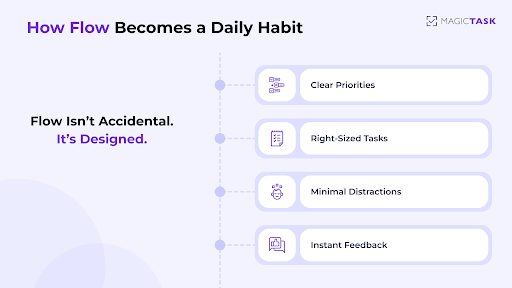
Here’s how it looks in real life:

  • Batch emails: Instead of responding throughout the day, you schedule two windows: 10:30 AM and 4:00 PM.
  • Dedicated communication time: During those blocks, you reply, forward, organize, and clear your inbox in one session.
  • Protect deep work: The rest of the morning becomes a focus block for creative or strategic tasks, uninterrupted.
  • Reduced stress: You no longer feel the urge to “just check,” because email already has a planned home in your schedule.

You still handle messages. You just don’t let them hijack your attention all day.

3. Create Focus Rituals

Flow becomes easier to reach when your brain recognizes familiar signals that say, “It’s time to focus now.” These cues just need to be consistent. When you sit in the same spot, open the same tools, or follow a small pre-work routine, your mind starts to associate those actions with concentration.

For example, you might clear your desk, put on instrumental music, and set a 25-minute timer before beginning deep work. Over time, that sequence becomes a trigger. The moment you start it, your brain shifts gears faster. You skip the warm-up phase and get into flow more quickly.

Focus rituals are about creating calm, predictable conditions where attention doesn’t have to fight to show up.

4. Declutter Digital Spaces

A cluttered digital environment is one of the quickest ways to sabotage focus. Even if you’re not actively clicking on every open tab or window, your brain still registers them as unfinished tasks. It’s like trying to concentrate in a room full of half-built projects. Mentally, there’s always something tugging at you.

Here are a few simple ways to declutter without a major overhaul:

●      Close tabs you don’t need for the current task. Even three tabs feel calmer than twelve.

●      Minimize background apps. If it’s not part of the work, it doesn’t need to be open.

●      Use one main workspace instead of multiple dashboards. Fewer places to check = fewer distractions.

●      Clear your desktop or downloads folder weekly. Small resets prevent digital chaos from piling up.

You want to face a screen that reflects what you’re focused on right now. When your environment stops competing for attention, flow becomes far easier to reach.

Turning Flow Into a Daily Habit With MagicTask

 The real transformation happens when those moments stop being occasional and start becoming consistent. That’s where the right systems and the right tools, like MagicTask, can make all the difference.

Now let’s look at how MagicTask helps turn flow from a lucky streak into a daily habit.

Turning Flow Into a Daily Habit

A Minimal UI That Reduces Cognitive Noise

Flow thrives in simplicity, and MagicTask’s interface is designed with that principle in mind. Unlike traditional task dashboards packed with widgets, categories, and notifications, MagicTask keeps your workspace clean and distraction-free. When you open the app, you’re greeted with clarity where there’s a structured backlog, a focused task lane, and progress markers that don’t overwhelm the screen.

This minimal design reduces the mental friction of deciding what to look at and where to start. Instead of scanning, clicking, and reorganizing, you can transition into work quickly. The environment does half the focusing for you. With fewer visual inputs and fewer decisions, your brain has more space to settle into deep concentration and remain there longer.

Task Sizing Helps You Choose the Right Work for Flow

Flow depends on balanced challenges, not too hard, not too easy. MagicTask’s S/M/L/XL task sizing makes that balance easy to find. When you categorize tasks by effort upfront, you can match them to your current energy and available time. That means you enter flow more often because the task fits the moment, not the ideal scenario.

Size Difficulty Ideal Flow Use
S Light Short sessions, warm-ups
M Moderate Steady deep work blocks
L High Peak energy periods
XL Extended Multi-session flow work

Sizing prevents overwhelm and creates realistic expectations, which reduces the fear of starting, one of the biggest barriers to flow.

XP and Micro-Feedback Reinforce Flow in Real Time

Flow requires a sense of progress, and MagicTask builds that into the experience. Every completed task adds XP, levels up your theme, and triggers subtle visual or audio cues. These micro-rewards are psychological reinforcement. Your brain receives a dopamine cue that says, this is working, keep going.

Here’s why this matters:

●      Small wins sustain momentum

●      Progress feels visible, not abstract

●      Motivation renews without external pressure

Instead of checking a box and moving on, you feel the completion. That feedback loop encourages you to stay in the zone longer and return to focused work more often, making flow less fragile and more repeatable.

Daily Flow Sessions Build a Stronger Focus Identity

Flow becomes part of who you are when practiced consistently. MagicTask supports this identity shift by making daily flow sessions easy to schedule and rewarding to track. When you routinely move tasks into “My Focus,” size them realistically, and finish them with satisfying feedback, you begin to internalize a new narrative: I’m someone who focuses deeply.

Over time:

●      Tasks take less effort to begin

●      The brain associates the app with concentration

●      Progress history reinforces commitment

Flow stops being a lucky occurrence and becomes predictable. Each day builds on the last, strengthening a habit and an identity grounded in focus, clarity, and calm productivity.

Conclusion

Flow is a skill you can build with clarity, structure, and systems that support focus instead of fighting it. When you reduce noise, choose the right task for your energy, and get immediate feedback on your progress, work stops feeling chaotic and starts feeling intentional.

MagicTask is built around those principles. Its clean interface clears mental space, task sizing helps you start with confidence, and XP rewards reinforce momentum. With repeated flow sessions, focus becomes less accidental and more predictable, something you can rely on rather than hope for.

If you’re ready to move from scattered days to meaningful progress, schedule your first flow session in MagicTask today and see how quickly chaos turns into clarity.

Next-Gen Gamification: What 2026 holds for task management tools

Next-Gen Gamification

Gamification used to be simple; add a badge here, a streak there, and call it “engaging.” But that phase didn’t last long. We got the badges, we smiled once, and then we ignored them forever.

Now things are changing. And it’s not subtle.

A recent study found that when gamification taps into real human needs, like autonomy, progress, and satisfaction, engagement rises dramatically. In other words, people don’t want points…. They want a purpose.

It makes total sense. Work is more demanding, and nobody wants tools that feel robotic or cold. We want something that keeps us moving, reminds us of our progress, and actually feels good to use. 

That’s why the next generation of gamified productivity is about emotion, identity, and connection. And with MagicTask’s design built around progress, personalization, and community, we’re already stepping into that future.  

The Evolution of Gamification in Work Tools

The evolution of gamification

Before we look ahead to what 2026 will bring, let’s rewind for a moment and see how far gamification has already come.

Early Gamification

If you rewind a decade, gamification looked a lot like giving out gold stars in elementary school. Companies were experimenting with “fun,” but most of it was surface-level. 

You remember the era:

  • Foursquare turned checking into places into a race for badges and mayorships.
  • Fitbit made steps feel like a game long before “10K a day” went mainstream.
  • Duolingo introduced streaks and XP, and suddenly everyone thought they were at least kind of learning French.
  • Even early workplace tools tried to sprinkle in leaderboards, hoping competition would magically fix motivation.

And guess what? It worked… but only for a while.

People loved the rush of earning a badge or watching a streak climb. These were the training wheels of gamification, and honestly, they’re a bit addictive. 

But here’s the thing no one said out loud at the time: Points kept us engaged, but they didn’t keep us connected.

You know the streak you maintain with your friends on Snapchat? It’s a rush when you see the points, but what happens when you see those points don’t actually get you anything? The novelty wears off. The badge walls blended together. What we gained in quick engagement, we lost in long-term meaning.

Early gamification taught the world that motivation can be sparked by rewards, but it can only be sustained by purpose.

And that realization is exactly what pushed gamification into its next phase, one where the experience matters more than the badgebook.

Modern Gamification

As the shine wore off early gamification, something interesting happened. People didn’t want more badges; they wanted better ones. Badges tied to progress. Points tied to meaning. Motivation tied to something that actually felt human;

That’s when modern gamification began to take shape.

Companies started shifting their approach: 

  • Headspace replaced streak obsession with gentle encouragement and “You showed up today” messages.
  • Strava moved beyond trophies and leaned into storytelling. Your runs became part of a larger narrative, not just a number.
  • Notion brought in playful emojis, minimal design, and a calm interface to make organization feel less like a chore.

And then there’s MagicTask, which took a different approach entirely. Instead of “gamifying productivity” in the traditional sense, it leaned into progress loops, the feeling you get when a theme levels up, when XP jumps after completing a task, when your workspace reacts to what you’ve accomplished. It’s gamification that resonates.

Instead of gamifying for excitement, teams began designing for experience:

  • Was the tool calming or overwhelming?
  • Did it make people feel capable, or guilty?
  • Was progress visible in a way that felt satisfying, not stressful?

Modern gamification became less about chasing the next star and more about creating an environment that gently nudges you toward consistency, the kind of consistency that builds actual habits, not just a high score.

And that shift laid the foundation for what’s coming next. Which brings us to where things are headed in 2026.  

Next-Gen Gamification

If early gamification was about excitement, and modern gamification is about experience, the next era is about emotion.

People aren’t looking for productivity apps that “keep them on track.” They want tools that feel supportive, energizing, and genuinely aligned with who they are. That shift is already shaping the next generation of gamification.

Future task tools will focus on things like:

  • Emotional cues that match energy levels
  • Visual styles that reflect personal taste and creativity
  • Workflows that adapt to your rhythm instead of forcing you into rigid structures

Instead of earning points for completing tasks, users will build a sense of personal identity: 

“This is how I work. This is who I am becoming.”

This is where MagicTask is already ahead. Instead of pushing users through a strict achievement system, it creates an environment where progress feels natural: themes that change with you, feedback that responds instantly, and a workspace that feels more like a companion than a dashboard.

The next wave of gamification will deepen that relationship, blending motivation with emotion, and turning productivity into something that feels personal, intuitive, and even a little bit comforting.

And as we move closer to 2026, that emotional connection will become the difference between a tool you “use”… and a tool you actually return to. 

The Shift from Rewards to Meaningful Motivation

For years, gamification revolved around collecting things. And while those rewards were fun at first, people don’t stay motivated by trinkets… they stay motivated by meaning.

Today’s users want tools that make their work matter. Not just another XP bump or shiny badge, but a feeling that their effort connects to something bigger, like progress, growth, identity, and momentum.

It’s the difference between:

  • “You earned 10 points.” and
  • “You moved closer to becoming the person you want to be.”

One is a reward. The other is a reminder.

This shift is backed by psychology. Researchers have found that external rewards trigger short bursts of effort, while intrinsic motivation creates behaviors that last. Think about it. You don’t read 20 books a year because someone gave you a sticker. You do it because each page feels like a step toward the version of you you’re proud of.

And this is where next-gen gamification is headed. 

Future tools will lean into:

  • Emotional satisfaction → feedback that feels earned and personal
  • Identity-building → a visual journey that reflects who the user is becoming
  • Personal growth loops → small wins that stack into real transformation
  • Reflective progress → users seeing not just what they did, but who it’s shaping them into

MagicTask already understands this. Instead of bombarding users with badges, it uses:

  • Themes that evolve with you
  • XP that feels like personal momentum, not a scoreboard
  • Sound and visual cues that quietly say, “Nice. Keep going.”
  • Progress loops that make even small wins feel like steps forward

The impact is subtle but powerful: Meaning, not mechanics, is becoming the heartbeat of gamified productivity. And it’s a shift that will define the next era of work tools. 

Personalization and Experience Design

If early productivity tools felt like spreadsheets and modern tools feel like clean dashboards, the future will feel more like stepping into a space that’s yours. A place that understands how you work, what motivates you, and even how you’re feeling that day. 

That’s the direction task management is headed.

People want a workspace that reflects their personality, their pace, and their preferences. A tool that feels almost like a companion rather than an application.

Imagine opening your task app and it adapts instantly:

  • The theme shifts based on your energy level
  • Your interface brightens or calms depending on your mood
  • Your “quest board” evolves as your goals evolve
  • Your avatar grows with you, visually tracking your commitment

This is where next-gen gamification is going: identity-driven productivity.

You’ll build a visual story of your progress. You’ll see your “character” level up, your themes evolve, your achievements stack into a narrative that feels deeply personal.

We already see hints of this future in MagicTask’s design:

  • Themes that level up with your workflow
  • Custom visuals that match your style
  • Subtle sound cues that reinforce rhythm and focus
  • An interface that feels alive, not static

It’s not personalization for the sake of aesthetics. It’s personalization that helps people feel connected to their work. It reinforces ownership. It turns your daily grind into something that looks and feels like you.

Because when a tool understands you, you naturally want to grow with it. 

The Rise of Shared Progress and Team Gamification

One of the most exciting shifts coming to gamified productivity is the move from solo progress to shared progress. Because work rarely happens alone. And motivation? It multiplies when people feel like they’re part of something bigger than themselves.

The future of gamification is social. 

Think less “everyone for themselves” and more “we’re leveling up together.” Teams will take on shared quests, unlock group achievements, and celebrate collective wins. Finishing a sprint will feel like completing a mission as a squad.

Picture this:

  • A marketing team earns XP together for launching a campaign
  • A customer success squad is hitting a group milestone for response time
  • A product team completing a “Feature Quest” and unlocking a team reward
  • Company-wide leaderboards where the goal isn’t competition, but community

Work becomes a multiplayer game in a way that reinforces collaboration, alignment, and shared accountability.

With shared boards, team visibility, and progress tracking that everyone can see, teams stay connected to each other’s efforts. When someone moves a task forward, everyone feels the momentum. 

As we move toward 2026, this idea of collective gamification will only grow stronger.

What next-gen gamification looks like

Conclusion

The future of gamification isn’t about stacking up badges or chasing louder animations. It’s about shaping work in a way that feels engaging, meaningful, and deeply human. A workspace that doesn’t just organize your tasks, but energizes you. A system that rewards progress, not just completion.

MagicTask is already stepping into that future. It transforms everyday tasks into a journey, one filled with momentum, shared wins, and progress you can actually feel. It’s not just a tool; it’s the evolution of how we stay motivated and connected in the modern world.

If you want to see where gamified productivity is headed, try MagicTask and experience it firsthand. Start today, join the movement, and be part of what’s next.