


You’ve been there. You open your planner, load up your to-dos, and feel confident you’re finally getting organized. Hours later, the list barely budges, and that sense of productivity you expected feels flat.
This is a widely observed phenomenon in how people work. Research shows that even when people plan realistically, they often underestimate how long tasks will take and overestimate how much they’ll accomplish. In one classic experiment, only around 13 % of participants completed their projects by the time they estimated a 50 % likelihood of finishing, and even at a 99 % estimated probability, fewer than half were done on time.
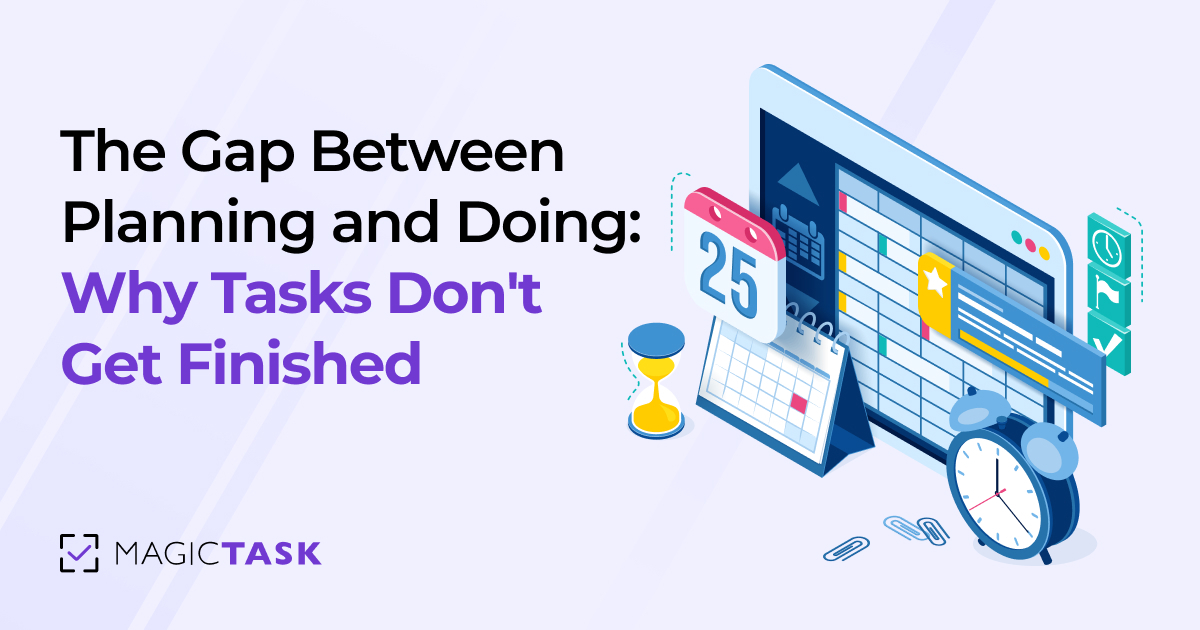
That gap between planning and doing, where intentions fail to translate into action, is a behavioral pattern rooted in how our minds forecast effort and manage execution. Understanding this breakdown is the first step toward closing it.
What Is the “Planning vs Doing Gap”?
Planning vs Execution Gap
The gap between planning and execution is the breakdown that occurs when
intentions are organized but not translated into consistent, physical action.
Planning feels productive because it gives you structure. You sort tasks, prioritize them, and maybe even color-code your week. Your brain experiences a sense of control and clarity. That feeling can mimic progress, even when no real output has happened yet.
Execution is different. Execution requires:
- A defined next action
- Energy in the present moment
- A decision to start
- Sustained attention until completion
Planning operates in the realm of ideas. Execution operates in the realm of effort. That distinction matters.
When you plan, you’re imagining the work. You’re mapping it out, visualizing how it will unfold. That mental simulation can create a subtle illusion of movement. The list looks organized. The calendar looks full. The system feels complete.
But thinking about work is not the same as advancing it.
The planning vs doing gap appears when:
- Tasks are defined at a high level but not broken into actions
- Lists grow longer, but output stays flat
- Time is spent organizing instead of executing
It’s the difference between “Work on marketing,” and“Draft the first three headlines for the landing page.”
One lives in abstraction. The other lives in motion.
The gap isn’t a failure of ambition. It’s a mismatch between intention and structure. Without a system that converts ideas into clear, executable steps, planning can quietly become a substitute for progress rather than a pathway to it.
The 7 Most Common Reasons Tasks Don’t Get Finished
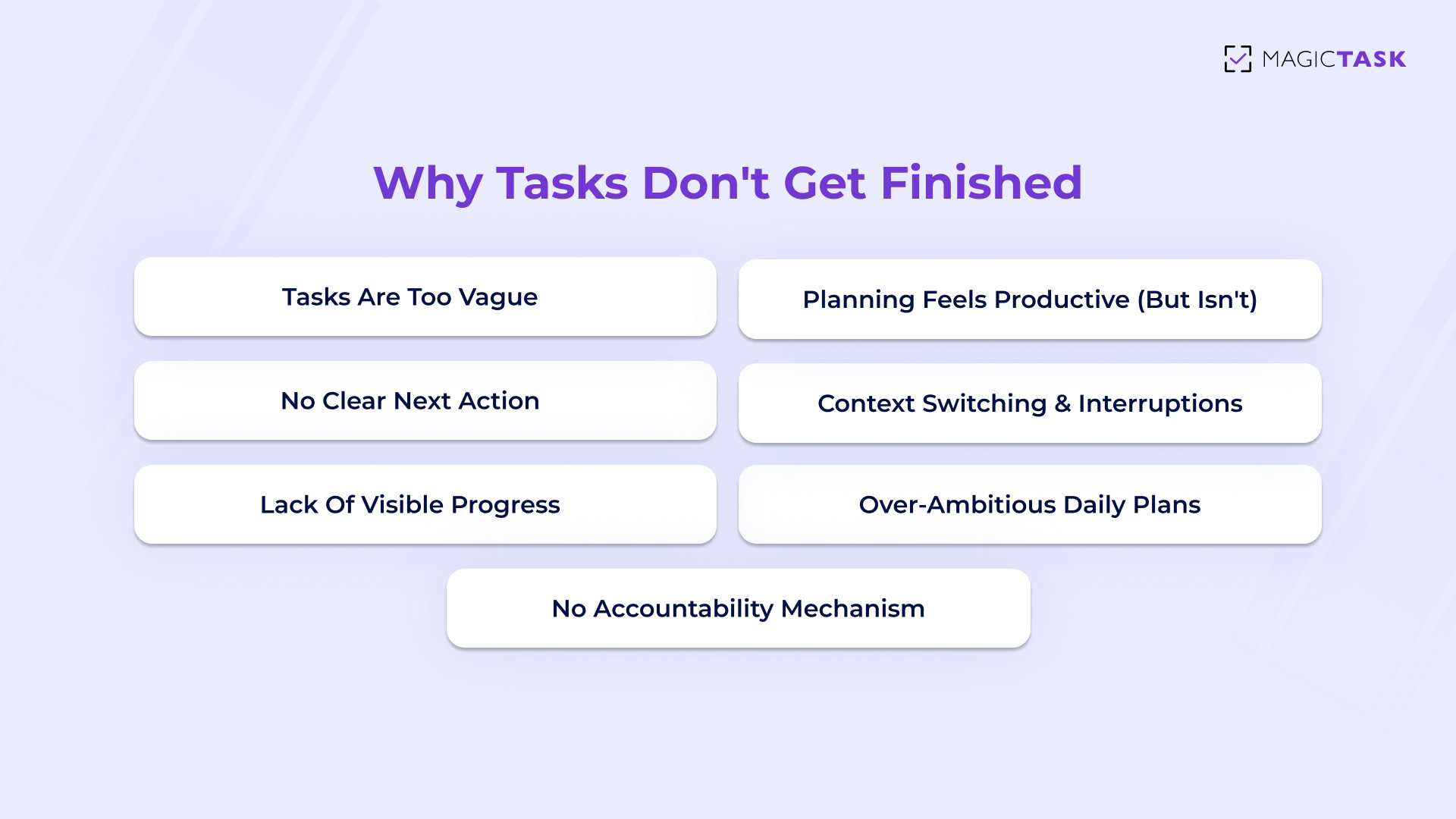
Most unfinished tasks stall because something in the structure breaks down. A task looks simple on paper, but once the moment to act arrives, friction appears.
The reasons are rarely dramatic. They’re small, repeatable blockers that quietly drain momentum. Understanding them makes it easier to spot where execution is slipping and why a full plan doesn’t always turn into finished work.
1. Tasks Are Too Vague
A task can sit on your list all week simply because it isn’t actionable.
When something says “Improve onboarding” or “Get finances in order,” your brain doesn’t see a clear starting line. It sees a cloud. And clouds are easy to postpone.
Vague tasks create hidden decision points. The moment you try to begin, you’re forced to define the scope, choose a direction, estimate the effort, and decide what “done” even means. That thinking phase feels heavier than the task might actually be.
So you delay it.
Specific tasks remove that mental negotiation. Compare:
- “Update client strategy”
- “Outline three bullet points for Q1 client strategy revision”
The second one lowers the activation energy. You know what to open. You know what to type. You know when you’re finished.
Execution depends on clarity at the moment of action. When tasks are defined at the outcome level instead of the action level, they create friction disguised as ambition. And friction, even small amounts, is often enough to keep something perpetually unfinished.
2. Planning Feels Productive (But Isn’t)
Planning delivers a subtle emotional reward. You sort tasks. You reorganize your week. You clean up your dashboard. Everything looks aligned. For a moment, you feel ahead. That feeling is real, but it isn’t the same as output.
Organizing activates the brain’s reward system because it creates order and perceived control. You experience a small dopamine lift simply from structuring your work. The list looks sharper. The calendar looks intentional. The system feels optimized. Nothing has actually moved forward.
This is where false progress creeps in. Planning can mimic productivity because it reduces uncertainty. It gives closure to open loops at a cognitive level, even though the physical work remains untouched.
Execution requires effort and sustained attention. Planning requires arrangement. Both feel active. Only one creates results.
3. No Clear Next Action
Even well-defined tasks can stall when the very first step isn’t obvious. Execution depends on immediacy. If you sit down and still have to figure out how to begin, your brain experiences friction, and friction quietly kills momentum.
That hesitation might only last a few seconds, but it creates just enough resistance to push you toward something easier. Email. Slack. A “quick” scroll. Momentum disappears before it starts.
Common signs that a task has no clear next action:
- Multiple decisions required: You must choose a direction before you can begin, which delays starting.
- Unspecified materials: You need files, data, or resources but haven’t defined exactly what to gather.
- Undefined finish line: You’re unsure what “done” actually looks like, so beginning feels risky.
- Re-orientation time: You have to reread notes or reconstruct context just to restart the work.
- Ambiguous first move: The task describes an outcome, not the first physical action.
When the next step is visible and concrete, action feels automatic. When it isn’t, your brain defaults to avoidance. Clarity at the starting point is often the difference between momentum and another unfinished task lingering on tomorrow’s list.
4. Context Switching and Interruptions
Every time you jump between tasks, like replying to a message, checking email, and attending a quick meeting, your brain has to reorient. That reset isn’t instant. Cognitive research shows attention residue lingers, meaning part of your focus stays attached to the previous task even after you’ve moved on.
Shallow work thrives in this environment.
Quick replies, minor updates, and small administrative tasks feel manageable and satisfying because they resolve fast. You can complete them in minutes. They offer immediate closure. Deep tasks don’t.
Meaningful work often requires:
- Rebuilding context
- Holding multiple variables in working memory
- Tolerating temporary uncertainty
- Staying with discomfort before clarity emerges
When interruptions dominate the day, shallow tasks crowd out deeper execution. You remain busy, but large, important tasks sit untouched because they demand uninterrupted time blocks.
The result isn’t laziness. It’s fragmentation.
Execution struggles not because you lack intention, but because attention keeps getting sliced into pieces too small to carry complex work forward.
5. Lack of Visible Progress
Humans need evidence that movement is happening. When progress is invisible, motivation fades. You might be working hard, but if there’s no clear signal that effort is accumulating, your brain struggles to justify continuing. Feedback loops are what sustain behavior. Without them, momentum feels abstract.
Visible progress creates reinforcement.
That reinforcement can take many forms:
- A checklist shrinking
- A milestone reached
- A streak continuing
- A measurable indicator moving forward
Without these signals, effort feels like it’s disappearing into a void. Large projects are especially vulnerable to this. You invest time, but the finish line still looks distant. The brain interprets that distance as stagnation.
Progress doesn’t have to be dramatic. It simply has to be seen. When the system makes advancement visible, even small steps feel meaningful. When progress stays hidden, tasks begin to feel endless, and endless tasks rarely get finished.
6. Over-Ambitious Daily Plans
Daily plans often reflect ideal conditions: perfect focus, uninterrupted hours, high energy. Real days rarely look like that. Meetings run long. Energy dips mid-afternoon. Unexpected requests appear.
When a schedule assumes optimal performance all day, it quietly sets you up for carry-over.
Common patterns include:
- Stacking multiple high-effort tasks in one day
- Ignoring transition time between activities
- Underestimating how long deep work actually takes
- Planning with morning energy in mind but executing in afternoon reality
An overloaded list creates pressure instead of clarity. Once it becomes obvious that everything won’t get done, motivation drops across the board.
Completion thrives on constraint. Fewer commitments increase follow-through. Planning for realistic capacity is what keeps tasks moving to “done” instead of rolling forward indefinitely.
7. No Accountability Mechanism
“I’ll remember” feels reassuring in the moment. It rarely works.
Without some form of external visibility or tracking, tasks rely entirely on internal memory and fluctuating motivation. That’s fragile.
Accountability doesn’t have to mean public pressure. It simply means the task exists somewhere outside your head, in a form that invites follow-through.
When there’s no accountability:
- Tasks get mentally postponed
- Deadlines become flexible
- Priorities shift quietly
- Important items sink under urgent ones
The human brain is designed to conserve energy. If no system is prompting, tracking, or reflecting your commitments back to you, avoidance becomes easy.
Lightweight accountability, even simple tracking, creates gentle tension. It keeps tasks present. It increases the likelihood that intention turns into action.
Without it, plans stay private. And private plans are the easiest ones to abandon.
The Psychology Behind Not Taking Action
Planning often acts as a form of anxiety avoidance. Organizing tasks, outlining projects, and refining systems create a sense of control. That control feels productive because it reduces discomfort. Starting the actual task, however, introduces exposure. Your work becomes visible. It might be imperfect. It might require revision. The brain subtly prefers preparation because it feels safer than performance.
Fear of imperfection reinforces this delay. Large tasks carry imagined standards. You picture the finished result before typing the first sentence. That gap between expectation and current ability can make beginning feel risky. Waiting for the “right” time or energy becomes a protective strategy. Smaller, contained actions lower that barrier because they shift the focus from delivering excellence to simply moving forward.
Decision fatigue adds another layer. Every task requires choices: where to start, how to approach it, and how long to spend on it. As the day progresses, cognitive energy declines. When mental bandwidth is low, the brain gravitates toward easier, shallower activities that provide quick resolution. Complex tasks remain untouched because they demand sustained attention and multiple decisions.
Unfinished tasks also linger in memory due to what psychologists call the Zeigarnik Effect, the tendency for incomplete work to stay mentally active. Open loops create background tension. A few unfinished items can motivate action. Too many create overwhelm. That overwhelm often pushes people back toward planning and organizing as a way to manage stress instead of completing the task itself.
Planning vs Execution: What Actually Drives Completion
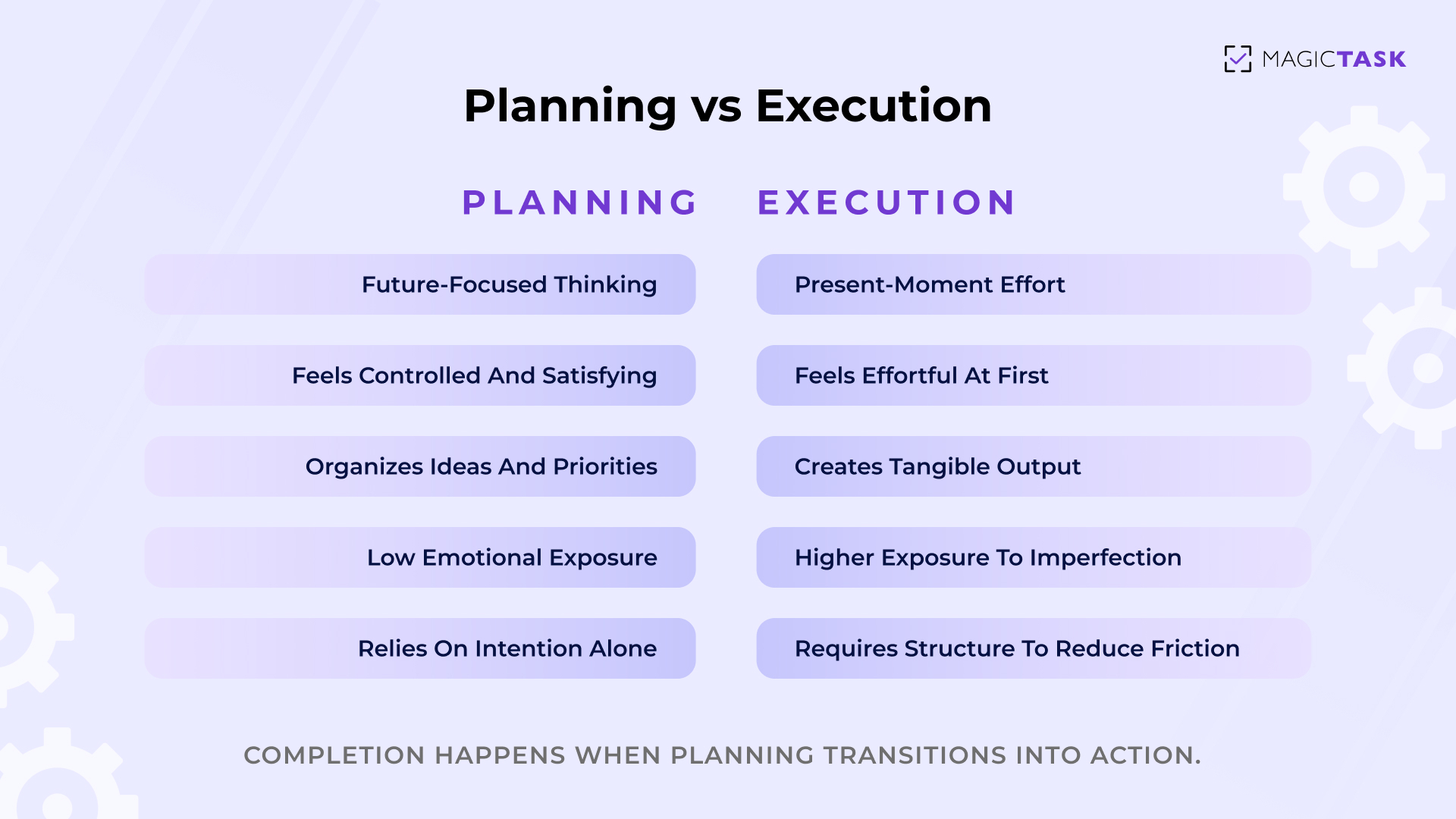
Planning and execution are often treated as two stages of the same process. In reality, they operate on different psychological mechanics.
Planning organizes intention. Execution converts intention into completed action. The gap appears when the structure ends at the planning phase and never extends into behavior.
Here’s how they differ:
| Aspect | Planning | Execution |
|---|---|---|
| Primary Focus | Organizing ideas and priorities | Taking concrete, physical action |
| Time Orientation | Future-focused thinking | Present-moment effort |
| Emotional Experience | Feels controlled and satisfying | Often feels effortful at first |
| Cognitive Demand | Strategy and decision-making | Sustained attention and follow-through |
| Output | Clarity about what should happen | Tangible progress and completed work |
| Motivation Source | Boost from organizing and structuring | Momentum from visible progress |
| Risk Level | Low emotional exposure | Higher exposure to imperfection |
| Dependency | Can rely on intention alone | Requires structure to reduce friction |
| Energy Pattern | Can be done in short bursts | Requires sustained energy blocks |
Execution answers: What am I doing right now?
Completion depends on designing work so that the transition from thought to action is smooth. When structure supports sustained attention and reduces starting friction, execution becomes consistent rather than occasional.
How to Close the Gap Between Planning and Doing
Closing the execution gap isn’t about trying harder. It’s about reducing friction at the moment of action. When tasks are structured to be clear, finite, and visible, completion becomes far more predictable.
Here’s how to design your workflow for follow-through.
Step 1: Convert Every Task Into a Physical Action
If a task can’t be done in one focused sitting, it is a project.
Projects create hesitation because they contain multiple hidden steps. The brain resists starting something undefined. Converting each item into a single, observable action lowers the barrier to entry.
Instead of listing outcomes, define movements:
- Open the document and draft the outline
- Review slides 1–5 for clarity
- Send follow-up email to client
Physical actions create immediacy. When the next step is concrete, starting feels automatic rather than negotiable.
Step 2: Make Progress Visible
Humans continue behaviors that provide feedback.
If effort disappears into a void, motivation fades. Visible progress, no matter how small, reinforces continuation. That visibility can come in many forms:
- Checklists that shrink
- Streak counters that track consistency
- Points or progress indicators
- Milestones that mark advancement
The goal is feedback. When the brain sees advancement, it’s more willing to keep going. Invisible effort rarely sustains momentum.
Step 3: Limit Daily Commitments
Overloading a day guarantees carry-over.
Planning for ideal energy levels leads to unfinished lists. Completion rates increase when daily commitments decrease. Fewer tasks create focus. Focus increases follow-through.
A simple rule: prioritize what must move forward today, not everything that could move forward.
When the list is shorter, the finish line feels reachable. That psychological shift alone increases the likelihood of completion.
Step 4: Add Time Boundaries
Open-ended tasks expand. Time-bound tasks move.
Without a defined time container, work stretches indefinitely or gets postponed. Time-boxing assigns a start and end window, reducing ambiguity.
For example:
- 30 minutes to draft
- 45 minutes to review
- 20 minutes to outline
Time limits reduce perfection pressure. They shift the goal from “finish flawlessly” to “make progress within this window.” That shift encourages starting, which is often the hardest part.
Step 5: Introduce Lightweight Accountability
Intentions are fragile when they live only in your head.
Light accountability increases follow-through without adding pressure. This might include:
- Tracking daily completion
- Sharing task visibility with a team
- Reviewing progress at the end of the day
- Using systems that reward consistency
Accountability works because it creates reflection.
Why Traditional To-Do Lists Often Fail
To-do lists create clarity at the planning stage. They capture everything that needs attention. Most lists stop at recording tasks and never guide them toward completion.
Common problems with traditional to-do lists include:
- No guidance on when to act: Tasks sit in a column without time boundaries, leaving you to decide in the moment what deserves attention.
- No clarity on how to start: Items describe outcomes rather than first actions, forcing extra thinking before execution begins.
- Weak prioritization under pressure: Urgent, low-effort tasks rise to the top while important, complex work keeps getting postponed.
- Equal visual weight: A five-minute task looks the same as a two-hour task, making planning unrealistic and energy management difficult.
- Zero engagement mechanics: Checking a box provides brief relief but no sustained feedback loop to encourage continued momentum.
- Easy rollover behavior: Unfinished tasks quietly move to tomorrow without structural consequences, reducing urgency.
A list can be perfectly organized and still produce minimal output. It tells you what exists. It doesn’t reduce friction at the moment of action.
How Better Task Systems Turn Plans Into Action
Execution improves when the system is designed for action, not organization alone. A strong task system does more than collect items. It shapes behavior at the moment of starting and finishing.
Better systems convert intention into movement by addressing the friction points that cause tasks to stall.
They do this in several ways:
- Force task clarity: Tasks must be defined as concrete, startable actions. Ambiguous outcomes are broken down into steps that can be completed in one sitting. This removes hesitation at the starting line.
- Reduce decision friction: Clear prioritization, visible task weight, or structured sequencing minimizes the number of choices required throughout the day. Fewer decisions preserve cognitive energy for actual work.
- Reward completion, not planning: Progress indicators, streaks, or milestones reinforce finished actions rather than time spent organizing. The system celebrates output instead of preparation.
- Create visible momentum: Each completed task contributes to measurable forward movement. That visibility encourages continuation because effort feels cumulative.
- Support realistic workload limits: By making capacity obvious, better systems prevent overload and increase follow-through.
Features alone don’t drive execution. A tool can have tags, folders, filters, and dashboards, yet still fail to produce completion. What matters more are the mechanics that guide behavior: clarity at the start, structure during effort, and reinforcement at the finish.
When engagement is built into execution, finishing tasks becomes a natural outcome of the system rather than a constant test of willpower.
Conclusion
Most unfinished work isn’t a motivation issue. It’s a structure issue.
The problem begins when the organization never turns into action. Lists alone don’t create progress. Systems that reduce friction and reward completion do.
When tasks are clear, limited, and visibly moving forward, momentum builds naturally. Small, consistent actions outperform perfectly crafted plans that never leave the page.
If you want to close the gap between planning and doing, try a system designed for execution. Test MagicTask for a week and see how visible progress and built-in momentum change the way you work.
FAQ: Planning vs Doing
Q1. Why do I plan a lot but never finish tasks?
Planning feels productive because it creates clarity and control, but it doesn’t guarantee action. Tasks often stall when they aren’t broken into concrete next steps or when too many are scheduled at once. The gap appears when the structure supports organizing but not execution.
Q2. Is over-planning a form of procrastination?
Yes, it can be. Over-planning often becomes a socially acceptable way to delay starting, especially when a task feels uncomfortable or uncertain. Organizing reduces anxiety, but it doesn’t move the work forward.
Q3. How many tasks should I plan per day?
Aim for 3 to 5 meaningful tasks per day, depending on their size. Fewer, clearly defined actions increase completion rates and reduce rollover. Overloading the list almost always lowers follow-through.
Q4. What’s the fastest way to start executing tasks?
Define the next physical action and commit to five focused minutes. Starting removes most resistance, and momentum often carries you beyond the initial time block.
Q5. How do teams reduce execution gaps?
Teams reduce execution gaps by making tasks visible and progress trackable. Shared boards, clear ownership, and lightweight accountability create alignment and increase follow-through across the group.