The Real Reason You Procrastinate – And How to Start Getting Things Done

The real reason you procrastinate

You glance at your to‑do list and feel your heartbeat spike. But instead of completing tasks and checking them off the list, you say, “Maybe later”.

Does that sound familiar?

If that scenario hits home, you’re experiencing the classic tug‑of‑war between your limbic system’s craving for instant comfort and your prefrontal cortex’s push for long‑term progress.

And you’re far from alone.

Studies show that 20–25% of adults classify themselves as chronic procrastinators, meaning millions of us face the same feeling.

So let's try understanding the real, science-backed reasons why we procrastinate and discuss strategies to get unstuck.

So, let’s get started. 

The Real Reason You Procrastinate

Before we get to the reason why we procrastinate, let’s get something clear. Procrastination isn’t a sign of laziness or a lack of willpower, but an emotional avoidance strategy. 

It kicks in whenever a task feels:

  • Overwhelming, when you’re staring at a blank page, wondering where even to begin
  • Ambiguous, when vague instructions leave you unsure what “update the report” actually means
  • Boring, when repetitive data entry makes you question why you bothered
  • Threatening, when the fear of failure or criticism stops you in your tracks

When you’re feeling all these feelings, your brain is torn between listening to the limbic system and the prefrontal cortex.

That’s what leads to the reasons for procrastination. 
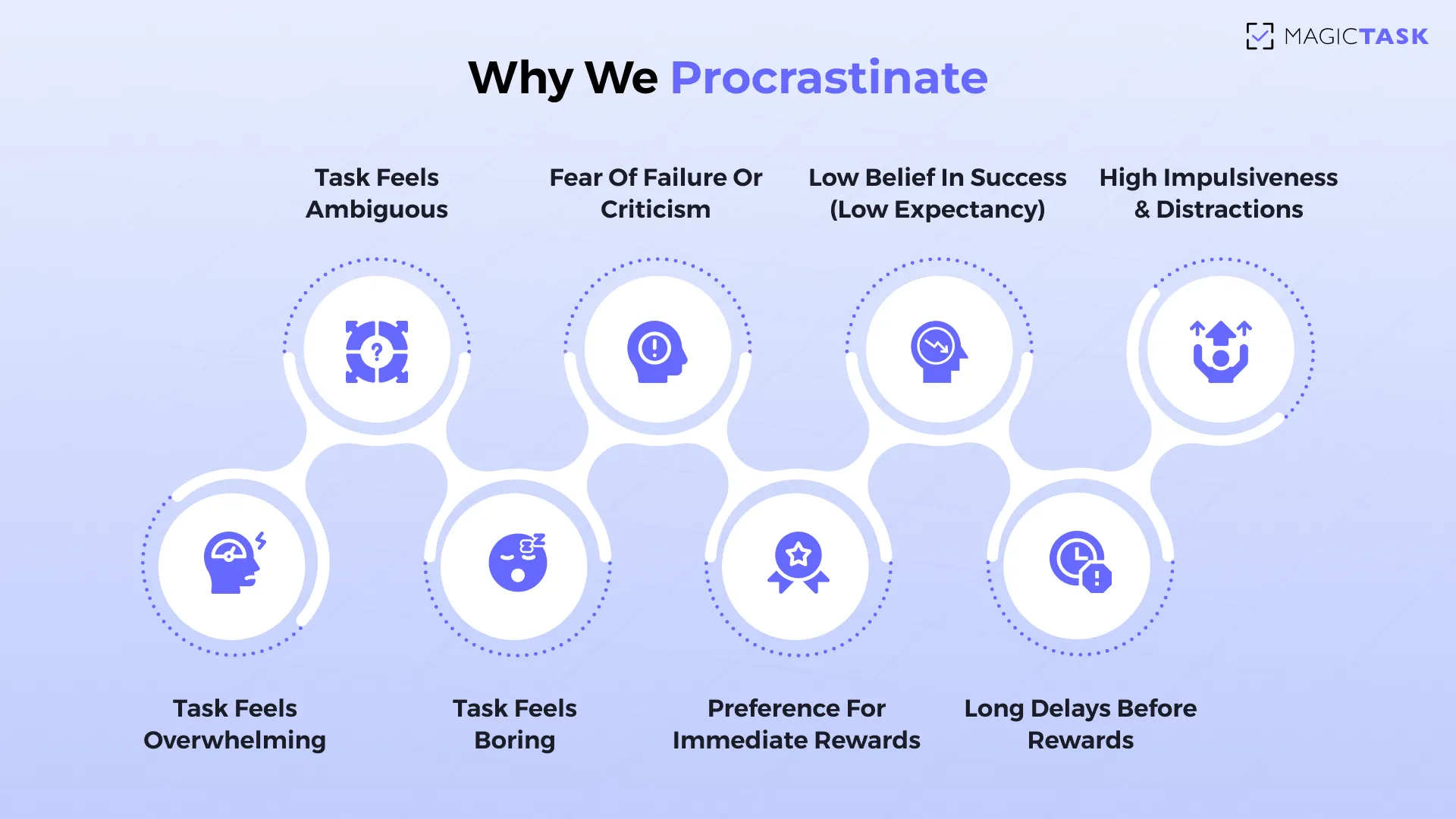
Why we procrastinate

Limbic Hijack

When your brain senses a task as uncomfortable, your threat‑detector (the amygdala) kicks into high gear.

This “limbic hijack” floods your system with stress hormones and a craving for relief, and suddenly, the closest source of comfort, like social media, snacks, or busy work, feels far more appealing than the real work at hand.

While your emotional center screams “avoid,” the prefrontal cortex—the part of your brain that plans, reasons, and wills itself forward—takes a back seat.

Scrolling through your feed or reorganizing your desktop triggers small hits of dopamine and reinforces avoidance, so every time you try to focus, your brain nudges you back toward the “easier” reward.

But it is only half the story; our brain’s reward system also tilts the scales toward bias.

Dopamine & Delay Discounting

Your midbrain dopamine neurons respond to any hint of reward, especially when it’s right in front of you.

Neuroscientists have shown that these neurons light up not only when you actually receive a treat, but even when you expect one, turning anticipation itself into a tiny hit of pleasure. 

But the farther away a reward lies, the smaller that dopamine surge becomes.

This “delay discounting” means your brain devalues tomorrow’s big achievement in favor of today’s quick payoff.
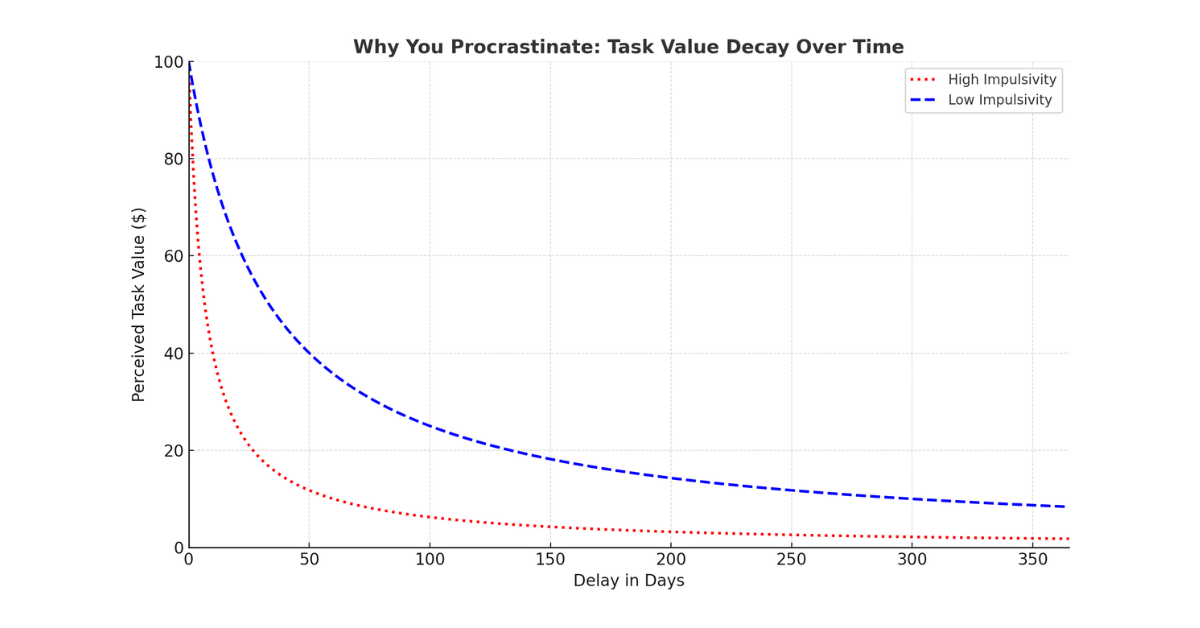
Dopamine & Delay Discounting

In practice, this is why you’ll find yourself breezing through a five‑minute email response while balking at a two‑hour market analysis that won’t pay off until next quarter. 

Temporal Motivation Theory

While dopamine surges and delay discounting show us what happens in the brain when we procrastinate, Temporal Motivation Theory (TMT) explains why certain tasks get sidelined and others tackled head‑on.

Developed by Piers Steel and Cornelius König, TMT distills motivation into a simple equation:

Motivation = (Expectancy × Value) / (1 + Impulsiveness × Delay)

Where, 

  • Expectancy is your belief that you can succeed.
  • Value is how rewarding you perceive the outcome to be.
  • Delay is the time until the reward arrives.
  • Impulsiveness reflects how much immediate comforts tempt you.
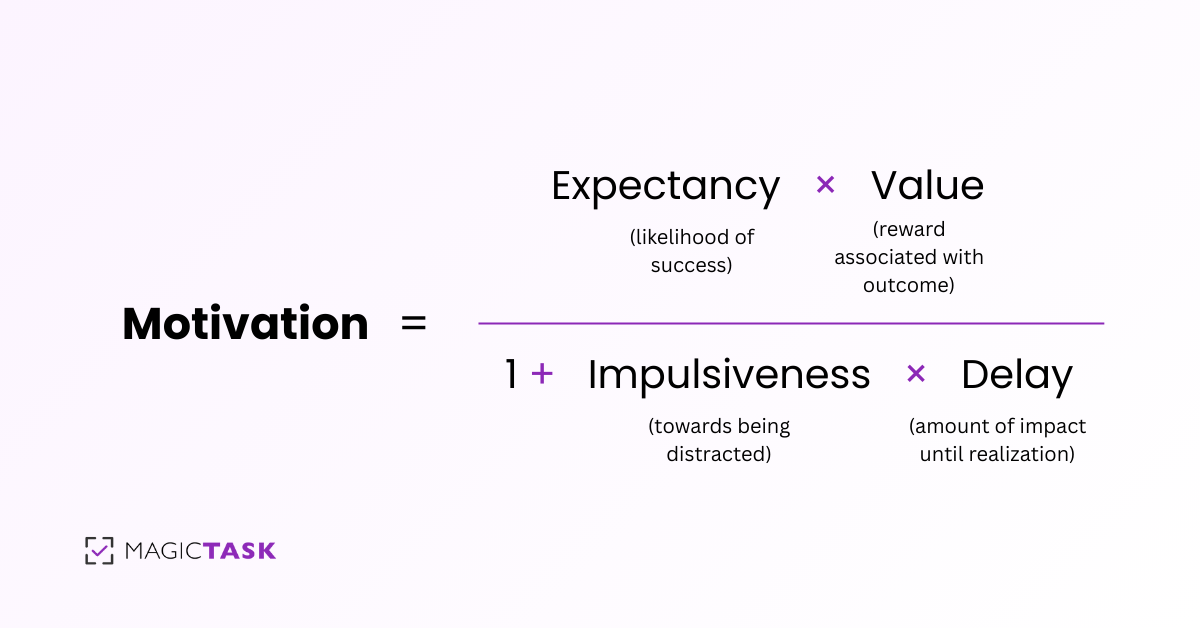
Temporal Motivation Theory

Imagine you have two tasks: writing next month’s annual report (high value, valuable to your career, but due in four weeks) versus drafting a five‑sentence email reply (low value, due immediately).

TMT predicts you’ll gravitate toward the email because the delay is minimal and impulsiveness drives you toward that quick win, even though the report may be far more critical.

What does it mean for procrastination?

  • Long delays and low expectancy crush motivation.
  • High‑value tasks still languish if they feel distant or too complex.
  • People with higher impulsiveness give in to distractions more easily.

By understanding TMT, you realize procrastination isn’t a moral failing, but a predictable outcome of our brain’s time‑sensitive calculus.

And once you know the formula, you can hack it and watch motivation take over.

Breaking free from procrastination means interrupting the cycle before it tightens its grip.

Procrastination Is a Cycle — Here’s What It’s Doing to You

When you delay, you’re not just pushing a task off your plate. You’re stacking stress on top of stress.

Did you know that the average person spends nearly 55 days a year — that’s almost two months — delaying essential tasks.

Over time, the habit loop of avoidance starts to erode your ability to accomplish things.

Here’s precisely what happens: 

  • Mental load buildup: Each postponement makes the task feel more daunting, so it becomes even harder to start next time.
  • Lower self‑trust: You miss commitments, and that chips away at your confidence in your follow‑through.
  • Missed deadlines and opportunities: Trying to wait until the last minute often means you miss the window to deliver your best work or even deliver at all.
  • Increased stress and guilt: Anxiety grows as due dates loom, and guilt sets in the moment you realize how much you’ve fallen behind.
  • Declining performance: You try to keep up, but rushed efforts lead to avoidable errors, reinforcing the belief that “I work better under pressure,” which only fuels more delay.

Let’s take the example of a product manager I worked with. By putting off stakeholder updates until the day before presentations, she repeatedly found herself scrambling for accurate data, burning out her team, and watching decision‑makers grow frustrated.

What began as a few skipped emails turned into a habit loop that threatened her credibility and her project’s success.

Breaking free means interrupting this cycle before it tightens its grip, which brings us to the five proven ways to break free from the procrastination cycle. 

Five Quick Ways to Start Getting Things Done

Now that you’ve seen how delaying just one task can snowball into missed deadlines, stress, and eroded confidence, it’s time to shift gears from “maybe later” to “done now.”

1. Break Tasks into Micro-Steps

When you face a project that feels enormous—say, “Finish the Q3 marketing presentation”—your brain balks.

That single directive demands dozens of decisions all at once, such as which slides you need, what data to include, and which design to choose. It’s no wonder we freeze or detour into something else, thinking that the task is abstract.

The antidote is to carve out the very first slice of the work.

Instead of “Finish presentation,” you might define your opening move as “Draft three talking points for the introduction.”

That tiny commitment takes less than two minutes and fits squarely within your brain’s comfort zone. You’re no longer wrestling the whole elephant. You’re merely petting its ear.

That one small win triggers a dopamine release, clears mental bandwidth, and gives you the confidence to tackle the next micro‑step.

You can use tools like MagicTask to find the starting point.

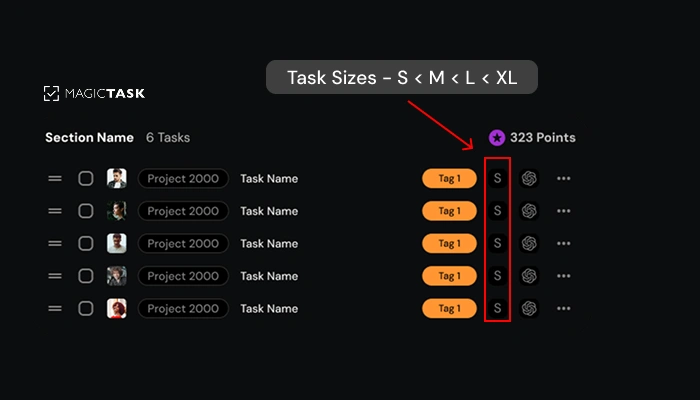
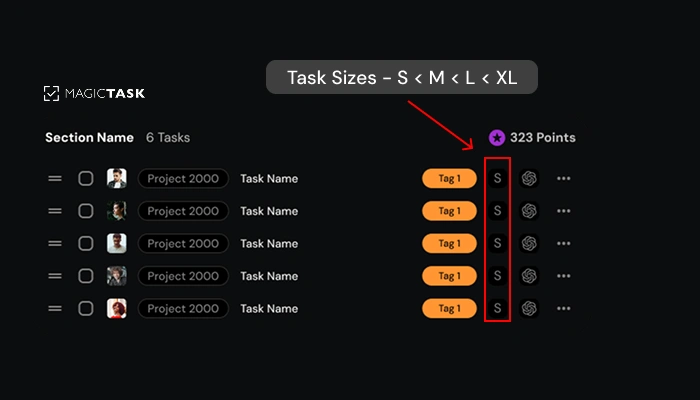
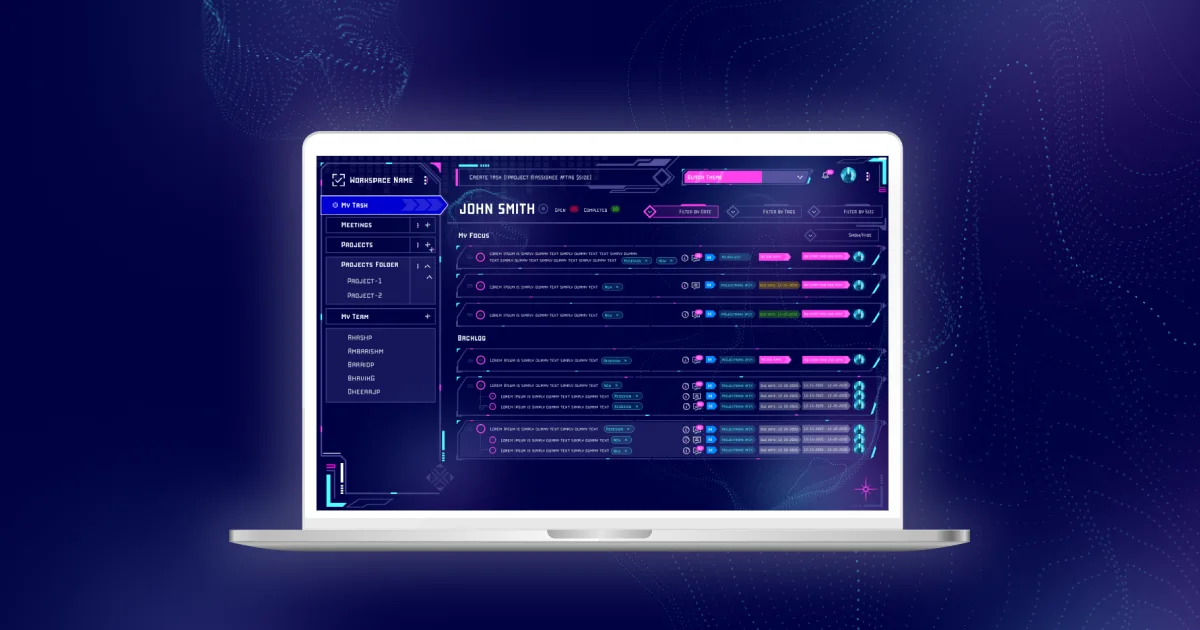
In MagicTask, each micro-step is its own item, sized “S, M, L, or XL”, so you can visualize exactly where to begin depending on the task size. Drag that smallest task into your “My Focus” lane, complete it, and feel the forward pull of genuine progress. 
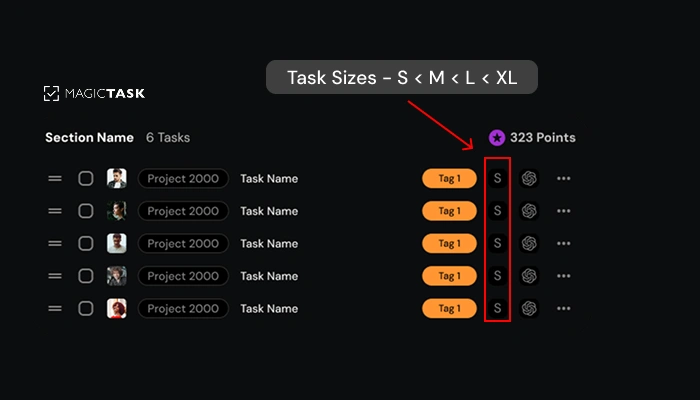
Task sizes in MagicTask

That initial win wakes your momentum, so why stop there? Turn every small task into a “do it now” move.

2. Use the Two-Minute Rule

A general rule of thumb to avoid procrastination is to stop adding things to your to-do list.

If a task can be done in under two minutes, do it immediately.

The Two-Minute Rule is rooted in cognitive load theory. 

Your brain is juggling dozens of open loops, like emails to send, forms to fill out, and quick replies. Each one adds mental friction.

Every time you defer a tiny task, it lingers in your working memory and steals precious attention from the work that matters.

By knocking out those under‑two‑minute actions on the spot, you declutter your mind and free up bandwidth for deeper work.

For example, instead of letting that notification about confirming your team’s lunch order sit unread, you tap “yes” right away. That single click clears a mental nag and delivers a minor dopamine hit that reinforces “action = relief.” 

As Nelson Mandela says, “It always seems impossible until it’s done.”  You just have to put your mind to it. 

3. Try the Pomodoro Technique

Now, that was about the small tasks, but what about when the bigger tasks stall you? That’s where the Pomodoro Technique steps in.
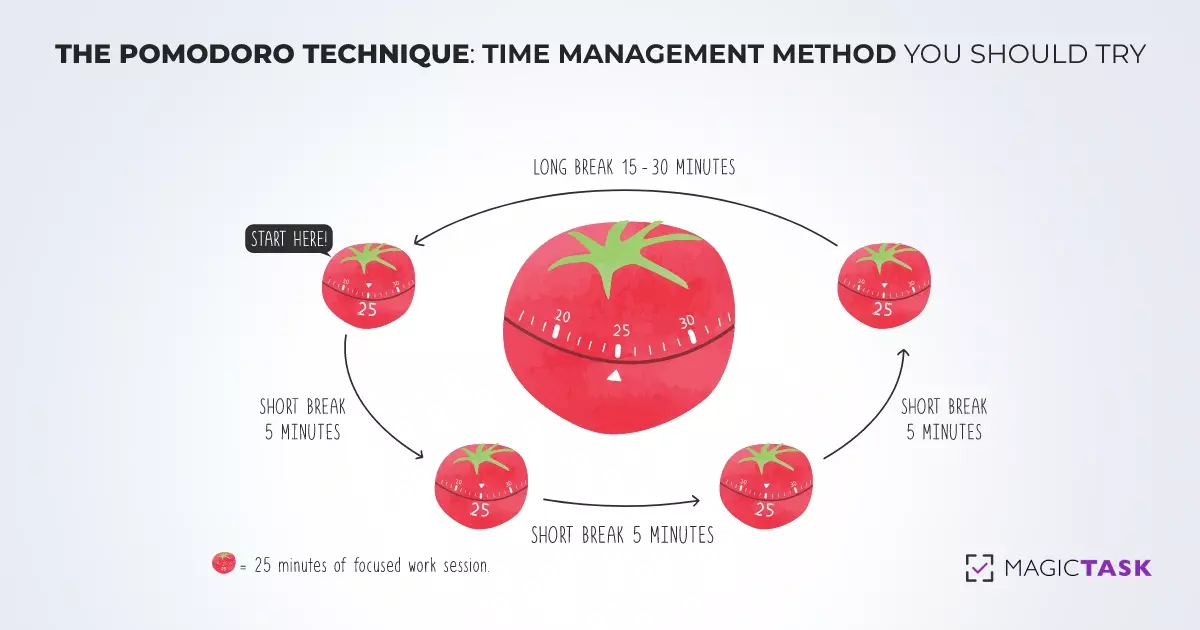
By breaking your day into bite‑sized sprints, it tricks your brain into sustained focus and permits you to rest before fatigue can set in. 

Here’s how it works: 

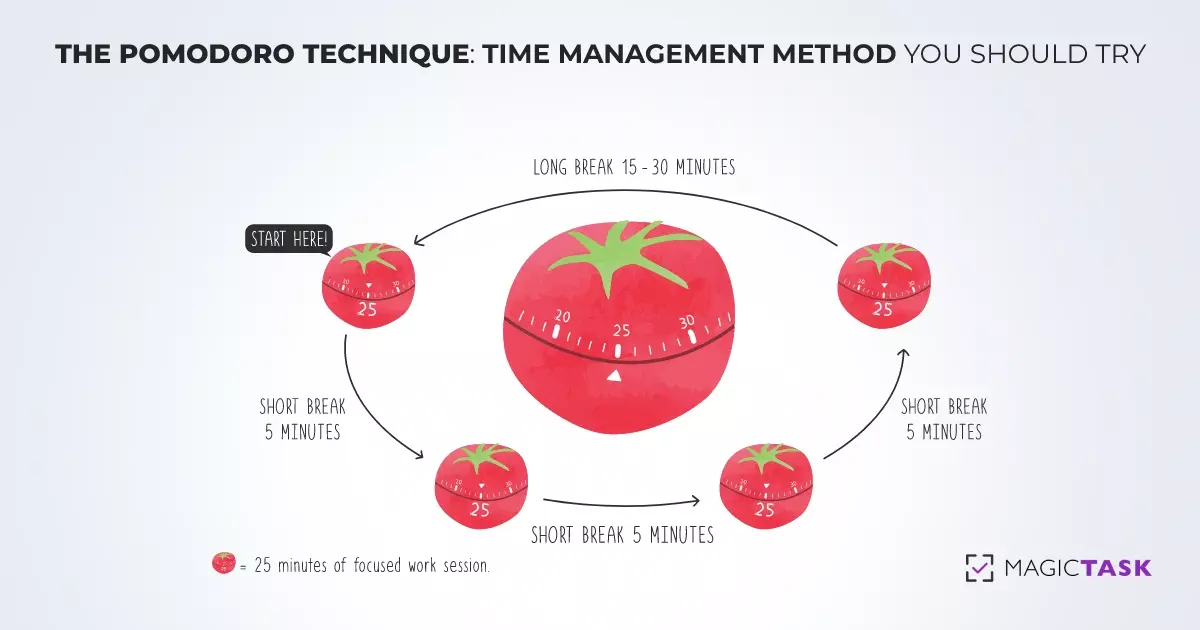
  • 25‑Minute Focus Sprint: Work on one straightforward, specific task—no email, no social media, no side quests. That finite window feels less intimidating than “work until you’re done.”
  • 5‑Minute Recharge: Step away to stretch, hydrate, or simply glance out the window. This brief pause helps reset your mental energy and maintain peak performance.
  • Repeat & Recover: After four Pomodoros, take a longer break (15–30 minutes). This deeper rest replenishes your willpower and wards off burnout.

The Pomodoro Technique clicks because it lowers the barrier to starting a task. Telling yourself you only need to work for 25 minutes makes even your most dreaded tasks feel manageable.

Each completed sprint delivers a mini‑victory that builds unstoppable momentum. That surge is powerful, but to keep it rolling, begin each Pomodoro with an action so easy it barely registers as work.

4. Start with a Low-Resistance Action

Sometimes the most challenging part is simply getting started.

When you stare at a blank page or an empty spreadsheet, your brain sees a vast expanse of unknowns—and it won’t step into that territory without a compelling reason.

That’s where a low‑resistance action can be helpful. 

You choose the single smallest, least threatening step you can imagine, like opening the file and typing one sentence. That way, you drastically reduce the “activation energy” your brain demands before it gets to work.

Psychologist Bluma Zeigarnik first observed in the 1920s that we often obsess over unfinished tasks and feel a psychological itch until they are completed.

That itch is your brain craving closure. When you give it a nibble—a one‑sentence start or a single chart in a deck—you satisfy the initial craving and spark the momentum that carries you forward.

Over time, these tiny openings break the procrastination loop and train your mind to expect progress.

5. Don’t Aim for Perfect — Aim for Progress

Perfectionism often disguises itself as thoroughness, yet it can be just as paralyzing as procrastination.

When every decision hinges on achieving an ideal outcome, projects linger in limbo—drafts never leave your desk, deadlines slip, and the promise of feedback remains unrealized.

A more productive path begins by embracing “progress over perfection.” 

Start each new deliverable with a strict time‑boxed draft session—say, 20 minutes of uninterrupted writing or planning—during which you produce a complete, if rough, version without stopping to edit.

As soon as that timer rings, mark the task as “done” and share it with colleagues or stakeholders. 

Their early feedback will direct your next steps, allowing you to refine the substance rather than tinkering endlessly with the form.

When you shift the focus from flawless first drafts to iterative improvement, you maintain forward momentum, capitalize on timely input, and transform perfectionism from an obstacle into a structured element of your workflow.

But you can’t always do it all by yourself. You need the right tools to get started and keep pushing, so you never look back at procrastination. 

How MagicTask Makes It Easier to Get Things Done

MagicTask helps you reduce the excuses your brain uses to avoid starting and replace them with genuine incentives to move forward.

Here’s how its gamification feature tackles each procrastination head-on:

1. Points & XP for Task Completion

Without clear feedback, even finished tasks can feel invisible.

MagicTask awards points and XP the moment you check something off, providing that immediate sense of accomplishment your brain craves.

Over time, watching your XP accumulate turns progress into a visible trajectory, so you never lose sight of how far you’ve come.
2. Level‑Up Themes & Animations

As you keep progressing, you unlock new themes and animations.

MagicTask injects a dose of novelty into routine chores. Each level‑up refreshes your interface, reminding you that consistent effort leads to tangible rewards.

3. Workspace & Global Leaderboards

You can see the gamified leaderboard spotlight both your personal bests and your standing within the team, creating friendly accountability and a transparent measure of success.

Seeing your name climb higher inspires you—and your colleagues—to keep moving forward.

4. Clean, Minimal Interface

MagicTask boasts a clean interface that strips away non‑essentials so that on launch, you see only your current focus. No distractions, no detours—just a clear path to your successive win.

MagicTask gives you the tools to win today, but building lasting consistency takes a broader playbook to help you every step of the way.

Want More Ways to Stay Consistent?

Level up your long‑term productivity with our eBook, Become the GOAT of Productivity. This is a research‑backed playbook designed to turn momentum into habit. It provides:

  • Advanced Mindset Tools: Techniques to rewire your habits and cultivate a growth‑oriented outlook.
  • Proven Systems: Ready‑to‑use frameworks for prioritization, goal‑setting, and decision‑making that remove the guesswork.
  • Daily Planning Techniques: Customizable templates and rituals—like morning success routines and weekly reviews—to keep you on track without burning out.

By combining MagicTask’s immediate rewards with the eBook’s strategic depth, you’ll not only crush today’s tasks but also build the habits that keep you at peak performance—day after day, quarter after quarter.

Conclusion

Procrastination is a habit that affects almost everyone at some point. But how you handle it will define your success. Your brain is wired to seek comfort before effort.

So, procrastination isn’t a moral failing; it’s an emotional shortcut. But the good news is that you can outsmart it with low‑resistance wins. 

By now, you know that:

  • Procrastination is driven by emotion, not laziness
  • You can prime your brain for action with micro‑steps
  • Small actions, repeated consistently, compound into significant progress

So here’s your next step: open MagicTask, choose one small task—maybe something you’d usually put off—move it into your Focus lane, and mark it done. That single checkmark will trigger the very momentum you need to tackle the next.

Know that momentum is built, not found. Start where you are—and let progress pull you forward.


How to Manage a Heavy Workload While Staying Focused and Motivated

manage heavy workload

Managing a heavy workload can feel like a full-time job in itself. Between back-to-back meetings, constant emails, and a growing list of priorities, it’s easy to lose focus, and even easier to lose motivation.

But even in the busiest seasons, it’s possible to take control of your time, your energy, and how you tackle each day, rather than just scrambling to keep up.

In this article, you’ll find practical strategies to help you manage a demanding workload, stay organized under pressure, and keep your motivation steady, even when the pace doesn’t slow down.

Let's start!

Why a Heavy Workload Leads to Stress and Burnout

But before we dive into our tested techniques, let’s first examine why an endless to-do list and constant distractions drain your energy and cause burnout.

1. Mental Overload Slows You Down

When your work plate is overflowing, your brain struggles to keep up. Cognitive overload makes it challenging to prioritize tasks, which often leads to procrastination.

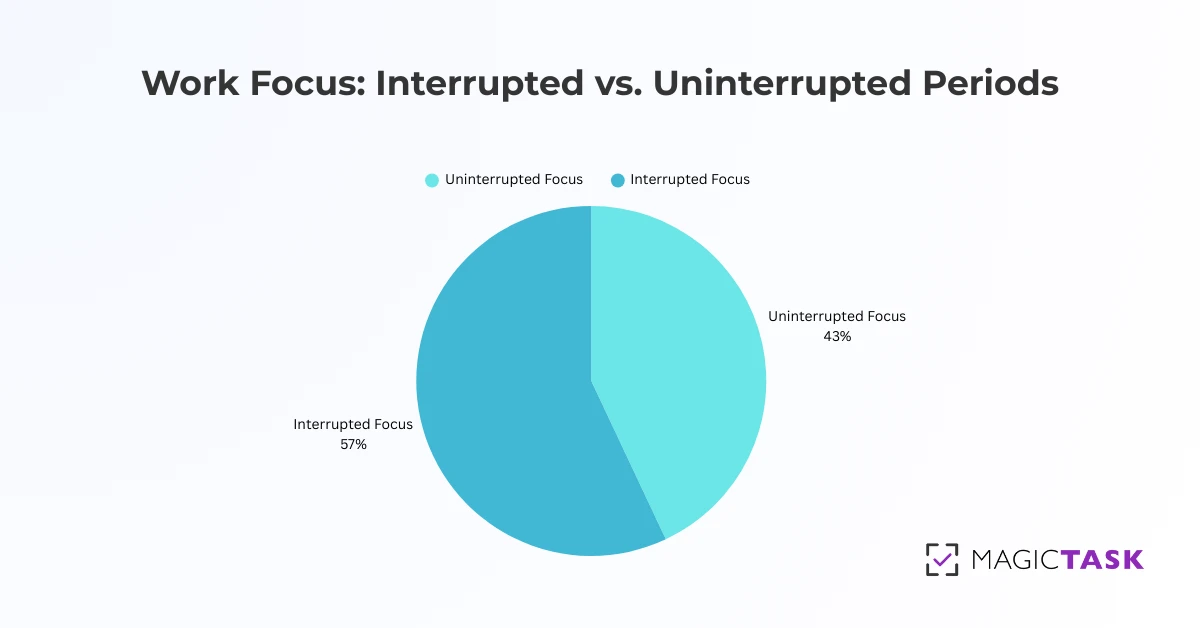
Research shows that over half of our focused periods are cut short by distractions, 57%.

Extended work sessions frequently derail even in collaborative environments due to constant disruptions. And while you might eventually pick your work back up the same day, you've already bounced between multiple unrelated tasks by then.

Focus at work

This frequent task-switching silently erodes your focus, undermining your productivity.

From a psychological standpoint, constant distractions overload the part of your brain that handles decision-making and prioritizing.

When your attention is constantly being pulled in different directions, even simple tasks can suddenly seem overwhelming, and that natural dopamine burst, your brain’s reward for a job well done, is significantly diminished.

Without a clear, uninterrupted focus, productivity slows, and you end up postponing decisions simply because your mind is overburdened.

2. Focus Slips, and Progress Stalls

When focus slips, it’s not just your output that suffers; it’s your momentum.

You start a task, get interrupted, try to pick it back up, and before long, you’re stuck in a loop of half-finished work. That feeling of always being busy but never actually finishing anything creates frustration and fatigue.

Even brief distractions can steal large chunks of your day. One small interruption can cost you up to 30 minutes of productive time. Multiply that across a workday, and it's easy to see how progress slows to a crawl, not because you're not working, but because you're never fully locked in.

3. Lack of Progress Feels Demotivating

When your to-do list is overflowing, it’s easy to feel like you’re working nonstop but not actually getting anywhere.

Take a sales manager, for example, juggling meetings, fine-tuning strategies, chasing leads, and handling reports. It’s a nonstop effort.

But without clear signs of progress, like steady revenue growth or team milestones, all that work starts to feel invisible.

And when progress feels invisible, motivation takes a hit. Even if you're chasing small wins, it’s hard to stay driven when nothing feels like it’s adding up.

4. Productivity Tools Can Feel Overwhelming

The tools designed to help you stay productive can sometimes end up doing the opposite.

With endless settings to adjust, features to learn, and dashboards to customize, you might find yourself spending more time setting things up than actually getting things done.

Instead of simplifying your workflow, these tools can become just another task on your list. And when the systems meant to save time start eating it up, the result is more frustration, not more focus.

💡 Key takeaway: You don’t just need to work harder—you need to work smarter.

Now that we’ve unpacked the problem, let’s look at what you can actually do about it.

Proven Techniques to Manage a Heavy Workload

You don’t need more hours in the day — you just need the right approach.

Here are some tried-and-true methods to help you stay sharp, organized, and on top of what matters most.

1. The Eisenhower Matrix: Prioritize Tasks Effectively

When your task list starts looking more like a scroll, it’s easy to treat everything like it’s equally urgent.

But not all of them need your attention. 

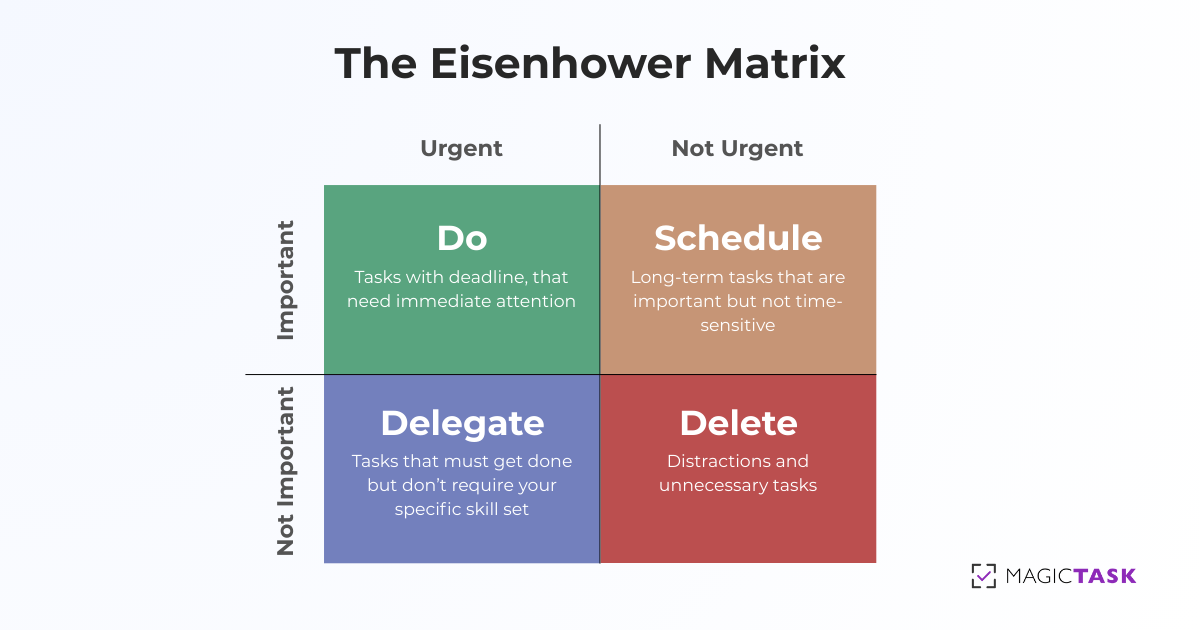
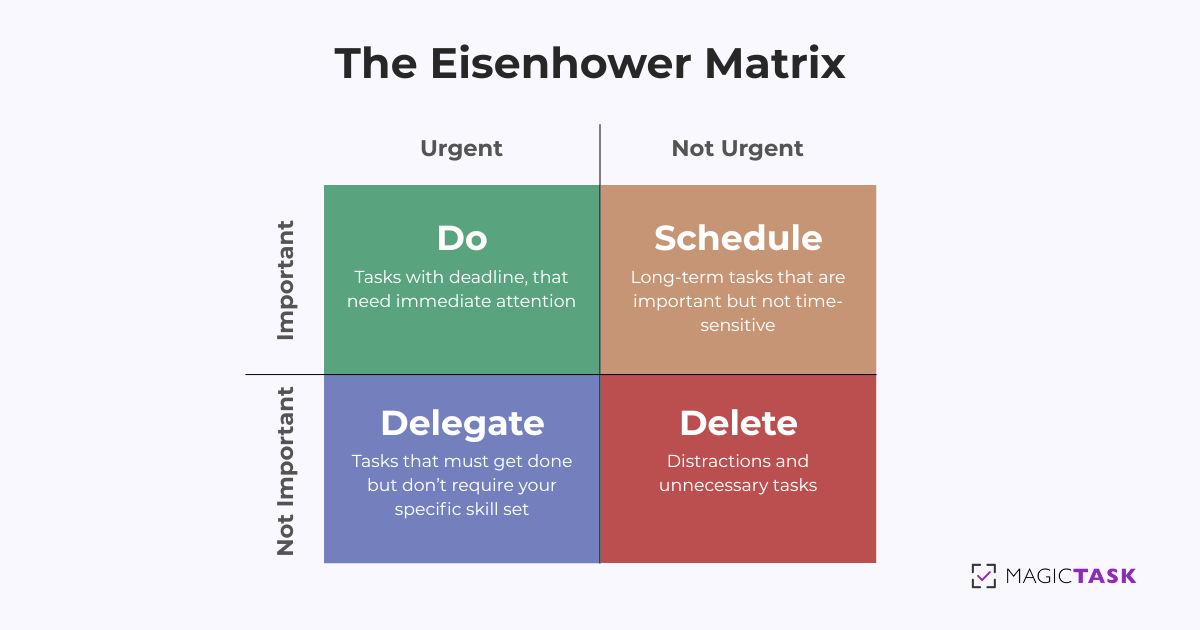
The Eisenhower Matrix is a simple task prioritization framework that helps you sort tasks by urgency and importance so you can focus on what matters most, not just what shouts the loudest.

Here’s how it works:

  • Urgent & Important: These are critical, deadline-driven tasks that have a real impact. They deserve your immediate attention.
  • Important, Not Urgent: Strategic work, long-term planning, and relationship-building fall here. They don’t scream for attention, but they’re essential.
  • Urgent, Not Important: These tasks might feel pressing, but don’t require your expertise. Pass them on to someone with a better grasp of the task when possible.
  • Neither Urgent nor Important: If a task isn’t time-sensitive or valuable, it’s clutter. Clear it out to reclaim your focus.

The Eisenhower Matrix

Let’s say you start your Monday with this chaotic list:

  • Finalize the client proposal due today
  • Respond to Slack messages
  • Plan next quarter’s marketing strategy
  • Review performance reports
  • Attend a meeting that could’ve been an email
  • Book a dentist appointment
  • Organize your Google Drive
  • Handle a last-minute request from your boss
  • Schedule 1:1s with your team
  • Scroll LinkedIn (again)

Now, let’s sort those into the matrix:

Category Urgent Not Urgent
Important
  • Finalize client proposal due today
  • Handle last-minute requests from the boss
  • Plan next quarter’s marketing strategy
  • Review performance reports
  • Schedule 1:1s with your team
  • Book a dentist appointment
Not Important
  • Respond to Slack messages
  • Scroll LinkedIn
  • Attend a meeting that could’ve been an email
  • Organize your Google Drive

The Eisenhower Matrix helps you get out of reaction mode. Instead of jumping from one “urgent” task to the next, you’ll lead your day with intention. And giving high-impact work the time it deserves.

Quick tip: Start your morning by sorting your top priorities into each category. You’ll be surprised how quickly clarity follows.

2. The Pomodoro Technique: Stay Focused with Timed Work Sessions

Are you staring at your screen, half-working, half-scrolling, and fully stressed?

The Pomodoro technique can help.

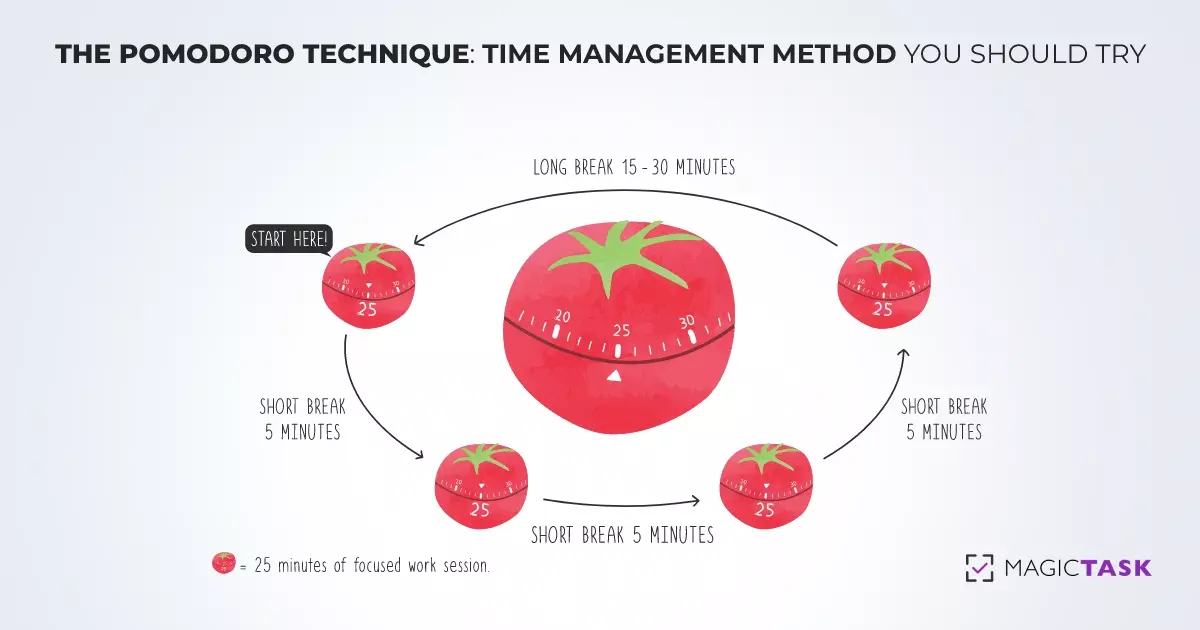
It’s a simple time management method that uses short bursts of focused work followed by regular breaks to keep your mind fresh and your motivation high.

Here’s how it works:

  1. Pick a task you want to tackle.
  2. Set a timer for 25 minutes (this is one “Pomodoro”).
  3. Work on that task and only that task until the timer rings.
  4. Take a 5-minute break—walk, stretch, breathe, and don’t doom scroll.
  5. After 4 Pomodoros, take a longer break (15–30 minutes).

This cycle helps maintain your concentration and prevents burnout over the long haul.

**Pomodoro technique**

For example, if you're in the middle of preparing a report, you set your timer for 25 minutes and work solely on the report, resisting the urge to check emails or browse social media.

Once your session ends, you step away, perhaps stretching or grabbing a coffee, and then return to the task with renewed focus. 

When you consistently apply this method, you transform a chaotic workday into a series of manageable sprints, each building on the last and moving you steadily toward your larger goals.

3. Task Batching: Minimize Task Switching

There's another strategy to maximize your productivity even further, known as Task Batching. It is about giving your brain permission to settle down and focus on one type of task at a time.

Instead of letting your to-do list turn into a constant game of "what’s next?"—which forces your mind to switch gears repeatedly—you group similar tasks into dedicated time blocks.

Here’s the idea in plain terms: if you block off an hour to answer emails, you're not constantly tearing your attention away when another task nudges for attention. That way, your mind stays locked in, and you breeze through that batch with fewer disruptions. 

Task batching

Completing a batch of similar tasks gives you a continuous, satisfying sense of accomplishment that propels you to the next challenge.

As Dr. Sahar Yousef, a cognitive neuroscientist at UC Berkeley, says, “The human brain works best when focusing on one thing at a time. We have a certain amount of cognitive capacity and a certain amount of attention.”

It reminds us that our mental energy is precious and finite. If we constantly scatter our focus, we risk diluting our efforts on tasks that do not matter. This brings us to another powerful strategy for managing our workload.

4. The 80/20 Rule (Pareto Principle): Focus on High-Impact Work

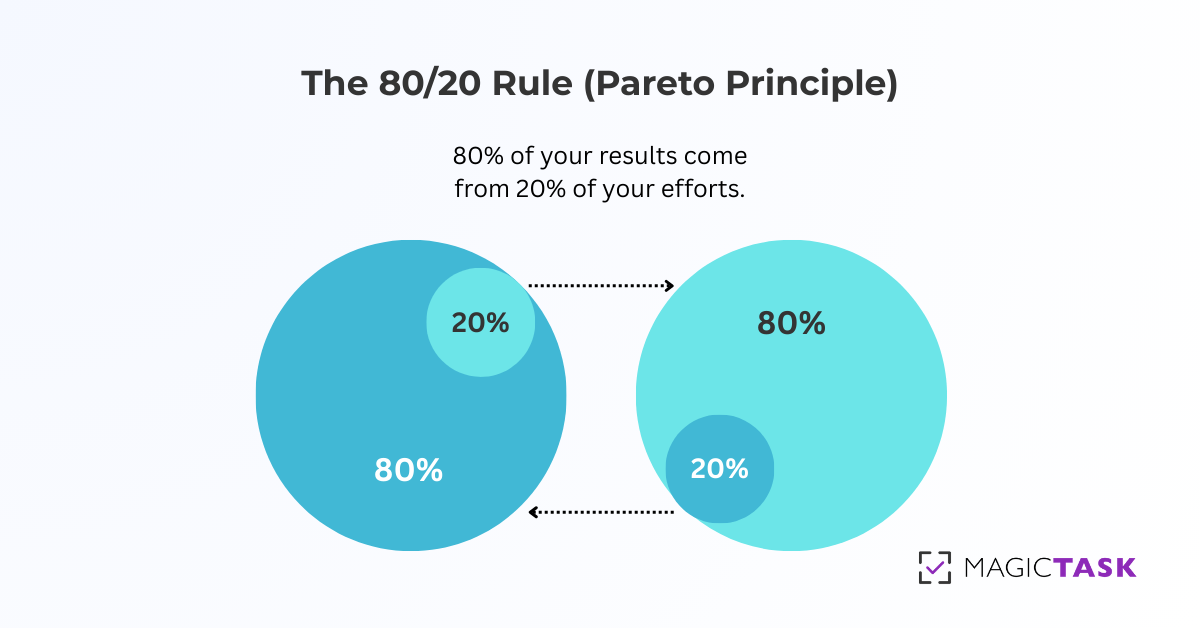
The 80/20 Rule, also known as the Pareto Principle, is built on a profound idea: 80% of your results come from just 20% of your efforts.

Applying this to your work involves identifying the few critical tasks that will have the most significant impact.

Think about everything on your to-do list. Many of those items might feel important, but not all of them will drive your success in the same way.

80 20 Rule

Here’s how you can apply the 80/20 Rule:

Step #1: Review Your Tasks:

Look at your to-do list. Which tasks will directly impact your goals? Which ones feel busy but aren’t moving the needle? Be honest about the value each task brings.

Step #2: Classify Tasks by Impact

Once you've identified your high-impact tasks, prioritize them. These are the ones that deserve the most attention and effort.

Step #3: Focus on High-Impact Activities

Give your most important tasks your full focus. Avoid getting distracted by tasks that might be easy but don’t contribute much to your larger objectives.

Step #4: Delegate or Eliminate Low-Impact Tasks

Delegate or eliminate tasks that don’t require your direct involvement. Your time is valuable, and low-impact tasks should not monopolize it.

Step #5: Measure and Adjust

Review your progress regularly. Is your focus on high-impact tasks yielding the results you want? If not, adjust and refine your approach. 

The beauty of the 80/20 Rule is its simplicity. Instead of focusing on doing more, it encourages doing less, but better. But even with fewer, more impactful tasks, time is still your most precious resource.

That brings us to the following proven technique. 

5. Time Blocking: Schedule Your Day for Maximum Productivity

Time blocking is one of the most effective techniques for managing a heavy workload.

It’s exactly what it sounds like—dedicating specific blocks of time to focused work. Instead of trying to fit tasks into your day as they come, you create a schedule in advance that ensures your most important tasks get the attention they deserve.

With clear boundaries for when and how long you’ll work on each task, you eliminate the mental load of deciding what to do next. This approach also encourages deep work, which leads to higher-quality results in less time.

How to Time Block?

1. Assess Your Tasks

Before blocking time, assess the tasks you need to accomplish. Break them down by priority, urgency, and complexity. Recognizing how much focus and energy each task requires will help you allocate appropriate time slots.

2. Create Time Blocks

Start by allocating time for your most important and demanding tasks. These are the activities that need uninterrupted focus.

For example:

  • 9:00 AM – 11:00 AM: Write the project proposal
  • 11:00 AM – 12:00 PM: Respond to emails
  • 12:00 PM – 1:00 PM: Lunch break
  • 1:00 PM – 3:00 PM: Research new business trends
  • 3:00 PM – 4:00 PM: Prepare client presentation

3. Be Specific with Your Blocks

It’s tempting just to say, “Work on the project proposal for two hours,” but the more specific you are, the better.

Define what you will accomplish during each block. For example, “Complete introduction and first draft of the proposal” gives you a concrete goal.

4. Schedule Breaks

It’s crucial to schedule breaks in between time blocks to avoid burnout. A 5-10 minute break every hour is a good practice.

The Pomodoro Technique is a successful method that you can integrate with time blocking.

5. Use a Calendar or Planner

Whether it’s a physical planner, Google Calendar, or a task management app, find a tool that works to organize your time. A clear view of your day will keep you accountable and help you stay on track.

6. Stick to Your Schedule

The key to time blocking is commitment. Try to stick to the blocks you’ve set, even if you get distracted. If something urgent pops up, move it to the next available time slot.

If you’re feeling scattered by your heavy workload, try time blocking. It might just be what you need to streamline your work and boost productivity. However, having the proper technique is only part of the equation. The tools you use matter, too.

How MagicTask Helps You Manage Your Workload and Stay Motivated

If the proven techniques mentioned above help you organize your workload, MagicTask helps you stay on top of it.

Here's how it turns structure into real momentum. 

1. Prioritize Work with Task Sizing

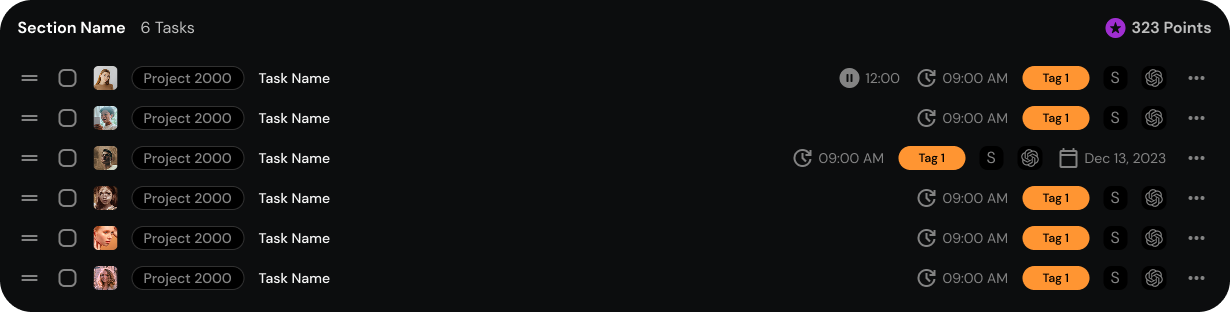
One of MagicTask’s most powerful features is its simple "Task Sizing" system. Every time you create a new task, you assign it a size — S, M, L, or XL — based on its complexity and how much time it will take.

Task sizing

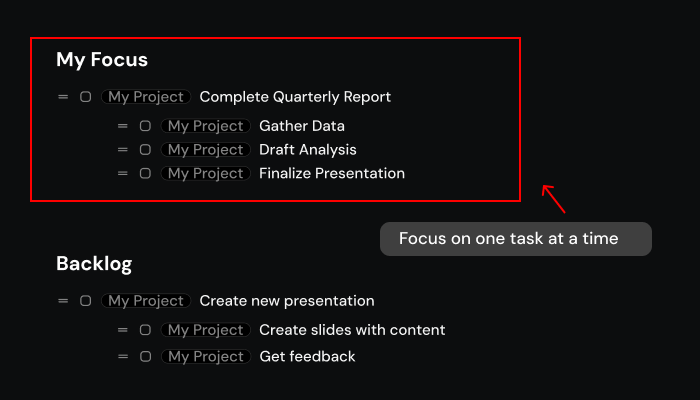
This helps you quickly sort through your workload and spot what needs your attention first. Instead of staring at a messy to-do list, you get a clear, structured view of what’s ahead. When you're ready to focus, just drag your top priority into the "My Focus" section and lock in.

Each completed task moves you forward in a visible way. That sense of progress, even in small steps, creates momentum, and that momentum is what keeps you motivated through busy days.

2. Stay Focused on One Task at a Time

Ever spent more time setting up your digital workspace than actually using it? Tools like Notion or Asana are packed with features, but all that flexibility can turn into a distraction. Instead of helping you focus, you end up lost in dashboards and settings.

MagicTask takes a different approach. It’s built to keep you locked in on what really matters — the task in front of you. No clutter, no endless tweaking. Just one clean, focused space where you can do your work without the usual noise.

Focus on one task at a time

When you open MagicTask, you’re not staring at a maze of tabs, charts, or distractions. You see, the one thing you’ve chosen to work on — and that’s it.

This simplicity gives your brain room to focus. No decisions to make about what to tackle next, no wasted energy jumping between priorities. You just get to work.

By cutting out the extras, MagicTask helps you get into a flow state faster and stay there longer. That’s the kind of focus most tools promise, but few actually deliver.

3. See Your Progress and Stay Motivated

Now that you're focused on one task at a time, the next step is seeing that focus pay off.  

Let’s say you’re compiling an annual performance report. As you work through gathering data, analyzing trends, and drafting insights, each task you complete earns you points. With MagicTask, these points accumulate, helping you level up and unlock new themes and animations.

Meanwhile, a dynamic leaderboard tracks your progress, not just as a personal record but also in comparison to your colleagues. This visual display of achievement and healthy competition reinforces every win, driving you to tackle the next section of the report with renewed energy.

In short, when every small task becomes a measurable victory, it keeps your motivation and focus sharp.

4. Work Feels Rewarding, Not Draining

With your progress now visible, you can feel the fireworks in your brain, a burst of dopamine celebrating each success.

rewards

MagicTask taps into that power by making task completion something you can see and feel. Every finished task rewards you, just like a game would. These rewards don’t just disappear into a scoreboard; they serve as milestones on your journey, giving you a clear sense of progress. 

As you level up, you unlock new game-like themes, celebrating your achievements in real time. It's not about distracting you with bells and whistles; it's about creating a system where your hard work is immediately recognized and reinvigorates your drive.

Gamification turns the workday into a collection of small wins. And you already know the power of small wins – they boost your productivity by as much as 28%.

Conclusion

At the end of it all, your goal is to manage a heavy workload with a motivated spirit. With the right system, you can stay productive without sacrificing your motivation.

When you structure your work, minimize distractions, and celebrate every small win, you unlock a sustained energy and focus cycle. These proven techniques pave the way to transform chaos into clarity. 

Are you ready to make work engaging instead of exhausting?

Try MagicTask today and experience how an innovative, gamified approach can turn even the busiest day into a series of rewarding wins.

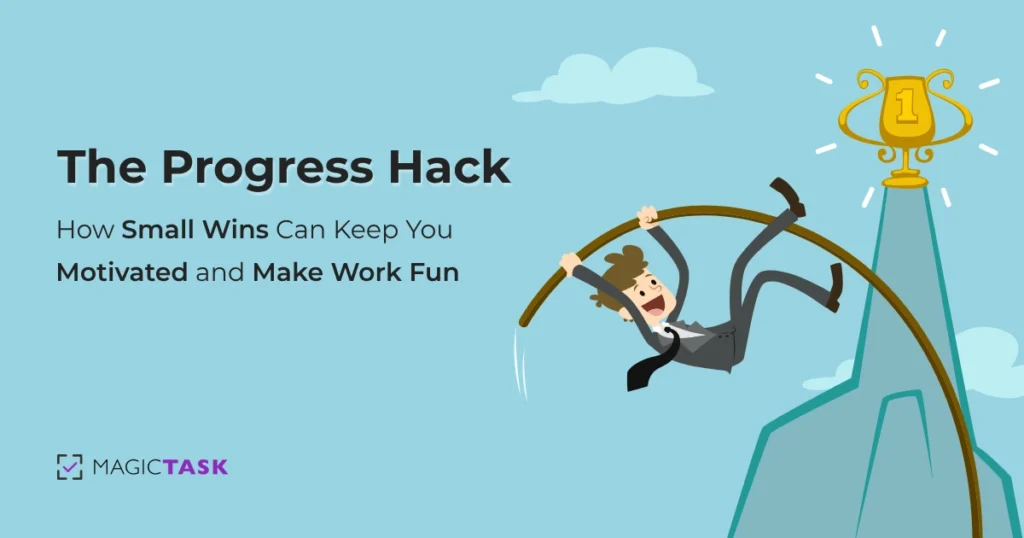
The Progress Hack – How Small Wins Can Keep You Motivated and Make Work Fun

The progress hack

Ever feel like you're working hard but not really getting anywhere? It's usually not the amount of work that's the problem. It's the quiet frustration of not seeing progress that slowly wears you down.

When it feels like you're just ticking boxes all day with nothing to show for it, it's easy to lose steam.

But what if you could actually see your progress? Like, really feel it, one small win at a time?

According to research published in the Harvard Business Review, tracking small, everyday achievements is the single most effective way to boost motivation at work. Even tiny wins can spark a sense of momentum and keep you moving forward.
And that’s where the Progress Hack (as I like to call it) comes in. It’s a simple way to turn small wins into momentum that actually keeps you going.

In this blog, I will show you how to put it into practice so you can stay focused, get more done, and enjoy the process.

Let's start.

The Science of Small Wins: Why Progress Fuels Motivation

Before diving into how to apply the Progress Hack, let’s take a closer look at why these small wins pack such a powerful punch. Understanding the science behind it can help you tap into motivation that actually lasts.

The Dopamine Rush

Our brains are wired to celebrate achievement, big or small. At the center of that celebration is dopamine, a feel-good chemical your brain releases every time you complete something that feels rewarding.

It doesn’t have to be a major milestone. Research shows that even modest wins like crossing off a task on your to-do list can trigger a dopamine boost. These midbrain neurons aren’t picky; they respond to any moment that signals progress.

The Dopamine Rush

That quick hit of dopamine acts like a quiet internal “Nice job, keep going!” It’s why finishing a task, however minor, feels satisfying.

It’s also why you might obsessively check things off a neatly organized task list or feel a little rush after leveling up in a game.

Take something simple: say you knock out a short report in ten minutes. Your brain registers that win and drops a little dose of dopamine, just enough to push you toward the next task.

Over time, those tiny wins stack up, creating a cycle of positive reinforcement that keeps your motivation alive.

And that’s how momentum begins to build.

Incremental Wins: The Building Blocks of Success

Long projects with no visible milestones can feel endless, draining your focus and making it hard to stay engaged. In contrast, a system highlighting even the smallest steps helps create structure, clarity, and motivation.

Let’s look at how this shift plays out:

Aspect Traditional Work With Small Wins
Attention Focus gets scattered without clear, short-term goals. Each mini-win keeps your attention anchored.
Emotion Sporadic feedback leaves you feeling disconnected. Frequent wins lift your mood and energy.
Progress Vague milestones make success hard to measure. Visible progress builds momentum and drive.

Each small win acts like a stepping stone. Together, they form a path that leads to your bigger goals and makes the journey feel achievable and rewarding.

As leadership expert John C. Maxwell says, “Small disciplines repeated with consistency every day lead to great achievements.”

Next, let’s explore how to turn this idea into something practical you can use every day.

How to Use the "Progress Hack" to Stay Motivated Every Day

Now that we’ve looked at why small wins matter, let me show you how to actually use the Progress Hack in your day-to-day work. It’s all about turning regular tasks into simple, trackable steps that keep you moving forward without burning out.

1. Break Work Into Mini-Wins

A thoughtful way to use the "Progress Hack" is to break down a big project into manageable steps.

For instance, you might break a marketing project into steps like drafting a campaign strategy, creating ad copy, setting up the campaign on a specific platform, and then setting up the report for monitoring. Each of these mini-wins gives you a boost of motivation and makes progress visible.

MagicTask makes this approach easy.

Task sizes in MT

You start by adding all your tasks to the Backlog, then assigning each a size—S, M, L, or XL—based on how you perceive the task in terms of effort, complexity, or urgency.

Just to be clear, these sizes aren't tied to exact time limits. The example below is simply to give you a general idea of how the sizing can work. You can define what each size means for you. What feels like a "Small" task to one person might be a "Medium" for someone else, and that’s totally fine.

Task Size Task Estimated Effort
S (Small) Send a follow-up email 5 to 15 minutes
M (Medium) Draft a brief project update 30 minutes to 1 hour
L (Large) Prepare a detailed presentation 1 to 2 hours
XL (Extra Large) Develop a comprehensive marketing strategy Half a day to a full day

When you drag a task from your Backlog into the "My Focus" section and complete it, you earn points and see your progress instantly. You instantly get your dose of dopamine to move on to the next task. 

2. Track Your Progress Like a Game

When you are playing a video game, you see clear progress. Your level-ups, achievements, and rankings keep you hooked.

Now, apply that same concept to your work. You win when every task is completed, and you look behind to see a pile of work already completed.

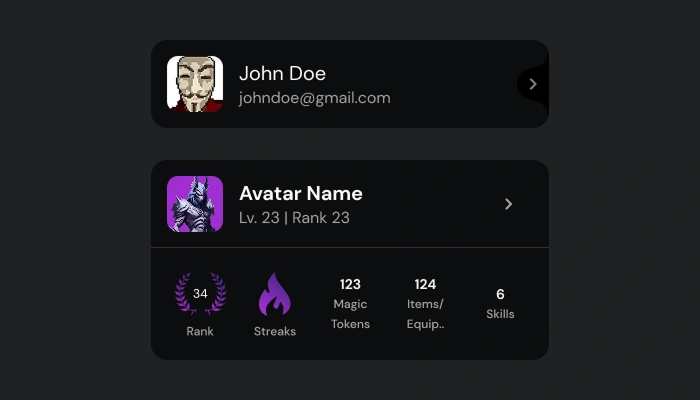
With MagicTask, each task you complete earns points based on its size. These points help you level up, and your progress is displayed on leaderboards within your workspace and globally. 

When you start tracking your progress like a game, even routine work feels more rewarding. Each completed task becomes a small win that keeps you moving. And while the points and levels are fun, it’s the sense of momentum that really makes the difference.

3. Healthy Competition Promotes Motivation

According to research, social motivation, especially competition, can significantly enhance attention and memory.

When you see how your achievements stack up against those of your peers or your own past performance, it pushes you to hone your focus and strive for continuous improvement.

In an environment where colleagues naturally compare notes and celebrate each other’s successes, every small win becomes a chance to compete in a friendly, uplifting way.

You might notice that when someone earns recognition for a sharp insight or a quick turnaround, it not only boosts their morale but also inspires you to push a little harder. This sort of healthy rivalry opens up a world of opportunities for more wins and constant progress.

MagicTask is designed to fuel both external and internal challenges. It lets you see how you measure up against your colleagues and encourages you to beat your previous best on the gamified leaderboard. 

3. Unlock Rewards and New Experiences as You Progress

Once you get into a rhythm, even small accomplishments can start to feel rewarding. And when you add in the element of surprise—new features, visuals, or sounds—progress becomes something you actually look forward to.

MagicTask builds on this by giving you fresh animations, sounds, and themes as you complete tasks and level up. These little changes keep your workspace feeling new, giving your routine just enough variety to stay interesting.

It’s a reminder that success isn’t about one big moment. It’s built through consistent action, one task at a time. And when your progress looks and feels rewarding, it's easier to keep going.

4. Shift Your Mindset: Redefine What Progress Looks Like

To stay motivated long term, you have to move beyond checking boxes. Progress isn’t just about completed tasks—it’s also about how you’re growing through them.

Rewards and motivation

Here are four overlooked forms of progress you can start tracking today:

  • Efficiency Gains
    Did you complete a task faster or with less effort than before? That’s a sign of growth, even if the task was small.
  • Improved Focus
    Were you less distracted today? Did you stay in flow longer? These wins often go unnoticed but directly impact performance.
  • Better Decision-Making
    If you made a clearer choice or solved a problem with less back-and-forth, that’s real improvement in how you think and work.
  • Emotional Awareness
    Noticing when you're overwhelmed or recognizing when you need a break is part of building long-term resilience and self-leadership.

By shifting your focus to include these less visible forms of progress, you give yourself more reasons to stay motivated, even on days when your task list feels ordinary.

MagicTask supports this mindset by giving you a visible trail of your progress. Each task completed is reflected in subtle theme changes, showing that growth isn’t just about doing more, but becoming better as you go.

Turning Gamification into a Daily Habit

You don’t need bursts of motivation to keep going—you need systems that make progress part of your daily routine. That’s where gamification really shines.

When you start your day with a clear focus, a few manageable challenges, and a way to track your wins, work becomes easier to step into. You’re not waiting for inspiration. You’re building momentum by design.

Here are three simple ways to turn gamification into a habit:

  • Start with One Win
    Kick off each day with a task you know you can complete quickly. That early win gives you a small push of energy to tackle what’s next.
  • Track Your Streaks
    Whether it's a string of focused work sessions or a few days of consistent task completion, streaks help build a rhythm you won’t want to break.
  • Reward Yourself with Milestones
    Don’t wait for the end of a project to celebrate. Set mini-milestones and attach small rewards to them—whether it's switching to a new theme in MagicTask or just stepping away for a well-earned break.

Gamification isn’t just a productivity trick—it’s a way to stay engaged with your goals every single day. And when progress feels good, showing up gets easier.

Start Your Progress Hack with MagicTask

If you’re ready to make work feel more rewarding, MagicTask is built to help you do exactly that.

From customizable task sizing to real-time progress tracking, gamified rewards, and dynamic themes—everything is designed to keep you focused, motivated, and moving forward.
Try MagicTask today and turn your workflow into a series of wins you can actually feel.

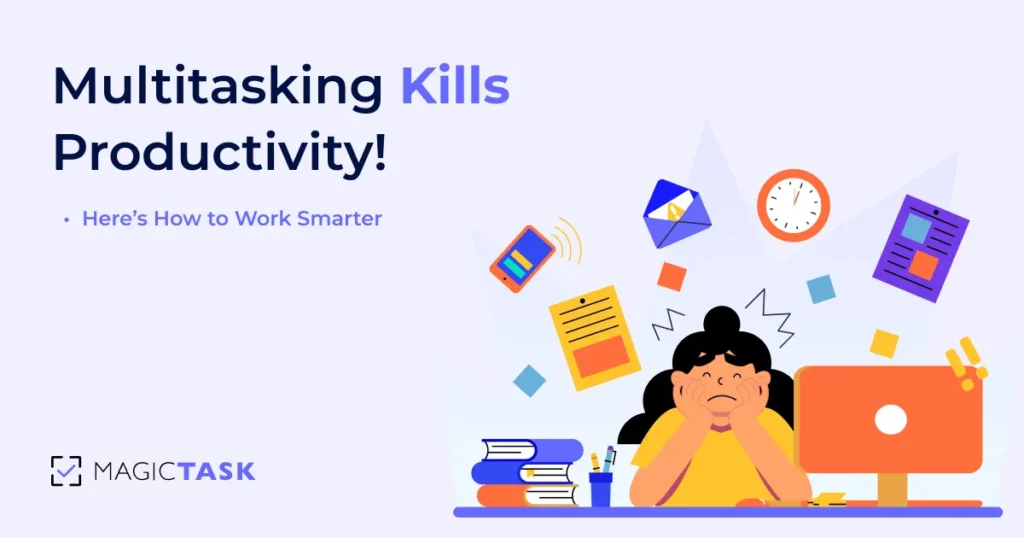
Multitasking Kills Productivity – Here’s How to Work Smarter

Multitasking Kills Productivity

Many people believe that handling multiple tasks at once makes them more productive. Maybe you do, too.

Do you ever find yourself constantly hopping between emails, meetings, and tasks, yet nothing seems to get done? It turns out that the very act of multitasking—switching from one task to another—can slash your productivity by up to 40%

So, what’s the best way to break free from the cycle of procrastination and finally get things done?

Instead of falling into the multitasking trap, let’s explore how to work efficiently without falling into the multitasking trap.

Why Multitasking Is Hurting Your Productivity

Before we get to smarter strategies, let’s pull back the curtain on the hidden toll multitasking takes. 

1. Task-Switching Slows You Down

When you multitask, you usually switch between different tasks without taking a break.

It might seem harmless, but even a split-second distraction can cost you dearly when it comes to complex tasks.

Let’s say you have to complete a detailed financial report at the end of the day, along with a few other tasks.

Now, every time you switch gears to look at an email or a pop-up notification, you risk overlooking a critical piece of data. That fleeting half-second loss might seem trivial, yet over the course of the day, it can add up to costly mistakes and missed deadlines. 

You need to understand that your brain takes time to reorient itself every time you switch tasks, creating mental lag.

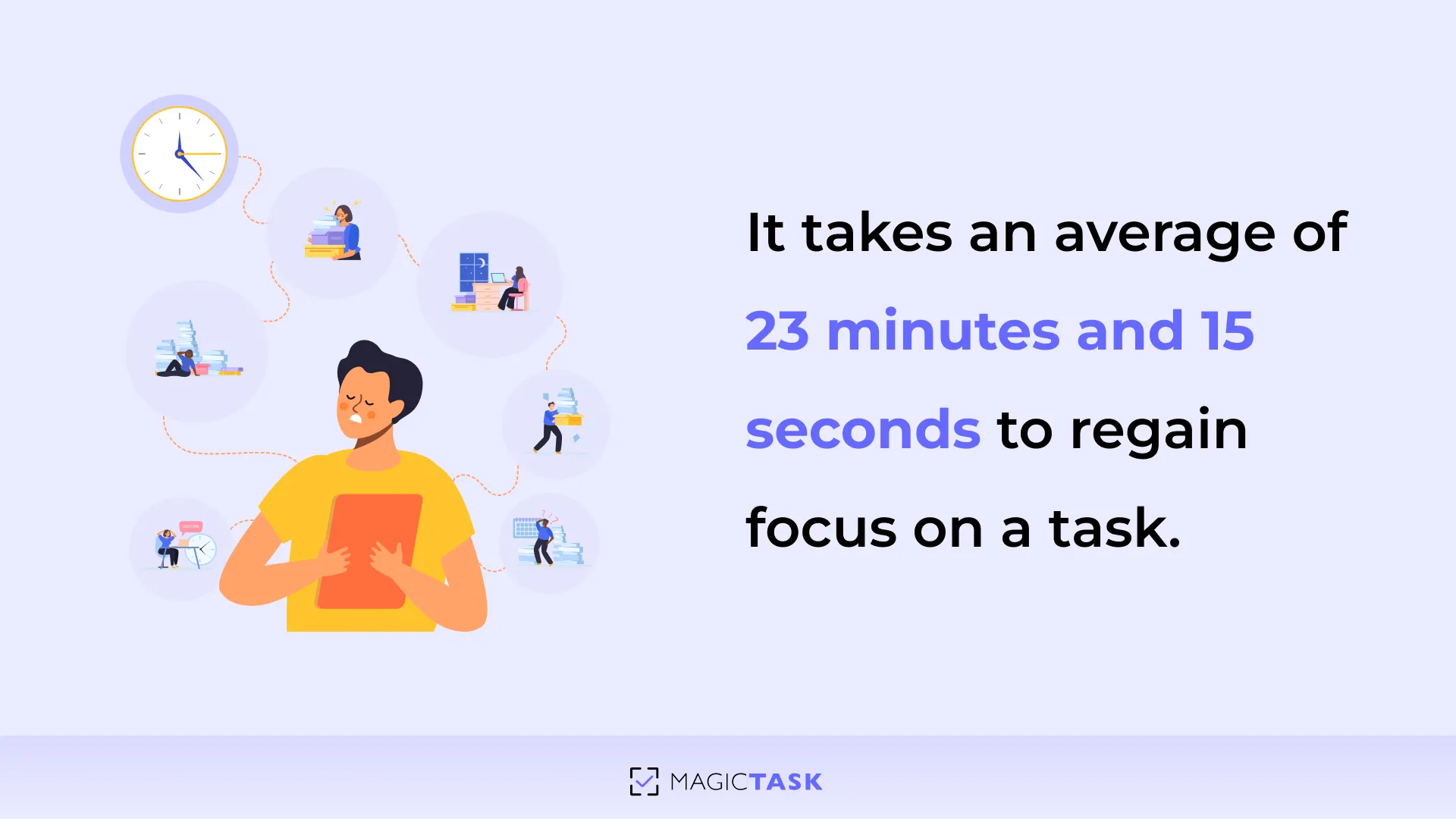
In fact, a study discovered that after an interruption, it takes an average of 23 minutes and 15 seconds to regain focus on a task. By focusing on one task at a time, you cut out that extra lag and boost your overall efficiency.

Task-Switching Slows You Down

But there's more at stake than just speed. The illusion of being busy comes at a greater cost.

2. More Mistakes, Less Focus

Your divided attention means you're more likely to overlook details and make mistakes. Multitasking hijacks your brain power.

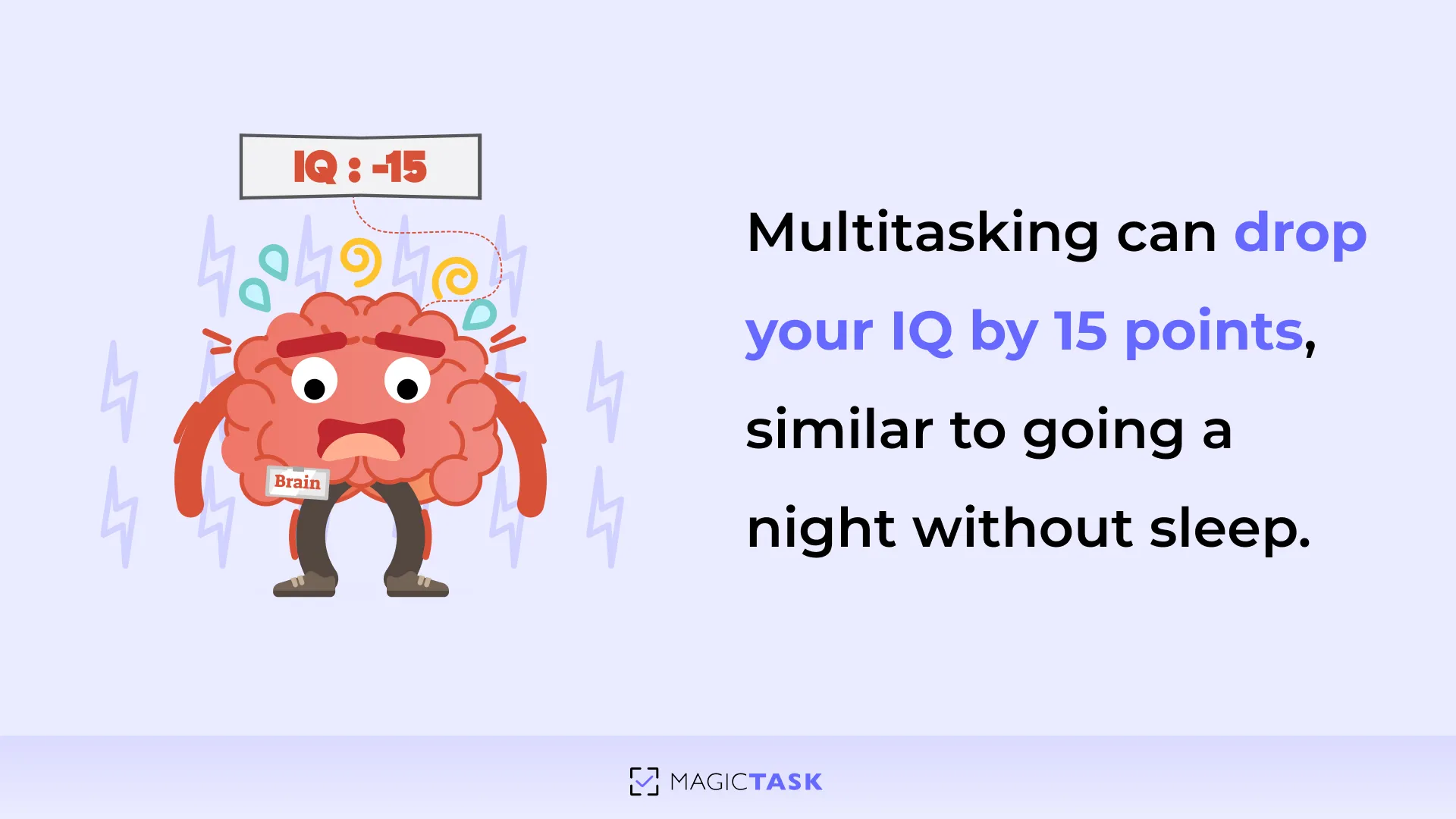
According to research, multitasking can lower IQ by 15 points—the cognitive equivalent of pulling an all-nighter. 

So, instead of having a clear, laser-sharp focus, your mind is spread too thin, and errors start to creep in.

This not only forces you to backtrack and rework what you've done, but it also drains your energy and hampers progress. 

Even if you sidestep mistakes by narrowing your focus, the toll of constant task-switching doesn't stop there.

Multitasking Means More Mistakes, Less Focus

3. Increased Mental Fatigue

Imagine spending your morning drafting a report, only to be interrupted by a flood of emails and an unexpected phone call that forces you to jump to a different project. 

Each time your brain has to hit the “reset” button, it drains your energy—like a phone battery that never quite reaches full charge.

And it’s not just your focus that takes a hit.

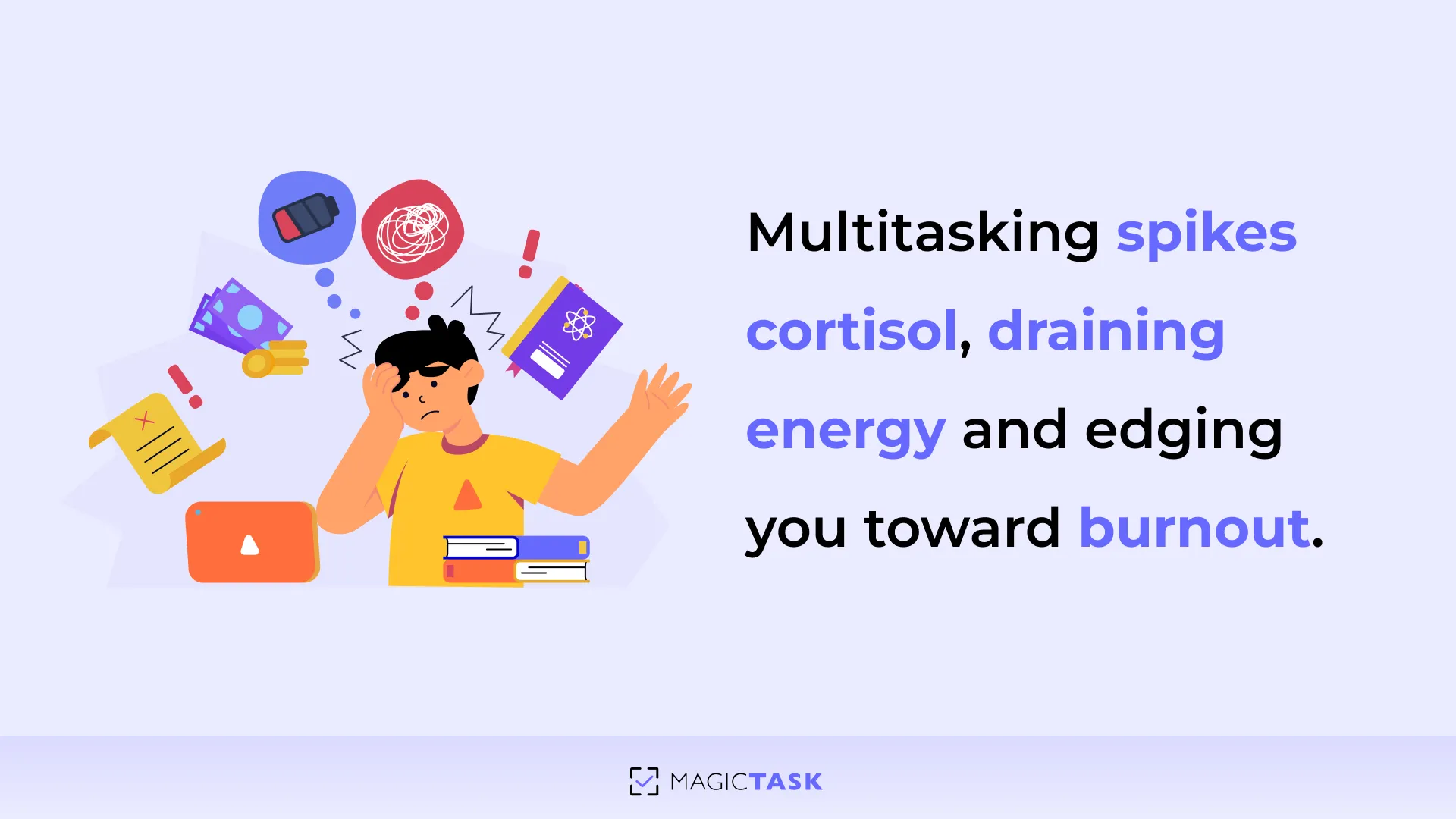
Multitasking has been found to spike cortisol levels, flooding your system with stress hormones that leave you mentally drained and inching closer to burnout.

By the end of the day, despite checking off countless tasks, you're left exhausted, unfocused, and wondering where your productivity went.

And what about the quality of work you managed to complete while multitasking? Is it good enough to make it to the top desk?

Multitasking Increases Mental Fatigue

4. Surface-Level Work Instead of Deep Focus

When you're constantly bouncing between tasks, you're not diving deep—you’re just skimming the surface.

Instead of fully engaging with a project, your attention is fragmented, and the work looks rushed and incomplete.

You lack the depth and insight that come from focused effort. 

And when there’s surface-level focus, you cannot always remember every detail of every task. Your brain barely has time to file away essential details. 

5. Poor Memory Retention

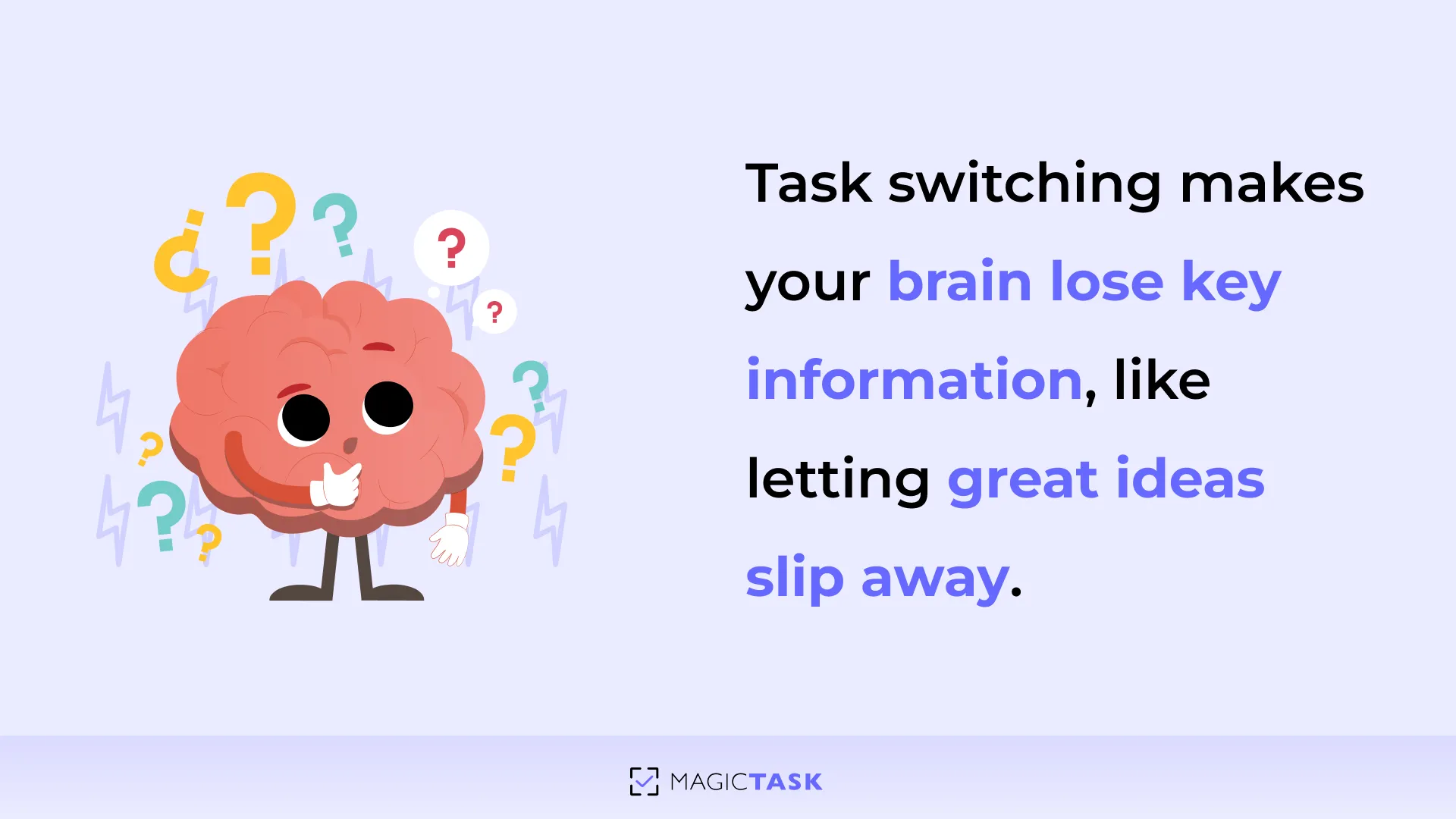
Research shows that your brain loses some precious information whenever you switch tasks—it's like letting your best ideas slip through your fingers.

Constant switching erodes your memory, so when you need those key insights the most, they might be nowhere to be found in the back of your brain. 

The logic is quite simple: when you focus on one task at a time, you reduce mistakes, boost your performance, and create work of a quality that stands out.

Deep focus leads to better, faster results that deserve a spot at the top of the desk.

As Gary Keller once said, “When you are trying to do two things at once, you either can’t or won’t do either well.”

Multitaskign leads to poor memory

So, how can you overcome these obstacles and work smarter without multitasking? 

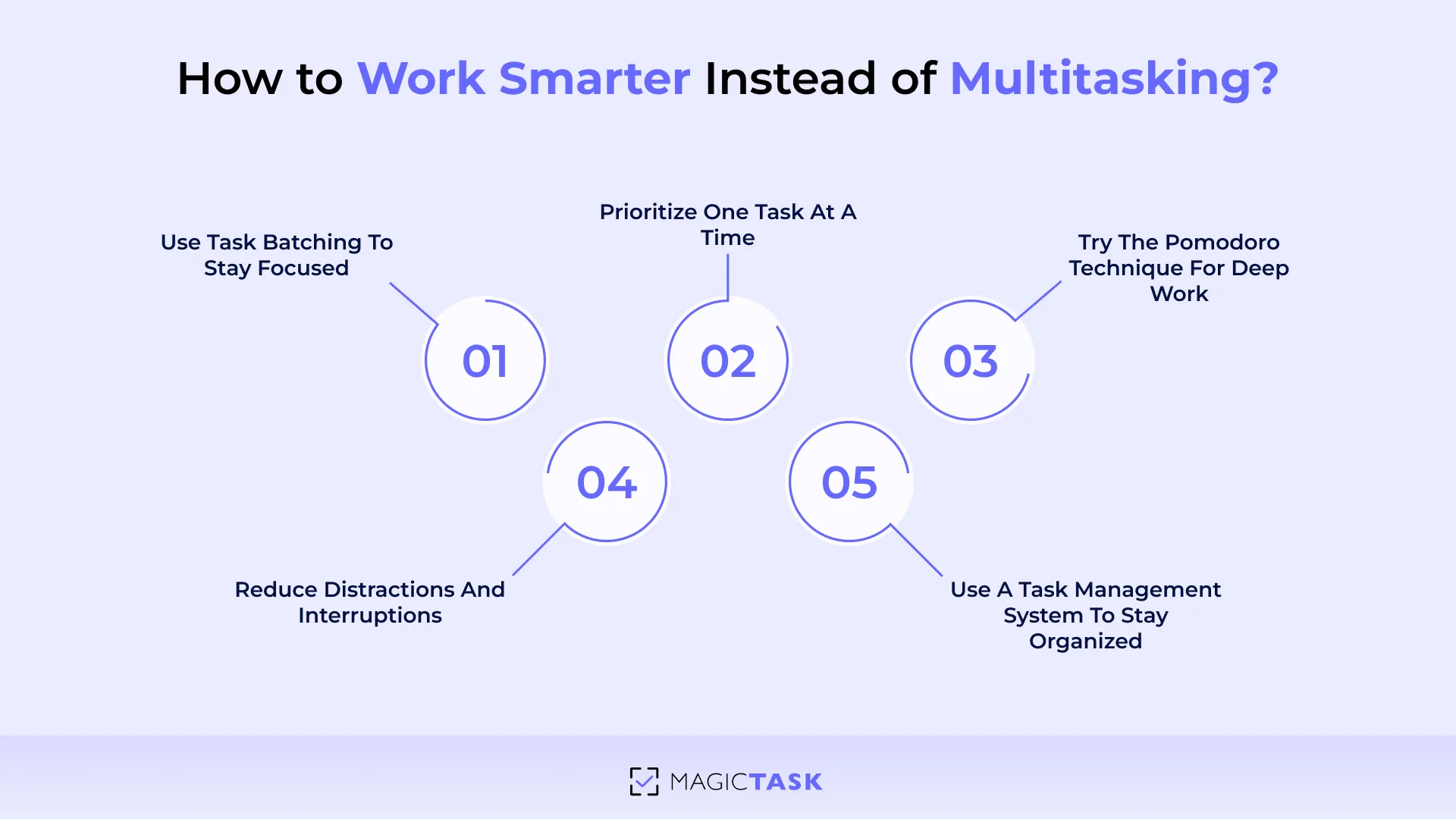
How to Work Smarter Instead of Multitasking

Let's explore practical strategies for harnessing laser-sharp focus and your full productivity potential.

1. Use Task Batching to Stay Focused

One of the most effective strategies is task batching. This means grouping similar tasks together and handling them in dedicated time blocks.

Consider this practical example:

Instead of interrupting your workflow by checking emails every few minutes, allocate a specific period solely for that purpose.

For example, you might decide to spend the first 30 minutes of your afternoon solely clearing your inbox rather than juggling emails throughout the day.

Then, group tasks like scheduling meetings, filing documents, or processing invoices into one continuous block later in the day.

Finally, dedicate uninterrupted time blocks for deep work—whether it’s brainstorming, drafting reports, or designing presentations—when you’re least likely to be disturbed. 

The key is to prioritize your tasks according to their emergency and address them individually. 

How to avoid multitasking

2. Prioritize One Task at a Time

Instead of jumping between tasks, complete one fully before moving on. A practical way to implement this is by using prioritization methods like the Eisenhower Matrix or the ABCD method.

The Eisenhower Matrix divides your tasks into four categories:

1. Urgent and Important: Tasks that demand immediate action.

Example: Responding to a client’s urgent request due in a few hours or fixing a critical bug in your software. 

2. Important, Not Urgent: Tasks that contribute to your long-term goals but don’t require immediate attention.

Example: Planning a strategic initiative for the next quarter or working on professional development. These tasks are vital but can be scheduled for later so you can give them your undivided attention when the time is right.

3. Urgent, Not Important: Tasks that seem pressing but may not significantly impact your objectives.

Example: Handling routine administrative emails or scheduling minor meetings. They require action but can often be delegated or done quickly without deep focus.

4. Neither Urgent nor Important: These distractions can be minimized or eliminated.

Example: Browsing social media or checking non-essential notifications. Recognizing these helps you avoid wasting time on activities that don't add value.

The Eisenhower Matrix

By sorting tasks into these quadrants, you can quickly identify which items require immediate focus and effort and which can wait.

The ABCD method takes a slightly different approach by ranking tasks based on priority levels:

  • A tasks: Must be done today—they’re your top priority.
  • B tasks: Should be done soon, but are not as critical as A tasks.
  • C tasks: Nice to do if time permits.
  • D tasks: Delegate or drop these if they don’t contribute much to your goals.

This simple ranking system guides you to start with the most crucial tasks, ensuring that less important activities don’t dilute your attention.

If you’re clear on your task prioritization, you must dive deep into the task. 

3. Try the Pomodoro Technique for Deep Work

The Pomodoro Technique is your kick to stay focused. This method breaks your day into focused 25-minute bursts of deep work—followed by a short break to catch your breath.

It’s like having a mini race against the clock, where each sprint propels you closer to your goals without letting distractions catch up.

It is your daily dose of productivity adrenaline. Instead of getting lost in endless hours of half-hearted effort, you commit to a solid focus block and recharge before diving back in. 

The Pomodoro Technique

With each Pomodoro session, you're giving your mind a chance to refresh to keep your creative juices flowing. Embrace these short, intense bursts, and watch your work transform into achievable victories.

According to reports, using the Pomodoro Technique for repetitive tasks is very effective. 

Once you've mastered those focused 25-minute sprints, the next challenge is keeping the chaos at bay.

4. Reduce Distractions and Interruptions

Every buzz and every ping is a thief, stealing your precious focus. Instead of letting your attention scatter with every interruption, set some ground rules. Tell your team, "I'm in the zone; please hold off until I'm done." 

Turn off non-essential notifications and carve out a space where the clamor fades away. The real breakthrough comes when you create a quiet corner for your thoughts in a world that never stops talking.

That’s when you enter a flow state—where ideas flourish and work gets done. It’s about protecting your creative energy so you can make something truly remarkable. 

All that’s left to do is bring order to the chaos.

5. Use a Task Management System to Stay Organized

When tasks pile up, it's easy to feel overwhelmed and slip into multitasking, which only deepens the clutter. Instead, a structured system gives you a clear plan.

Take a product launch, for example.

Instead of scribbling tasks on sticky notes and juggling them in your head, you break the project into clear, prioritized steps: market research, concept development, prototype creation, testing, and finally, launch.

A sound system lets you see these steps, track your progress, and hold you accountable without overloading your brain.

This way, you know exactly what needs to be done next and can celebrate each completed task. 

How MagicTask Helps Eliminate Multitasking and Improve Productivity

Now that we've explored how cutting through distractions and focusing on one task at a time can transform your workday, it’s time to implement these strategies.

MagicTask helps you stay focused and improve your productivity. Here’s how:

1. Focus on One Task at a Time with a Gamified System

With MagicTask, you can clear the clutter from your mind by dumping all your tasks into one central "Backlog."

Once you add all your tasks, you assign each one a size—S, M, L, or XL—based on its complexity, deadline, or due date. This simple classification helps you understand the scope of each task at a glance.

MT tasks UI

When it’s time to work, you drag and drop the task that’s due today—or the one that really needs your attention—into your "My Focus" section. At that moment, you focus solely on that task.

All other tasks remain in the Backlog, out of sight and out of mind, until you're done. Only when you complete and check off the focused task do you return to the Backlog to pick your next priority.

This process creates a distraction-free environment where you can give your full attention to the task at hand. By isolating each task in the "My Focus" zone, MagicTask helps you make genuine progress and rewards you for a job well done.  

2. Earn Points and Level Up for Task Completion

Every time you finish a task, you earn points. This system offers simple, measurable proof that you're making progress.

It reinforces the habit of focusing on one task at a time instead of bouncing between incomplete work. As your points accumulate, you level up and unlock new animations and themes that make your progress visible and engaging. 

The beauty of this approach is its clarity. You know precisely what you’ve accomplished, and every completed task pushes you closer to a new level. It’s a tangible way to see progress and stay motivated, ensuring that every effort counts.

3. No More Clutter – A Clean and Intuitive Task Management Experience

While tracking your wins is crucial, keeping your workspace free of distractions is just as important.

If you have ever worked with Asana or Notion, you must have noticed that layers of features and endless data pages become overwhelming. Instead of helping with task management, these platforms draw your precious time into customization. 

MagicTask takes a different approach. Its clean, intuitive design ensures that you see only what matters—your tasks and priorities—without the extra clutter.

This smooth experience reduces the urge to multitask and keeps your focus exactly where it should be. With MagicTask, every minute is dedicated to progress, not wrestling with confusing interfaces. 

4. Stay Motivated with Progress Tracking and Leaderboards

With the clutter out of the way, MagicTask takes it further by celebrating every win. With its built-in progress tracking and leaderboards, you can see exactly how much you've accomplished and how close you are to your next milestone. 

Instead of your progress disappearing into the background, it's displayed front and center—giving you an instant snapshot of how far you've come. This clarity turns every completed task into a motivational milestone that keeps you moving forward.
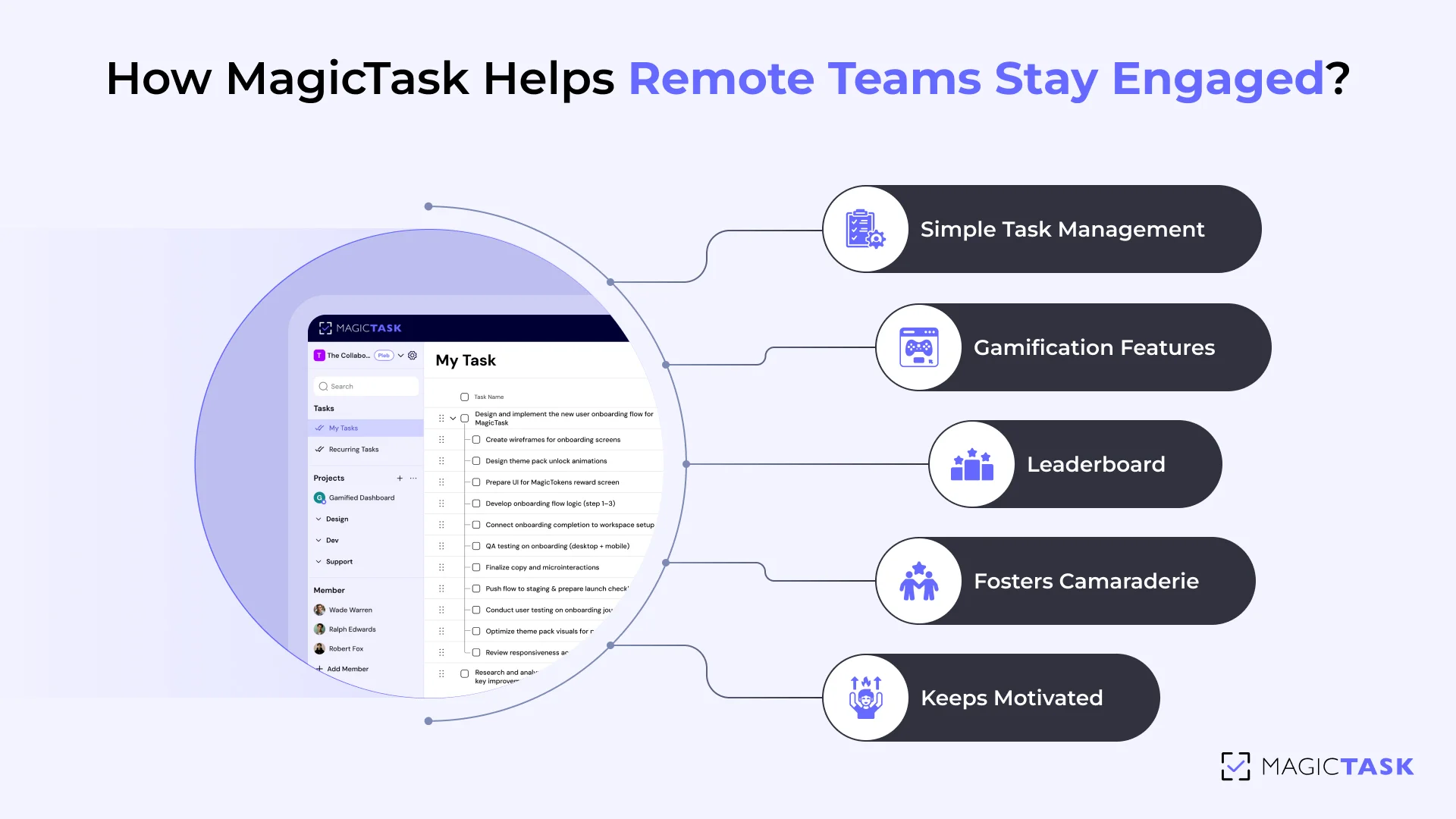
With leaderboards that track individual and team performance, MagicTask injects a healthy dose of competition into your day. Watching your name climb the ranks against colleagues or even on a global scale fuels that drive to excel, one focused task at a time.

Every point earned, every level up, and every badge unlocked is a reminder that your focused efforts are paying off. You don’t need to complete all things at once. Just the ones that count. 

Conclusion: Work Smarter, Not Harder

It's clear that multitasking is a constant shuffle from one task to another—a pattern that slows you down, reduces quality, and drains energy.

The more thoughtful way forward is simple: zero in on one task at a time, prioritize what truly matters, and let your work speak for itself.

By eliminating the urge to switch between tasks, you'll find that you not only achieve faster, better results but also enjoy a calmer, more satisfying workday.

Are you ready to leave the chaos behind? It's time to ditch the myth of multitasking and embrace a focused, efficient way of working with MagicTask

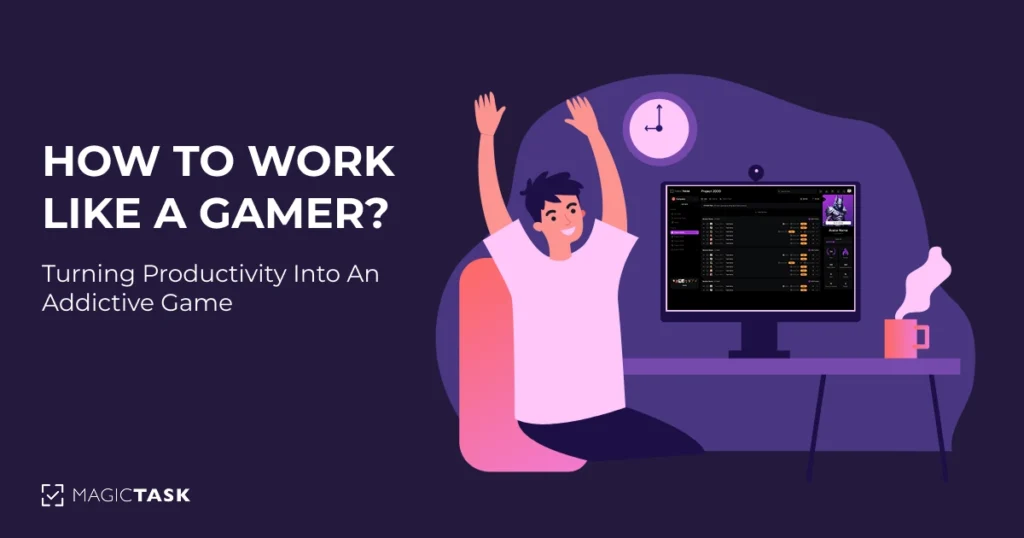
How to Work Like a Gamer: Turning Productivity into an Addictive Game

how to work like a gamer

Have you wondered why the same person who dreads endless emails can lose themselves in a video game for hours?

The answer is quite simple. Because games are fun, challenging, and downright rewarding. On the other hand, work often feels like a chore. In fact, only 15% of employees are truly engaged at work, which is hardly a reflection of a productive workforce.

But what if work could feel like a game? What if you could turn your daily tasks into quests, complete with rewards and that addictive sense of progress?

In this post, we’ll show you how to work like a gamer—so work stops feeling like a grind and starts feeling like a game worth winning.

Let's start.

Why Games Are So Addictive (And Work Isn’t)?

To understand why games captivate us while work is just “work,” let's take a quick look at a classic study with mice.

One group gets a piece of cheese handed to them on a silver platter, while another has to solve a puzzle to earn the same treat. The puzzle-solving mice experience a powerful dopamine surge—the very chemical that fuels our drive for achievement.

The other group will never feel the urge to solve a puzzle to get cheese because they know it will be handed to them no matter what. 

This isn’t just a fun anecdote. It reveals why our brains crave rewards after work and why so many workplaces feel unrewarding by comparison.

That’s the real difference: games give us what work often doesn’t.

Let’s break down what makes games so engaging and where work often falls short.

1. Instant Rewards

Instant Rewards

When you’re playing games, every action is instantly celebrated, whether it’s earning experience points, leveling up, or collecting loot. 

Imagine this in a work setting: picture yourself submitting a report, then waiting days or even weeks for a simple nod of approval from management.

Instead of the immediate burst of feedback you’d get in a game, you’re left in limbo, wondering if your effort was even noticed.

But instant gratification isn’t the only thing games do right. They also make sure you always know where you stand.

2. Clear Progression

Clear Progression

Games make progress obvious—whether it’s a level-up, a progress bar, or a completed mission, you always know exactly where you stand. That constant feedback keeps you motivated and moving forward.
Now, compare that to a typical work project. You might have deadlines for concept approval, prototyping, and testing, but without clear checkpoints in between, it can all blur together.

One minute you're deep in creative work, the next, you're blindsided by a deadline. Without defined milestones, it's hard to know how far you’ve come or how much is left.

That’s why structure matters. Clear progress keeps you focused, on track, and actually excited to reach the next stage.

3. Just the Right Challenge

Just the Right Challenge

Games hit the sweet spot by balancing difficulty with your skill level. They’re not so easy that you get bored, nor so hard that you feel defeated. This balance keeps you engaged and eager to tackle the next challenge.

Now, think about your workday. Are your tasks pushing you just enough to stay focused and interested? Or are you drowning in data, emails, and meetings that feel either mindless or totally unmanageable?

The key is finding that middle ground. Whether you're tackling a big project, managing a team, or launching something new, the work should stretch your skills without sending you into stress mode.

If it constantly feels like too much or too little, it might be time to rethink how you structure your workload.

4. Fun & Competition

Fun & Competition

Know that feeling you get when you’re on the leaderboard, leaving all the other competitors to weep at your victory? That’s precisely the feeling that games give you. They tap into your natural desire for competition and recognition. It’s a constant, friendly push to be better than you were yesterday.

It should be the same for work. Healthy competition can motivate you to perform just a tad better than the other person beside your desk.

A recent survey shows that 63% of workers believe competition has made them more productive. With deadlines looming, that visual achievement display spurs everyone to work with greater focus and accuracy. 

The best part of games is that failure isn’t the end of the road.

5. No Fear of Failure

No Fear of Failure

In the gaming world, failing is just another step toward mastery. The safety net of being able to try again without real-world consequences removes the fear of failure and encourages experimentation.

That’s precisely why gamification works.

Most people will choose a system that rewards effort, tracks progress, and makes work feel engaging rather than just another obligation. 

How to Make Work Feel Like a Game?

So, how do you bring that same sense of progress, challenge, and reward into your workday?

It all starts with the right tool. Something that replaces dull task trackers with a system that actually makes you want to get things done.

1. Find a Gamified Task Management System

A great game runs on a great engine. And when it comes to productivity, your task management system is that engine.

Traditional to-do lists may help you stay organized, but they rarely inspire action. They’re static, uninspiring, and easy to ignore. What you need instead is a tool that turns every task into something you actually want to complete.

That’s where gamified task management comes in.

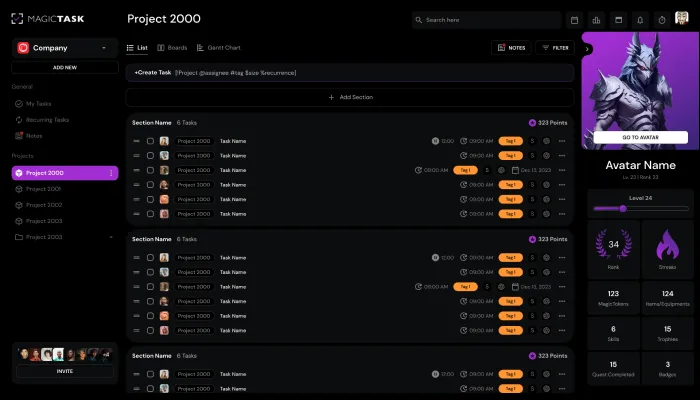
MagicTask - gamified task management tool

These systems bring game-like mechanics into your daily workflow. Here’s what that looks like:

  • Instant Feedback when you complete a task, giving you a quick sense of progress and momentum.
  • Clear goals or tasks view, tasks broken into achievable steps so you always know what’s next.
  • Built-in Motivation through rewards, visuals, and unlockable elements/features that keep things feeling fresh.
  • Friendly Competition using leaderboards or point systems to encourage consistent effort and team-wide focus.

With tools like MagicTask, every click feels like progress, every milestone is acknowledged, and your workload becomes more than just a list—it becomes a game you’re excited to play.

2. Set Mini-Challenges for Yourself

Rather than viewing big projects as an insurmountable mountain, see them as a series of smaller, exciting challenges that build momentum with every step.

Instead of staring down a never-ending to-do list, break your work into mini-challenges with clear targets. 

For example, if you have a significant report to write, set a mini-challenge to finish the research section by Tuesday, draft the outline by Wednesday, and complete the first full draft by Friday. Each mini-challenge becomes a win on its own.

MagicTask makes this approach easy.

You can add a main task—say, “Complete Quarterly Report”—and then break it down into subtasks like “Gather Data,” “Draft Analysis,” and “Finalize Presentation.” 

![Set mini challenges](/images/set-mini-challenges-for-yourself .webp)

Each subtask can have its due date. This way, every tick off your list becomes a mini celebration, keeping you motivated throughout the day.

3. Turn Tasks into Quests

Why simply 'write a report' when you can declare, 'Complete mission: Q4 Growth Report'?

It's a slight shift in language that transforms a mundane task into an epic quest. 

MagicTask fuels this mindset shift by letting you rename your tasks and infuse them with purpose. Every time you complete a mission, the platform rewards you with vibrant themes and playful animations.

It’s like little nods that say, “You did that, and it matters.” It’s like unlocking a new level in a game, where the journey becomes the reward. 
4. Track Your Wins Like Achievements

Every completed task should feel like a small win, not just another checkbox ticked off.

With MagicTask, those wins are celebrated visually, giving you the same kind of recognition you’d get from unlocking an achievement in a game.

Here’s how that might look in action:

  • Inbox Zero Victory: Clear out your inbox, and you’re rewarded with a quick, celebratory animation that marks your focus and momentum.
  • Project Triumph: Finish a major project and earn enough points to unlock a new feature or theme. It’s a visual reminder of real progress.
  • Mini-Challenge Milestone: Even the small stuff matters. Complete a tiny task and get a satisfying pop-up to keep your energy going.

MagicTask makes sure every win counts and reminds you that each completed task is a step toward mastering your day.

5. Make Failure Feel Like a Respawn, Not a Game Over

Picture yourself immersed in your favorite game. You lose a level—bam! But instead of quitting, you hit "respawn." You regroup, adjust your strategy, and dive back in better than before.

That’s the magic of gaming. Failure isn’t the end. It’s just part of the path to mastery.

Now imagine if your work operated the same way. What if a missed deadline or a rough draft wasn’t a setback but just a signal to recalibrate and try again?

With MagicTask, it’s easy to iterate and improve. You can revisit tasks, adjust timelines, and stay flexible without losing momentum. The system is built to support learning and forward movement—not punishment for missteps.

Every stumble becomes a step forward. Just like in a game, you don’t lose—you learn. And that mindset shift turns every misfire into momentum for your next big win.
Conclusion: Work Smarter, Not Harder (Like a Gamer!)

Are you ready to break free from the grind? MagicTask turns your workday into a high-stakes adventure, keeping you on your game.

With MagicTask, every task becomes a win. Each deadline transforms into a clear milestone; every setback is just another opportunity to level up. Instead of waiting for distant approvals, you'll celebrate instant victories. 

Try MagicTask today and experience how work can become an exciting, rewarding journey.

Why Do Remote Employees Feel Disengaged? (And How to Fix It)

remote employee disengagement

Ever feel like your remote team is only half present—cameras off, minimal interaction, and a general sense of “just going through the motions”? 

You’re not alone. 

According to a recent Gallup report, more than 50% of remote employees say they struggle to feel connected to their company’s mission and vision. 

If you’re leading a remote team, that number can sting even more. When your colleagues are scattered across different couches, time zones, and sweatpants, it’s easy to slip into a “going through the motions” routine.

But it doesn’t have to be this way. 

In the next few minutes, I’ll walk through the reasons why remote employees sometimes feel adrift—and, more importantly, how you can help them rediscover that spark of motivation.

Let’s dive in.

Why Do Remote Employees Feel Disengaged?

You can always roll out more meetings, add fancy new tools, or put new policies in place—but if you don’t address the real reasons people feel cut off, you’re only putting a band-aid on a deeper issue. 

When you truly understand what’s causing remote disengagement, you can create a culture where employees feel excited to log on daily.

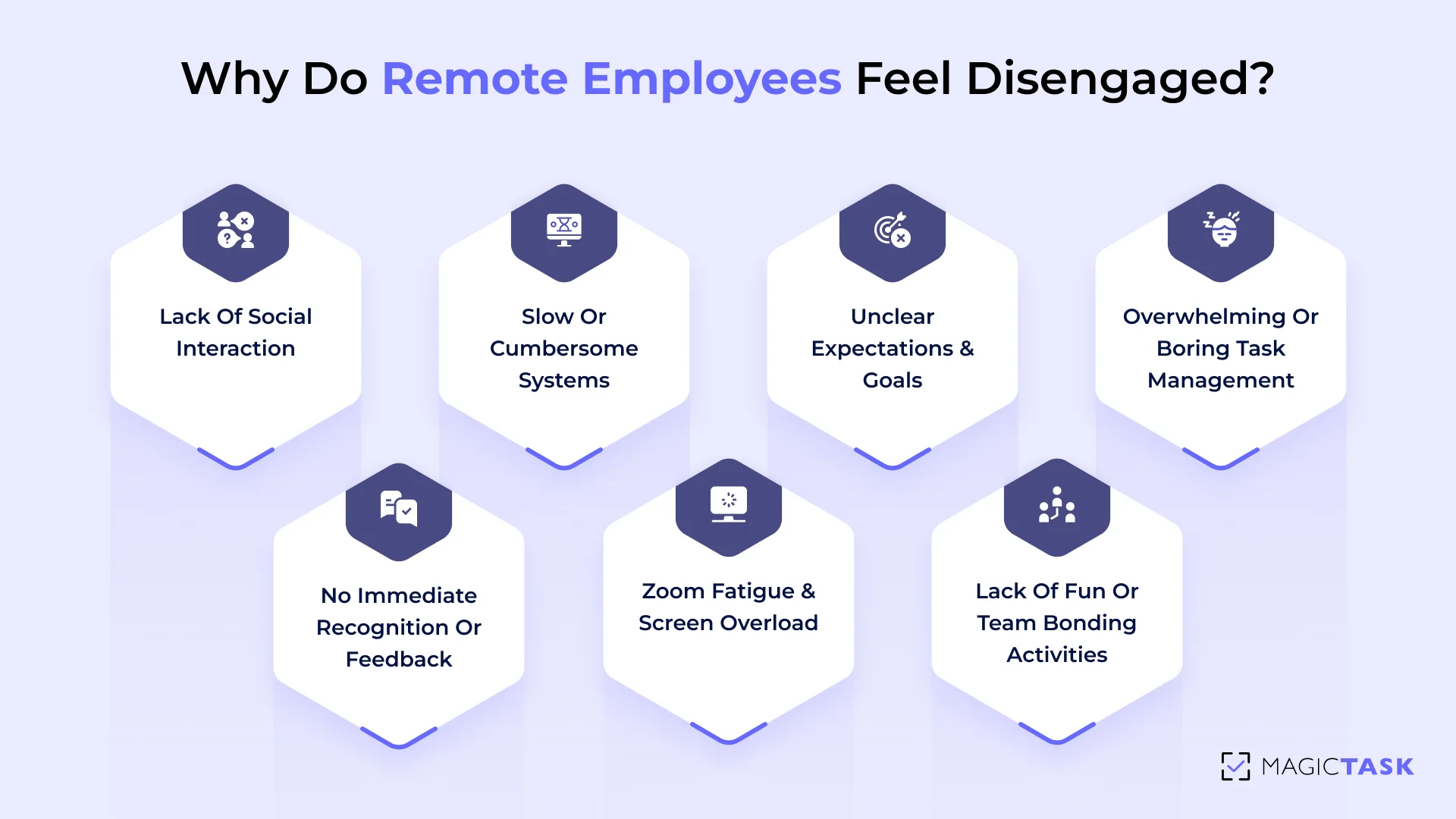
Here are the most common reasons why remote employees feel disengaged:

why do remote employees feel disengaged

1. Lack of Social Interaction

Humans are wired for connection. In a traditional office, those connections happen naturally through quick chats by the coffee machine, spontaneous brainstorming sessions, or just a shared laugh over an inside joke. These small, everyday moments build trust, spark creativity, and strengthen a sense of belonging.

But in a remote setting, these interactions don’t happen organically. Without them, employees can start to feel like faceless names on a screen—disconnected from their colleagues and, over time, disengaged from their work. When people feel invisible, their motivation fades, collaboration suffers, and they may start questioning their place within the company.

2. Slow or Cumbersome Systems

Technology is supposed to make work easier, not more frustrating. But nothing kills momentum faster than a slow-loading tool, a cluttered system, or a never-ending series of clicks just to update a simple task. Instead of getting things done, employees waste time wrestling with software that should be helping them.

When every small action feels like a chore, motivation disappears. Work stops feeling like a place to create and problem-solve—it turns into a daily grind of navigating roadblocks. Over time, that frustration adds up, making even the best employees feel stuck and disengaged.

3. Unclear Expectations & Goals

When remote employees aren’t given clear objectives, they’re left wondering what to prioritize. Without clear direction, tasks start to feel arbitrary, and employees may spend time on work that ultimately doesn’t move the needle.

Take this example—a marketing manager tells the team to “increase engagement” on social media but doesn’t specify which platforms to focus on, which metrics define success, or what kind of content works best.

Some team members focus on likes, others on comments, while a few try boosting follower count. The result? Scattered efforts, misalignment, and frustration as no one knows if they’re actually making progress.

4. Overwhelming or Boring Task Management

No one signs up for a job just to check boxes, but that’s exactly what most task management tools turn work into—rigid, repetitive, and uninspiring. Instead of feeling like they’re contributing to something meaningful, employees get bogged down in endless lists, complicated workflows, and overly structured processes.

When every task feels like just another step in an assembly line, motivation fades. Employees start working for the sake of finishing rather than finding purpose in what they do. Over time, this mechanical approach drains creativity, stifles innovation, and makes work feel more like a chore than a challenge.

5. No Immediate Recognition or Feedback

In an office, recognition happens naturally—a quick “nice job” in passing, a nod of approval, or a spontaneous round of applause after a successful presentation. These little moments add up, making employees feel valued and seen.

In a remote setting, those moments disappear. When great work goes unnoticed, silence starts to feel like invisibility. Employees begin to wonder if their contributions even matter. Without consistent feedback, motivation erodes, and engagement slips away, not because employees don’t care, but because they feel like no one else does.

6. Zoom Fatigue & Screen Overload

At first, video calls seemed like the perfect solution for remote work—face-to-face interaction, seamless collaboration, and a way to stay connected. But now? They’ve become exhausting.

Back-to-back meetings leave employees drained before they even start their real work. Staring at tiny squares for hours on end feels isolating, not engaging.

And when every discussion, no matter how minor, turns into a scheduled call, productivity takes a hit. Instead of bringing teams together, excessive meetings are pulling them away from meaningful, focused work.

7. Lack of Fun or Team Bonding Activities

A great team isn’t just a group of people working toward a goal—it’s a group of people who enjoy working together. In an office, that bond forms naturally through casual chats, inside jokes, and spontaneous “Hey, what do you think about this?” moments.

In a remote world, those interactions don’t just happen—they have to be created. Without them, work becomes purely transactional. Conversations stay strictly work-related, and personal connections fade.

Over time, the team starts feeling less like a team and more like a collection of individuals just doing their jobs.

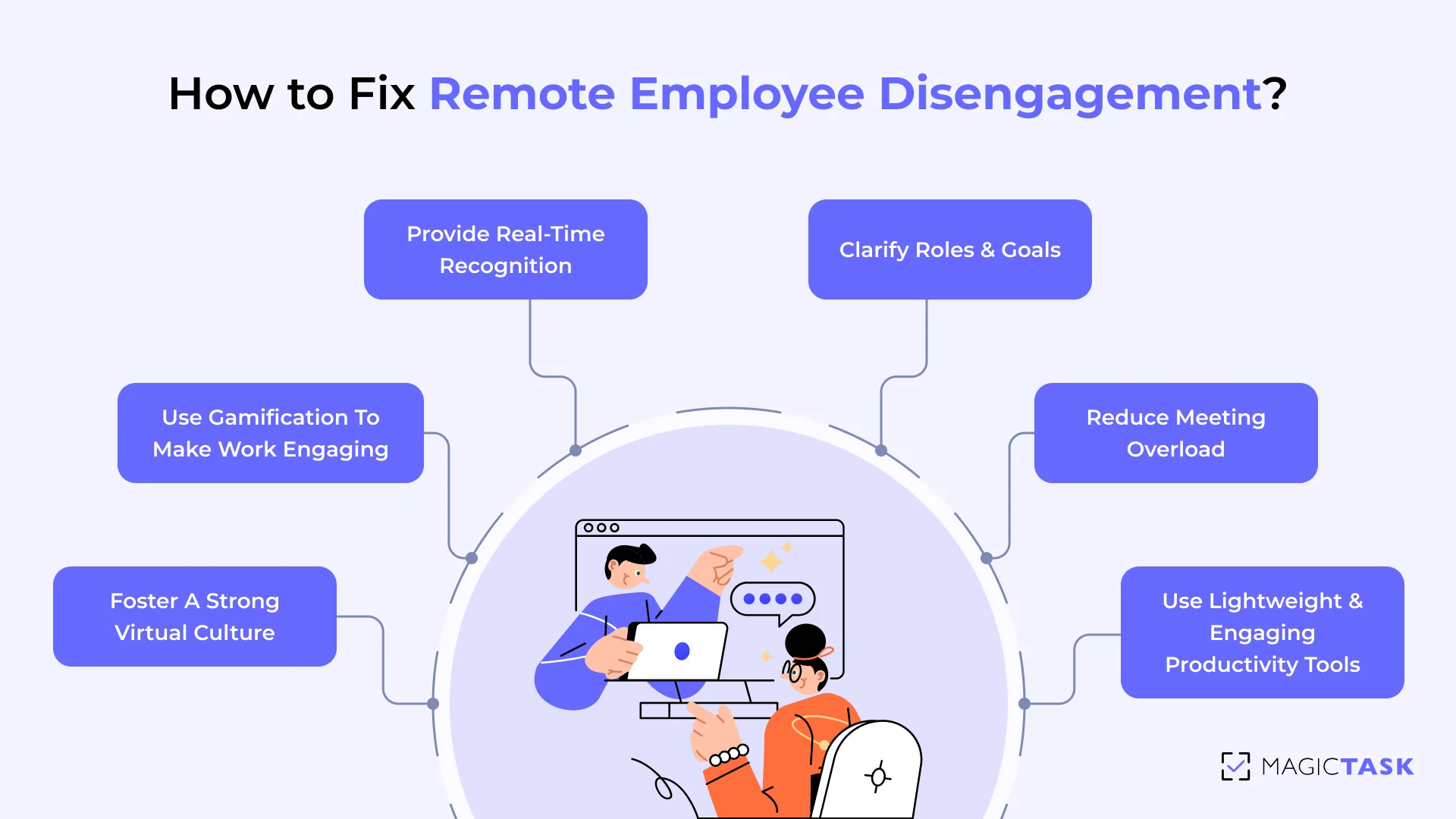
How to Fix Remote Employee Disengagement?

Now that we understand why remote employees feel disconnected, let’s explore practical steps you can take to re-engage your remote team.

The goal is to create an environment where employees feel connected, valued, and empowered—no matter where they are.

1. Foster a Strong Virtual Culture

Building a strong virtual culture is about creating a space where everyone feels seen and heard.
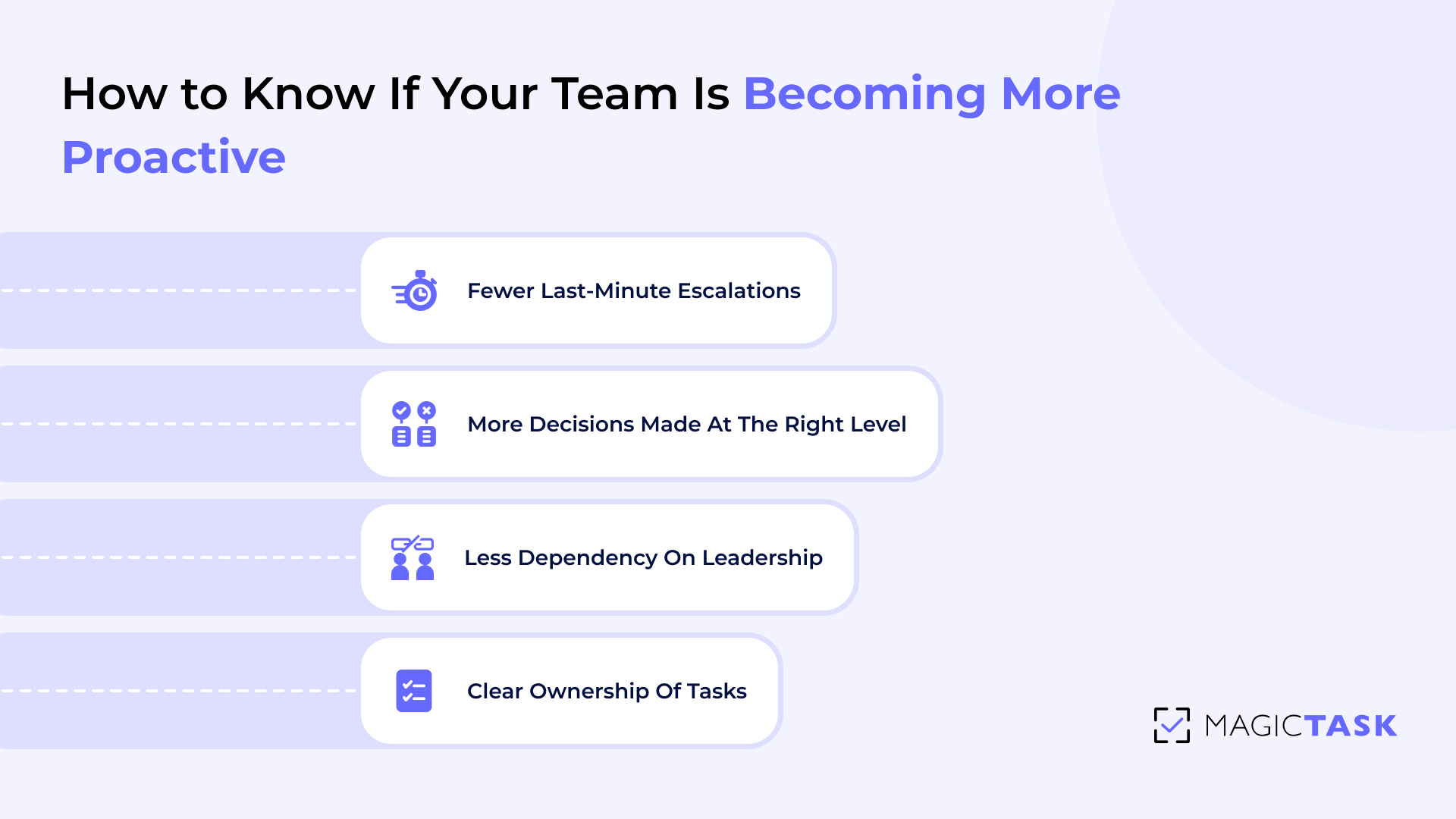
Start by making time for authentic conversations. Consider dedicating the first 10 minutes of your weekly team call to a casual check-in. Set up virtual coffee breaks or create informal Slack channels for non-work discussions.

These micro-interactions can rebuild the sense of belonging that remote work often lacks.

Ask questions like, “What’s something good that happened this week?” or “What’s one challenge you’re facing right now?”

This isn’t just small talk; it’s about human connection. When people know that their struggles and successes matter, they’re more likely to open up and collaborate. It might even be as simple as encouraging a daily “good morning” in your team chat where everyone shares a quick personal update.

fixing remote employee disengagement

2. Use Gamification to Make Work Engaging

Remote work can feel like running on a treadmill—you’re moving but not moving forward. But gamification flips the script.
Here’s what leaders can do to make work fun: 

  • Visualize Progress: Allow employees to see their progress through badges, milestones, or leveling up as tasks are completed.
  • Foster Friendly Competition: Establish a leaderboard or friendly challenges that reward initiative and proactive behavior.
  • Deliver Instant Feedback: Make sure that achievements are recognized immediately, reinforcing momentum and boosting morale.
  • Transform Routine Tasks: Incorporate game elements to turn everyday tasks into engaging challenges that motivate employees to take ownership.

3. Provide Real-Time Recognition

Real-time recognition is about making sure that when someone does a great job, it's acknowledged right away. Instead of waiting for the weekly roundup or the annual review, capture the moment as it happens. 

Here’s how you can do it:

  • Make recognition a habit. Public shoutouts, quick check-ins, and immediate feedback should be part of the daily workflow—not an afterthought.
  • Turn progress into something tangible. Tools like MagicTask make momentum visible, so employees don’t feel like they’re working in a void.
  • Celebrate effort, not just outcomes. Recognizing initiative, problem-solving, and creative thinking reinforces proactive behavior before the results even show up.

People do their best work when they know it matters. Try to appreciate the small wins rather than only big accomplishments. 

4. Clarify Roles & Goals

Clarify roles and goals so your team isn’t left guessing what’s expected. When remote employees don’t know their specific responsibilities or how their work fits into the bigger picture, it creates confusion and can drain motivation. 

As a leader, you can:

  • Set Measurable Objectives. Instead of asking for a vague improvement, specify a clear target, such as “Increase newsletter open rates by 15% over the next quarter.”
  • Break Down Larger Goals. Divide big projects into smaller, actionable tasks. For instance, if the goal is to increase user sign-ups, outline steps like optimizing the landing page, creating targeted ad campaigns, and scheduling weekly performance reviews.
  • Maintain Open Communication. Schedule regular check-ins to discuss progress, address questions, and adjust targets if necessary. This ongoing dialogue ensures everyone understands their role and how their work contributes to the overall objective.

5. Reduce Meeting Overload

If you’ve ever sat through a call where nothing gets done, you know how draining it can be. Instead, try swapping some of those calls for a quick email or a shared document update. 

For instance, instead of scheduling a 30-minute meeting to discuss weekly progress, ask your team to jot down their updates in a shared space. This not only cuts down on the number of meetings but also gives everyone the freedom to work uninterrupted.

It’s about being intentional. Look at your calendar and ask, “Is this meeting really necessary?” If the answer isn’t a clear yes, consider whether there’s a faster, less disruptive way to communicate. 

6. Use Lightweight & Engaging Productivity Tools

You don’t need a behemoth system with endless features that only slow everyone down. Instead, opt for tools that are intuitive and simple to use—ones that feel more like an assistant than another task to manage.

Try switching to a platform that offers quick task updates and clear visuals of progress without overwhelming your team with too many options.

When tools are designed to be engaging, it’s easier for your team to stay focused on their work rather than wrestling with the software. The right tool should feel like a natural extension of your workflow, helping you keep things moving without adding extra hassle.

How MagicTask Helps Remote Teams Stay Engaged?

We know you're juggling a lot: project timelines, team morale, and the constant pressure to deliver exceptional results.

You understand that a happy, engaged team is a productive team, and you're searching for tools that reflect that understanding.

And let's be honest, some task management tools feel like they're designed to waste your time.

Seriously, who has time to wait five minutes for a page to load?

That's where MagicTask comes in.

MagicTask was built during the pandemic to help remote employees make work fun and exciting. Unlike other complex task management systems with a bit of a learning curve, MagicTask helps you get started almost immediately.

But it's not just about speed. It's about fun, too.

how magictask help keep employee engaged

Here’s how MagicTask uses gamification to transform everyday tasks into rewarding moments that build genuine connections:

  • Gamification Magic: MagicTask adds a layer of gamification to your daily task management. It smartly transforms routine work into a series of little wins.
  • Built-in Leaderboard: You have a built-in leaderboard that rewards you for moving things along. You compete with others using the MagicTask system, and as you finish more tasks, you move up in the leaderboard.
  • Fostering Camaraderie: It’s not about turning work into a competition for the sake of it—it's about fostering that same kind of camaraderie you’d get when you play a favorite video game with friends. 
  • Real Connections Through Gaming: Shared challenges can spark genuine bonds—just imagine your team reconnecting over friendly competition, where every completed task feels like teaming up with a trusted friend.

Conclusion

Tackling remote disengagement starts with understanding why employees feel disconnected. Small changes can make a big impact, especially when work feels engaging and rewarding.

MagicTask helps bring that sense of challenge and motivation back. It’s fast, simple, and designed to make everyday tasks more rewarding. Sign up for MagicTask now and see how a more engaging workflow can transform your team’s energy and productivity.

How to Build a Proactive Team (& the Tools That Help)

build proactive team

Ever feel like your team is stuck in reactive mode, always waiting for direction instead of taking initiative?

As a leader, it’s frustrating to chase updates, approve every decision, and feel like progress stalls without your input. The difference between a team that moves forward and one that doesn’t often comes down to one thing: proactivity.

When employees take ownership of their work, things just flow. Projects move forward, problems get solved, and you’re not constantly stepping in to keep things on track.

But proactivity isn’t about pushing people to work harder. It’s about building a culture where ownership and accountability come naturally.

In this blog, you’ll learn how to make that shift, plus the best tools to help your team take initiative with confidence.

Why Teams Struggle with Proactivity (& How Leaders Contribute to the Problem)

Let's first understand why teams struggle with proactivity.

Before building a proactive team, you must understand why so many employees hesitate to take the initiative.

Too often, teams wait for instructions instead of acting independently. It’s easy to assume they lack initiative, but the truth is that leaders usually shape this behavior without realizing it.

Think about it. A well-meaning manager reviews every detail, double-checks work, and steps in to fix mistakes. Over time, the team stops making decisions because they’ve learned it’s safer to wait for approval. What started as quality control has turned into hesitation.

Here are five key reasons teams struggle with proactivity. And in many cases, leadership habits are a big part of the problem.

Why Teams Struggle with Proactivity

1. Lack of Clear Goals & Ownership

Proactive teams need clarity. If employees aren’t sure what success looks like, they hesitate. Broad goals like “we need to improve sales” or “let’s boost engagement” leave too much room for interpretation.

Without clear direction and ownership, tasks get passed around, and everyone assumes someone else will take charge—but no one does.

The Fix: Define success with clear, measurable goals and assign ownership. Instead of saying “increase engagement,” set a specific target: “Raise team engagement scores by 10% next quarter by implementing weekly check-ins and peer recognition programs.”

When employees know exactly what they’re responsible for and what the goal is, they’re far more likely to take the initiative.

2. Fear of Making Mistakes

Proactivity thrives in an environment where employees feel safe to take risks. Without psychological safety, teams become overly cautious. They second-guess decisions, avoid experimenting, and focus more on avoiding mistakes than making progress. When missteps lead to blame or punishment, innovation stalls, and employees stick to what feels safe.

Research backs this up. Google’s Project Aristotle, a study analyzing over 180 teams, found that psychological safety is the most important factor in team success. Employees need to trust that taking initiative won’t backfire.

The Fix: Foster a culture where learning matters more than perfection. Make it clear that mistakes are part of growth. Reward initiative—even when the outcome isn’t perfect. When employees know they won’t be reprimanded for trying, they’ll be more willing to step up.

3. A Reactive Work Culture

Some workplaces thrive on chaos, where the loudest voice wins. The people who swoop in at the last minute to "save the day" are seen as heroes.

But when leadership rewards firefighting, teams quickly learn that preventing problems doesn’t get noticed. Instead of anticipating and planning ahead, they wait for things to break—because that’s what earns recognition.

The Fix: Shift the focus from reactive to proactive achievements. Recognize and reward employees who prevent issues before they happen. Create a monthly “Forward Thinker” spotlight or offer small bonuses and professional development opportunities for those who identify and fix bottlenecks early. Publicly acknowledging proactive problem-solvers in meetings or newsletters encourages others to do the same.

4. Over-reliance on Meetings & Status Updates

If your team is constantly in meetings, when do they actually get work done? A workplace that leans too heavily on check-ins, approvals, and status updates slows progress and creates unnecessary bottlenecks. Instead of making decisions, employees spend their time reporting on work that hasn’t even happened yet.

The Fix: Cut unnecessary meetings and empower employees to make decisions without waiting for approval. Before scheduling a meeting, ask yourself:

  • Can this update be shared via email or a project tool?
  • Does everyone on the invite list truly need to be there?
  • What specific outcome or decision do we need from this meeting?

Trimming down meetings gives teams the time and autonomy to focus on actual work rather than just talking about it.

Platforms like MagicTask help by improving accountability so teams stay aligned without constant check-ins.

5. Leaders Unknowingly Create Dependency Loops

Many leaders unintentionally train their teams to be dependent instead of proactive. By micromanaging, stepping in too quickly to solve problems, or requiring approval for every little decision, they create a cycle where employees stop taking initiative. Over time, they learn that waiting for direction is safer than acting on their own.

The Fix: Shift from control to guidance. Instead of giving immediate answers when an employee is stuck, ask guiding questions like “What approaches have you considered?” or “What would you do if I weren’t available?”

This encourages problem-solving and builds confidence. The more employees practice independent decision-making, the more ownership they take over their work.

Studies show that employees with a proactive mindset tend to perform better and advance faster in their careers. Those actively seeking improvements, anticipating challenges, and taking initiative consistently receive higher performance evaluations. (Source)

Now that we’ve looked at the common roadblocks and how to fix them, let’s explore what leaders can do to make proactivity a natural part of the team’s culture.

Key Leadership Strategies to Build a Proactive Team

Building a proactive team starts with intentional leadership. You see, every team has “proactive potential,” and it’s your job to bring that out in your employees.

Key Leadership Strategies to Build a Proactive Team

Here's how to do that:

1. Set a Culture of Proactive Ownership

Proactivity starts with a mindset shift. If employees see decisions and problem-solving as "someone else’s job," they’ll default to waiting for instructions. True ownership happens when individuals feel responsible not just for tasks, but for outcomes.

  • Make Ownership Non-Negotiable: Assign each project or initiative to a single owner who’s accountable for driving it forward. 
  • Convey Impact: Show how each role connects to larger business goals. When people see the direct impact of their work, they’re more motivated to anticipate needs and solve problems.
  • Encourage Solution-Based Thinking: Train employees to bring potential solutions, not just problems. This small shift pushes them to think proactively rather than waiting for answers.

2. Set SMART, Outcome-Driven Goals

Proactivity flourishes in clarity. Use SMART goals (Specific, Measurable, Achievable, Relevant, Time-bound) to define success. Here's how:

  • Specific: Clearly state what needs to be achieved and who’s responsible.
  • Measurable: Include numbers or milestones (e.g., “Increase Net Promoter Score by 10 points”).
  • Achievable: Challenge the team but keep it realistic.
  • Relevant: Align objectives with broader business priorities so each person sees the bigger picture.
  • Time-bound: Attach a deadline to foster urgency and focus.

Here's a quick comparison between a vague goal and a SMART goal:

  • Vague Goal: “Improve customer satisfaction.”
  • SMART Goal: “Increase our online customer satisfaction rating from 4.0 to 4.5 by the end of Q2 by speeding up response times and offering personalized follow-ups.”

Clear goals give employees direction and autonomy to step up without micromanagement.

Remember this rule:

Autonomy + Accountability = High Performance

Give employees the freedom to make decisions within their scope, but hold them responsible for results.

If there’s too much autonomy and no accountability, tasks get deprioritized, and progress stalls. On the other hand, too much accountability with no autonomy makes employees feel micromanaged, and initiative dies.

The sweet spot is to empower employees with decision-making authority while making expectations crystal clear.

Tools like MagicTask make this easier by providing transparency, tracking progress, and ensuring that accountability doesn’t turn into micromanagement.

3. Improve Task & Project Visibility Without Micromanaging

Visibility can be a double-edged sword. Too much tracking feels suffocating, and too little allows priorities to slip.

  • Define What Matters: Not every task requires detailed updates. Focus on major deliverables and milestones rather than everyday to-do items.
  • Automate Progress Tracking: Use tools that provide real-time visibility and asynchronous updates, like MagicTask, to keep everyone informed without constant status meetings.
  • Shift from Status Updates to Accountability: Instead of asking “What’s done?” ask “What’s next?” This encourages forward-thinking and ownership rather than just reporting.

4. Encourage Proactive Problem-Solving

The fastest way to kill proactivity is to answer every question the moment it’s asked. When employees know that you’ll always have the solution, they stop looking for answers themselves. That’s how dependency loops form. Teams that can’t move forward without a leader’s constant input.

Instead of giving immediate answers, flip the script. The next time someone brings you a problem, ask guiding questions: “What do you think?”  or “What have you tried so far?”

This forces them to brainstorm solutions before seeking approval. Over time, your team will develop their own problem-solving reflex.

But culture alone isn’t enough. You need a strong framework. Encourage teams to break problems into steps: define the issue, propose solutions, and recommend a course of action.

When problem-solving becomes the expectation, leaders move from being the fixers to being the guides. And that’s when real proactivity begins.

5. Reduce Decision Bottlenecks

Every stalled project, missed deadline, and frustrated team often traces back to one issue—decisions are stuck at the top. When employees aren’t sure what they can decide on their own, they hesitate. Instead of moving forward, they wait. And wait. And wait.

Leaders who want a proactive team must create clarity around decision-making by adopting the Trust-Delegate-Verify model:

  • Trust your team to make sound decisions without constant oversight.
  • Delegate authority clearly—define which decisions employees can make independently.
  • Verify results after the fact rather than controlling each step.

The real challenge? Knowing when to step in and when to step back. If you’re solving problems your team should be handling, you’re slowing everything down. That’s why using a Decision Authority Framework ensures decisions are made at the right level:

  • Level 1: Team members decide independently and inform the group.
  • Level 2: Team members consult others, then decide.
  • Level 3: Requires leadership approval (e.g., budget changes, major strategic shifts).

When employees know their decision-making boundaries, they don’t wait for permission but act confidently. The result? Faster execution, fewer bottlenecks, and a team that runs smoothly without everything needing to go through leadership.

6. Walk the Talk

If you want a proactive team, start by being proactive yourself. Teams mirror their leaders in most ways. If you’re stuck in old ways, hesitant to try new approaches, or quick to dismiss ideas, don’t expect your team to step up with innovation or initiative.

Create a culture where experimenting is encouraged, and discussions are welcomed.

Say yes more often—at least long enough to ask, “How could this work?” instead of “Why won’t this work?” The more you embrace curiosity and forward-thinking, the more your team will too.

The Best Tools to Drive Proactive Team Behavior

Even the most engaged teams can slip into reactive habits if they don’t have the right systems to keep tasks visible, streamline updates, and encourage ownership.

Fortunately, a range of tools exists to help you cement a culture of proactivity by making work more transparent, organized, and (yes) even fun.

Below are a few categories to consider and how each can bolster proactive team behavior.

1. Task Management & Visibility

Clarity is key to proactivity. A good task management tool should make it easy to see who’s doing what, when it’s due, and how it ties to larger goals.

Below is a quick comparison of three popular task management options. Each has its own strengths and weaknesses, so it’s essential to consider your team’s specific needs.

Tool Pros Cons
MagicTask
  • Gamification features boost engagement and motivation
  • Transparency and real-time visibility into individual and team tasks
  • Easy-to-use, most straightforward task management system
  • Simple task management features and new features are getting added every month
Asana
  • Robust project views (timelines, calendars) for complex workflows
  • Intuitive interface once you learn the basics
  • Overwhelming for smaller teams
ClickUp
  • Highly customizable for various use cases (task lists, wikis, etc.)
  • Broad feature set covers multiple project management styles
  • Steep learning curve due to many features

Ultimately, the best tool depends on your team’s size, culture, and project requirements. 

If you need a fun, game-inspired way to keep people engaged, MagicTask’s gamification can deliver that extra motivational spark.

Asana’s view options, like timelines and calendars, make it a solid fit for more complex or large-scale projects.

ClickUp stands out for its versatility and customization but may feel overwhelming for teams new to project management software.

2. Automated Reporting: Reduce Manual Updates

Constant status updates can slow teams down. Tools like Slack Workflows automate reporting so employees can focus on execution rather than repeating the same updates in endless check-ins. 

But combined with MagicTask’s transparent task tracking, teams get a real-time view of progress without the need for constant follow-ups.

3. AI-Powered Productivity Assistants: Smarter Workflows

Imagine having a personal assistant that organizes your day, tells you what to focus on next, and makes sure nothing falls through the cracks. That’s what AI-powered tools like Reclaim.ai and Motion do. 

If your team struggles with prioritization, Reclaim.ai can automatically reorder tasks and find free calendar blocks, ensuring important work gets done first. Motion goes a step further by scheduling tasks around existing calendar events, giving you a real-time blueprint of your day.

However, even the smartest assistant needs a solid foundation. Pair AI tools with a clearly defined task system, like MagicTask or any other project management platform, to help them accurately prioritize and manage your team’s workload.

How to Know If Your Team Is Becoming More Proactive

Proactivity is about working smarter. And like any good habit, it’s built through small, consistent changes that compound over time.

How to Know If Your Team Is Becoming More Proactive

So, how do you know if your team is shifting from reactive to proactive? Look for these leading indicators:

  • Fewer last-minute escalations: Problems get solved early, not when they’re on fire.
  • More decisions made at the right level: Employees act without needing constant approval.
  • Less dependency on leadership: Teams troubleshoot issues before they reach your desk.
  • Clear ownership of tasks: Work moves forward without bottlenecks or hesitation.

The key to sustaining proactivity is tracking it, not through micromanagement but through systems that reinforce ownership.

MagicTask helps teams measure accountability and initiative, keeping progress visible without unnecessary oversight. It gives your team the clarity, accountability, and autonomy they need to take action before problems arise.

No more chasing updates. No more last-minute scrambles. No more waiting for permission. Just a team that moves fast, thinks ahead, and gets things done.

Ready to build a truly proactive team? Sign up for MagicTask today.

How to Reduce Bureaucracy and Speed Up Decision-Making in the Workplace

Reduce Bureaucracy in workplace

Did you know that employees spend nearly a third of their workweek on bureaucratic tasks—things like preparing reports, sitting in meetings, and chasing approvals?

That’s valuable time that could be spent on meaningful work instead of getting caught up in red tape.

When bureaucracy takes over, projects slow down, decision-making drags, and employees feel frustrated. It creates roadblocks that sap energy, stall progress, and make organizations less agile.

So how do you cut through the clutter and keep work moving?

The key is to simplify processes, remove unnecessary steps, and create a culture where decisions happen faster without sacrificing accountability. 

Let’s explore some smart strategies to make that happen.

How Bureaucracy Affects Team Productivity & Decision-Making

Bureaucratic processes are supposed to keep things organized. They set clear steps and rules to reach a goal. But too often, poor planning and lack of coordination get in the way. 

Simple tasks take longer, and valuable time and resources go to waste. These effects ripple through some of the most important parts of a business.

How Bureaucracy Affects Team Productivity & Decision-Making

1. Slower Project Execution

They say the early bird gets the worm — and in business, that couldn’t be more true.

Speed and decisiveness often make the difference between leading the market and falling behind. But when every decision must climb a long ladder of approvals, that agility disappears. Timelines stretch, momentum slows, and opportunities slip through the cracks.

By the time the final go-ahead arrives, it’s too late — the early bird is long gone. And the worm? Well, it didn’t just escape — it found someone bolder, faster, and ready to act.

2. Employee Disengagement

What happens when good ideas get stuck in a maze of bureaucracy? Frustration takes hold.

Employees who start out motivated and full of energy watch their initiatives stall, tangled in layers of red tape. Slowly, their excitement fades, replaced by a sense of powerlessness.

When people stop believing their efforts make a difference, their motivation drops — and so does productivity. By the time approval finally comes through, the energy is gone — and the opportunity has long since slipped away.

3. Lack of Accountability

Without clear accountability, mistakes go unresolved, decisions get delayed, and progress stalls.

Accountability is the backbone of trust and progress. Without it, mistakes linger, decisions stall, and everyone’s left wondering who’s supposed to care.

The people putting in the work start to feel invisible and their effort is drowned out by a chorus of "not my problem." And when that happens, frustration turns into apathy. 

4. Reduced Agility

I’ve seen it happen — a brilliant idea arrives, full of promise and possibility, and then it hits the wall of established procedure.

Bureaucracies love their rules, their steps, their “this is how we’ve always done it” mindset. But the world doesn’t wait for forms to be filled and boxes to be checked.

When systems are too rigid, opportunities slip away, and the chance to evolve disappears. You can’t stay competitive when you’re always a few steps behind.

5. Decision Fatigue

Have you ever felt so worn out by choices that even the simplest decision feels impossible? That’s what happens in organizations drowning in bureaucracy. Leaders and teams face endless rounds of approvals and formalities, and eventually, the weight of it all starts to wear them down.

The mental exhaustion from constant bureaucratic hurdles can impair judgment and reduce the quality of choices made. Over time, this can diminish the organization's effectiveness and responsiveness.

6. Inefficient Use of Resources

I’ve watched good people spend their days filling out paperwork and sitting in meetings that lead nowhere, and I wonder — when do they get to do the work that matters?

Bureaucratic processes eat up time and energy, pulling talented minds away from creative, strategic, and impactful work.

The more we focus on the system, the less we focus on the mission — and that’s a cost no organization can afford.

7. Stifled Innovation

Excessive bureaucracy can discourage creative thinking and experimentation. When every suggestion has to crawl through layers of hierarchy, people stop speaking up. They stop dreaming big. They stop believing their creativity has a place.

And in that silence, the organization loses its chance to grow. Innovation needs room to breathe — but bureaucracy keeps tightening its grip.

Key Strategies to Reduce Bureaucracy

Reducing bureaucracy helps teams work faster and make better decisions. It’s about cutting unnecessary steps, giving people clear responsibilities, and keeping work flowing smoothly.

Here are some simple and effective ways to make that happen:

1. Cut Down Approval Steps

I get why leaders fear cutting approval steps—it feels like losing control. But in my experience, that’s not the case.

A flat organizational structure combined with simple systems allows decisions to happen faster while maintaining accountability. By focusing on results rather than excessive formalities, teams can work with greater autonomy and still achieve their goals efficiently.

Take the example of a SaaS company preparing for a product installation. A customer urgently needs the product set up, but internal regulations and rigid approval requirements cause significant slowdowns. Every step—technical changes, legal compliance, and budget approvals—requires sign-off from different departments.

How to Fix It

  • Set clear boundaries: Define which decisions require executive approval and which can be handled at the team level.
  • Empower mid-level managers: Trust managers to approve routine tasks without escalating everything upward.
  • Create fast-track processes: For time-sensitive projects, develop a streamlined approval process that bypasses unnecessary steps.

Platforms like MagicTask eliminate these bureaucratic slowdowns by creating what I call “organized chaos.” The interface is clean and simple, but don’t mistake that for basic — it keeps teams aligned without adding a layer of complexity.

Tasks get assigned, tracked, and finished without the usual waiting. And those real-time updates cut down the constant check-ins and follow-ups. Finally, work moves at the pace it’s meant to.

Strategies to reduce bureaucracy

2. Make Accountability Clear

When accountability is unclear, projects stall and important decisions get delayed. Teams waste time figuring out who’s responsible, and tasks slip through the cracks. This often happens in larger organizations where overlapping roles and complex hierarchies blur ownership.

For example, in a product launch, if no one takes clear ownership of timelines or deliverables, departments may wait on each other, assuming someone else is handling critical steps. As a result, deadlines are missed, and productivity suffers.

The solution lies in assigning clear responsibility for every task and decision. When accountability is clear, teams move faster, collaboration improves, and there’s less need for repeated check-ins or follow-ups. It keeps projects on track and decisions on time.

3. Improve Communication Channels

Studies have shown that effective communication can lead to a 25% increase in team performance, while poor communication contributes to project delays and low morale.

For example, when a product team waits days for feedback from sales or marketing, projects lose momentum. Missed messages cause confusion and setbacks. When priorities are unclear, deadlines get pushed back, and productivity slows down.

To keep decisions moving forward:

  • Centralize project discussions: Use a single platform where all updates, feedback, and decisions are easily accessible.
  • Keep conversations task-focused: Link discussions directly to specific tasks so nothing gets lost in unrelated messages.
  • Minimize unnecessary meetings: Share updates and request input through written channels to avoid excessive time spent on calls.
  • Encourage real-time collaboration: Use tools that offer live comments and notifications for faster responses.

Streamlined communication keeps teams aligned, reduces back-and-forth, and ensures quicker workflows without sacrificing clarity.

4. Speed Up Workflows by Cutting Red Tape

Unnecessary bureaucracy slows down progress, creating frustrating roadblocks that stall productivity.

Excessive documentation, multiple approval layers, and redundant formalities drain valuable time that could be spent executing high-impact work. Cutting red tape isn’t about eliminating structure—it’s about removing inefficiencies that slow down tasks.

Start by pinpointing where processes get stuck. 

  • Are approvals taking too long? 
  • Do projects require excessive sign-offs?


By mapping out workflows, teams can identify areas where unnecessary steps add little value and remove them strategically.

Replace long email chains and unnecessary meetings with centralized platforms that provide instant updates and clear task ownership. Regularly review and remove outdated policies that add complexity without contributing to efficiency or outcomes.

5. Reduce Hierarchical Layers

Excessive layers of management slow down the working and dilute accountability. When every decision must pass through multiple levels of approval, teams spend more time waiting than acting. This results in missed opportunities and delayed execution.

A flatter organizational structure speeds up workflows by enabling faster communication and quicker decisions. It reduces the need for constant oversight while giving teams more autonomy.

Key steps to reduce hierarchical bottlenecks:

  • Delegate decision-making authority: Trust team leads and subject matter experts to make informed choices.
  • Simplify reporting lines: Minimize the number of managers involved in routine approvals.
  • Encourage direct collaboration: Allow cross-functional teams to communicate and make decisions without always going through higher management.

Reducing unnecessary management layers creates a more agile environment where teams can focus on execution rather than waiting for permissions.

6. Standardize Processes and Workflows

Inconsistent processes often lead to confusion, delays, and repeated back-and-forth. Without a clear framework, teams waste time figuring out how to approach tasks instead of executing them. 

Standardizing workflows reduces this friction by establishing clear steps for common activities. It ensures that everyone follows the same approach. Clear processes also help identify and eliminate unnecessary steps, keeping only what’s essential.

When teams know exactly how to move from task initiation to completion, they can make decisions faster and with greater confidence.

7. Role Model It

Leadership behavior sets the tone for how decisions are made across an organization.

When leaders prioritize efficiency, minimize unnecessary approvals, and trust their teams to make informed choices, it encourages a culture of productivity.

Conversely, leaders who micromanage or delay decisions through excessive caution create an environment where bureaucracy thrives.

The truth is, cutting red tape isn’t just about policies — it’s about example.

When leaders make clear, thoughtful decisions and empower others to do the same, they set a standard. They show that productivity matters more than formality.

Delegating authority, being transparent about priorities, and simplifying processes — that’s how you build a team that moves forward with confidence, not one stuck waiting for permission.

8. Automate Processes

The best leaders have one thing in common: they never stop learning. In a world where new technology pops up every day, staying informed is a necessity.

The right tools can simplify operations, cut through bureaucracy, and help teams focus on what really matters. When leaders embrace innovation, they show their teams that change isn’t something to fear but something to harness.

Adapting to new solutions keeps businesses flexible, responsive, and ready for whatever comes next. 

What used to take hours can now happen in minutes, thanks to automation. Management tools bring everything into one system, cutting down on manual work and mistakes. The result?

Smoother, faster, and more efficient workflows with more time to focus on what really matters.

The Role of Smart Task Management Tools in Eliminating Bureaucracy

Smart task management tools play an important role in cutting through bureaucracy and keeping teams focused on execution.

These tools simplify workflows, reduce unnecessary steps, and provide real-time visibility into project progress. They eliminate the need for constant status meetings and long email chains by offering a centralized platform. 

The most effective task management tools share a few common characteristics:

  • Simple, intuitive design: A clean and easy-to-use interface ensures teams spend less time figuring out the tool and more time getting work done.
  • Clear task ownership: Assigning responsibilities directly within the platform prevents confusion and holds team members accountable.
  • Real-time updates: Instant visibility into task progress keeps everyone aligned without the need for frequent check-ins.
  • Effortless delegation: Tasks can be assigned quickly, reducing delays in getting work started.

How MagicTask Can Help

MagicTask takes this a step further by combining smart task management with a gamified experience. Its hyper-simplified design minimizes distractions and keeps the focus on productivity.

MagicTask

Features like quick task addition, seamless delegation, and clear progress tracking reduce the friction often associated with traditional project management tools.

The gamified approach introduces an element of engagement rarely seen in workplace tools. By turning task completion into a rewarding experience, MagicTask keeps teams motivated and proactive. This not only speeds up the course of action to be taken but also ensures teams remain focused and driven.

With MagicTask, teams experience organized workflows without the burden of excessive formalities, helping them stay agile and results-oriented.

Conclusion

Reducing bureaucracy is essential for creating a workplace where decisions happen quickly, projects move forward without delay, and teams stay engaged and accountable.

When teams are empowered to make informed decisions without being slowed down by excessive approvals, the entire organization benefits from faster execution and higher-quality outcomes.

Adopting the right tools and practices makes this shift easier. A well-structured task management platform like MagicTask brings order without complexity, helping teams stay organized and productive. 

Preventing Team Burnout Without Losing Productivity: A Leader’s Guide

preventing team burnout

Workplace burnout has become a growing concern, affecting both individual well-being and overall team productivity.

In fact, 77% of employees experience burnout at least once in their lifetimes. While productivity is essential, pushing teams too hard can lead to exhaustion, disengagement, reduced accountability, and declining efficiency. The challenge for leaders here is to balance high-performing teams without impacting their productivity.

And, with the right tools in place, your teams will be able to stay more focused, engaged, and productive without reaching a breaking point.

Let's discuss the practical strategies to prevent burnout while maintaining efficiency. 

Understanding Team Burnout and How It Impacts Productivity

Burnout is a state of emotional, physical, and mental exhaustion caused by prolonged stress. It often goes unnoticed, but the effects can be severely damaging. Burnout leads to decreased motivation, higher turnover, and reduced performance at work as well as in personal life. 

Leaders may mistake burnout for a temporary slump, assuming things will improve on their own. However, ignoring the warning signs can have lasting consequences for both employees and business outcomes. So, how can leaders spot team burnout before it’s too late?

burnout symptoms

Recognizing Burnout: Signs and Symptoms

One of the major reasons for team burnout is persistent stress and unmanageable workloads. Common signs include: 

  • Chronic fatigue and reduced energy levels – Employees appear constantly drained, struggle to concentrate, or take longer to complete routine tasks.
  • Decreased motivation and engagement – A noticeable drop in enthusiasm, hesitation to take initiative, or a lack of interest in new projects.
  • More mistakes and lower quality of work – An increase in errors, missed deadlines, or inconsistent performance due to mental exhaustion.
  • Emotional detachment and irritability – Employees become withdrawn, avoid collaboration, or react negatively to feedback.

These signs are often overlooked, especially in high-performing teams, where meeting deadlines and delivering results can mask underlying burnout. But remember, a burned-out team may continue producing results today while silently heading toward disengagement.

Why Burnout Is Bad for Your Business

A team suffering from burnout doesn’t just struggle individually—it affects the entire organization. How?

The consequences of team burnout include:

  • Decreased efficiency – Fatigue leads to slower work, more errors, and diminished creativity.
  • Disengagement – Employees lose interest in their tasks, reducing collaboration and innovation.
  • Higher turnover costs – Burned-out employees are more likely to quit, increasing hiring, training, and lost productivity expenses.

Ignoring burnout in pursuit of higher productivity creates a cycle of stress and inefficiency. In the long run, it can do more harm than good.

So why does burnout happen in the first place? Let's see.

Common Causes of Team Burnout

Burnout isn’t just about heavy workloads—it’s often a result of workplace culture and management practices. Some key contributors include:

  • Excessive workload – Unrealistic deadlines and high-pressure environments leave employees feeling constantly overwhelmed.
  • Lack of autonomy – Employees who feel micromanaged or have little control over their work often experience frustration and disengagement.
  • Poor task management – Disorganized workflows and unclear priorities create unnecessary stress, forcing employees to spend more time figuring out what to do rather than actually doing it.

Preventing burnout starts with addressing these root causes and creating a sustainable work environment where teams can stay productive without sacrificing well-being.

The Hidden Danger: High Performers May Hide Burnout

Burnout often goes unnoticed, especially in high-performing teams. Many employees push through exhaustion, assuming that productivity and timely delivery mean everything is under control. However, a burned-out team may produce results today while silently heading toward disengagement.

For example, imagine a top performer who always meets deadlines but starts working late nights, skipping breaks, and avoiding team discussions. On the surface, their output may seem fine—but internally, they could be struggling with stress and exhaustion. If left unaddressed, this can lead to a sudden drop in performance or even an unexpected resignation.

A Quick Self-Check for Leaders

To assess if burnout may be affecting your team, ask yourself:

  • Have I noticed a drop in team morale or enthusiasm?
  • Are employees frequently making small mistakes or missing deadlines?
  • Do team members seem exhausted even after breaks or time off?
  • Is there a shift in communication—are people becoming withdrawn or irritable?

If you answered “yes” to any of these, it may be time to step in and address potential burnout before it escalates.

How Leaders Can Prevent Team Burnout While Maintaining Productivity

I get it. Maintaining productivity is challenging for teams as well as leaders. With fewer resources and heavier workloads, the risk of burnout increases. Therefore, leaders must take proactive steps to create balance for themselves and their teams.

Here’s how:

1. Rethinking Productivity: Focus on Outcomes, Not Just Effort

Shifting to an outcome-based approach helps teams stay effective without feeling overwhelmed. Instead of measuring productivity by hours worked, leaders should focus on impact and results. This ensures high performance without unnecessary stress.

  • Work smarter, not harder – Encourage deep work sessions and minimize unnecessary meetings. This helps employees stay focused, complete tasks efficiently, and avoid mental fatigue.
  • Distribute workloads fairly – Overloading high performers can lead to burnout, while underutilizing others reduces engagement. A balanced workload keeps motivation and efficiency high across the team.
  • Set realistic deadlines – Unachievable deadlines create pressure and rushed work, often leading to mistakes. Clear, realistic timelines allow teams to maintain high-quality output without excessive stress.

2. Smarter Workflows & Task Management

Unclear tasks lead to confusion and frustration, making teams work harder than necessary. When expectations are vague, more time is spent figuring out what needs to be done rather than completing the work itself. Clear task definitions with well-defined objectives reduce mental strain and improve focus.

Not every task requires immediate attention, but employees may feel pressured to handle everything at once without clear priorities. Leaders can prevent this by categorizing work into "must-do" and "nice-to-have," ensuring that essential tasks are completed without overwhelming the team.

Strict deadlines often create unnecessary stress. Introducing flexibility, such as buffer periods or staggered due dates, helps maintain efficiency without constant pressure. A structured yet adaptable approach to deadlines allows teams to stay productive while reducing burnout risk.

3. Selecting the Right Tools

The right tools can simplify workflows, but the wrong ones can add unnecessary complexity.

Many productivity apps offer endless customization, allowing users to tweak every detail to suit their preferences. While this flexibility seems beneficial, it often leads to frustration and inefficiency.

For example, Notion is a highly customizable project management platform. However, many users find themselves spending more time organizing their workspace than actually completing tasks. This constant need for refinement can create a cycle of inefficiency, ultimately leading to burnout.

A simpler, more structured task management system eliminates these distractions. MagicTask is designed with this philosophy in mind. It keeps task management simple yet powerful by allowing teams to focus on work rather than tool configurations. It reduces cognitive overload and promotes a clear workflow.

4. Delegate Tasks and Communicate Often

Burnout often stems from uneven workload distribution, where some team members take on more than they can handle. Effective delegation ensures tasks are spread out fairly, preventing individuals from feeling overwhelmed.

Leaders must recognize team strengths and assign work accordingly, allowing everyone to contribute without unnecessary stress.

Clear and frequent communication is equally important. Uncertainty about expectations or project status can lead to anxiety and mental fatigue.

Regular check-ins, open discussions, and transparent workflows create an environment where employees feel supported. Encouraging feedback also helps leaders identify signs of burnout early and make necessary adjustments before it impacts productivity.

5. Evaluate and Reset Expectations

Unrealistic goals and constant pressure to deliver can quickly lead to burnout.

Leaders must regularly assess whether performance expectations align with available resources and team capacity. If deadlines are consistently causing stress, it may be time to adjust timelines or redefine success metrics.

A culture of continuous evaluation allows teams to stay agile and adapt to changing workloads. Instead of focusing solely on output, leaders should emphasize progress, quality, and sustainable performance.

Setting realistic goals and celebrating small wins keeps motivation high while preventing exhaustion from unrealistic demands.

6. Automate Repetitive Work with AI

Repetitive tasks drain energy, consume valuable time, and contribute to burnout.

When teams spend hours on manual data entry, report generation, or status updates, they have less capacity for high-impact work. Automating these processes with AI-powered tools can reduce cognitive overload and improve efficiency.

AI-driven task management systems can streamline workflows by handling routine follow-ups, prioritizing tasks, and even predicting deadlines based on workload patterns.

For example, automation can assign tasks based on team availability, send reminders, or generate reports without manual input. This not only minimizes errors but also allows employees to focus on more meaningful work.

Embracing AI doesn’t mean replacing human effort, it means optimizing it. With the right automation tools, businesses can maintain high productivity without overloading their workforce.

7. Encourage Employees to Set Boundaries

Work can easily spill into personal time if there aren’t clear boundaries. Many employees feel pressured to stay connected after hours, respond to emails immediately, or take on extra tasks beyond their capacity.

Over time, this lack of separation between work and personal life results in reduced motivation, increased stress, and lower overall productivity.

Leaders play an important role in promoting a culture where setting boundaries is not only accepted but encouraged. This can be done by promoting clear work hours, discouraging after-hours communication unless necessary, and respecting employees’ time off.

Simple policies like “no email after 7 PM” or designated focus hours help create a healthier work environment.

Additionally, leading by example is essential. When managers demonstrate healthy boundaries, such as taking breaks, unplugging after work, and prioritizing well-being, employees feel more empowered to do the same. Encouraging regular check-ins on workload and mental health also makes sure that no one feels overwhelmed.

How MagicTask Can Help Prevent Burnout

Burnout stems from mental overload of unfinished tasks. Many task management tools, while powerful, add to this problem by requiring excessive setup.

how magictask prevents burnout

MagicTask takes a different approach by offering a clean, distraction-free interface that simplifies work without unnecessary complexity.

One of MagicTask’s strengths is its ease of use. Unlike platforms like Notion, which can overwhelm users with limitless customization, MagicTask is designed for immediate productivity.

There’s no need to spend hours configuring workflows—teams can start managing tasks effectively immediately. This simplicity prevents administrative fatigue and allows leaders and employees to focus on getting work done.

Another way MagicTask combats burnout is by helping users declutter their minds. A long, unorganized to-do list can feel overwhelming even when you begin working on it. MagicTask encourages a one-task-at-a-time approach, reducing mental overload and making it easier to maintain focus. This structured method helps employees stay engaged without feeling constantly behind.

Additionally, MagicTask uses gamification, a unique feature that keeps motivation levels high. Completing tasks triggers small rewards, streaks, and achievements that provide a sense of progress and accomplishment. This dopamine boost makes even repetitive work feel more satisfying. It reduces the emotional drain often associated with daily tasks.

MagicTask offers a balanced solution where efficiency and well-being go hand in hand to ensure that high performance doesn’t come at the cost of burnout.

Creating a Sustainable Work Environment for Long-Term Success

Leaders need to promote an environment of honesty, sincere empathy, and shared accountability. It is the duty of every leader to encourage the growth of their team members and demonstrate commitment to their work. This means creating a sustainable work environment for long-term success.

1. Work-Life Balance Strategies That Actually Work

Leaders must find ways to promote work-life balance without compromising results. Encouraging intentional breaks and respecting non-working hours can reduce burnout. Simple strategies, like prioritizing clear tasks, help employees recharge without affecting productivity.

For hybrid and remote teams, work fatigue is a major challenge. Without a structured office environment, work can blend into personal life, making it harder to disconnect. 

Leaders should support flexible yet structured schedules, ensuring employees maintain clear start and stop times for their workday. A well-rested team is more engaged, innovative, and productive, leading to sustained success for both employees and the business.

2. Cultivating a Culture of Recognition and Support

A workplace that values and appreciates its employees instills long-term motivation and reduces burnout. Leaders can build a culture of recognition by regularly acknowledging individual and team achievements. Even small gestures, such as a simple thank-you or public appreciation, can go a long way in boosting morale.

Encouraging peer recognition is equally important. When employees celebrate each other’s efforts, it creates a positive and supportive work environment. Implementing structured recognition programs, such as monthly awards, shout-outs in team meetings, or bonuses for outstanding contributions, reinforces a sense of value and belonging.

Beyond recognition, emotional and professional support play a key role in preventing burnout. Leaders should provide employees with mentorship opportunities, clear career growth paths, and resources to manage stress effectively. When employees feel appreciated and supported, they stay engaged, productive, and motivated to perform at their best.

Conclusion

A sustainable work environment is where employees feel motivated, supported, and empowered to do their best work. Leaders who prioritize well-being while maintaining clear expectations create teams that thrive in the long run.

MagicTask helps businesses achieve this balance by simplifying task management with the twist of gamification.

MagicTask turns daily workflows into a fun experience that keeps teams focused and engaged. Investing in the right tools and strategies today leads to long-term success.

Create your free MagicTask account now

10 Strategies to Promote Efficient Work Culture

Promote efficient work culture

Is your team truly making the most of their workday? Or are they busy without really being productive?

No matter your industry or business size, one thing remains constant: the need for greater productivity. At the core of that is work efficiency—helping employees work smarter, not harder.

Yet, despite its benefits, a study found that the average worker is productive for less than three hours per day. Various factors can hinder work efficiency, but identifying the root cause is the first step toward improvement.

Through our experience building MagicTask—a productivity tool loved by everyone—we've discovered key strategies for fostering an efficient work culture and reclaiming valuable hours each week.

Let’s read on and, explore those strategies and learn the concept of working efficiently.

What is Work Efficiency?

Work efficiency involves completing tasks and goals with minimal time, effort, and resources, maximizing productivity. It ensures higher productivity without negatively impacting individuals' well-being and measures how effectively your team works.

To achieve this, focus on essential activities and eliminate unnecessary tasks or delays from the work process.

As an example of work efficiency, let's say you typically spend three to four hours compiling and preparing a monthly update report. Then, one day, you find ways to improve the work process with the help of new automation software and some new strategies.

As a result, you can now complete the same report in just two hours. This reduction in time for accomplishing the same task showcases an increase in your work efficiency.

Why Does Efficiency Matter at the Workplace?

Have you ever wondered how some teams accomplish more in less time while maintaining quality? The secret lies in work efficiency—but why is it so important?

Here’s why working efficiently matters at the workplace:

1. Accomplishing more – Efficient workflows help teams complete more tasks in less time, boosting overall productivity.

2. Increased profit margins – Inefficient processes, wasted time, and resources cost businesses money. Streamlining tasks reduces inefficiencies, in turn leading to less expenditure.

3. Improved Employee Satisfaction – Do your employees feel overwhelmed? When workflows run smoothly, employee stress goes down. This leads to higher job satisfaction and retention.

4. Better Quality Output – Working efficiently isn’t just about speed. It’s also about fewer errors and enhanced work quality.

5. Positive work culture – Efficiancy fosters a positive culture where employees feel motivated, collaborate effectively, and maintain a healthy work-life balance.

6. Competitive Advantage – In a fast-paced market, efficiency helps businesses stay agile, adapt to trends, and outperform competitors.

How efficient is your workplace? Identifying and improving inefficiencies can transform productivity, morale, and success.

Key Challenges in Maintaining Efficiency at Work

Every organization looks forward to improving work efficiency, and employees want to be more productive and do meaningful work. Yet, despite this, achieving work efficiency can feel challenging. Constant distractions disrupt focus and lead to unfinished projects and fragmented workflows.

The first step to improving efficiency is recognizing the key challenges that hinder productivity. Here are some of the most common obstacles in maintaining work efficiency.

1. Inefficient or no tool.

Your team can't be truly efficient even with the best intentions if your organization lacks the right tools.

Managing multiple stakeholders, processes, and projects requires digital tools designed for seamless collaboration. Without them, work remains fragmented, slowing productivity.

2. Lack of clear directions.

Unclear employee roles, targets, and timelines create confusion. They may lead to delays, missed deadlines, and wasted time correcting mistakes. Without clear direction, teams struggle to prioritize effectively.

Conflicting work priorities further result in poor time and resource management. This ultimately reduces efficiency and impacts overall output.

3. Insufficient support and guidance.

Employees still need ongoing support and guidance even when work expectations are clear. However, some may hesitate to ask for help, fearing they’ll seem incompetent.

This leads to wasted time, mistakes, and decreased efficiency. The solution? Foster a culture of continuous learning where employees feel encouraged to ask questions, seek guidance, and grow on the job.

4. Slow, inefficient work processes.

If your team spends too much time on administrative tasks instead of their core responsibilities, inefficient internal processes may be the reason for low productivity.

Complex rules, too many steps for simple tasks, and a cumbersome approval process can all slow productivity and hinder efficiency. Streamlining workflows is key to keeping your team focused on what truly matters.

5. Frequent endless meetings monopolizing work timing.

Modern workplaces are filled with distractions—open office spaces, endless app notifications, and an often-overlooked culprit: meetings.

Some days are packed with back-to-back meetings, leaving little time for meaningful work and a waste of valuable resources. Besides, short 30-minute gaps between meetings aren’t enough to dive back into tasks, making productivity slip away.

6. Multitasking.

While multitasking is a valuable skill, it can reduce efficiency. Constant task-switching creates mental lag, making it harder to focus. When employees feel pressured to respond to every email or notification, they get distracted by less important tasks—shifting focus away from high-impact, strategic work.

7. Employee disengagement.

Disengaged employees are less productive because they lack a strong connection to the company. In contrast, highly engaged teams see 21% higher productivity, according to Gallup.

Without a strong attachment to company goals, employees are less likely to put in their best effort, resulting in missed deadlines, decreased collaboration, and overall lower performance.

10 Strategies to Promote Efficiency at Work

While the best approach varies by person and situation, certain strategies consistently enhance work efficiency.

Improving efficiency requires strategic planning, technology, and a positive work culture. Here are 10 simple yet effective ways to boost productivity in your organization.

1. Develop Effective Collaboration.

Collaboration plays a key role in workplace efficiency but can disrupt productivity without structure. A quick request from a coworker can be as distracting as a notification, especially in remote settings.

Ensure everything is defined clearly—work expectations, communication channels, and mutual respect for each other’s time—to enable smooth teamwork. Without clear collaboration guidelines, employees are left to navigate teamwork on their own, leading to inefficiencies.

2. Stay Organized with the help of Task Management Tool.

Managing tasks through email and meetings is time-consuming and often leads to information loss and inefficiency. A task management tool keeps everything organized by providing an overview of task progress accessible anytime and anywhere.

With a centralized task management system like MagicTask, teams can track assignments, deadlines, and discussions without sifting through emails or messages. Moreover, such tools offer a visual workflow, ensuring accountability and smooth collaboration—whether in the office or remotely.

3. Use Asynchronous Communication to Eliminate Unnecessary Meetings.

Asynchronous video sharing helps explain tasks without scheduling meetings. Such pre-recorded videos work well for onboarding, presentations, and tutorials, allowing employees to watch, pause, and take notes at their own pace.

Tools like Zoom let teams record, share, and comment on videos, improving clarity and reducing repetitive explanations. Organizing these videos on a task board streamlines access, ensuring efficient collaboration without constant meetings.

4. Push back low-priority Tasks.

Just because you can do something doesn’t mean you should. Protecting your team’s time by pushing back on low-priority requests is key to meeting KPIs.

When you are overloaded with tasks that align with company goals, prioritize. Focus on what’s most impactful, say no to non-urgent tasks, and communicate openly with other stakeholders. Clear, timely responses help manage expectations and maintain efficiency.

5. Review and Refine Processes regularly.

Regularly reviewing and refining processes is key to maintaining efficiency. Simplify where possible—eliminate unnecessary steps, limit decision-makers, and ensure only essential stakeholders are involved.

If meetings or projects don’t add value to your team, speak up and focus on higher-impact work. While some processes, like legal or safety protocols, must remain thorough, efficiency can still be optimized through automation, team feedback, and better workload distribution.

6. Help Employees Set Clear Boundaries.

Saying no can be difficult, but taking on too much leads to inefficiency. Encourage employees to set boundaries and decline tasks that don’t align with priorities or capacity.

Whether they are already tackling a busy week or need time for personal development, there’s nothing wrong with turning down opportunities if they’re not helpful. This improves time management, reduces burnout, and allows them to focus on delivering quality work.

7. Plan for Success.

A solid project plan provides clarity on scope, KPIs, methods, and timelines. Documenting it in clear terms helps secure stakeholder buy-in and guides team execution.

Project management tools streamline planning by enabling real-time updates, centralized feedback, and quick stakeholder communication. Strategic resource allocation strengthens execution, keeping projects on track and within budget. Regularly reviewing your plan ensures alignment with KPIs, allowing timely adjustments for success.

8. Encourage Regular Breaks.

Encourage regular breaks to sustain productivity and prevent burnout. Short rest periods recharge energy, improve focus, and enhance performance.

Working longer doesn’t always mean better results—without rest, efficiency drops. Just like a muscle, the brain needs downtime to stay sharp. A well-rested team fosters a healthier, more productive work culture.

9. Use Technology to Automate Processes.

Using the right technology makes work easier and more efficient. Automate repetitive tasks like data entry and payroll to reduce errors and free up time for more valuable work.

Use project management, communication, and analytics tools to improve collaboration, decision-making, and organization. However, technology is only effective if employees know how to use it—proper training ensures teams maximize its benefits.

10. Keep Meetings Structured & Short.

Limit unnecessary meetings to keep work moving. Too many meetings can lead to rushed tasks and more mistakes. To stay efficient, only meet when necessary and always have a clear agenda shared in advance.

This ensures that the right people are present, everyone is prepared, and discussions stay focused. Agendas should include action items, key updates, discussion points, and relevant files. Sending them 24–48 hours ahead saves time and makes meetings more productive.

How Can MagicTask Help You Work Efficiently?

MagicTask

Is your team struggling with low productivity, duplicate efforts, or wasted time? Imagine a simple tool that helps you work more efficiently, even on complex projects.

With MagicTask, you and your team can maximize productivity and stay on track. It can help you turn chaotic workdays into structured, productive ones.

Here’s how it can help you work smarter.

1. Hyper-simplicity.

Companies tired of complicated productivity tools that slow down their teams find MagicTask just the right platform for their task management needs.

Why?

  • MagicTask is built by eliminating cluttered interfaces and unnecessary features. This keeps things effortless and distractions-free.
  • Unlike complex platforms, MagicTask allows your team to stay focused, collaborate easily, and get more done—faster. Users get to start quickly on a task, track it, and finish it off.
  • With an intuitive UI and minimal features, task management becomes smooth, efficient, and even fun.

2. Centralized task management.

Understanding the difficulty of juggling between multiple platforms, MagicTask offers a centralized platform.

Benefits?

  • It brings tasks related to sending emails, chats, sharing documents, task management, to-do lists, project management, notifying teams, etc, all under a single umbrella.
  • With MagicTask, you can track projects, tasks, and files in real-time, ensuring your team has everything they need at their fingertips.
  • No more lost information or miscommunication—just a seamless workflow.

3. Increased accountability.

If your team regularly misses deadlines and is unclear about their responsibilities, this can bring down efficiency.

  • MagicTask boosts accountability by assigning clear tasks, tracking progress, setting deadlines, and ensuring everyone knows what needs to be done and when.
  • MagicTask’s real-time updates eliminate the need for constant follow-ups, while task comments enable seamless feedback.
  • So, there is no more guesswork—just a structured, efficient workflow.

4. Gamification features.

Gone are the days when fear and discipline drove productivity. Today, motivation is key—and that’s where MagicTask comes in.

  • MagicTask makes work feel like a game.
  • MagicTask uses instant feedback and rewards to keep your employees motivated. Just as in video games, completing tasks triggers a satisfying loop of progress and gratification, making productivity both engaging and addictive.
  • With MagicTask's gamification features, work becomes competitive but engaging and rewarding. Employees earn points on task completion, level up, and achieve milestones, making even the most routine tasks exciting.

Conclusion.

Work efficiency isn’t about doing more—it’s about working smarter. Staying organized with the right tools creates a productive environment and keeps your team focused. Juggling multiple platforms for tasks and communication only slows you down. It wastes time, creates confusion, and kills momentum.

MagicTask simplifies everything with a centralized task management system. No more switching between tools or losing track of important work.

Just seamless collaboration, better productivity, and a smoother workflow. Ready to level up your team’s efficiency? Sign up today and see the difference!