
Why Most Productivity Systems Fail After Setup and How to Make Them Stick
Most productivity systems feel incredible at the beginning. You block off an afternoon. You organize tasks. You create categories, workflows, tags, and maybe even color codes. Everything suddenly feels clear. Calm. Under control.
And then… a few weeks later, you stop opening the system.
The lists go stale. Tasks pile up. The tool that once made you feel productive now feels heavy, even slightly guilt-inducing. Eventually, you abandon it altogether and tell yourself you’ll “try again later.”
If that sounds familiar, you’re not bad at productivity. You’ve just experienced something most systems are quietly built to cause.
This post is about why productivity systems fail after setup and what actually makes them stick in real life.
Why Setup Feels Productive but Rarely Leads to Execution
Setting up a productivity system can feel like a breakthrough moment. Your tasks are organized, your workflow looks clean, and for the first time in a while, work feels manageable. That feeling is real, but it’s also misleading. What feels like progress during setup often has very little to do with actually getting work done.
Here’s why that happens.
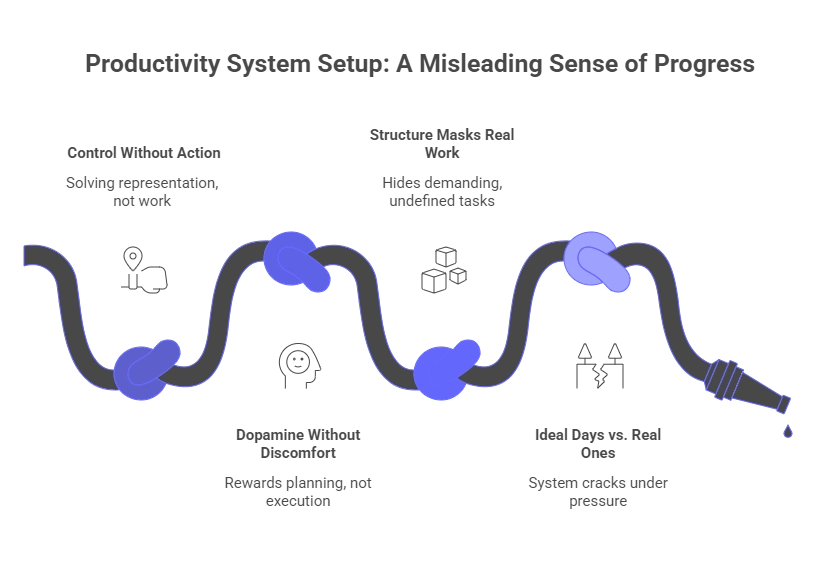
Setup Gives You Control Without Requiring Action
During setup, you’re solving a representation problem, not a work problem. You’re deciding where things go, not moving them forward. That distinction matters.
Organizing tasks creates a sense of control because uncertainty is reduced. You know what exists. You know where it lives. Your brain interprets that clarity as productivity, even though no execution has taken place yet. It’s satisfying because it’s safe. There’s no risk of failure, no hard thinking, no resistance to push through.
Control feels productive. Action is productive. The two just aren’t the same thing.
Planning Delivers Dopamine Without Discomfort
Planning rewards the brain quickly. You get the mental payoff of “being responsible” without the discomfort of starting difficult work. There’s no ambiguity, no judgment, and no chance of getting stuck.
Execution is different. It involves uncertainty, effort, and the possibility of doing something poorly. Setup lets you delay that moment while still feeling like you’re moving forward.
That’s why it’s easy to keep refining a system instead of using it. The reward loop is immediate and low-risk, and the brain learns to prefer it.
Structure Masks the Real Work Ahead
A well-organized system can hide how demanding the actual work is. Large, complex tasks look manageable once they’re neatly categorized, even if they haven’t been broken into actionable steps.
This creates a dangerous gap:
- The system looks calm and under control
- The work itself is still heavy and undefined
When it’s time to execute, that gap becomes obvious. Starting feels harder than expected, and the system that once felt helpful suddenly offers no support for how to begin.
Setup Happens on Ideal Days But Execution Happens on Real Ones
Set up usually happens in a quiet moment. You have time, focus, and energy. Execution rarely does.
Once normal work resumes, meetings, interruptions, and low-energy afternoons, the system has to survive conditions it wasn’t designed for. If it relies on sustained motivation or perfect focus, it starts to crack immediately.
That’s when engagement drops. Not because the system is wrong, but because it was built for a version of your day that doesn’t exist most of the time.
The Transition From Setup to Execution Is Where Systems Are Tested
A productivity system isn’t proven by how good it looks when everything is organized. It’s proven by how it behaves the moment you’re busy, distracted, or tired.
If the system doesn’t help you:
- Start small
- Choose what matters now
- Feel progress quickly
Execution is where productivity lives. And most systems stop supporting you right before you get there.
The Most Common Reasons Productivity Systems Break Down
Productivity systems rarely fail in dramatic ways. They don’t crash or suddenly stop working. Instead, they slowly lose relevance. You open them less often. Tasks stop moving. Eventually, the system feels disconnected from how you actually work, and you drift away.
These breakdowns are predictable. They happen for the same reasons, again and again.
- Complexity grows faster than usefulness: What starts as a simple setup accumulates views, rules, tags, and exceptions. Each added layer increases the mental effort required to use the system, until maintaining it feels heavier than the work itself.
- Tasks aren’t defined clearly enough to act on: Vague or oversized tasks create hesitation. When it’s unclear how to start or how much effort is required, the brain delays action, especially on busy or low-energy days.
- Everything competes for attention at once: Without a clear way to surface what matters now, urgent but low-impact work crowds out important tasks. The system lists work but doesn’t help you choose.
- The system collapses on imperfect days: Many systems assume steady motivation and focus. When energy drops or schedules change, consistency breaks, and restarting feels harder than quitting.
- Progress becomes invisible: When completed work simply disappears, effort feels unrewarded. Without visible momentum, engagement fades over time.
None of these failures mean that the user “did it wrong.” They mean the system wasn’t designed to support real-world execution.
Productivity systems break down when they stop helping you move forward, especially on the days when moving forward is hardest.
Why Systems Fail Without Feedback and Momentum
Even when tasks are clear and priorities are set, another problem emerges: progress becomes invisible.
Traditional systems are transactional. You complete a task, it disappears. There’s no accumulation, no sense that effort is adding up. Over time, this disconnect erodes motivation.
Without feedback:
- Effort feels unnoticed: Work doesn’t feel acknowledged once it’s done.
- Consistency feels pointless: Showing up daily doesn’t feel different than showing up occasionally.
- Momentum fades: There’s no reinforcement loop to keep engagement alive.
Momentum matters more than perfect organization. Systems that fail to create it are eventually abandoned.
What Makes a Productivity System Stick Over Time
Once you move past why systems fail, the real question becomes simpler: what actually lasts? Not what looks impressive during setup, not what promises total control, but what survives busy weeks, low-energy days, and shifting priorities.
Systems that stick don’t demand more discipline. They quietly remove the reasons people stop using them.
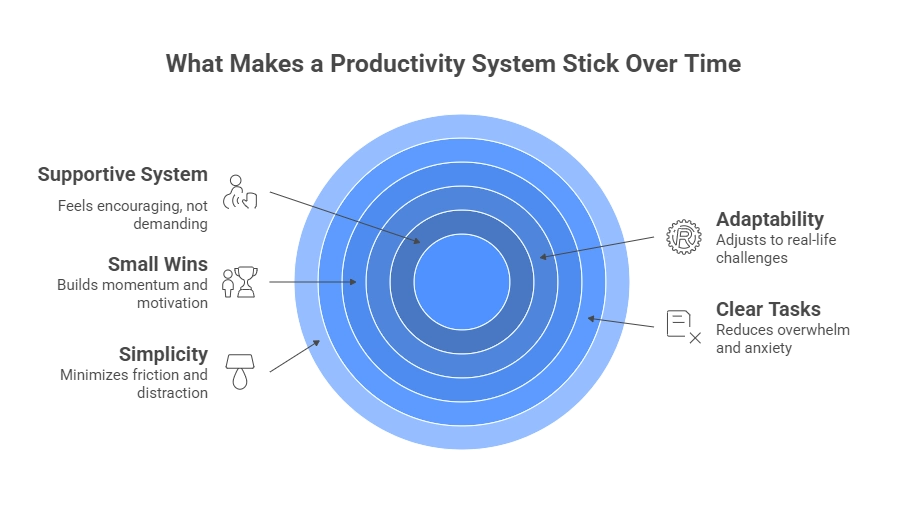
Simplicity Keeps the System Out of Your Way
The systems people return to are almost always the simplest ones. Not because simplicity is trendy, but because it lowers the mental cost of starting.
Think about the tools you’ve abandoned. Chances are, you didn’t stop using them because they were too basic. You stopped because they asked too many questions before you could begin: Which view? Which priority? Which filter?
A system that sticks feels obvious the moment you open it. You know where to look. You know what matters. There’s no setup tax before the work starts. When simplicity reduces cognitive load, starting something new becomes the default.
Clear Tasks Make Starting Feel Safe
Resistance often has nothing to do with motivation and everything to do with uncertainty. When a task feels vague or oversized, starting feels risky. You don’t know how long it will take, where to begin, or whether you have enough energy to finish.
Systems that stick replace ambiguity with clarity. Instead of “Work on proposal,” you see something like “Outline section two” or “Review client feedback.” The task tells you exactly what to do next.
That clarity changes behavior. Starting feels manageable, even on busy days. And when starting feels safe, progress happens more often than not.
Small Wins Create Momentum You Can Feel
Consistency isn’t built through big breakthroughs. It’s built through small wins that happen often enough to matter.
When effort is acknowledged, even in small ways, people keep going. Seeing progress accumulate reinforces the idea that showing up counts. That’s especially important during long projects where results aren’t immediate.
Think of the difference between finishing a task and seeing it disappear versus finishing a task and feeling like you’ve added something to your progress. One feels empty. The other feels motivating.
Systems that stick make progress visible, so effort never feels wasted.
Adaptability Keeps the System Alive on Real Days
The biggest test of any productivity system isn’t how it performs on a perfect day. It’s how it behaves when things go wrong.
Meetings run long. Energy drops. Plans change.
Systems that demand consistency collapse under those conditions. Systems that adapt survive them. They allow for smaller efforts on hard days. They make restarting feel normal instead of discouraging. They treat progress as cumulative, not fragile.
When a system bends instead of breaking, people trust it. And trust is what keeps them coming back.
The Systems That Stick Feel Supportive, Not Demanding
In the end, productivity systems that last don’t feel like something you have to keep up with. They feel like something that’s there for you.
They reduce friction instead of adding it. That’s what makes a system stick. Not perfection, but persistence.
How MagicTask Helps Productivity Systems Stick in Real Life
Most productivity systems fail not because people stop caring, but because the system stops supporting them once real work begins. MagicTask is designed around that exact gap. Instead of rewarding planning or perfect routines, it focuses on helping people keep going, especially on busy, imperfect days.
Here’s how MagicTask supports sustained use rather than short-lived setup excitement:
- Execution over configuration: You don’t need elaborate workflows or constant maintenance. Tasks are easy to add, easy to understand, and ready to act on immediately.
- Task sizing that respects real energy: S/M/L/XL task sizing helps you choose effort that fits the day you’re having, not the day you planned for. Smaller efforts still move progress forward.
- Visible progress that doesn’t disappear: Completed tasks contribute to XP and momentum, so effort feels cumulative rather than fleeting.
- Consistency without punishment: Missing a day doesn’t erase progress or break motivation. Restarting feels normal, not discouraging.
- A system that adapts instead of breaking: Whether days are busy, interrupted, or low-energy, the system continues to support forward movement.
Productivity systems stick when they feel supportive. MagicTask works because it’s designed around execution, momentum, and real life.
If your current system only works when everything goes right, it may be time to try one built for how work actually happens.
Conclusion
Productivity systems don’t fail because people lack motivation or discipline. They fail because they’re designed for ideal days, the quiet, focused ones that don’t reflect how work actually unfolds. Real days are busy, interrupted, and unpredictable, and most systems simply aren’t built to survive that reality.
Systems stick when they support execution instead of just planning, when progress is visible instead of fleeting, and when momentum is protected even on imperfect days. Clarity, adaptability, and reinforcement matter far more than complexity or feature depth.
If your current setup looks good but rarely gets used, it’s worth rethinking what you’re optimizing for. Choose MagicTask, which is designed for consistency and helps you keep going when motivation fades, and real work begins.
Similar Blogs

The Fresh Start Effect: Why Starting Small Helps You Build Better Habits
Have you ever felt a sudden urge to get your life together just because it was a Monday? Or the f
How to Use Leaderboards to Improve Team Performance
I’ve worked with enough teams to notice a pattern. People are doing great work, deadlines are met
Deep Work, Simplified: Cut the Noise and Focus on What Matters
Have you ever sat down at your desk, ready to get into the zone, only to find your attention pull
FAQS?Have questions? Look here
Most productivity systems fail because they focus on organization instead of execution. Setup creates a sense of control, but without clear next steps, visible progress, and adaptability for busy days, users stop engaging.
Planning and organizing tasks give a quick psychological reward without requiring real effort. Execution involves uncertainty and energy, so people delay it, even when the system looks perfect.
To make a productivity system stick, keep it simple, define tasks clearly, make progress visible, and design it for imperfect days. Systems that reduce friction and support small wins are more sustainable.
Momentum fades when progress becomes invisible. If completed tasks disappear and effort doesn’t accumulate, motivation drops. Systems that show cumulative progress help maintain engagement.
Consistency improves when tasks are clearly defined and small enough to start easily. Choosing effort levels that match your energy, especially on busy days, prevents burnout and system abandonment.

Make Work Feel Like Play
Follow Us


