
The Fresh Start Effect: Why Starting Small Helps You Build Better Habits
Have you ever felt a sudden urge to get your life together just because it was a Monday? Or the first day of a new month? That feeling isn’t random. Researchers at Wharton studied this phenomenon, called the Fresh Start Effect, and found that people feel more motivated to pursue goals right after moments that feel like a reset, such as a new week, birthday, or missed streak. Those moments help us mentally separate who we were from who we want to be
And that explains a lot. We wait for clean slates because they feel hopeful. They give us permission to try again without carrying yesterday’s mess into today. But if you’ve ever started strong and then quietly slipped back into old habits, you already know the problem. Motivation spikes fast, but it doesn’t stick on its own.
This post is about what actually makes fresh starts work. Not big promises or dramatic changes, but small, repeatable actions that turn “starting over” into real progress.
The Psychology Behind a Fresh Start
Fresh starts feel powerful because they tap into how the mind processes identity, time, and motivation. But that power comes from a few specific psychological shifts, and understanding them explains both why fresh starts feel so good and why they so often fade.
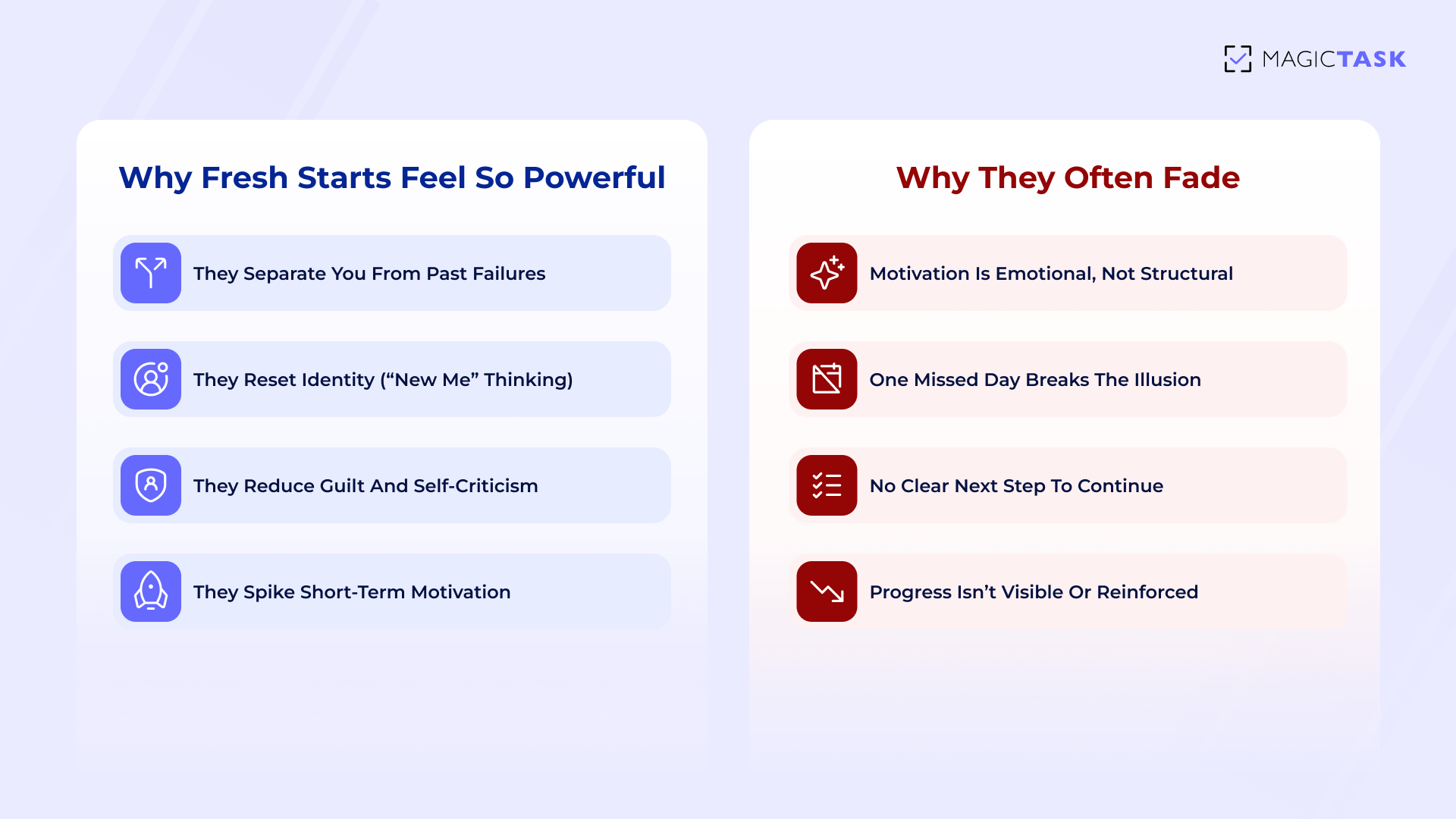
Fresh Starts Create Distance from Past Failures
When you decide to “start fresh,” your brain does something important: it puts space between you and your past behavior. Missed habits, broken streaks, and unfinished goals stop feeling like proof of who you are and start feeling like things that happened before this moment.
That distance matters. Guilt and self-criticism drain motivation quickly. A fresh start softens that internal pressure by mentally closing one chapter and opening another. You’re stepping into something new. That emotional reset makes action feel lighter and more possible.
They Help You Separate Your ‘Old Self’ from Your ‘New Self’
Fresh starts also work because they allow identity to reset. Instead of thinking, “I’m someone who never sticks to habits,” the mind shifts toward, “I’m becoming someone who’s trying again.”
This separation is subtle but powerful. Behavior change is easier when it aligns with who you believe you are becoming. A fresh start gives you permission to rewrite that story, even if nothing else has changed yet. The problem is that identity alone doesn’t carry behavior forward. Without follow-through, the new self never fully forms.
Motivation Spikes but It’s Fragile
The motivation that comes with a fresh start is real. It feels energizing, hopeful, even exciting. But it’s also temporary. Motivation is an emotional state, not a system. It’s strongest at the beginning, when everything feels clean and full of possibility.
As soon as effort is required, especially repeated effort, motivation begins to wobble. A missed day, a busy schedule, or a low-energy moment can quickly puncture that initial high. Without support, people interpret that drop as failure, even though it’s completely normal.
Without Structure, the Effect Fades Quickly
This is where most fresh starts fall apart. The feeling is there, but there’s nothing holding it in place. No clear next step. No scale that makes the habit feel doable. No feedback that reinforces progress.
Without structure, the mind drifts back to familiar patterns, not because the fresh start “didn’t work,” but because it wasn’t anchored. Motivation needs something to attach itself to. When fresh starts are paired with small, repeatable actions, they turn into momentum. When they aren’t, they turn into another reset waiting to happen.
The psychology is that fresh starts open the door, but systems decide whether you walk through it.
The Habit-Building Mistakes That Turn Fresh Starts Into Failures
Fresh starts often fail because the approach was too heavy. Right after a reset, motivation is high, and optimism takes over. That’s when people tend to aim big and unknowingly set themselves up for pressure they can’t sustain.
Here are some of the most common mistakes that quietly undo fresh starts:
- Trying to change everything at onceBig overhauls feel inspiring at first, but they create overwhelm fast. When too much depends on perfect execution, even one slip feels like the whole effort is broken.
- Treating missed days as failureSkipping a habit once isn’t a problem. Interpreting it as proof you “can’t stick with things” is. This mindset turns normal interruptions into emotional setbacks.
- All-or-nothing thinkingWhen progress only counts if it’s perfect, momentum disappears. One missed workout, one off-day, or one unfinished task can derail the entire habit.
- Starting at an unsustainable intensityHabits built on peak motivation rarely survive low-energy days. If the first step is too demanding, repetition becomes unlikely.
Fresh starts don’t fall apart because people lack discipline. They fall apart because the bar is set too high, too quickly. When the first step feels heavy, repeating it becomes harder, and the reset quietly fades.
The real key isn’t starting strong. It’s starting in a way you can return to, even on your worst day.
The Power of Small, Repeatable Actions
Big change feels exciting. Small change feels doable. And when it comes to building habits that actually last, doable wins every time. Small actions lower the mental barrier to starting. They just require showing up. And when showing up feels easy, repetition becomes possible.
This is where real momentum begins. Not with intensity, but with consistency.
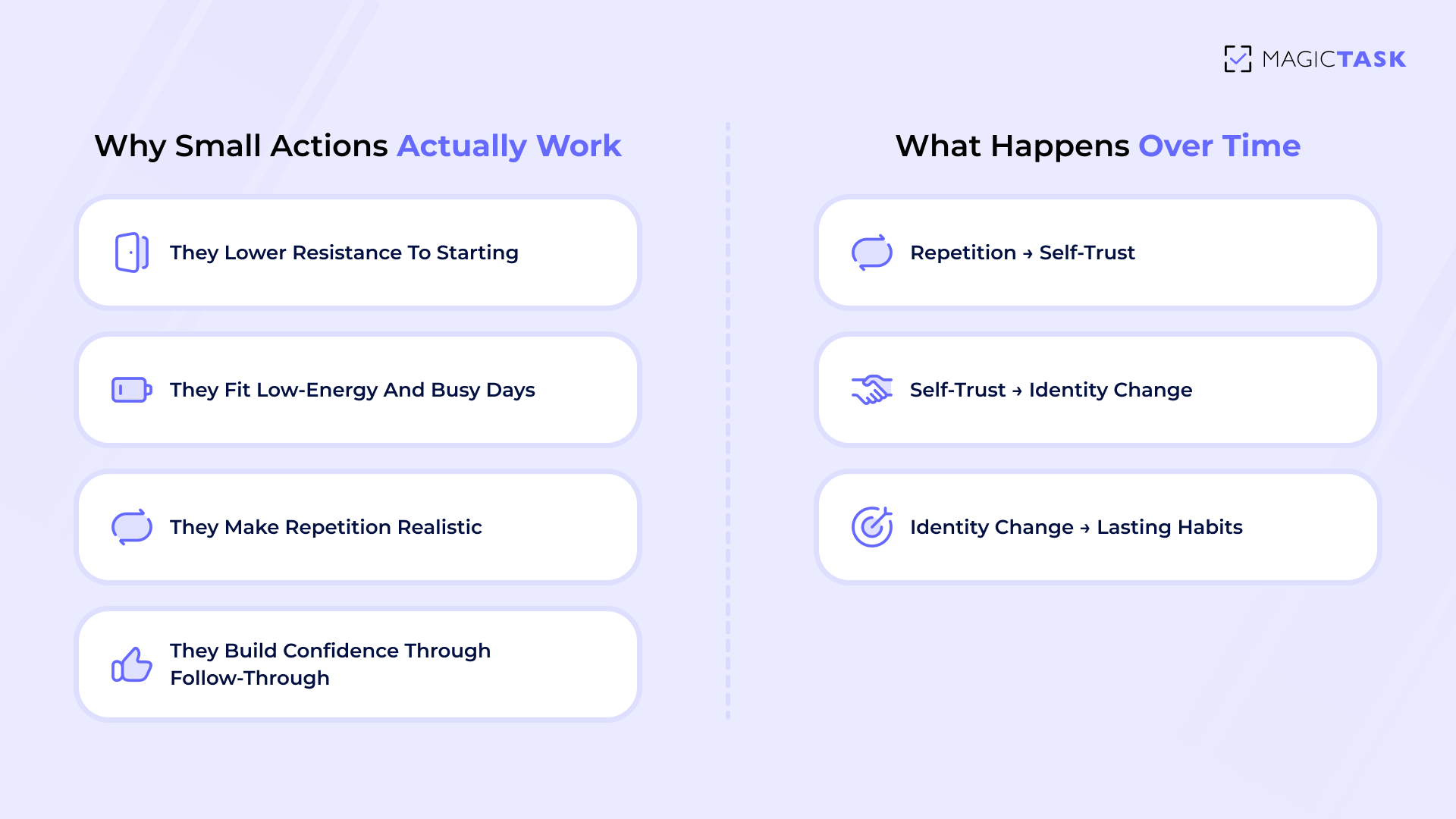
Small Actions Lower Resistance and Make Starting Easy
The hardest part of any habit is starting. Small actions shrink that resistance to almost nothing. A five-minute walk doesn’t trigger the same internal debate as an hour-long workout. Writing one paragraph doesn’t feel as heavy as “finish the entire draft.”
Because the step feels manageable, your brain stops pushing back. You don’t need to negotiate with yourself. You just begin. And once you begin, continuing becomes much easier.
Small actions remove the drama from progress. They turn “I should” into “I can.”
Repetition Builds Confidence and Identity
Confidence comes from keeping promises to yourself. Each time you complete a small action, you reinforce a quiet belief: I follow through.
Over time, that repetition reshapes identity. You stop seeing yourself as someone who “tries” to build habits and start seeing yourself as someone who simply does. That identity shift matters more than motivation ever could.
Repetition turns behavior into self-trust. And self-trust is what makes habits stick.
Early Wins Create Motivation Through Progress
Motivation follows action. Early wins provide proof that effort leads somewhere. Even little progress feels encouraging when it’s visible and consistent.
Those wins don’t need to be dramatic. They just need to be real.
- You showed up today
- You completed the task
- You moved forward, even slightly
That sense of progress fuels the next action. Momentum grows because progress feels tangible, not hypothetical.
Momentum Survives Low-Energy Days When Habits Feel Achievable
The true test of a habit is on your worst day. Small, repeatable actions are powerful because they still fit when energy is low, time is tight, or life gets messy.
When habits are designed to be achievable:
- Missed days don’t feel catastrophic
- Restarting feels natural
- Consistency survives imperfect weeks
Momentum doesn’t depend on feeling inspired. It depends on having a habit small enough to repeat, even when motivation is quiet.
That’s how habits stop breaking. And how progress keeps going.
How MagicTask Helps With The Fresh Start Effect
MagicTask is developed around the reality of habit-building, not the ideal version of it. Instead of demanding perfection, it helps you restart with clarity and momentum. Small actions feel valid. Progress feels visible. And showing up, even imperfectly, is still rewarded.
The result is a system that doesn’t just allow fresh starts, but actively supports them. Fresh starts stop being dramatic resets and start becoming something quieter and more powerful: a reliable way to keep going.
1. Starting Small With S/M/L/XL Tasks
One of the biggest reasons fresh starts fail is that the first step feels too heavy. Motivation might be high, but when the task itself feels overwhelming, resistance shows up fast. MagicTask’s S/M/L/XL task sizing solves this by helping you choose a starting point that actually fits your energy and context.
Instead of committing to an all-or-nothing habit, you decide the size of today’s effort. A habit can be as small as an S task on a low-energy day or scale up to L or XL when momentum builds. That flexibility makes starting feel safe instead of intimidating.
By validating small actions, MagicTask removes pressure from the beginning. You’re building consistency. And when consistency feels achievable, fresh starts stop feeling fragile and start turning into habits that last.
2. XP and Progress That Reward Showing Up
Fresh starts fall apart when progress feels invisible. You show up, put in effort, and yet it feels like nothing changed. MagicTask approaches motivation differently by rewarding presence and effort, not just perfect streaks or big outcomes.
Every time you complete a task, even a small one, you earn XP and see your progress move forward. That feedback matters. It tells your brain, this counts. Showing up today wasn’t wasted, even if it wasn’t your best day.
This approach shifts motivation away from pressure and toward encouragement:
- The effort is acknowledged immediately
- Small wins feel meaningful
- Progress builds even on imperfect days
Instead of waiting for motivation to return, progress itself becomes the motivator. By rewarding showing up, MagicTask helps fresh starts turn into steady momentum, one completed action at a time.
3. Streaks Without Punishment
Streaks can be motivating until they become a source of pressure. In many systems, missing a day feels like failure. One break, and the streak resets to zero, taking motivation down with it. That all-or-nothing framing is exactly what turns fresh starts into quiet exits.
MagicTask treats streaks differently. They’re designed to encourage consistency, not punish imperfection. Missing a day doesn’t erase your progress or undo the effort you’ve already put in. Instead of framing consistency as fragile, the system keeps momentum intact and makes it easy to continue.
This approach changes how streaks feel:
- They highlight patterns, not perfection
- They encourage returning, not quitting
- They support real life, not ideal routines
By removing punishment, streaks become a gentle nudge rather than a hard rule. And when restarting feels safe, people are far more likely to keep going.
4. Progress Cues That Reward Effort
One of the quiet reasons people abandon habits is that effort often goes unnoticed. You put in the work, but there’s no signal that it mattered. MagicTask solves this with progress cues that make effort visible.
Each completed task moves something forward. XP accumulates. Progress indicators change. Visual feedback confirms that your time and energy had an impact, even if the task itself was small. That recognition helps your brain connect effort with progress, which is essential for motivation to stick.
These cues make progress feel tangible. They reduce the urge to quit after slow days
When effort is consistently acknowledged, habits stop feeling fragile. Progress cues remind you that showing up counts, and that’s often all you need to keep going.
Conclusion
Fresh starts don’t fail because people lack motivation. They fail because the first step is often too big, too rigid, or too unforgiving to repeat. When restarting feels heavy or punishing, momentum disappears before it has a chance to build.
Starting small changes everything. Small actions lower resistance, reduce pressure, and make it easier to show up again tomorrow. When effort is acknowledged, missed days aren’t treated as failure, and progress stays visible, habits become something you return to.
MagicTask is built around this reality. It supports fresh starts without guilt, rewards effort over perfection, and helps small beginnings turn into steady progress.
Choose one tiny habit today. Start where you are. And let MagicTask help you turn that fresh start into something that finally lasts.
Similar Blogs
The Dopamine Trap: Why Some Gamified Apps Fail Users (and What Actually Works)
Gamified apps promise motivation. They promise streaks, badges, XP, and momentum. At first, it fe
The Productivity Reset Ritual: A 10-Minute Daily Routine to Stay Organized and Motivated
Have you ever ended a day feeling exhausted… but not accomplished? You answered emails. You jumpe
Why Gamification Works for Productivity in Modern Workflows
Gamification is often misunderstood. For many people, it brings to mind flashy rewards or surface
FAQS?Have questions? Look here
The Fresh Start Effect is a psychological phenomenon where people feel more motivated to pursue goals after meaningful time markers like Mondays, birthdays, New Year’s Day, or the start of a new month. These moments create a mental separation between past behavior and a new beginning, making change feel more possible.
Fresh starts feel motivating because they reduce guilt from past failures and allow people to reframe their identity. Instead of focusing on what didn’t work before, the brain views the moment as a clean slate, which boosts optimism and willingness to try again.
Motivation fades because it’s an emotional spike, not a system. Once the initial excitement wears off and effort is required, many people struggle to maintain momentum. Without structure, small setbacks like missed days can quickly derail progress.
Fresh starts can help, but only when paired with small, repeatable actions. On their own, fresh starts provide motivation, not sustainability. Habits stick when the starting point feels manageable and progress is reinforced consistently.
Common mistakes include trying to change everything at once, setting goals that are too intense, treating missed days as failure, and using all-or-nothing thinking. These approaches create pressure that makes habits difficult to repeat.
Small habits lower resistance and make starting easier. When actions feel achievable, people are more likely to repeat them. Over time, repetition builds confidence, strengthens identity, and creates momentum that survives low-energy days.
Consistency builds habits even when motivation is low. Motivation comes and goes, but systems built around small, repeatable actions make progress possible regardless of mood, energy, or schedule.
The key is removing punishment from missed days. Restarting works best when progress isn’t erased and effort still counts. Viewing habits as something you return to, rather than something you break, makes restarting feel natural instead of discouraging.
MagicTask supports fresh starts by encouraging small, flexible actions instead of all-or-nothing goals. Features like task sizing, XP rewards, and non-punitive streaks help motivation turn into steady momentum rather than short-lived enthusiasm.
Yes. MagicTask is designed for real life, not perfect routines. It rewards showing up, even on low-energy days, and makes progress visible so consistency feels achievable instead of overwhelming.

Make Work Feel Like Play
Follow Us


