
The Productivity Reset Ritual: A 10-Minute Daily Routine to Stay Organized and Motivated
Have you ever ended a day feeling exhausted… but not accomplished? You answered emails. You jumped between meetings. You handled urgent requests. You were busy the entire time. And yet, when you finally close your laptop, there’s this quiet thought in the back of your mind: What did I actually move forward today?
That feeling is the modern productivity trap. We start our days reacting instead of resetting. We open our inbox before we open our priorities. We let notifications decide what matters. And without meaning to, we spend the day managing noise instead of making progress.
You don’t need a new productivity system. You just need a short, consistent reset. A simple 10-minute daily ritual can clear mental clutter, realign your priorities, and rebuild momentum, even on your busiest days.
What Is a Productivity Reset Ritual?
A productivity reset ritual is a short, daily practice that clears mental clutter and realigns your priorities before you move deeper into work. It’s not a full planning session. It’s not a weekly overhaul. It’s simply a focused pause — a way to step back, reset your direction, and start with clarity instead of chaos.
Think of it as wiping the mental whiteboard clean.
During the day, open loops build up: half-finished thoughts, small tasks you meant to remember, worries about deadlines, ideas you haven’t captured yet. When those stay in your head, they compete for attention. A reset ritual moves them out of your mind and into a clear system so your brain can focus again.
Why 10 Minutes Works
Ten minutes feels small, and that’s exactly the point.
Long planning sessions sound productive, but often get skipped when you’re busy. A 10-minute reset is short enough to do even on low-energy days. The low friction makes consistency possible.
- Short duration: You don’t need motivation or ideal conditions to begin.
- Clear boundary: Time-boxing prevents overthinking and perfectionism.
- Daily repetition: Small resets done consistently beat occasional big overhauls.
When something feels achievable, you’re more likely to repeat it. And repetition is what turns clarity into habit.
Planning vs. Resetting: What’s the Difference?
Many people confuse resetting with planning. They’re not the same.
| Planning | Resetting |
|---|---|
| Focuses on long-term goals and future strategy | Focuses on today's clarity and immediate alignment |
| Often involves reorganizing systems or workflows | Involves clearing mental clutter and choosing priorities |
| Can become complex and time-consuming | Is short, simple, and time-boxed |
| Optimizes structure | Optimizes focus |
| Happens occasionally | Happens daily |
Planning asks, “What should I accomplish this month?”
Resetting asks, “What matters right now?”
The 10-Minute Reset Framework (Step-by-Step)
Now that you know what a productivity reset ritual is, let’s make it practical.
Minute 1–2: Clear the Mental Noise
Start by emptying your head.
Not organizing. Not prioritizing. Just extracting.
Open a blank space and do a rapid brain dump. Write down every task, worry, reminder, or loose idea floating in your mind. Big or small. Personal or professional. If it’s taking up mental space, it goes on the list.
- Unfinished tasks: Things you meant to do yesterday but didn’t.
- Lingering worries: Deadlines, conversations, follow-ups.
- Random ideas: Thoughts that keep resurfacing.
- Tiny reminders: The small tasks that quietly drain attention.
The goal isn’t structure. The goal is relief.
When everything lives in your head, it competes for attention. Once it’s captured in one place, your brain stops trying to hold onto it. You’ll already feel lighter by minute two.
Minute 3–4: Clean & Close
Now that everything is out of your head, it’s time to tidy it up — quickly.
This isn’t deep organizing. It’s fast refinement.
- Mark completed tasks: Acknowledge what’s already done so it stops lingering mentally.
- Delete irrelevant items: Remove things that no longer matter.
- Clarify vague tasks: Turn “Work on presentation” into “Draft slide outline.”
This step matters because ambiguity creates resistance. When tasks are unclear, starting feels heavy. When they’re specific, action feels possible.
By minute four, you’ve gone from mental clutter to a usable list.
Minute 5–6: Identify the “Big 3”
Now choose the three tasks that will define your day.
Not ten. Not everything. Just three.
- One high-impact task: The work that truly moves something forward.
- One supportive task: Something necessary but lighter in cognitive load.
- One quick win: A small, easily completable task to build early momentum.
This works because it balances pressure and progress. The high-impact task creates meaning. The supportive task keeps the momentum steady. The quick win builds confidence fast.
Instead of staring at a long list, you now have a focused starting line.
Minute 7–8: Time Block Intentionally
Next, assign realistic time slots to your Big 3.
This is about protecting intention.
- Assign clear windows: Decide roughly when each task will happen.
- Protect deep work time: Give your high-impact task uninterrupted space.
- Leave buffer space: Don’t overfill the day. Expect interruptions.
Time blocking forces commitment. When a task has a home on your calendar, it becomes harder to ignore.
You’re no longer hoping to get to it. You’ve decided when it happens.
Minute 9–10: Motivation Lock-In
The final step is small but powerful. Define today’s intention in one sentence. Something simple, like:
- “Today I move the proposal forward.”
- “Today I protect my focus.”
- “Today I finish what I start.”
Then briefly visualize completing your Big 3. Imagine closing the day knowing those tasks are done. That mental rehearsal strengthens follow-through.
If you want, add a quick reward trigger:
- A favorite playlist for deep work.
- A streak tracker you don’t want to break.
- A small end-of-day reward if the Big 3 are complete.
This final step connects clarity to emotion. And emotion is what sustains action. Ten minutes later, your day becomes intentional.
Why This Ritual Works (Psychology Behind It)
A reset ritual isn’t just “something productive you should do.” It solves real psychological challenges that slow people down every day, especially when work feels overwhelming. The science behind these effects helps explain why a short daily habit can change how your brain responds to tasks, decisions, and momentum.
Reduces Cognitive Load
Your brain has a limited mental capacity for processing information and maintaining focus. When too many tasks, open loops, and decisions accumulate, cognitive load increases, and your ability to think clearly decreases. A 2025 integrative review on decision fatigue found that repeated decision-making leads to reduced efficiency and impaired decision quality, highlighting how excess mental load can drain your cognitive resources over time.
By clearing mental noise in the first steps of your reset, you shift tasks out of your mind and into your system, freeing up precious mental space. This reduction in cognitive load makes it easier to stay focused and act without hesitation.
Replaces Decision Fatigue With Clarity
Decision fatigue describes how our decision-making quality declines after making many choices in a short period, a familiar experience in today’s task-heavy schedules. Studies estimate that an average adult makes tens of thousands of decisions a day, many of them small but mentally draining.
When your reset ritual helps you clarify what matters early, you reduce the number of spontaneous decisions your brain has to make later. Instead of choosing what to do next dozens of times throughout the day, you already have a clear structure to follow. That turns daily decision-making from draining to directional.
Builds Consistency Through Small Daily Wins
Psychological research shows that frequent small wins can significantly improve motivation and “inner work life,” the ongoing emotional experience of work.
When your reset ritual surfaces quick wins (like the “Big 3”), each completed step reinforces a sense of achievement. Those small wins give your brain a regular dopamine signal because progress has become visible. Over time, micro-successes build momentum and make consistency feel easier than hesitation.
Creates a Visible Sense of Progress
Humans are wired to respond to progress cues. When we see movement toward a goal, our engagement increases. This is one reason why games use progress bars, levels, and milestones: visible feedback drives motivation, not just the tasks themselves.
In the context of your reset ritual, capturing mental noise, clarifying tasks, and marking wins creates a sense of forward motion. This visible progress helps anchor your productivity, turning abstract intentions into something concrete you can measure and repeat.
Morning vs. Night: When Should You Do It?
The beauty of a productivity reset ritual is that it works at different times of day. What matters isn’t when you do it but that you do it consistently.
Some people need clarity before they begin. Others need closure before they rest. Your work style and energy patterns should guide the choice.
Here’s how to decide.
- Morning reset: clarity before actionStarting your day with the 10-minute ritual helps you move from reactive to intentional. Instead of opening the email first, you define your Big 3, protect focus time, and begin with direction. This works well if your mornings are your most focused hours and you want to control momentum early.
- Morning reset: reduced decision fatigue throughout the dayBy choosing priorities upfront, you eliminate constant “What should I work on next?” decisions. This is especially helpful in remote or flexible schedules where structure isn’t built in.
- Night reset: calm mind before sleepIf unfinished tasks tend to linger mentally, doing the ritual at the end of the day clears open loops. Capturing tomorrow’s priorities reduces rumination and makes it easier to disconnect.
- Night reset: smoother morning startWaking up to a pre-aligned plan lowers resistance. Instead of thinking through priorities half-awake, you step directly into action.
- Hybrid approach: light reset at night, deeper reset in the morningSome people prefer a quick capture and clean-up at night, followed by choosing the Big 3 in the morning when energy is higher.
The best option is the one you can repeat. If mornings feel rushed and chaotic, try evenings. If evenings feel drained and distracted, try mornings.
Common Mistakes to Avoid
Watch out for these common mistakes:
- Turning 10 minutes into 45: Expanding the ritual into a full planning session defeats its purpose. Keep it tight, focused, and time-boxed.
- Overloading the “Big 3”: Choosing three heavy, demanding tasks increases pressure instead of momentum. Balance impact with realism.
- Skipping it when you feel behind: The days you feel most overwhelmed are the days you need the reset most. Skipping reinforces chaos.
- Perfecting instead of extracting: Spending too much time organizing instead of clearing mental clutter slows the process.
- Planning without execution follow-through: A reset sets direction, but action still needs to happen. Don’t let the ritual become another form of productive procrastination.
Keep it simple. Keep it consistent.
Turning the Ritual Into a Habit
A reset ritual only works if it happens regularly. When it becomes part of your routine, you stop debating whether to do it. You just begin.
Here’s how to make that happen.
- Attach it to an existing trigger: Pair the reset with something you already do daily. After your first cup of coffee. Right before you open your inbox. During your shutdown routine at night. Habit stacking removes the need to remember. The trigger does the reminding.
- Track streaks for visibility: Seeing consecutive days builds momentum. Even a simple visual cue that says “Day 6” reinforces consistency and gives you something to protect.
- Use the “don’t miss twice” rule: Missing once is normal. Missing twice turns into a pattern. If you skip a day, make the next reset non-negotiable, even if it’s shorter than usual.
- Review weekly for pattern improvement: At the end of the week, look back. Were your Big 3 realistic? Did you overload certain days? Small adjustments improve the ritual without reinventing it.
Habits aren’t built through intensity. They’re built through repetition. When the reset becomes automatic, clarity becomes automatic too.
Conclusion: Control the Start, Control the Day
When you begin your day scattered, the rest of the day follows. When you begin with clarity, intention, and a defined focus, momentum builds naturally. Ten deliberate minutes can shift everything, from reactive busyness to meaningful progress.
The productivity reset ritual works because it’s simple. It clears mental noise. It reduces decision fatigue. It helps you choose what matters. And it gives you small wins that carry you forward.
You don’t need a new system every time things feel messy. You just need a reset.
If you want a clean, distraction-free space to run this ritual daily, try it inside MagicTask. Its simple interface, task clarity, and visible progress cues make resetting effortless.
Start with one 10-minute reset tomorrow. Control the start, and you’ll control the day.
Have you ever ended a day feeling exhausted… but not accomplished? You answered emails. You jumped between meetings. You handled urgent requests. You were busy the entire time. And yet, when you finally close your laptop, there’s this quiet thought in the back of your mind: What did I actually move forward today?
That feeling is the modern productivity trap. We start our days reacting instead of resetting. We open our inbox before we open our priorities. We let notifications decide what matters. And without meaning to, we spend the day managing noise instead of making progress.
You don’t need a new productivity system. You just need a short, consistent reset. A simple 10-minute daily ritual can clear mental clutter, realign your priorities, and rebuild momentum, even on your busiest days.
What Is a Productivity Reset Ritual?
A productivity reset ritual is a short, daily practice that clears mental clutter and realigns your priorities before you move deeper into work. It’s not a full planning session. It’s not a weekly overhaul. It’s simply a focused pause — a way to step back, reset your direction, and start with clarity instead of chaos.
Think of it as wiping the mental whiteboard clean.
During the day, open loops build up: half-finished thoughts, small tasks you meant to remember, worries about deadlines, ideas you haven’t captured yet. When those stay in your head, they compete for attention. A reset ritual moves them out of your mind and into a clear system so your brain can focus again.
Why 10 Minutes Works
Ten minutes feels small, and that’s exactly the point.
Long planning sessions sound productive, but often get skipped when you’re busy. A 10-minute reset is short enough to do even on low-energy days. The low friction makes consistency possible.
- Short duration: You don’t need motivation or ideal conditions to begin.
- Clear boundary: Time-boxing prevents overthinking and perfectionism.
- Daily repetition: Small resets done consistently beat occasional big overhauls.
When something feels achievable, you’re more likely to repeat it. And repetition is what turns clarity into habit.
Planning vs. Resetting: What’s the Difference?
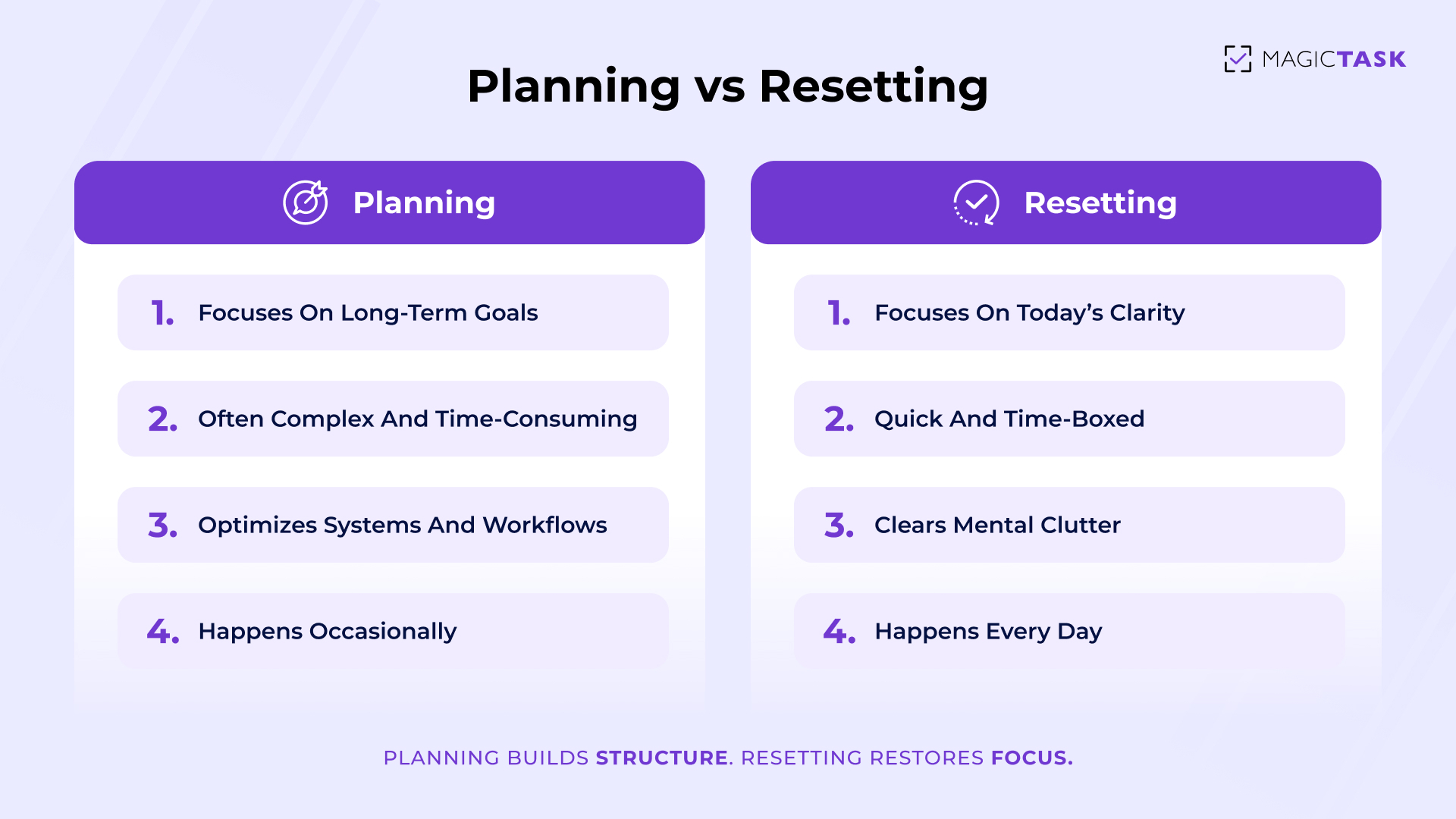
Many people confuse resetting with planning. They’re not the same.
| Planning | Resetting |
|---|---|
| Focuses on long-term goals and future strategy | Focuses on today’s clarity and immediate alignment |
| Often involves reorganizing systems or workflows | Involves clearing mental clutter and choosing priorities |
| Can become complex and time-consuming | Is short, simple, and time-boxed |
| Optimizes structure | Optimizes focus |
| Happens occasionally | Happens daily |
Planning asks, “What should I accomplish this month?”
Resetting asks, “What matters right now?”
The 10-Minute Reset Framework (Step-by-Step)
Now that you know what a productivity reset ritual is, let’s make it practical.
Minute 1–2: Clear the Mental Noise
Start by emptying your head.
Not organizing. Not prioritizing. Just extracting.
Open a blank space and do a rapid brain dump. Write down every task, worry, reminder, or loose idea floating in your mind. Big or small. Personal or professional. If it’s taking up mental space, it goes on the list.
- Unfinished tasks: Things you meant to do yesterday but didn’t.
- Lingering worries: Deadlines, conversations, follow-ups.
- Random ideas: Thoughts that keep resurfacing.
- Tiny reminders: The small tasks that quietly drain attention.
The goal isn’t structure. The goal is relief.
When everything lives in your head, it competes for attention. Once it’s captured in one place, your brain stops trying to hold onto it. You’ll already feel lighter by minute two.
Minute 3–4: Clean & Close
Now that everything is out of your head, it’s time to tidy it up — quickly.
This isn’t deep organizing. It’s fast refinement.
- Mark completed tasks: Acknowledge what’s already done so it stops lingering mentally.
- Delete irrelevant items: Remove things that no longer matter.
- Clarify vague tasks: Turn “Work on presentation” into “Draft slide outline.”
This step matters because ambiguity creates resistance. When tasks are unclear, starting feels heavy. When they’re specific, action feels possible.
By minute four, you’ve gone from mental clutter to a usable list.
Minute 5–6: Identify the “Big 3”
Now choose the three tasks that will define your day.
Not ten. Not everything. Just three.
- One high-impact task: The work that truly moves something forward.
- One supportive task: Something necessary but lighter in cognitive load.
- One quick win: A small, easily completable task to build early momentum.
This works because it balances pressure and progress. The high-impact task creates meaning. The supportive task keeps the momentum steady. The quick win builds confidence fast.
Instead of staring at a long list, you now have a focused starting line.
Minute 7–8: Time Block Intentionally
Next, assign realistic time slots to your Big 3.
This is about protecting intention.
- Assign clear windows: Decide roughly when each task will happen.
- Protect deep work time: Give your high-impact task uninterrupted space.
- Leave buffer space: Don’t overfill the day. Expect interruptions.
Time blocking forces commitment. When a task has a home on your calendar, it becomes harder to ignore.
You’re no longer hoping to get to it. You’ve decided when it happens.
Minute 9–10: Motivation Lock-In
The final step is small but powerful. Define today’s intention in one sentence. Something simple, like:
- “Today I move the proposal forward.”
- “Today I protect my focus.”
- “Today I finish what I start.”
Then briefly visualize completing your Big 3. Imagine closing the day knowing those tasks are done. That mental rehearsal strengthens follow-through.
If you want, add a quick reward trigger:
- A favorite playlist for deep work.
- A streak tracker you don’t want to break.
- A small end-of-day reward if the Big 3 are complete.
This final step connects clarity to emotion. And emotion is what sustains action. Ten minutes later, your day becomes intentional.
Why This Ritual Works (Psychology Behind It)
A reset ritual isn’t just “something productive you should do.” It solves real psychological challenges that slow people down every day, especially when work feels overwhelming. The science behind these effects helps explain why a short daily habit can change how your brain responds to tasks, decisions, and momentum.
Reduces Cognitive Load
Your brain has a limited mental capacity for processing information and maintaining focus. When too many tasks, open loops, and decisions accumulate, cognitive load increases, and your ability to think clearly decreases. A 2025 integrative review on decision fatigue found that repeated decision-making leads to reduced efficiency and impaired decision quality, highlighting how excess mental load can drain your cognitive resources over time.
By clearing mental noise in the first steps of your reset, you shift tasks out of your mind and into your system, freeing up precious mental space. This reduction in cognitive load makes it easier to stay focused and act without hesitation.
Replaces Decision Fatigue With Clarity
Decision fatigue describes how our decision-making quality declines after making many choices in a short period, a familiar experience in today’s task-heavy schedules. Studies estimate that an average adult makes tens of thousands of decisions a day, many of them small but mentally draining.
When your reset ritual helps you clarify what matters early, you reduce the number of spontaneous decisions your brain has to make later. Instead of choosing what to do next dozens of times throughout the day, you already have a clear structure to follow. That turns daily decision-making from draining to directional.
Builds Consistency Through Small Daily Wins
Psychological research shows that frequent small wins can significantly improve motivation and “inner work life,” the ongoing emotional experience of work.
When your reset ritual surfaces quick wins (like the “Big 3”), each completed step reinforces a sense of achievement. Those small wins give your brain a regular dopamine signal because progress has become visible. Over time, micro-successes build momentum and make consistency feel easier than hesitation.
Creates a Visible Sense of Progress
Humans are wired to respond to progress cues. When we see movement toward a goal, our engagement increases. This is one reason why games use progress bars, levels, and milestones: visible feedback drives motivation, not just the tasks themselves.
In the context of your reset ritual, capturing mental noise, clarifying tasks, and marking wins creates a sense of forward motion. This visible progress helps anchor your productivity, turning abstract intentions into something concrete you can measure and repeat.
Morning vs. Night: When Should You Do It?
The beauty of a productivity reset ritual is that it works at different times of day. What matters isn’t when you do it but that you do it consistently.
Some people need clarity before they begin. Others need closure before they rest. Your work style and energy patterns should guide the choice.
Here’s how to decide.
- Morning reset: clarity before actionStarting your day with the 10-minute ritual helps you move from reactive to intentional. Instead of opening the email first, you define your Big 3, protect focus time, and begin with direction. This works well if your mornings are your most focused hours and you want to control momentum early.
- Morning reset: reduced decision fatigue throughout the dayBy choosing priorities upfront, you eliminate constant “What should I work on next?” decisions. This is especially helpful in remote or flexible schedules where structure isn’t built in.
- Night reset: calm mind before sleepIf unfinished tasks tend to linger mentally, doing the ritual at the end of the day clears open loops. Capturing tomorrow’s priorities reduces rumination and makes it easier to disconnect.
- Night reset: smoother morning startWaking up to a pre-aligned plan lowers resistance. Instead of thinking through priorities half-awake, you step directly into action.
- Hybrid approach: light reset at night, deeper reset in the morningSome people prefer a quick capture and clean-up at night, followed by choosing the Big 3 in the morning when energy is higher.
The best option is the one you can repeat. If mornings feel rushed and chaotic, try evenings. If evenings feel drained and distracted, try mornings.
Common Mistakes to Avoid
Watch out for these common mistakes:
- Turning 10 minutes into 45: Expanding the ritual into a full planning session defeats its purpose. Keep it tight, focused, and time-boxed.
- Overloading the “Big 3”: Choosing three heavy, demanding tasks increases pressure instead of momentum. Balance impact with realism.
- Skipping it when you feel behind: The days you feel most overwhelmed are the days you need the reset most. Skipping reinforces chaos.
- Perfecting instead of extracting: Spending too much time organizing instead of clearing mental clutter slows the process.
- Planning without execution follow-through: A reset sets direction, but action still needs to happen. Don’t let the ritual become another form of productive procrastination.
Keep it simple. Keep it consistent.
Turning the Ritual Into a Habit
A reset ritual only works if it happens regularly. When it becomes part of your routine, you stop debating whether to do it. You just begin.
Here’s how to make that happen.
- Attach it to an existing trigger: Pair the reset with something you already do daily. After your first cup of coffee. Right before you open your inbox. During your shutdown routine at night. Habit stacking removes the need to remember. The trigger does the reminding.
- Track streaks for visibility: Seeing consecutive days builds momentum. Even a simple visual cue that says “Day 6” reinforces consistency and gives you something to protect.
- Use the “don’t miss twice” rule: Missing once is normal. Missing twice turns into a pattern. If you skip a day, make the next reset non-negotiable, even if it’s shorter than usual.
- Review weekly for pattern improvement: At the end of the week, look back. Were your Big 3 realistic? Did you overload certain days? Small adjustments improve the ritual without reinventing it.
Habits aren’t built through intensity. They’re built through repetition. When the reset becomes automatic, clarity becomes automatic too.
Conclusion: Control the Start, Control the Day
When you begin your day scattered, the rest of the day follows. When you begin with clarity, intention, and a defined focus, momentum builds naturally. Ten deliberate minutes can shift everything, from reactive busyness to meaningful progress.
The productivity reset ritual works because it’s simple. It clears mental noise. It reduces decision fatigue. It helps you choose what matters. And it gives you small wins that carry you forward.
You don’t need a new system every time things feel messy. You just need a reset.
If you want a clean, distraction-free space to run this ritual daily, try it inside MagicTask. Its simple interface, task clarity, and visible progress cues make resetting effortless.
Start with one 10-minute reset tomorrow. Control the start, and you’ll control the day.
Similar Blogs


The Dopamine Trap: Why Some Gamified Apps Fail Users (and What Actually Works)
Gamified apps promise motivation. They promise streaks, badges, XP, and momentum. At first, it fe

Why Gamification Works for Productivity in Modern Workflows
Gamification is often misunderstood. For many people, it brings to mind flashy rewards or surface
How Gamified Productivity Tools Solve Task Fatigue (and Keep Teams Engaged)
You’re already buried every Monday with deadlines, messages, meetings, and a dozen priorities fig
FAQS?Have questions? Look here
Planning focuses on long-term goals, strategies, and organizing systems to move toward future outcomes. Resetting focuses on the present moment by clearing mental clutter, reassessing priorities, and creating clarity for the day ahead. While planning looks forward, resetting helps you realign and regain focus right now.
Resetting helps reduce overwhelm and improves focus by simplifying what needs attention today. Instead of constantly planning or reorganizing systems, a reset allows you to pause, clear distractions, and choose the most important tasks for the moment.
A reset can be done once or multiple times a day depending on your workflow. Many people benefit from a short reset in the morning, midday, or at the end of the workday to regain clarity and realign priorities.
Yes. Planning and resetting serve different purposes. Planning helps define long-term direction and structure, while resetting keeps you focused and aligned with immediate priorities. Using both together creates a balanced productivity system.
Constant planning can become complex and time-consuming. Resetting, on the other hand, is simple and time-boxed. It allows you to quickly refocus, reduce mental clutter, and move forward with clear priorities.

Make Work Feel Like Play
Follow Us


