
Next-Gen Gamification: What 2026 holds for task management tools
Gamification used to be simple; add a badge here, a streak there, and call it “engaging.” But that phase didn’t last long. We got the badges, we smiled once, and then we ignored them forever.
Now things are changing. And it’s not subtle.
A recent study found that when gamification taps into real human needs, like autonomy, progress, and satisfaction, engagement rises dramatically. In other words, people don’t want points…. They want a purpose.
It makes total sense. Work is more demanding, and nobody wants tools that feel robotic or cold. We want something that keeps us moving, reminds us of our progress, and actually feels good to use.
That’s why the next generation of gamified productivity is about emotion, identity, and connection. And with MagicTask’s design built around progress, personalization, and community, we’re already stepping into that future.
The Evolution of Gamification in Work Tools
Before we look ahead to what 2026 will bring, let’s rewind for a moment and see how far gamification has already come.
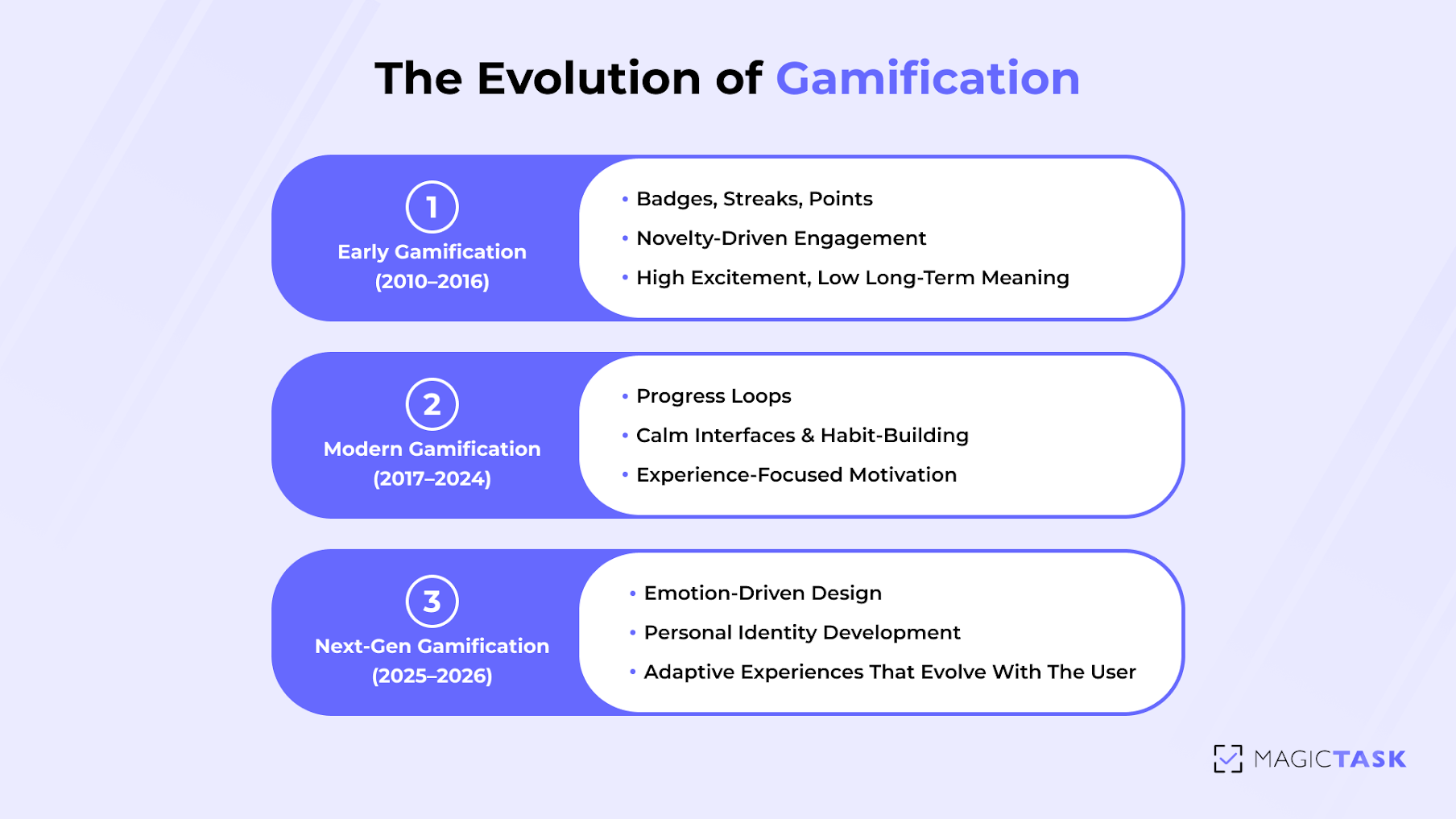
Early Gamification
If you rewind a decade, gamification looked a lot like giving out gold stars in elementary school. Companies were experimenting with “fun,” but most of it was surface-level.
You remember the era:
- Foursquare turned checking into places into a race for badges and mayorships.
- Fitbit made steps feel like a game long before “10K a day” went mainstream.
- Duolingo introduced streaks and XP, and suddenly everyone thought they were at least kind of learning French.
- Even early workplace tools tried to sprinkle in leaderboards, hoping competition would magically fix motivation.
And guess what? It worked… but only for a while.
People loved the rush of earning a badge or watching a streak climb. These were the training wheels of gamification, and honestly, they’re a bit addictive.
But here’s the thing no one said out loud at the time: Points kept us engaged, but they didn’t keep us connected.
You know the streak you maintain with your friends on Snapchat? It’s a rush when you see the points, but what happens when you see those points don’t actually get you anything? The novelty wears off. The badge walls blended together. What we gained in quick engagement, we lost in long-term meaning.
Early gamification taught the world that motivation can be sparked by rewards, but it can only be sustained by purpose.
And that realization is exactly what pushed gamification into its next phase, one where the experience matters more than the badgebook.
Modern Gamification
As the shine wore off early gamification, something interesting happened. People didn’t want more badges; they wanted better ones. Badges tied to progress. Points tied to meaning. Motivation tied to something that actually felt human;
That’s when modern gamification began to take shape.
Companies started shifting their approach:
- Headspace replaced streak obsession with gentle encouragement and “You showed up today” messages.
- Strava moved beyond trophies and leaned into storytelling. Your runs became part of a larger narrative, not just a number.
- Notion brought in playful emojis, minimal design, and a calm interface to make organization feel less like a chore.
And then there’s MagicTask, which took a different approach entirely. Instead of “gamifying productivity” in the traditional sense, it leaned into progress loops, the feeling you get when a theme levels up, when XP jumps after completing a task, when your workspace reacts to what you’ve accomplished. It’s gamification that resonates.
Instead of gamifying for excitement, teams began designing for experience:
- Was the tool calming or overwhelming?
- Did it make people feel capable, or guilty?
- Was progress visible in a way that felt satisfying, not stressful?
Modern gamification became less about chasing the next star and more about creating an environment that gently nudges you toward consistency, the kind of consistency that builds actual habits, not just a high score.
And that shift laid the foundation for what’s coming next. Which brings us to where things are headed in 2026.
Next-Gen Gamification
If early gamification was about excitement, and modern gamification is about experience, the next era is about emotion.
People aren’t looking for productivity apps that “keep them on track.” They want tools that feel supportive, energizing, and genuinely aligned with who they are. That shift is already shaping the next generation of gamification.
Future task tools will focus on things like:
- Emotional cues that match energy levels
- Visual styles that reflect personal taste and creativity
- Workflows that adapt to your rhythm instead of forcing you into rigid structures
Instead of earning points for completing tasks, users will build a sense of personal identity:
“This is how I work. This is who I am becoming.”
This is where MagicTask is already ahead. Instead of pushing users through a strict achievement system, it creates an environment where progress feels natural: themes that change with you, feedback that responds instantly, and a workspace that feels more like a companion than a dashboard.
The next wave of gamification will deepen that relationship, blending motivation with emotion, and turning productivity into something that feels personal, intuitive, and even a little bit comforting.
And as we move closer to 2026, that emotional connection will become the difference between a tool you “use”… and a tool you actually return to.
The Shift from Rewards to Meaningful Motivation
For years, gamification revolved around collecting things. And while those rewards were fun at first, people don’t stay motivated by trinkets… they stay motivated by meaning.
Today’s users want tools that make their work matter. Not just another XP bump or shiny badge, but a feeling that their effort connects to something bigger, like progress, growth, identity, and momentum.
It’s the difference between:
- “You earned 10 points.” and
- “You moved closer to becoming the person you want to be.”
One is a reward. The other is a reminder.
This shift is backed by psychology. Researchers have found that external rewards trigger short bursts of effort, while intrinsic motivation creates behaviors that last. Think about it. You don’t read 20 books a year because someone gave you a sticker. You do it because each page feels like a step toward the version of you you’re proud of.
And this is where next-gen gamification is headed.
Future tools will lean into:
- Emotional satisfaction → feedback that feels earned and personal
- Identity-building → a visual journey that reflects who the user is becoming
- Personal growth loops → small wins that stack into real transformation
- Reflective progress → users seeing not just what they did, but who it’s shaping them into
MagicTask already understands this. Instead of bombarding users with badges, it uses:
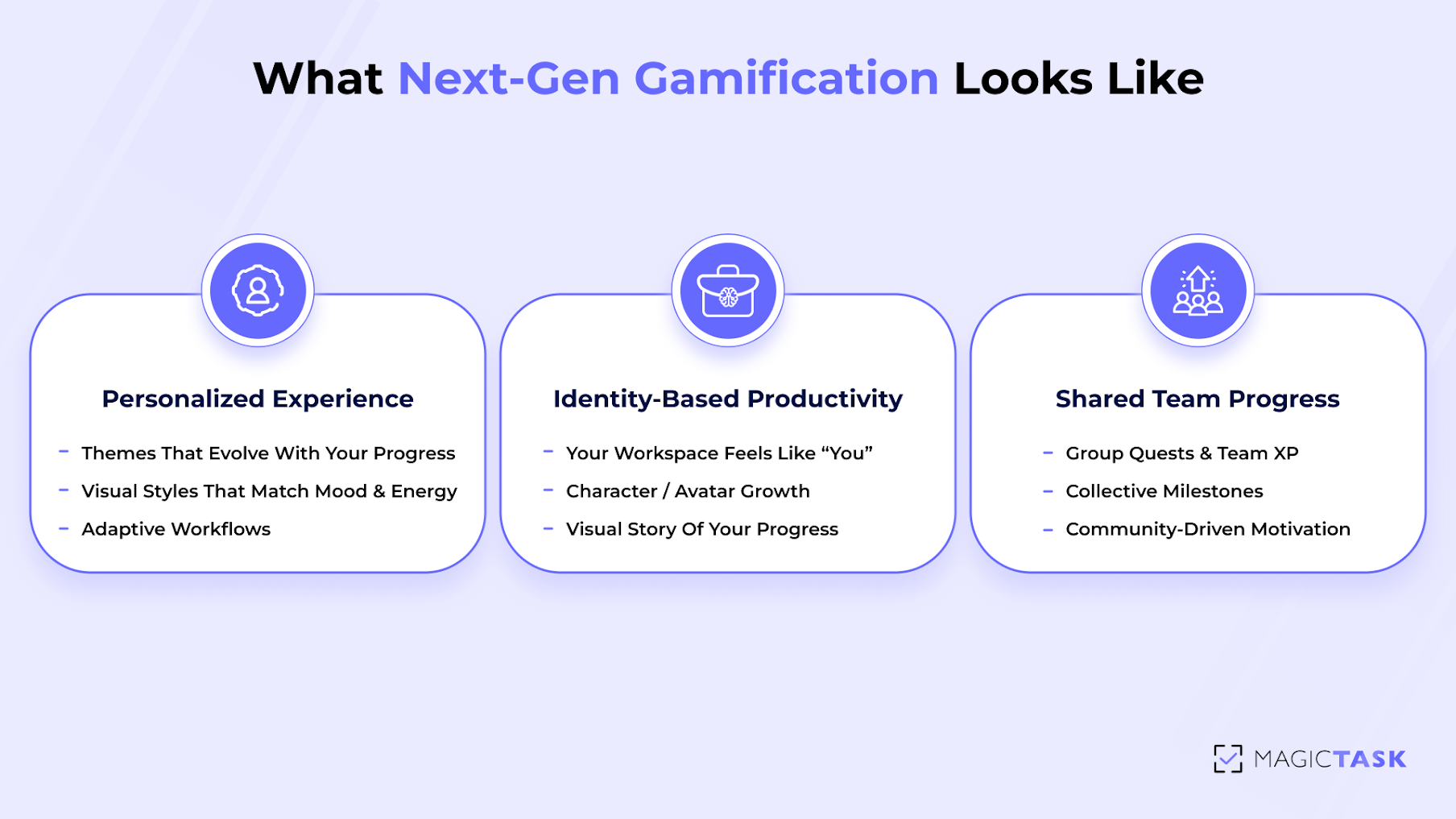
- Themes that evolve with you
- XP that feels like personal momentum, not a scoreboard
- Sound and visual cues that quietly say, “Nice. Keep going.”
- Progress loops that make even small wins feel like steps forward
The impact is subtle but powerful: Meaning, not mechanics, is becoming the heartbeat of gamified productivity. And it’s a shift that will define the next era of work tools.
Personalization and Experience Design
If early productivity tools felt like spreadsheets and modern tools feel like clean dashboards, the future will feel more like stepping into a space that’s yours. A place that understands how you work, what motivates you, and even how you’re feeling that day.
That’s the direction task management is headed.
People want a workspace that reflects their personality, their pace, and their preferences. A tool that feels almost like a companion rather than an application.
Imagine opening your task app and it adapts instantly:
- The theme shifts based on your energy level
- Your interface brightens or calms depending on your mood
- Your “quest board” evolves as your goals evolve
- Your avatar grows with you, visually tracking your commitment
This is where next-gen gamification is going: identity-driven productivity.
You’ll build a visual story of your progress. You’ll see your “character” level up, your themes evolve, your achievements stack into a narrative that feels deeply personal.
We already see hints of this future in MagicTask’s design:
- Themes that level up with your workflow
- Custom visuals that match your style
- Subtle sound cues that reinforce rhythm and focus
- An interface that feels alive, not static
It’s not personalization for the sake of aesthetics. It’s personalization that helps people feel connected to their work. It reinforces ownership. It turns your daily grind into something that looks and feels like you.
Because when a tool understands you, you naturally want to grow with it.
The Rise of Shared Progress and Team Gamification
One of the most exciting shifts coming to gamified productivity is the move from solo progress to shared progress. Because work rarely happens alone. And motivation? It multiplies when people feel like they’re part of something bigger than themselves.
The future of gamification is social.
Think less “everyone for themselves” and more “we’re leveling up together.” Teams will take on shared quests, unlock group achievements, and celebrate collective wins. Finishing a sprint will feel like completing a mission as a squad.
Picture this:
- A marketing team earns XP together for launching a campaign
- A customer success squad is hitting a group milestone for response time
- A product team completing a “Feature Quest” and unlocking a team reward
- Company-wide leaderboards where the goal isn’t competition, but community
Work becomes a multiplayer game in a way that reinforces collaboration, alignment, and shared accountability.
With shared boards, team visibility, and progress tracking that everyone can see, teams stay connected to each other’s efforts. When someone moves a task forward, everyone feels the momentum.
As we move toward 2026, this idea of collective gamification will only grow stronger.
Conclusion
The future of gamification isn’t about stacking up badges or chasing louder animations. It’s about shaping work in a way that feels engaging, meaningful, and deeply human. A workspace that doesn’t just organize your tasks, but energizes you. A system that rewards progress, not just completion.
MagicTask is already stepping into that future. It transforms everyday tasks into a journey, one filled with momentum, shared wins, and progress you can actually feel. It’s not just a tool; it’s the evolution of how we stay motivated and connected in the modern world.
If you want to see where gamified productivity is headed, try MagicTask and experience it firsthand. Start today, join the movement, and be part of what’s next.
Similar Blogs
Gamified Productivity: Supporting Mental Well-Being Without Burnout
You don’t clock out of your mind when you log into work. Your mental health walks right in with y
The Dopamine Trap: Why Some Gamified Apps Fail Users (and What Actually Works)
Gamified apps promise motivation. They promise streaks, badges, XP, and momentum. At first, it fe
The Productivity Reset Ritual: A 10-Minute Daily Routine to Stay Organized and Motivated
Have you ever ended a day feeling exhausted… but not accomplished? You answered emails. You jumpe
FAQS?Have questions? Look here
Next-generation gamification focuses on emotional connection, personalization, and adaptive experiences rather than simple points or badges. It creates a more human-centered, motivating workflow.
Early gamification relied on streaks, badges, and competition. By 2026, the focus shifts to purpose-driven motivation, identity building, personalized experiences, and emotional feedback that enhances long-term engagement.
Badges create quick engagement but fade over time when they lack meaning. Modern users want purpose, progress, and tools that reflect personal growth—lasting motivation comes from intrinsic rewards, not novelty.
Future tools will adapt to user behavior, mood, and work style. Interfaces may change based on energy levels, themes may evolve as users grow, and workflows will adjust to each person’s natural rhythm.
Emotional design will make productivity apps feel supportive and intuitive. Instead of rigid structures, apps will offer feedback, visuals, and cues that match users’ emotions, helping them stay motivated and connected.
Team-based gamification will introduce shared quests, group XP, and collective achievements. This strengthens alignment, boosts morale, and turns collaboration into a rewarding, multiplayer experience.
Meaningful motivation supports long-term habit building. When users feel their work contributes to identity, growth, and purpose, they return to the tool naturally—not because of external rewards.
MagicTask already integrates progress-focused XP, evolving themes, personalization, and an emotionally engaging workspace. It emphasizes motivation through meaningful progress rather than superficial rewards.
Yes. With emotional cues, personalized environments, and identity-driven design, future task tools will make work feel more engaging, supportive, and satisfying—not just productive.
Expect deeper personalization, adaptive interfaces, emotional feedback loops, identity-building systems, and shared team-based gamification experiences that turn work into a collaborative journey.

Make Work Feel Like Play
Follow Us


