
New Year, New Habits: Stick to Your Goals with MagicTask
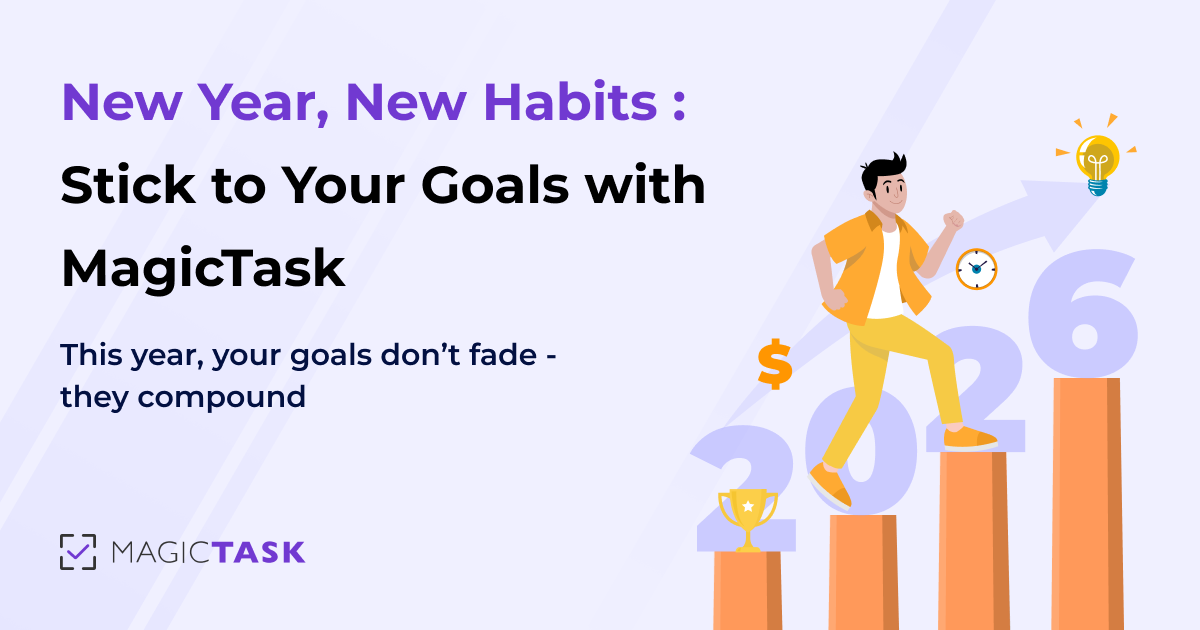
Every January feels the same, doesn’t it? We start the year with bold plans and a full tank of optimism. This will be the year we finally get fit, learn the language, fix our routines, read more books, sleep better, eat healthier… the list goes on.
But by February, most of that excitement slips. In fact, 80% of New Year’s resolutions fail before the second month, because motivation was doing all the heavy lifting. And motivation, as we all know, is a terrible long-term strategy. Life gets busy, and even the best intentions start to wobble.
What you needed was a structure that made the goal easier to follow, one small step at a time. MagicTask brings that structure. It turns daily habits into something visible, rewarding, and surprisingly fun with satisfying progress loops. And when small actions feel meaningful, they stick.
If you’re ready to make this the year your habits finally last, let’s talk about why resolutions fall apart… and how to rebuild them in a way that actually works.
Why Most New Year's Resolutions Fail
By now, you’ve probably learned that it’s not the idea of a resolution that trips you up; it’s everything that happens after the excitement fades. And it usually fades fast because most resolutions are built on a shaky foundation from the start.
A big part of the problem is that resolutions tend to live in our heads as fantasy versions of our future selves. We imagine the outcome, the healthier, calmer, more organized us, but we don’t build a bridge between today and that version. The goal is clear, but the path is not.
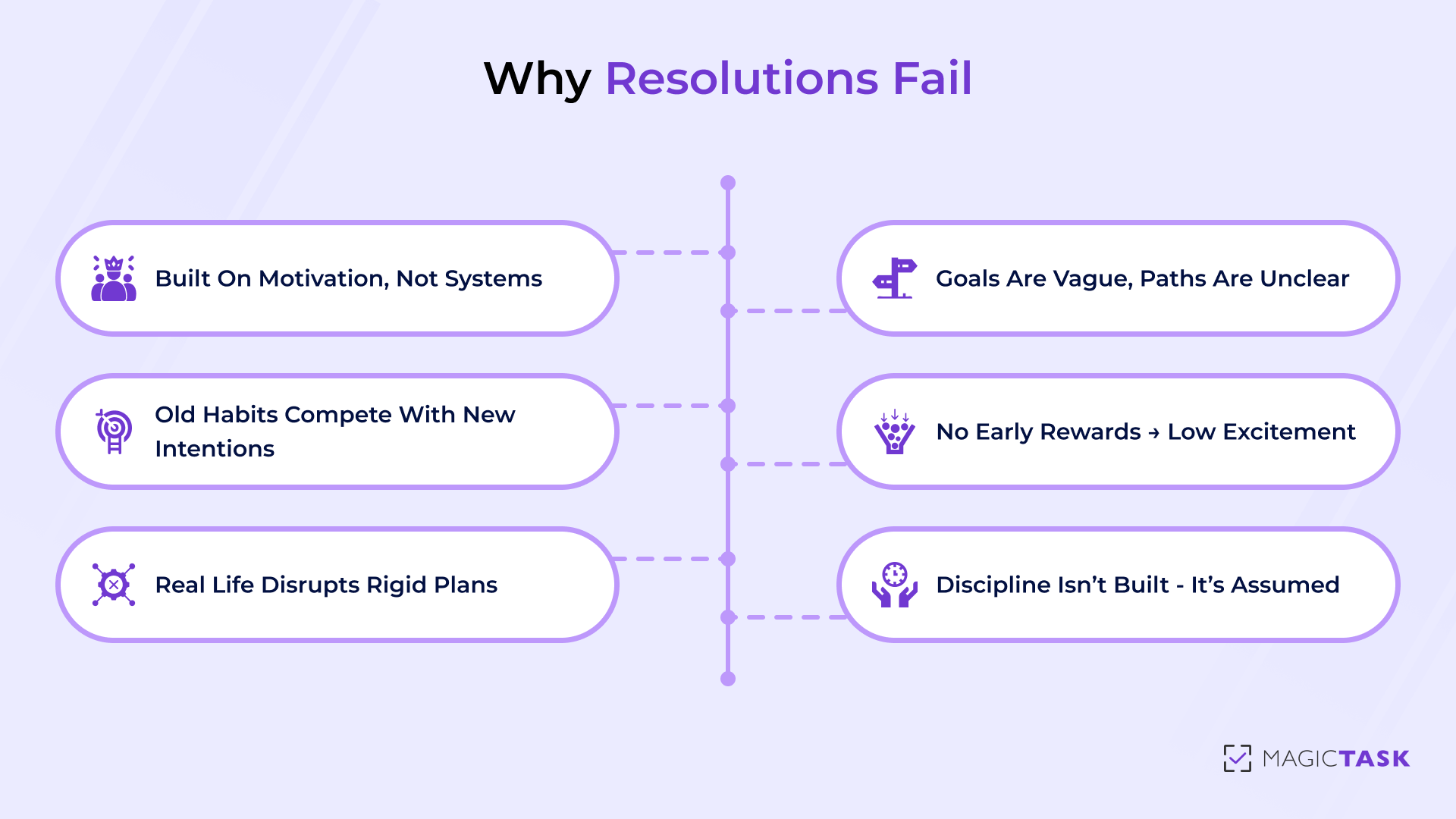
There are a few less obvious reasons resolutions slip through your fingers:
- They rely on a “new year, new me” burst of energy that simply isn’t sustainable.
- They compete with old habits that are far more ingrained and easier to follow. It’s your consciousness that needs to change before your behavior can change.
- They rarely include immediate rewards, so there’s nothing that feels good in the beginning when it matters most.
- They don’t account for real life with the sick days, the busy days, the low-energy days.
- They assume discipline will magically appear, instead of being something built slowly over time.
So when February shows up with normal schedules, normal stress, and normal energy levels, the resolution that once felt exciting now feels like another heavy obligation.
But when you replace big, blurry resolutions with small actions, and you pair those actions with feedback, momentum, and tiny wins, habits start to feel surprisingly doable. And that’s where micro-habits come in.
Turning Resolutions into Micro-Habits
Big goals sound inspiring, but they rarely fit into the rhythm of everyday life. “Get fit,” “be more organized,” “read more,” “sleep better” are identities, not actions. And identities don’t change in one leap. They change through tiny, repeatable steps that feel almost too easy to ignore.
Micro-habits shrink your resolution into something small enough to start, simple enough to repeat, and satisfying enough to stick. Instead of demanding huge effort, micro-habits focus on creating momentum, the kind that makes you think, “Okay, I can do that again tomorrow.”
When you build your habits this way, consistency becomes something you grow into, not something you force.
Now let’s look at how to turn your big January vision into small daily actions you can actually follow through on.
1. Break the Big Goal Into Its Smallest Possible Action
Most resolutions fail because the goal is too big to act on in a single step. “Get in shape,” “be more productive,” or “learn a new language” sound great on paper, but your brain doesn’t know what to do with something that broad. Micro-habits solve that by shrinking the goal into the smallest possible action you can complete without negotiation.
Instead of asking, “How do I overhaul my entire routine?” you ask, “What’s the smallest step I can take today?” That tiny step becomes the seed of the habit.
For example:
Big goal: “Get fit this year.”
Micro-habit: “Do 10 squats after brushing my teeth.”
It’s so small you can do it half-asleep. And strangely, that’s the point. When a habit is small enough to start instantly, you’re far more likely to repeat it.
Small actions are the only actions that reliably compound.
2. Make the Habit So Easy You Can Do It on Your Worst Day
Anyone can keep a habit going on a good day when you’re rested, motivated, and everything goes as planned. The real test is what happens on the days that don’t cooperate: the long workdays, the low-energy mornings, the evenings when your brain feels like oatmeal. Most resolutions collapse here, not because the goal wasn’t meaningful, but because it required more effort than a tough day could handle.
That’s why micro-habits should feel almost laughably easy. Easy enough that even the tired, stressed, unmotivated version of you can still pull it off without thinking.
Here’s what that looks like in practice:
Big habit: “Read more books this year.”
Worst-day habit: “Read one page.”
One page sounds tiny… and that’s exactly why it works. On your best days, you’ll read more. On your worst days, you’ll still show up to keep the habit alive.
The goal isn’t perfection. It’s survival. If a habit can survive your worst days, it will flourish on your best ones.
3. Attach the Habit to Something You Already Do
One of the easiest ways to make a habit stick is to anchor it to something you already do every day. This method, often called “habit stacking,” works because it removes decision-making entirely. You don’t have to remember the habit, motivate yourself into doing it, or find the right moment. The cue is already built into your routine.
Think of your day as a row of hooks. Your current habits, like brushing your teeth, making coffee, opening your laptop, and washing your face, are already hanging there. All you’re doing is adding a new, tiny habit onto a hook that already exists.
Example:
Existing habit: Make morning coffee.
New micro-habit: Take one mindful breath while the coffee brews.
The brilliance of this approach is its simplicity. You’re not creating time; you’re piggybacking on time that already exists. That means fewer excuses, fewer steps, and far less friction. They start feeling like natural extensions of your day.
4. Turn Vague Intentions Into Clear, Daily Tasks
A major reason habits don’t stick is that the intention is vague.
“I want to be healthier.”“I want to be more organized.”“I want to stress less.”
These are desires, not actions.
Your brain doesn’t know where to start, so it delays, negotiates, or forgets. Clarity removes all that friction. When you turn a fuzzy resolution into a concrete daily action, you replace uncertainty with direction, and direction is far more powerful than motivation.
Instead of asking yourself, “How do I become healthier?” ask, “What does ‘healthier’ look like today?”
This is where tools like MagicTask can quietly support you. Instead of holding the entire resolution in your head, you translate it into clear, actionable daily tasks, the kind that actually get done because they’re visible and specific. You just add your daily tasks into the backlog, drag them to the main focus section, and then watch yourself climb the leaderboard as you finish them.
Examples:
Vague: “Eat better.”
Clear: “Add one vegetable to today’s lunch.”
Vague: “Be more productive.”
Clear: “Complete one S-size task before noon.”
Clarity beats motivation every single time. When the step is obvious, the habit becomes repeatable.
5. Celebrate Every Completion to Reinforce Identity
Habits aren’t just about what you do but about who you’re becoming. Every small completion is evidence that supports a new identity. When you finish a micro-habit, even something tiny, your brain registers it as proof:
“I’m someone who shows up.”“I’m someone who takes care of myself.”“I’m someone who follows through.”
Identity changes with consistent, tiny wins.
This is why celebrating your completions matters. You’re not cheering for the size of the action; you’re reinforcing the identity behind it. Even the smallest success deserves acknowledgment, because acknowledgment fuels repetition.
MagicTask’s habit loops, like XP boosts, streaks, check-offs, and theme progress, are built around this psychology. They don’t just mark something as done; they make the moment feel good. And when completing a habit feels good, your brain wants to experience that feeling again.
Celebration doesn’t have to be loud. Sometimes it’s a checkmark. Sometimes it’s a visual cue. Sometimes it’s the quiet satisfaction of noticing your streak grow. But every celebration, no matter how small, builds the identity that keeps the habit alive.
How MagicTask Helps You Stay Consistent
Even the best micro-habits need a support system that reminds you to show up, rewards you when you do, and keeps you moving when motivation dips. That’s the real magic of habit-building tools: they make consistency feel easier, lighter, and a little more enjoyable. MagicTask was designed with that exact idea in mind.
Instead of relying on willpower (which fades) or memory (which fails), MagicTask gives you visible progress and a workspace that makes habits feel like wins. Let’s look at how it does that.

XP and Streaks Reinforce Daily Progress
Most habits fall apart because the early days don’t feel rewarding. You stretch for five minutes, drink more water, or read one page, and there’s no immediate payoff. Nothing changes yet. Your brain doesn’t get a “good job” signal, so sticking with the habit feels harder than starting it.
MagicTask fixes that by rewarding every completion.
When you finish a task, no matter how small, you earn XP. You see progress added instantly. The visual feedback tells your brain: “That effort mattered.” This tiny hit of satisfaction is exactly what keeps habits alive in the early weeks.
Streaks add another layer of motivation. Every day you show up, your streak grows, creating a sense of momentum you don’t want to break. And the best part? The pressure is gentle. It nudges you without making you feel punished on off days.
- XP = immediate reward.
- Streaks = ongoing identity.
Together, they help you stay consistent even when your motivation is running on fumes.
Task Sizing Helps You Choose Realistic Habit Steps
One of the biggest reasons habits fail is that we choose steps that are too big for real life. On a good day, they’re fine. On a busy, low-energy, or stressful day? They’re the first thing to go.
MagicTask solves this by letting you size your habits before you commit to them. Each task gets an S, M, L, or XL label, a simple visual cue that helps you understand the effort involved and choose the version of the habit that actually fits your day.
This turns habit-building into a flexible system rather than an all-or-nothing commitment.
Here’s what that looks like:
| Task Size | Effort Level | Example Habit | When to Use |
|---|---|---|---|
| S | Very small | Read 1 page, stretch for 5 minutes | Low-energy days; keep the streak alive |
| M | Moderate | Read 5–10 pages, walk 15 minutes | Normal days; steady progress |
| L | Focused effort | Gym session, 30 min study block | High-energy days; deeper work |
| XL | Multi-step | Weekly meal prep, long workout | Weekend routines; intentional planning |
Now your habit is a spectrum. You can scale up when you feel strong, scale down when you don’t, and still stay consistent.
This kind of adaptability is what transforms habits from something you “try to do” into something you keep doing, no matter what the day looks like.
Level-ups and Visual Rewards Make Habits Feel Satisfying
There’s a reason games keep you hooked: they show you progress. Every time you advance to the next level, unlock a new skin, or hit a milestone, you feel a small rush because your effort has become visible.
MagicTask brings that same sense of satisfaction into your daily habits.
Each time you complete tasks, you’re literally leveling up your theme, unlocking animations, sound cues, and small visual changes that signal momentum. It’s a subtle but powerful feedback loop that keeps your habits emotionally rewarding rather than mechanically repetitive.
And emotional rewards matter. Research shows that visible progress triggers the brain’s dopamine pathways — the same ones responsible for motivation and satisfaction. The more you feel your progress, the easier it is to return to the habit tomorrow.
To make this even more tangible:
Here’s what a habit might feel like with MagicTask:
- You finish your micro-habit for the day.
- XP pops up instantly with a quick hit of “nice, I did it.”
- Your streak number climbs, reinforcing your identity.
- Your theme levels up, unlocking a new visual flourish.
- Suddenly, a tiny habit feels like a small win, not something to check off as fast as possible.
These little emotional “yes moments” accumulate. You start to crave showing up. You begin looking forward to the next win.
And that’s how habits stick through satisfaction.
The Minimalist Interface Eliminates Friction
Most habit trackers and productivity tools fall apart because they add more work to the work. There are too many buttons, dashboards, and places to click before you actually do the thing you set out to do. And when you’re already short on time or energy, that extra friction is enough to break the habit before it begins.
MagicTask was built to eliminate that problem entirely.
The interface is clean, calm, and intentionally distraction-free. No clutter. No noise. No complicated setup. When you open the app, you see exactly what needs your attention. Your habits live right alongside your daily tasks, so you don’t have to jump between apps or remember which tool tracks what.
This simplicity matters more than it seems. In behavior psychology, the harder something is to start, the less likely you are to return to it. But when you remove even tiny friction, starting becomes automatic.
Here’s what that looks like in real life:
- You open MagicTask and immediately see your micro-habits for the day.
- You tap once to complete the action.
- You get instant feedback (XP, streak, progress).
- You move on with your day.
No mental load. No searching. No overwhelm.
Habits survive when they’re easy to begin. MagicTask makes starting feel effortless, which is exactly why staying consistent becomes easier too.
Building Momentum Beyond January
Starting a new habit is easy. Keeping it alive after January takes something different: visibility, small wins, and a system that reminds you why you began in the first place. Motivation fades, and momentum is what carries you forward.
MagicTask helps you build that momentum by making your progress impossible to miss. When you can see your streaks growing, your XP climbing, and your themes leveling up, you naturally reinforce the identity that keeps habits going:
“I’m someone who follows through.”
A simple way to stay consistent is to create monthly challenges or “Habit Quests.” Instead of aiming for a perfect year, aim for a focused 30-day mission. It feels lighter, more doable, and more satisfying to complete.
Pair that with a quick weekly review, just a minute or two to look at your completed tasks and acknowledge your progress:
- What did you show up for this week?
- Which small wins made you proud?
- Where did your streak stay alive?
These little check-ins matter. When progress stays visible and rewarding, consistency stops feeling like effort and starts feeling natural.
Conclusion
Sticking to your goals has never been about the burst of willpower you feel on January 1st. It’s about the tiny actions you choose, repeat, and celebrate. Big resolutions fade. Small, meaningful habits stay.
MagicTask makes those small actions easier to show up for by giving you clarity, rewards, and momentum you can actually feel. Each checkmark, each streak, each level-up turns consistency into something satisfying, something you look forward to, not something you push yourself through.
If you’re ready to make this the year your habits finally last, start simple. Pick one habit. Add it to MagicTask. Celebrate the win each day.
Start your first habit in MagicTask today, and watch how quickly your resolutions begin to stick.
Similar Blogs
Why Most Productivity Systems Fail After Setup and How to Make Them Stick
Most productivity systems feel incredible at the beginning. You block off an afternoon. You organ
The Fresh Start Effect: Why Starting Small Helps You Build Better Habits
Have you ever felt a sudden urge to get your life together just because it was a Monday? Or the f
How to Use Leaderboards to Improve Team Performance
I’ve worked with enough teams to notice a pattern. People are doing great work, deadlines are met
FAQS?Have questions? Look here
Most New Year’s resolutions fail because they rely too heavily on motivation, which fades quickly. Goals are often vague, too big, or lack a clear daily structure. Without small, repeatable steps and immediate rewards, the habit breaks as soon as life gets busy.
Micro-habits are tiny, easy-to-repeat actions that help you build consistency. Because they require very little effort, they work even on low-energy days. Over time, these small actions compound into meaningful long-term change, making them far more effective than big, all-at-once resolutions.
Start by identifying the smallest possible action related to your goal. For example, instead of “Get fit,” try “Do 10 squats after brushing my teeth.” Shrinking your goal into something simple and repeatable makes it much easier to stay consistent.
A worst-day habit is the version of your habit that you can complete even when you’re tired, stressed, or unmotivated. It keeps your streak alive and prevents the habit from collapsing on difficult days. Example: reading one page instead of a full chapter.
Habit stacking works by attaching a new micro-habit to an existing routine. Since the cue already exists (like making coffee or brushing your teeth), it reduces friction and makes the new habit easier to remember and repeat.
Vague goals like “be healthier” or “be more productive” are hard to act on. Clear, specific actions eliminate ambiguity and give your brain a direct path to follow. For example, “Add one vegetable to lunch” is easier to follow than “Eat better.”
MagicTask reinforces habits using XP, streaks, task sizing, and visual rewards. These features provide immediate feedback, momentum, and motivation — making consistency feel satisfying instead of stressful. It also keeps your routine clear and clutter-free, reducing friction.
Task sizing in MagicTask labels habits as S, M, L, or XL based on effort. This helps you choose the right version of the habit for your energy level each day — allowing flexibility while maintaining consistency.
Streaks and XP offer instant rewards and visible progress, which trigger positive reinforcement. This makes you more likely to return to the habit daily because your brain begins to associate the action with satisfaction and achievement.
Focus on momentum, not perfection. Use micro-habits, track progress visually with tools like MagicTask, and review your wins weekly. Creating monthly “Habit Quests” can also keep your goals fresh and easier to maintain long-term.

Make Work Feel Like Play
Follow Us


