
How to Use Leaderboards to Improve Team Performance
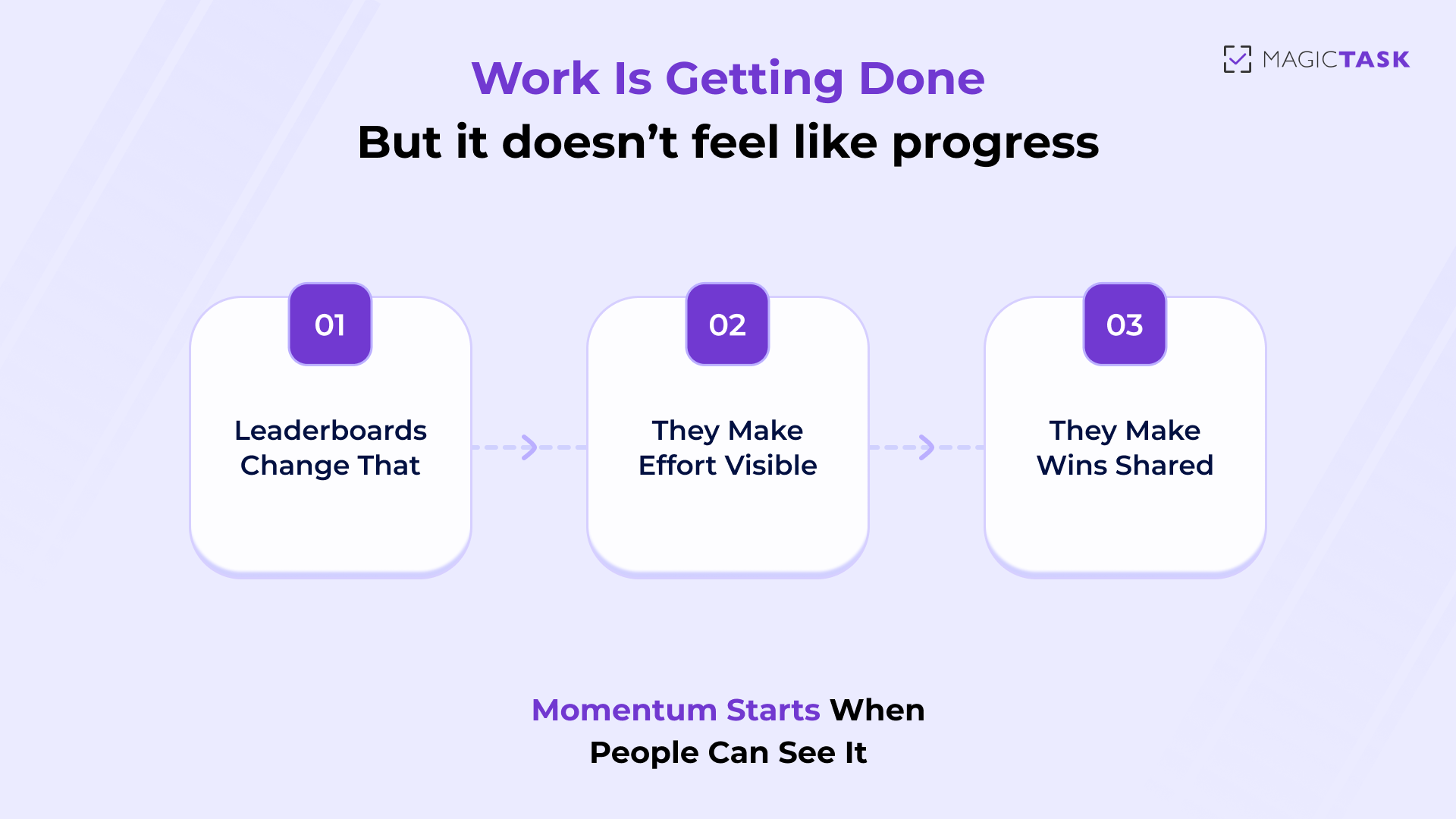
I’ve worked with enough teams to notice a pattern. People are doing great work, deadlines are met, tasks are completed, but it never really feels like progress. There’s no shared moment of “Hey, we’re moving.” And when progress feels invisible, motivation slips. Which makes sense, considering 83.6% of employees say they feel more motivated when they receive regular recognition.
That’s why leaderboards matter. They make progress visible. They make wins feel real. And they give teams something to rally around together.
What Are Leaderboards in the Workplace?
Leaderboards in the workplace are simple, visual systems that show progress, achievement, or performance in a way the entire team can see. Think of them as a shared scoreboard to make effort visible. Instead of wondering who’s moving the work forward, everyone can see it at a glance.
Leaderboards aren’t one-size-fits-all. They can be built around different goals or team dynamics, and they don’t always need to track the same metrics. Some teams use them for productivity; others use them for milestones, streaks, or skill-building progress.
Common types of leaderboards include:
- Individual leaderboards: highlight personal progress, great for motivation and ownership.
- Team leaderboards: track collective momentum, perfect for collaborative goals.
- Short-term leaderboards: refresh weekly or monthly to keep engagement high.
- Long-term leaderboards: show overall growth, progress, and consistency across months or quarters.
The purpose is simple: leaderboards help teams see progress, care about it, and stay connected to it.
Common Pitfalls of Traditional Performance Tracking
Traditional performance tracking tools look helpful on the surface. They’re organized, structured, and make leaders feel like they have control. But for the people actually doing the work, these tools often lead to disengagement over time.
The issue isn’t the data. It’s the way the data lives, hidden, delayed, or so flat that no one feels anything when progress happens. And when progress doesn’t feel meaningful, motivation doesn’t stick.
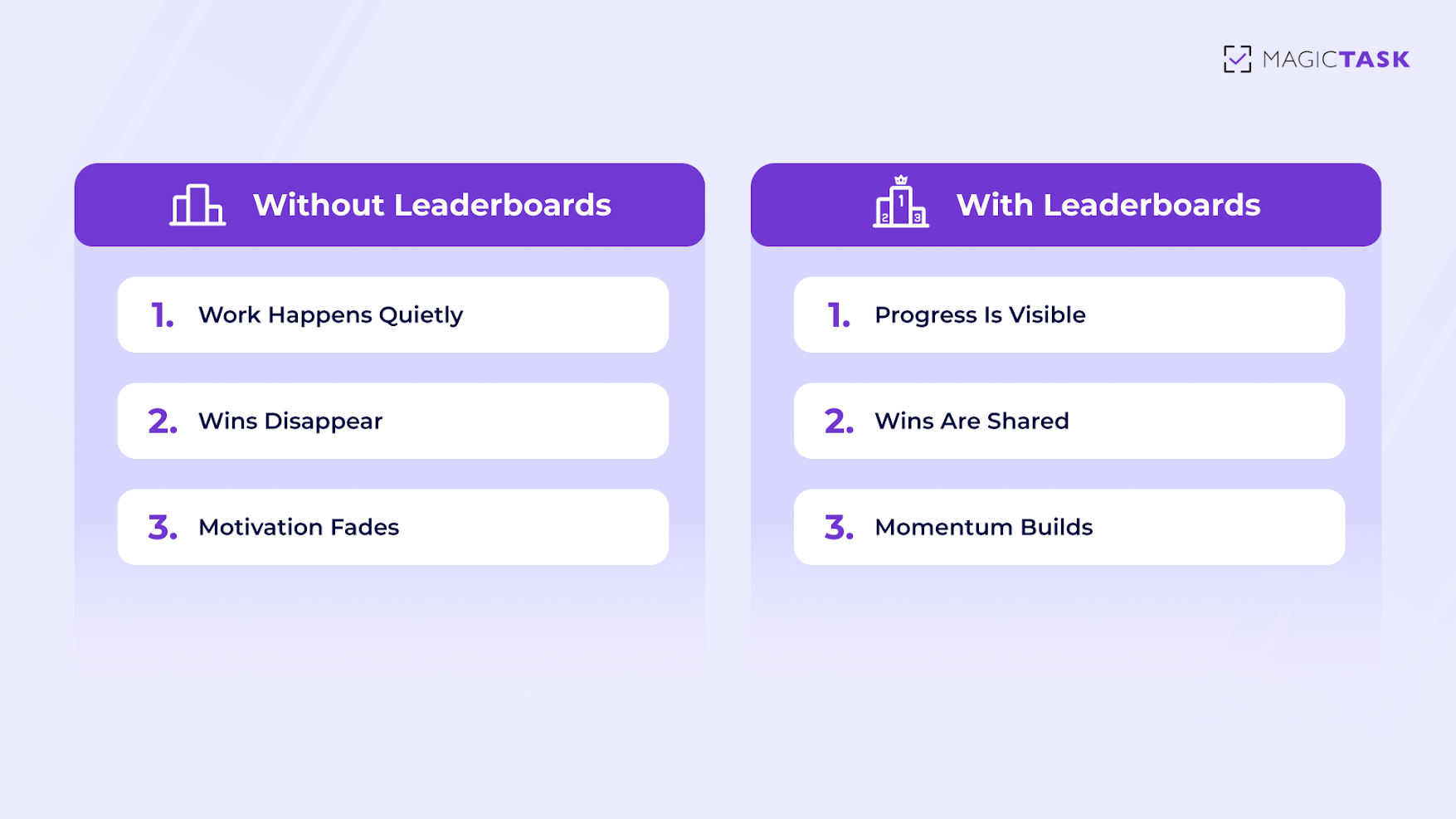
Here are the biggest ways traditional systems fall short:
1. Lack of Transparency
In many organizations, performance tracking lives in dashboards that only managers review. The team does the work, but the visibility stays locked away. And while leaders feel informed, employees feel disconnected from the bigger picture. There’s no shared sense of progress, just silent reporting.
When people can’t see their impact, they can’t feel proud of it. And when progress is hidden, motivation has nowhere to anchor. Over time, updates become something people do because they have to, not because they care.
As a result, a quiet gap grows between effort and recognition. Work gets done, but no one experiences the satisfaction of seeing the needle move, and that’s where engagement starts to fade.
2. Numbers Without Meaning or Emotion
Traditional performance tracking often reduces progress to raw data, where you can see tasks completed, hours logged, and percentage bars creeping forward. Is it useful for reporting? Yes. Is it motivating? Not usually.
Numbers alone don’t create connection or pride. People don’t stay motivated because they see a percentage go from 42% to 47%. They stay motivated when they can see their contribution and feel momentum building. Without that emotional layer, tracking becomes routine, and routine eventually becomes ignored.
3. Flat Experience With No Recognition or Momentum
In most traditional tracking systems, completing a task feels the same as not completing one — flat. You check a box, update a cell, or mark something as “done,” and… nothing happens. There’s no visible shift in progress. The system records it, but it doesn’t respond to it.
And that lack of response matters. Think about the last time you finished a big task, clicked “complete,” and the platform simply removed it from view. It felt more like it disappeared than like something meaningful happened. There was no moment of satisfaction, just the next task waiting.
Over time, this flat experience dulls motivation. When progress doesn’t feel rewarding, people stop caring about tracking it, and eventually, they stop showing up in the tool at all.
How Leaderboards Improve Team Performance
Some teams run on deadlines. Others run on caffeine. But the best-performing teams run on visibility because small wins feel bigger. That’s what leaderboards bring to the table. Just a clearer way for teams to see the story unfolding as they build it.
Let’s break down why they work so well.
1. Motivation Through Visibility
When people see their name on a board, moving up, contributing, and earning points, something clicks. It’s the same feeling you get when closing your last Apple Watch ring for the day. You don’t have to do it… But now you kind of want to.
Visibility isn’t about showing who’s “best.” It’s about reminding everyone: “Hey, what you’re doing matters.”
2. Friendly Competition Creates Accountability
A well-designed leaderboard doesn’t pit people against each other, but it sparks healthy momentum.
It’s the difference between: “Ugh… I need to update my tasks,” versus “Oh, I’m two points behind Sarah? Game on.”
Competition feels fun when the stakes are simple and the feedback is instant. In fact, for 78.3% of people, it gives the nudge they didn’t know they needed.
No guilt. No pressure. Just a gentle, playful push to keep going.
3. Micro-Achievements Keep Teams Consistent
Leaderboards don’t wait for big milestones to celebrate progress. They celebrate the tiny steps along the way.
Leaderboards create micro-moments of success:
- Finishing a task
- Logging progress
- Keeping a streak alive
- Moving up one spot
Each small win signals progress, and progress fuels consistency. Leaderboards aren’t about scoring, ranking, or comparing. They’re about energy. They turn everyday work into something that feels active, alive, and shared.
And when work feels like that, performance grows naturally.
How MagicTask Uses Leaderboards to Boost Engagement
Leaderboards often get a bad reputation because so many tools implement them the wrong way. There’s harsh ranking, public shame, or a system where one “winner” sits at the top while everyone else silently falls behind. That kind of leaderboard divides teams.
MagicTask was built differently. Instead of treating leaderboards as a scoreboard, it treats them as a shared motivation engine, something that brings clarity, energy, and momentum into the workday. It doesn’t reward only speed or volume. It rewards effort, consistency, progress, and participation, the things that actually shape high-performing teams.
MagicTask leaderboards aren’t about competition. They’re about engagement, identity, and shared forward motion.
Let’s break down how it works.
1. Streaks: Encouraging Habits, Not Hustle
In many tools, progress is only recognized when something big happens, like when a major task is completed, a project is closed, or a milestone is delivered. But productivity isn’t built on occasional big pushes. It’s built on repeatable habits.
MagicTask’s streak system reinforces daily consistency, even if the progress is little. Completing tasks daily adds to a streak, giving users a visible reminder: “I’m someone who shows up.”
This design lowers pressure while still building momentum.
Streaks help teams:
- Stay accountable to daily habits
- Avoid the “start strong, fade later” cycle
- Build a rhythm of continuous progress
- Feel rewarded for showing up, not just finishing big tasks
And mainly, missing a streak isn’t punished. There’s no shame mechanic. The system encourages engagement without weaponizing failure.
2. Levels: Turning Growth Into a Story
While streaks focus on consistency, levels focus on progress over time. Every task completed earns XP (experience points). Over days, weeks, and months, those points accumulate, showing long-term growth.
This transforms the experience from a list of finished tasks into a trackable upward journey.
Levels tap into a simple human truth: We love seeing ourselves improve.
Here’s how levels shift motivation:
| Without Levels | With Levels |
|---|---|
| Progress disappears once a task is finished | Progress accumulates and becomes visible |
| No emotional connection to effort | Users feel they’re advancing and evolving |
| Hard to see long-term growth | Growth is documented, celebrated, and clear |
Levels make productivity feel like a personal adventure that you can enjoy completing.
3. Achievement-Based Leaderboards
Most leaderboards track whoever does the most, which benefits certain roles (like sales) while penalizing others who do fewer tasks but more important ones. MagicTask avoids that trap by using achievement-based metrics, not raw-volume metrics.
That means the leaderboard prioritizes:
- Impact
- Consistency
- Contribution
- Milestones
- Completion ratios
- Personal growth
Not just speed.
This makes the leaderboard feel inclusive, not competitive in a cutthroat way.
A typical MagicTask leaderboard snapshot might look like this:
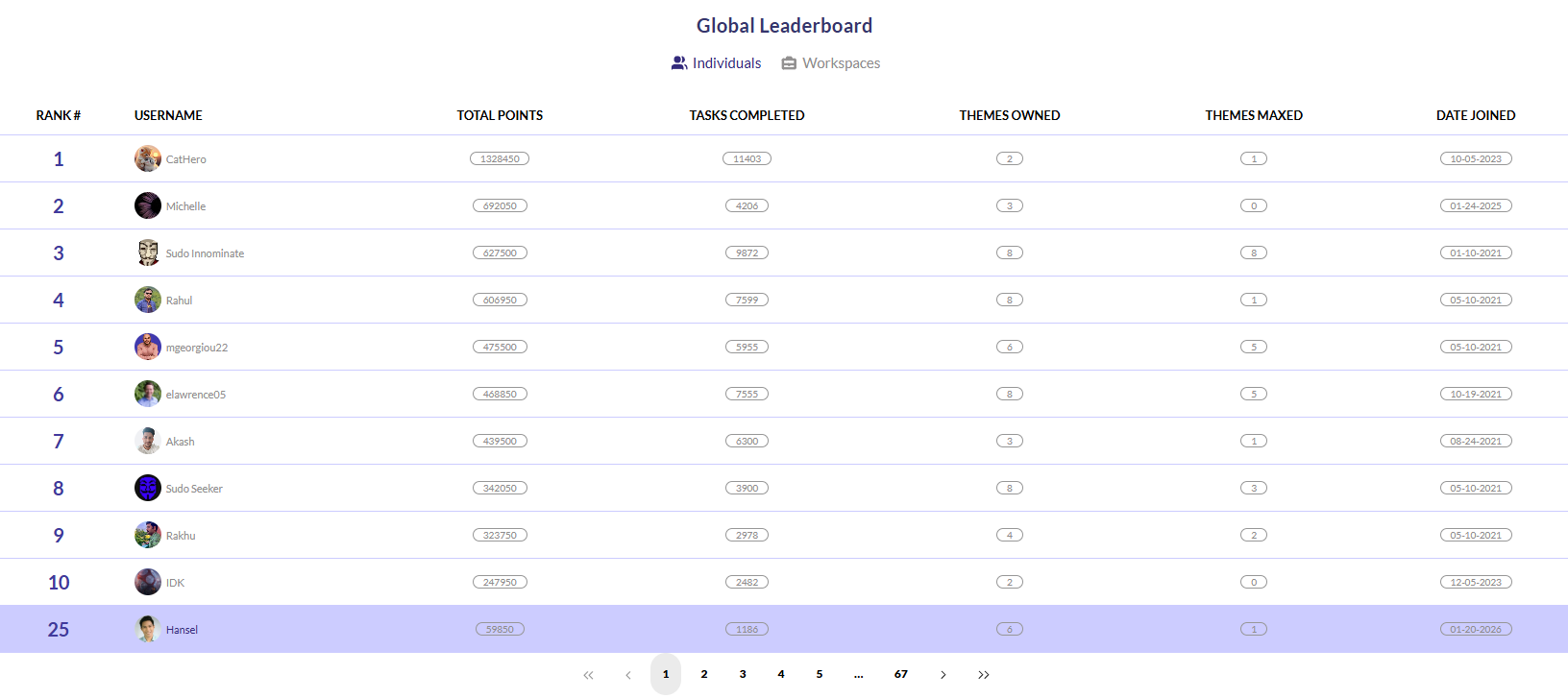
There’s more to celebrate here than just “number of tasks.”
4. Collaboration Over Competition
This is where MagicTask stands out the most. Leaderboards are designed to bring teams closer, not divide them.
MagicTask shifts the psychology from “I need to beat everyone” to “We’re all moving forward together.”
It does this through features like:
- Shared boards where teams see progress collectively
- Team streaks that reward group consistency
- Milestone unlocks that belong to the whole team
- Theme unlocks that become a shared visual celebration
This creates a feeling of: “We’re part of something.”
Competition exists, but it’s supportive, energizing, and rooted in community.
5. Reward Mechanics That Make Engagement Feel Good
MagicTask pairs leaderboards with subtle but meaningful emotional rewards:
- Visual animations
- XP bursts
- Unlockable themes
- Milestone badges
- Progress celebrations
They trigger small dopamine hits that reinforce the habit loop:
Task → Feedback → Satisfaction → Repeat
Over time, the system trains teams to enjoy completing tasks, which means engagement becomes natural.
MagicTask’s leaderboard system works because it’s about recognizing progress, reinforcing consistency, and making productivity feel rewarding.
It aligns with how humans stay motivated: through visibility, momentum, and shared celebration.
Conclusion: From Tracking to Thriving With Leaderboards
Performance tracking shouldn’t feel like a chore, and it shouldn’t live in a dashboard no one opens. When progress is invisible, motivation fades. When recognition is missing, engagement drops. And that’s how tools, even the well-intentioned ones, eventually collect dust.
Leaderboards make progress feel meaningful. They turn effort into something visible. They help teams see momentum, celebrate wins, and stay connected to the work they’re doing.
And with MagicTask, leaderboards are a shared motivation system designed to build consistency, confidence, and culture. Teams don’t need more tracking. They need to feel progress.
If your team is ready for that kind of shift, it may be time to see what leaderboards can do when they’re designed with motivation in mind — not measurement alone.
Try MagicTask and experience the difference to inspire your team.
Similar Blogs

Why Most Productivity Systems Fail After Setup and How to Make Them Stick
Most productivity systems feel incredible at the beginning. You block off an afternoon. You organ
The Fresh Start Effect: Why Starting Small Helps You Build Better Habits
Have you ever felt a sudden urge to get your life together just because it was a Monday? Or the f
Deep Work, Simplified: Cut the Noise and Focus on What Matters
Have you ever sat down at your desk, ready to get into the zone, only to find your attention pull
FAQS?Have questions? Look here
Leaderboards in the workplace are visual tools that display progress, achievements, or performance metrics so teams can clearly see how work is moving forward. They help make effort visible and progress tangible.
Leaderboards improve team performance by increasing visibility, motivation, and accountability. When progress is easy to see, teams stay engaged, celebrate small wins, and maintain consistent momentum.
No. Effective workplace leaderboards focus on motivation and engagement rather than cutthroat competition. The best systems encourage consistency, collaboration, and shared progress instead of ranking people harshly.
Team leaderboards should track meaningful metrics such as task completion, consistency, milestones, contribution levels, and progress over time. Avoid tracking only raw volume, as it can discourage some roles.
Leaderboards can hurt morale if they rely on public shaming or reward only top performers. When designed around progress, recognition, and inclusion, leaderboards actually improve morale and engagement.
Leaderboards work best when updated in real time or on a short cycle (daily, weekly, or monthly). Frequent updates help teams feel momentum and keep motivation high.
Individual leaderboards highlight personal progress and accountability, while team leaderboards focus on collective momentum and collaboration. Many high-performing teams use a mix of both.
Visibility helps employees see that their work matters. When progress is visible, recognition feels real, wins feel earned, and motivation naturally increases.
Leaderboards support long-term productivity by rewarding consistency, habits, and growth over time. Features like streaks, levels, and achievements help teams sustain engagement beyond short bursts.
MagicTask uses achievement-based leaderboards that reward effort, consistency, collaboration, and growth rather than just speed or volume. Its design focuses on shared momentum instead of individual competition.

Make Work Feel Like Play
Follow Us


