
From Chaos to Flow: Build Unbreakable Focus with MagicTask
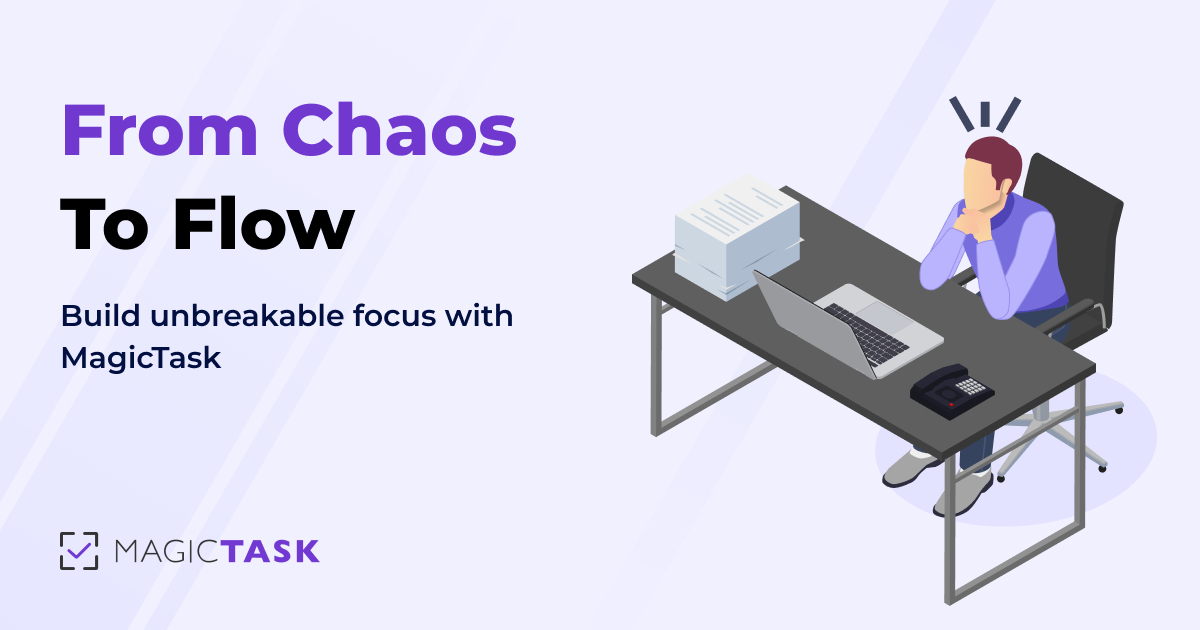
Do you ever finish a full day of “work” and wonder what you actually accomplished? You weren’t idle. You were busy, but your focus never quite landed where it mattered. According to research, people switch tasks every 40 seconds on average, and even brief interruptions can dramatically reduce overall focus and productivity.
That constant fragmentation breaks your flow, the mental state where you’re fully engaged, thinking clearly, and making real progress without fighting your attention. When you’re in flow, everything falls into place one by one. But in a world full of alerts, tabs, and multitasking, reaching that state can feel rare.
In this post, we’ll explore how to move from daily chaos into that state of sustained, meaningful focus through simplicity, intention, and systems that help attention stick.
Why Focus Is Hard to Maintain Today
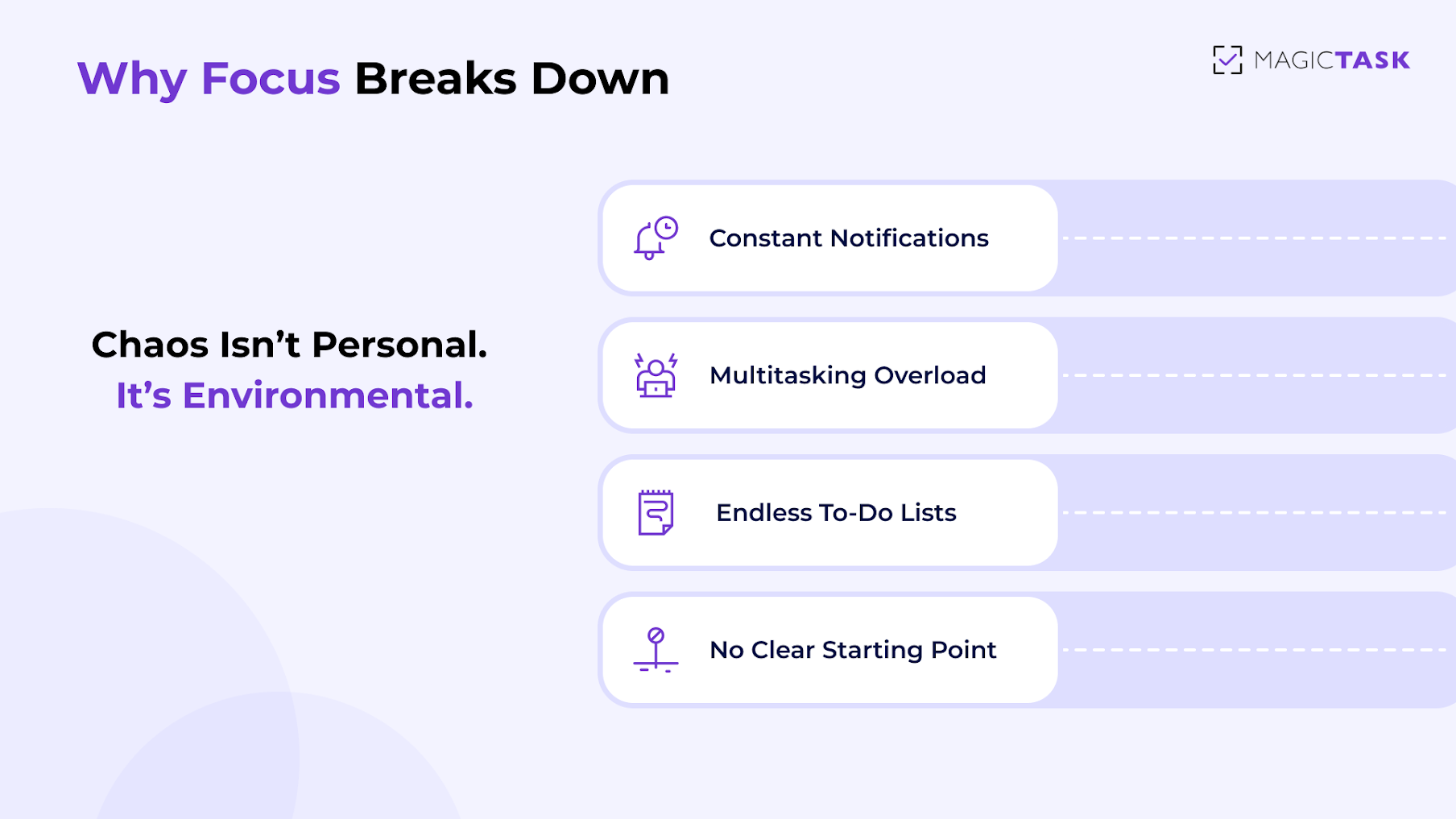
Focus hasn’t become harder because we suddenly lack discipline. It’s harder because our environment demands attention in a hundred different directions at once.
● Too many inputs: You try to start a task, but Slack and email notifications interrupt every few minutes. By the time you return to your work, you’ve forgotten where you left off.
● Multitasking overload: You jump between a spreadsheet, a Google Doc, and your inbox, all at the same time**.** It feels productive, but mentally, you’re restarting over and over again.
● Endless task lists: Your to-do list has 25 items with no clear starting point. So instead of tackling something meaningful, you choose the quickest task just to feel busy.
● Lack of structure: You tell yourself you’ll “get into deep work later,” but urgent requests and small tasks fill the entire day. There’s no place for flow to enter your work state.
Over a full day, those tiny distractions add up and leave us mentally exhausted before meaningful work even begins. The problem is the chaos surrounding you. And until that changes, flow will remain something you stumble into, instead of something you can reach on demand.
What It Really Takes to Reach a Flow State
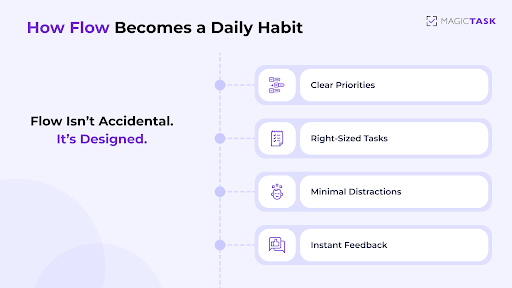
When your mind knows exactly what to focus on and gets clear feedback along the way, attention naturally deepens. The goal is to set up an environment where focus feels effortless. Let’s break down what that looks like in real life.
Clear Goals and One Defined Task
Flow begins with clarity. When you sit down knowing exactly what you’re working on, your brain doesn’t need to negotiate or choose. It can simply begin. Compare that to days when your task list is vague, like “work on the presentation,” “plan next sprint,” “catch up on emails.” Those lack direction, and direction is what guides focus. A simple, specific goal, like “solve the login issue” or “draft the intro paragraph,” gives your brain a path.
Once the choice is made, switching temptation fades. You stop bouncing between tasks and settle into one, allowing momentum to build. Flow isn’t about working on everything. It’s about committing to one thing long enough to make real progress.
Balanced Difficulty
Flow happens in the sweet spot, just hard enough to be engaging, but not so difficult that it feels overwhelming. Think of the difference between solving a tricky puzzle versus facing an impossible one. The first pulls you in. The second shuts you down. The same goes for work.
When tasks match your skill level, they create curiosity and drive. If they’re too easy, boredom sets in. If they’re too complex, anxiety and procrastination take over. In flow, your brain is stretched. You feel capable, not lost. That balance keeps you moving forward, one small win at a time. It’s the moment when you catch yourself thinking, “I can do this,” and suddenly two hours pass without noticing.
Minimal Distractions in the Environment
Every notification, tab switch, or “quick check” fractures attention, forcing your brain to climb back into focus again and again. It’s like trying to run while stopping every few steps. You never build rhythm.
Minimizing distractions doesn’t require total silence or monk-like discipline. It simply means creating a space that supports attention instead of breaking it. That might be closing tabs unrelated to the task, silencing notifications, or setting boundaries around communication during focus blocks. When your environment is calm, your brain has room to think deeply and follow ideas to completion, the core of flow.
Immediate Feedback That Reinforces Progress
One of the biggest triggers for flow is seeing your effort pay off in real time. Humans are wired to respond to feedback. It’s why finishing a paragraph, solving a bug, or checking off a task feels good. That micro-reward gives your brain the dopamine hit that makes you keep going. Without feedback, work can feel endless or abstract, making focus harder to maintain. With it, motivation renews itself. You begin to associate deep work with progress rather than exhaustion.
It’s the subtle sense of momentum that keeps you immersed longer than you planned. Flow thrives on that loop of work, feedback, and satisfaction, repeated until time seems to move differently.
How to Reduce Chaos and Build Focus With Simple Systems
More often, flow starts with a few small systems that remove friction and make focus easier to reach. The problem is that your brain is constantly pulled in different directions. When you simplify what competes for your attention, focus shows up more naturally.
It’s the small choices you make before you start working, like what to prioritize, what to ignore, and how to create space for deep attention. Put them together, and chaos begins to settle. Instead of reacting all day, you can finally create a work environment where focus has room to breathe.
1. Prioritize Tasks Based on Impact
One of the biggest reasons chaos takes over your day is that urgent tasks push their way to the front, while high-impact work quietly sits in the background. When everything feels immediate, it’s easy to spend hours reacting instead of progressing. That’s why shifting your focus from urgency to impact is so powerful. It helps you decide what actually deserves your attention, not just what’s shouting the loudest.
A simple way to do this is through a decision matrix, often called the Eisenhower Matrix, which helps categorize tasks based on their true value. Instead of asking, “What needs to be done first?” ask, “What moves my work forward?”
Here’s a clear breakdown:
| Category of Task | Urgent | Not Urgent |
|---|---|---|
| Important | Do now: Critical tasks that are both time-sensitive and high-impact. | Schedule + protect: Long-term, meaningful tasks that deserve focused, deep work. |
| Not Important | Delegate or batch: Tasks that feel urgent but don’t meaningfully move work forward. | Reduce or eliminate: Low-value or distracting tasks that add noise without results. |
This matrix helps you spot the real game-changers, the tasks that move you forward versus the ones that just keep you busy.
When you prioritize impact-driven work:
● You start important tasks sooner
● Deep work becomes predictable, not accidental
● Your energy goes toward progress, not just maintenance
Chaos thrives when urgency rules. Flow emerges when you choose tasks that matter.
2. Use Task Batching and Time-Blocking for Uninterrupted Work
One of the simplest ways to reduce chaos is to stop treating every task as if it needs attention the moment it appears. Task batching and time-blocking help you reclaim control by grouping similar activities together and assigning them dedicated windows.
Think of batching as putting tasks into categories of emails, admin work, design, and meetings, rather than scattering them throughout the day. Instead of answering messages every time your phone buzzes, you block a 30-minute window to handle all communication at once. The effect is immediate: you stay in one mental mode longer, which reduces context switching and preserves energy.
Here’s how it looks in real life:
- Batch emails: Instead of responding throughout the day, you schedule two windows: 10:30 AM and 4:00 PM.
- Dedicated communication time: During those blocks, you reply, forward, organize, and clear your inbox in one session.
- Protect deep work: The rest of the morning becomes a focus block for creative or strategic tasks, uninterrupted.
- Reduced stress: You no longer feel the urge to “just check,” because email already has a planned home in your schedule.
You still handle messages. You just don’t let them hijack your attention all day.
3. Create Focus Rituals
Flow becomes easier to reach when your brain recognizes familiar signals that say, “It’s time to focus now.” These cues just need to be consistent. When you sit in the same spot, open the same tools, or follow a small pre-work routine, your mind starts to associate those actions with concentration.
For example, you might clear your desk, put on instrumental music, and set a 25-minute timer before beginning deep work. Over time, that sequence becomes a trigger. The moment you start it, your brain shifts gears faster. You skip the warm-up phase and get into flow more quickly.
Focus rituals are about creating calm, predictable conditions where attention doesn’t have to fight to show up.
4. Declutter Digital Spaces
A cluttered digital environment is one of the quickest ways to sabotage focus. Even if you’re not actively clicking on every open tab or window, your brain still registers them as unfinished tasks. It’s like trying to concentrate in a room full of half-built projects. Mentally, there’s always something tugging at you.
Here are a few simple ways to declutter without a major overhaul:
● Close tabs you don’t need for the current task. Even three tabs feel calmer than twelve.
● Minimize background apps. If it’s not part of the work, it doesn’t need to be open.
● Use one main workspace instead of multiple dashboards. Fewer places to check = fewer distractions.
● Clear your desktop or downloads folder weekly. Small resets prevent digital chaos from piling up.
You want to face a screen that reflects what you’re focused on right now. When your environment stops competing for attention, flow becomes far easier to reach.
Turning Flow Into a Daily Habit With MagicTask
The real transformation happens when those moments stop being occasional and start becoming consistent. That’s where the right systems and the right tools, like MagicTask, can make all the difference.
Now let’s look at how MagicTask helps turn flow from a lucky streak into a daily habit.
A Minimal UI That Reduces Cognitive Noise
Flow thrives in simplicity, and MagicTask’s interface is designed with that principle in mind. Unlike traditional task dashboards packed with widgets, categories, and notifications, MagicTask keeps your workspace clean and distraction-free. When you open the app, you’re greeted with clarity where there’s a structured backlog, a focused task lane, and progress markers that don’t overwhelm the screen.
This minimal design reduces the mental friction of deciding what to look at and where to start. Instead of scanning, clicking, and reorganizing, you can transition into work quickly. The environment does half the focusing for you. With fewer visual inputs and fewer decisions, your brain has more space to settle into deep concentration and remain there longer.
Task Sizing Helps You Choose the Right Work for Flow
Flow depends on balanced challenges, not too hard, not too easy. MagicTask’s S/M/L/XL task sizing makes that balance easy to find. When you categorize tasks by effort upfront, you can match them to your current energy and available time. That means you enter flow more often because the task fits the moment, not the ideal scenario.
| Size | Difficulty | Ideal Flow Use |
|---|---|---|
| S | Light | Short sessions, warm-ups |
| M | Moderate | Steady deep work blocks |
| L | High | Peak energy periods |
| XL | Extended | Multi-session flow work |
Sizing prevents overwhelm and creates realistic expectations, which reduces the fear of starting, one of the biggest barriers to flow.
XP and Micro-Feedback Reinforce Flow in Real Time
Flow requires a sense of progress, and MagicTask builds that into the experience. Every completed task adds XP, levels up your theme, and triggers subtle visual or audio cues. These micro-rewards are psychological reinforcement. Your brain receives a dopamine cue that says, this is working, keep going.
Here’s why this matters:
● Small wins sustain momentum
● Progress feels visible, not abstract
● Motivation renews without external pressure
Instead of checking a box and moving on, you feel the completion. That feedback loop encourages you to stay in the zone longer and return to focused work more often, making flow less fragile and more repeatable.
Daily Flow Sessions Build a Stronger Focus Identity
Flow becomes part of who you are when practiced consistently. MagicTask supports this identity shift by making daily flow sessions easy to schedule and rewarding to track. When you routinely move tasks into “My Focus,” size them realistically, and finish them with satisfying feedback, you begin to internalize a new narrative: I’m someone who focuses deeply.
Over time:
● Tasks take less effort to begin
● The brain associates the app with concentration
● Progress history reinforces commitment
Flow stops being a lucky occurrence and becomes predictable. Each day builds on the last, strengthening a habit and an identity grounded in focus, clarity, and calm productivity.
Conclusion
Flow is a skill you can build with clarity, structure, and systems that support focus instead of fighting it. When you reduce noise, choose the right task for your energy, and get immediate feedback on your progress, work stops feeling chaotic and starts feeling intentional.
MagicTask is built around those principles. Its clean interface clears mental space, task sizing helps you start with confidence, and XP rewards reinforce momentum. With repeated flow sessions, focus becomes less accidental and more predictable, something you can rely on rather than hope for.
If you’re ready to move from scattered days to meaningful progress, schedule your first flow session in MagicTask today and see how quickly chaos turns into clarity.
Similar Blogs
The Productivity Reset Ritual: A 10-Minute Daily Routine to Stay Organized and Motivated
Have you ever ended a day feeling exhausted… but not accomplished? You answered emails. You jumpe
Why Gamification Works for Productivity in Modern Workflows
Gamification is often misunderstood. For many people, it brings to mind flashy rewards or surface
How Gamified Productivity Tools Solve Task Fatigue (and Keep Teams Engaged)
You’re already buried every Monday with deadlines, messages, meetings, and a dozen priorities fig
FAQS?Have questions? Look here
A flow state is a mental state where you are fully focused, deeply engaged, and working with clarity and momentum. Time feels effortless, distractions fade, and progress happens naturally.
Modern work environments are filled with constant interruptions like notifications, emails, and multitasking demands. These fragment attention and prevent the sustained focus needed to enter flow.
You can reduce chaos by prioritizing high-impact tasks, batching similar work, time-blocking deep work sessions, decluttering digital spaces, and using simple focus systems that limit decision fatigue.
Effective focus habits include working on one clearly defined task at a time, matching task difficulty to your energy level, minimizing distractions, creating focus rituals, and tracking visible progress.
Task sizing breaks work into realistic effort levels, making it easier to start without feeling overwhelmed. When tasks match your time and energy, focus increases and flow becomes more achievable.
MagicTask supports flow with a minimal interface, task sizing, focus sessions, and XP-based feedback. These features reduce cognitive overload and reinforce progress, making deep focus easier to repeat daily.
Yes. With the right systems, environment, and tools, flow can shift from an occasional experience to a consistent habit. Repeated focus sessions train your brain to enter deep work more naturally over time.

Make Work Feel Like Play
Follow Us


