
Deep Work, Simplified: Cut the Noise and Focus on What Matters
Have you ever sat down at your desk, ready to get into the zone, only to find your attention pulled in a dozen directions before you even start? You probably got a ping from Slack or a new email, and suddenly the thought of deep, focused work feels like a distant dream.
You’re not imagining it. Our brains simply aren’t built for constant distraction. Every time we switch tasks, we pay a cognitive price. Research shows that after an interruption, it can take up to 23 minutes and 15 seconds just to regain full focus on the original task.
That constant state of reaction is the enemy of deep work. But it becomes possible the moment you clear the noise, define what matters, and build systems that protect your attention instead of scattering it.
In this post, we’ll simplify deep work so you can cut through the chaos, reclaim focus, and do meaningful work without burning out.
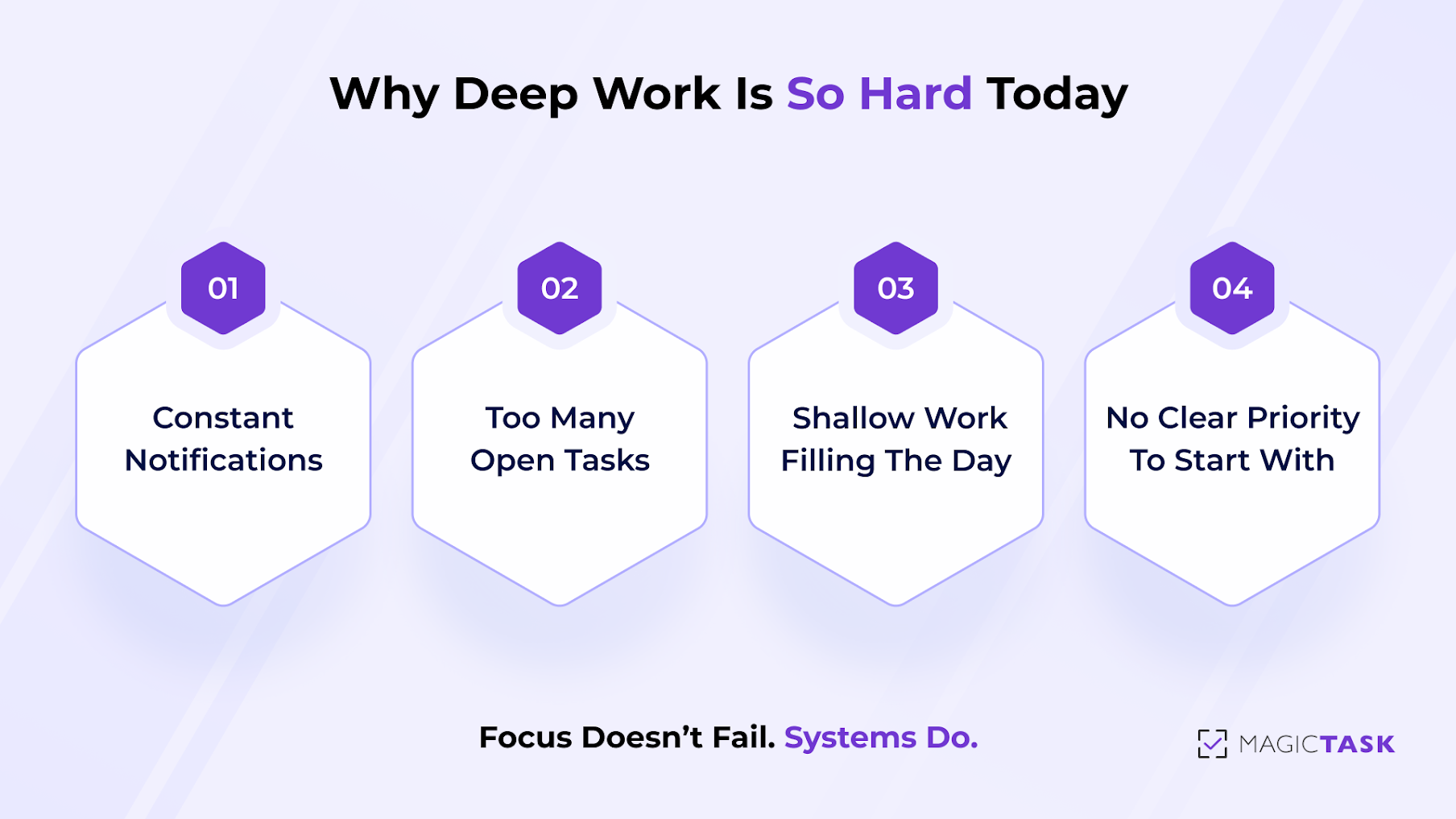
Why Deep Work Is Hard in Today’s World
If deep work feels out of reach, it’s not a personal failure. It’s the environment. Modern work is engineered for speed, visibility, and constant response. Even with the best intentions, the conditions most of us work in make sustained attention incredibly difficult.
Constant Digital Noise Breaks Focus Before It Starts
Focus disappears because it never gets a chance to settle. The moment you sit down to work, the noise begins in the form of a notification you didn’t ask for but somehow feel obligated to check. Even when you ignore it, your attention still shifts. Your brain takes note, and the thread breaks.
What makes this especially draining is how subtle it is. You don’t feel interrupted in a dramatic way. Instead, your focus gets chipped away in tiny pieces until deep thinking becomes impossible. You’re technically working, but your mind is constantly resetting, trying to remember where it left off.
Deep work needs uninterrupted stretches to form momentum. Digital noise prevents that momentum from ever building. Without quiet mental space, focus stays shallow and exhausting. And by the end of the day, it’s not that you didn’t work hard, it’s that your attention never had a chance to fully engage.
Once noise sneaks in, the next habit shows up almost automatically, that is, trying to do everything at once.
Multitasking Creates the Illusion of Productivity
There’s a long-standing myth that humans use only a small portion of their brain, with the rest just sitting there, waiting to be unlocked. If that were true, multitasking wouldn’t feel so exhausting, and focus would simply be a matter of trying harder.
But that belief doesn’t hold up. Research shows that nearly two-thirds of the American public and even more than a quarter of science teachers still believe the “10% brain” myth. That misconception fuels the idea that we should be able to juggle multiple tasks at once if we just apply enough willpower.
The reality is far less forgiving. The brain has no unused reserve waiting to step in. Attention is limited, and when it’s stretched too thin, performance suffers.
Here’s what multitasking quietly does to deep work:
- Fragments attention so focus never deepens
- Increases cognitive load, making work feel harder than it should
- Reduces quality, even when tasks are completed
- Creates mental residue that slows you down long after the switch
- Trains the brain to crave interruption, not concentration
What makes multitasking especially dangerous is how normal it feels. We’ve been conditioned to believe that constant switching is just part of modern work. But deep work requires fewer inputs, fewer decisions, and a single thread of attention.
Overloaded Task Lists Drain Mental Energy
When everything sits in front of you at once, your brain has to work overtime deciding what deserves attention. That constant decision-making burns mental fuel that should be spent on doing the work itself.
Instead of starting, you scan. You reorder. You hesitate. Each choice, this task or that one? now or later? important or urgent?, adds friction. Over time, that friction turns into avoidance, not because the work is hard, but because the list feels heavy.
Overloaded task lists create a few hidden problems:
- Decision fatigue sets in early, leaving less energy for focused thinking
- Important work gets buried under easier, more urgent tasks
- Starting feels harder than finishing, so progress stalls
- Focus fractures as attention jumps between too many options
Deep work needs a short list, a clear priority, and a single starting point. When your task list is simplified, your mind relaxes. And when the mind relaxes, focus finally has room to deepen.
Lack of Structure Makes Focus Feel Optional
Focus does not stay still because nothing in your day protects it. When tasks, priorities, and time all float loosely, deep work becomes something you intend to do.
Without structure, focus competes with everything else. Urgent messages feel louder than important work. Shallow tasks sneak in because they’re easier to start. And deep work keeps getting postponed until “later,” a time that never quite arrives.
A lack of structure creates subtle but powerful friction:
- No clear starting point, so work gets delayed
- Important tasks are lost to urgent interruptions
- Focus time gets squeezed out, not scheduled
- Progress feels random, not intentional
Deep work thrives inside clear boundaries. When structure is in place, focus stops feeling optional and starts feeling automatic.
What Deep Work Really Requires
Deep work isn’t about superhuman discipline or locking yourself away for hours. It’s about setting the right conditions, so focus can actually happen. When those conditions are in place, deep work feels natural. When they’re missing, focus feels forced.
Let’s break down what deep work truly needs and give you something practical to use right away.
Clear Goals and Defined Focus Blocks
Deep work starts with knowing exactly what you’re working on and when you’re working on it. Vague intentions like “work on the project” invite distraction. Specific goals create direction.
Instead of blocking time and hoping focus shows up, pair each focus block with a clear outcome:
- “Draft the first two pages”
- “Solve one core problem”
- “Design one screen”
Clarity removes hesitation, and hesitation is where distractions sneak in.
A Clutter-Free Mental and Digital Environment
Focus doesn’t like clutter. Open tabs, scattered notes, and half-finished tasks quietly compete for attention, even when you’re not actively looking at them.
Before deep work, clear the runway:
- Close unnecessary tabs
- Silence notifications
- Write down distracting thoughts so your brain doesn’t hold onto them
When your environment is calm, your thinking follows.
One Clearly Defined Task
Deep work breaks the moment you ask your brain to choose between multiple tasks. One session, one task. That’s all it takes.
When your brain knows there’s only one thing to focus on, it stops scanning for alternatives and settles into the work itself.
Momentum Through Visible Progress
Focus strengthens when effort feels rewarding. Seeing progress, even little progress, tells your brain it’s worth staying engaged. Feedback doesn’t have to be big or loud; it just needs to be visible.
Checkmarks, progress bars, XP, or a simple “done” list all reinforce momentum.
Try This: The 10-Minute Deep Work Reset
Before your next focus session, do this quick reset:
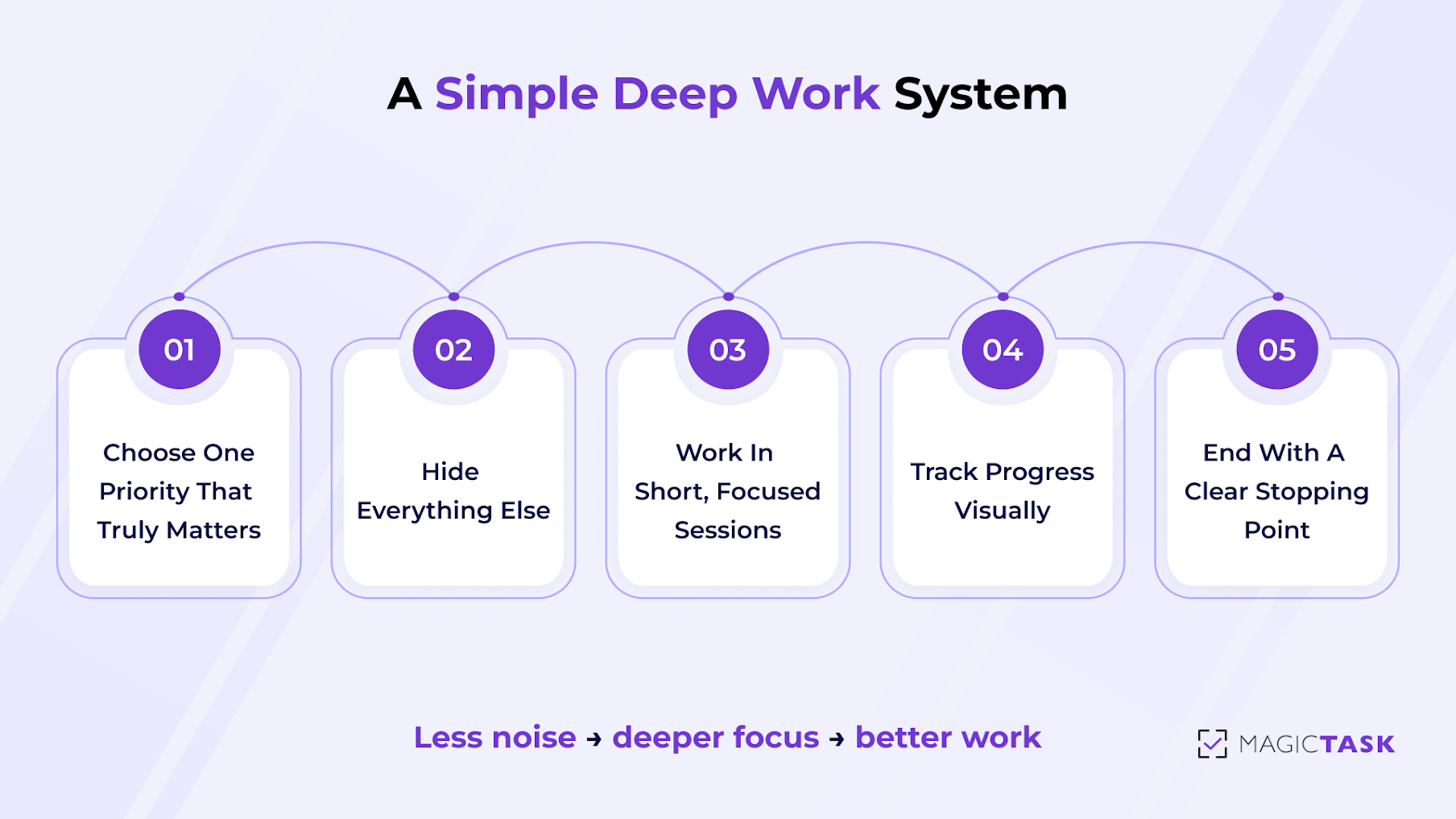
- Define one task. Write it down clearly.
- Set a timer for 25 minutes. No multitasking allowed.
- Clear your space. Close tabs. Silence notifications.
- Work until the timer ends. Don’t stop early.
- Mark visible progress. Note what you completed.
That’s it.
Deep work requires intention. When goals are clear, the environment is quiet, and progress is visible, focus stops feeling elusive and starts feeling achievable.
Simple Systems to Reduce Noise and Build Focus
When everything feels urgent, and everything demands a response, deep work never gets a clear path. The good news is that you don’t need a complicated system to cut through the noise. A few intentional changes can dramatically improve how easily you settle into focused work.
Here are practical, low-effort ways to reduce distraction and build focus into your day.
- Prioritize tasks by impact, not urgencyBefore starting your day, identify one or two tasks that will make the biggest difference if completed, even if they aren’t the loudest. Deep work lives in impact, not in inboxes.
- Remove or batch low-value activitiesNot every task deserves immediate attention. Group emails, messages, and small admin work into designated windows so they don’t interrupt your focus. When shallow tasks are contained, deep work gets space to breathe.
- Use simple focus ritualsRepetition signals your brain that it’s time to focus. This can be as simple as setting a timer, putting on the same background sound, clearing your desk, or opening a specific document. Over time, these cues make focus easier to access.
- Declutter digital spacesFewer tabs. Fewer lists. Fewer open tools. Each open item pulls at your attention, even if you’re not actively using it. Close what you don’t need, keep one task visible, and let your screen support focus instead of scattering it.
When your systems reduce friction instead of adding it, focus becomes something you return to naturally, not something you have to chase.
Turning Deep Work into a Consistent Habit With MagicTask
Deep work becomes powerful when it stops being a one-off effort and starts becoming part of your routine. The goal is to make focused work something you return to regularly, even when energy is low or distractions are high. Consistency turns deep work from a productivity technique into a habit.
MagicTask supports this shift effectively. Instead of asking you to rely on motivation, it helps you build repeatable focus rituals, track progress, and reinforce the satisfaction that keeps you coming back. Over time, deep work stops feeling like a special event and starts feeling like your default mode.
1. Schedule Focus Sessions Like Real Commitments
You often think, “I’ll get to it when things calm down,” but it’s the first thing to disappear once the day fills up. This is where structure makes all the difference.
MagicTask’s Backlog holds everything that has to be done, like coming up with ideas, upcoming tasks, and long-term projects, without demanding your attention all at once. It keeps mental clutter out of the way, so focus doesn’t have to compete with a hundred other thoughts.
When it’s time to work deeply, you don’t scan a long list. You intentionally pull one meaningful task from the Backlog into My Focus. That simple action turns deep work into a commitment. My Focus becomes your protected lane, the work you’ve already decided deserves your attention.
This approach does two important things:
- It removes the pressure to choose what matters in the moment.
- It signals to your brain that this time is reserved for something important.
Deep work thrives when it’s planned ahead of time. By separating everything you need to do from what you’re focusing on right now, MagicTask helps you show up for concentrated work with clarity.
2. Use Task Sizing to Match Focus to Energy Levels
Not every deep work session needs the same amount of intensity. Some days you’re sharp and energized. Other days, focus is available in small doses. One of the easiest ways to keep deep work consistent is to match the size of the task to the energy you actually have, not the energy you wish you had.
MagicTask’s S / M / L / XL task sizing makes this decision effortless. Instead of guessing whether a task fits your current focus level, you size it ahead of time. That clarity removes friction and helps you start faster.
Here’s how task sizing supports sustainable deep work:
| Task Size | Focus Intensity | Best Used For | Example Deep Work |
|---|---|---|---|
| S | Light focus | Short sessions, low-energy days | Outline ideas, review notes |
| M | Moderate focus | Standard deep work blocks | Write a section, design a screen |
| L | High focus | Peak-energy sessions | Draft a full document, solve a complex problem |
| XL | Extended focus | Planned, multi-session work | Major project or deep research |
Instead of skipping deep work on low-energy days, you adjust the scope. You still show up, still focus, and still make progress, just at the right scale.
This flexibility is what keeps deep work from turning into an all-or-nothing habit. When the work fits your energy, consistency becomes much easier to maintain.
3. Build Momentum Through Visible Progress and Feedback
Deep work needs reinforcement. When effort disappears into a void, it’s hard to stay engaged. Momentum builds when your brain can see that time spent concentrating actually moved something forward.
MagicTask makes progress visible in small but powerful ways. Each completed task adds XP, nudges your level forward, and reinforces the sense that focused effort pays off. Instead of wondering whether a deep work session was “worth it,” you get immediate feedback that confirms it was.
That feedback loop matters more than it seems. Visible progress does a few important things:
- Signals completion, which gives your brain permission to rest
- Reinforces consistency, making it easier to return to focus tomorrow
- Turns effort into satisfaction, not just relief
- Creates forward momentum, even when progress feels incremental
By pairing focused sessions with visible progress markers, MagicTask helps you feel the impact of your work in real time.
4. Reduce Decision Fatigue Before Focus Begins
Deep work usually fails before it starts. The moment you sit down and have to decide what to work on, how long to work, or whether the task is worth your energy, focus slips away.
Preparing tasks in advance removes that friction.
When you size tasks ahead of time, place them in your Backlog, and intentionally move a small set into My Focus, you eliminate decision-making at the moment focus is required. Your brain doesn’t need to negotiate. It already knows the plan.
This preparation allows your mind to settle faster:
- No scanning long lists
- No second-guessing priorities
- No mental energy wasted choosing where to begin
Focus thrives when decisions are already made. The less your brain has to choose, the more it can concentrate.
5. Reflect Weekly to Strengthen the Deep Work Identity
Consistency sticks when it becomes part of how you see yourself. Weekly reflection helps shift deep work from something you try to do into something you are known for, even to yourself.
Taking a few minutes each week to review completed focus tasks, streaks, or progress changes how you interpret your effort. You’re no longer guessing whether deep work is happening. You can see it.
That visibility reinforces a powerful identity statement: “I’m someone who works deeply.”
Reflection doesn’t need to be complicated. A simple weekly check-in can ask:
- What focused work did I protect this week?
- Where did I stay consistent, even briefly?
- What helped me focus the most?
Over time, these small reflections anchor deep work into your routine. It stops feeling like a productivity technique and starts feeling like your default way of working.
Conclusion
Deep work isn’t about doing more or pushing harder. It’s about creating the conditions where focus can actually exist. When noise is reduced, decisions are simplified, and progress is visible, meaningful work stops feeling out of reach and starts feeling natural.
By protecting focus sessions, matching tasks to energy, and building momentum through small wins, deep work becomes something you return to consistently, not something you chase on your best days. Over time, that consistency changes how you work and how you see yourself.
If your days have felt busy but scattered, this is your invitation to try MagicTask. Create one focused session. Choose one meaningful task. Let everything else wait.
Similar Blogs

Why Most Productivity Systems Fail After Setup and How to Make Them Stick
Most productivity systems feel incredible at the beginning. You block off an afternoon. You organ
The Fresh Start Effect: Why Starting Small Helps You Build Better Habits
Have you ever felt a sudden urge to get your life together just because it was a Monday? Or the f
How to Use Leaderboards to Improve Team Performance
I’ve worked with enough teams to notice a pattern. People are doing great work, deadlines are met
FAQS?Have questions? Look here
Deep work is the ability to focus without distraction on cognitively demanding tasks. It allows you to produce higher-quality work in less time by minimizing interruptions and shallow activities.
Deep work is difficult because modern work environments are filled with constant notifications, multitasking expectations, and overloaded task lists. These conditions fragment attention and prevent sustained focus.
Research shows it can take over 20 minutes to fully regain focus after an interruption. Frequent task switching makes deep work exhausting and significantly reduces productivity.
Yes. Multitasking fragments attention, increases cognitive load, lowers work quality, and creates mental residue that makes it harder to focus even after switching back to the original task.
Deep work requires clear goals, a distraction-free environment, one clearly defined task, protected focus time, and visible progress to maintain momentum.
Start small. Define one task, remove distractions, set a short timer, and focus on that single task until the timer ends. Even short, consistent sessions build the habit of deep work.
The 10-minute deep work reset is a simple process to prepare for focused work by defining one task, clearing distractions, setting a timer, and tracking visible progress at the end of the session.
Overloaded task lists drain mental energy and create decision fatigue. Simplifying your task list helps your brain relax, making it easier to focus deeply on important work.
Urgent work demands immediate attention, while deep work creates long-term value. Deep work focuses on high-impact tasks that require concentration rather than quick responses.
Deep work becomes consistent when it’s scheduled, protected, and supported by simple systems that reduce decision fatigue and make progress visible over time.

Make Work Feel Like Play
Follow Us


