

Change Realm Skip to main content

How to Reduce Bureaucracy and Speed Up Decision-Making in the Workplace

Reduce Bureaucracy in workplace

Did you know that employees spend nearly a third of their workweek on bureaucratic tasks—things like preparing reports, sitting in meetings, and chasing approvals?

That’s valuable time that could be spent on meaningful work instead of getting caught up in red tape.

When bureaucracy takes over, projects slow down, decision-making drags, and employees feel frustrated. It creates roadblocks that sap energy, stall progress, and make organizations less agile.

So how do you cut through the clutter and keep work moving?

The key is to simplify processes, remove unnecessary steps, and create a culture where decisions happen faster without sacrificing accountability. 

Let’s explore some smart strategies to make that happen.

How Bureaucracy Affects Team Productivity & Decision-Making

Bureaucratic processes are supposed to keep things organized. They set clear steps and rules to reach a goal. But too often, poor planning and lack of coordination get in the way. 

Simple tasks take longer, and valuable time and resources go to waste. These effects ripple through some of the most important parts of a business.
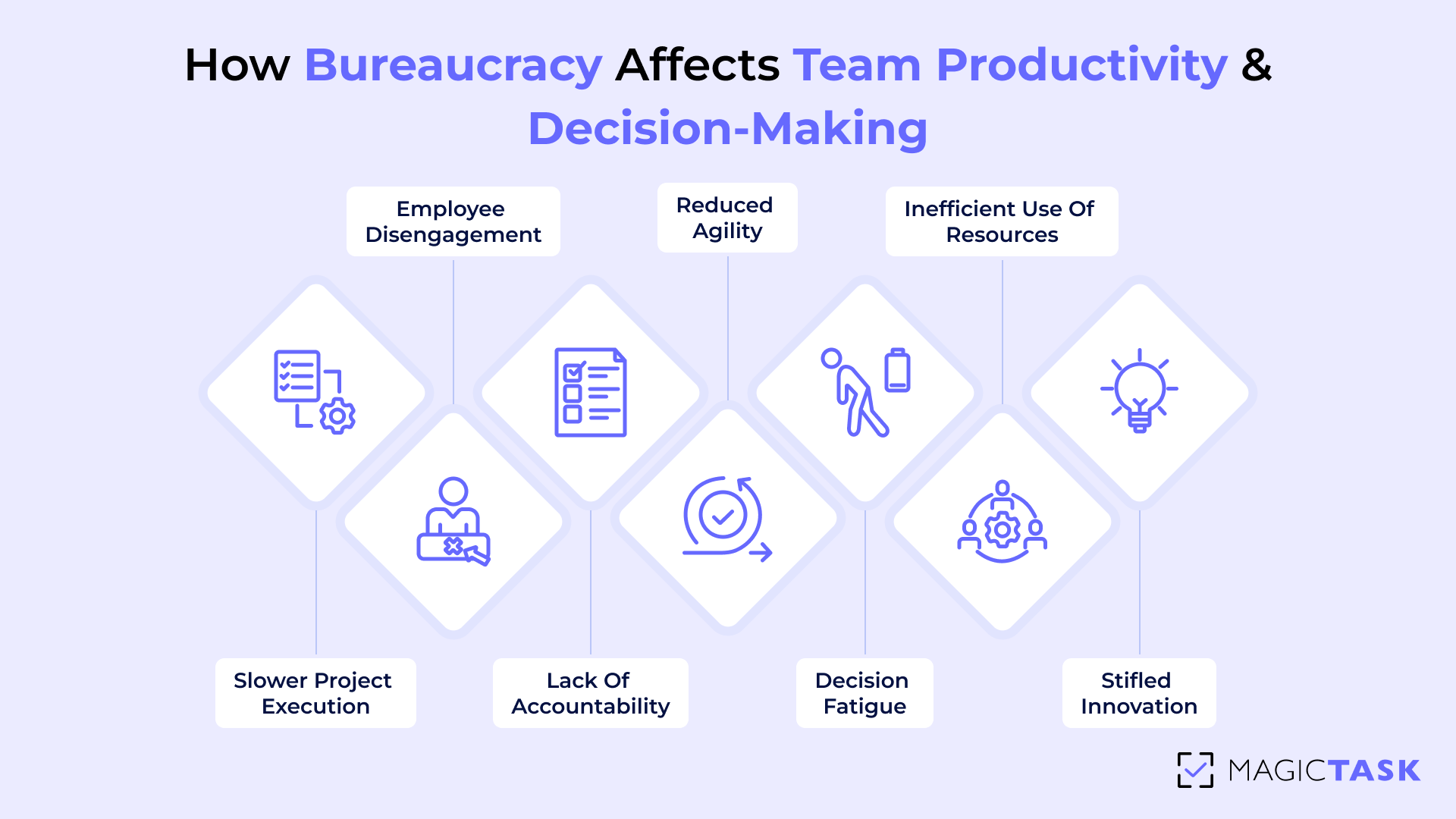
How Bureaucracy Affects Team Productivity & Decision-Making

1. Slower Project Execution

They say the early bird gets the worm — and in business, that couldn’t be more true.

Speed and decisiveness often make the difference between leading the market and falling behind. But when every decision must climb a long ladder of approvals, that agility disappears. Timelines stretch, momentum slows, and opportunities slip through the cracks.

By the time the final go-ahead arrives, it’s too late — the early bird is long gone. And the worm? Well, it didn’t just escape — it found someone bolder, faster, and ready to act.

2. Employee Disengagement

What happens when good ideas get stuck in a maze of bureaucracy? Frustration takes hold.

Employees who start out motivated and full of energy watch their initiatives stall, tangled in layers of red tape. Slowly, their excitement fades, replaced by a sense of powerlessness.

When people stop believing their efforts make a difference, their motivation drops — and so does productivity. By the time approval finally comes through, the energy is gone — and the opportunity has long since slipped away.

3. Lack of Accountability

Without clear accountability, mistakes go unresolved, decisions get delayed, and progress stalls.

Accountability is the backbone of trust and progress. Without it, mistakes linger, decisions stall, and everyone’s left wondering who’s supposed to care.

The people putting in the work start to feel invisible and their effort is drowned out by a chorus of "not my problem." And when that happens, frustration turns into apathy. 

4. Reduced Agility

I’ve seen it happen — a brilliant idea arrives, full of promise and possibility, and then it hits the wall of established procedure.

Bureaucracies love their rules, their steps, their “this is how we’ve always done it” mindset. But the world doesn’t wait for forms to be filled and boxes to be checked.

When systems are too rigid, opportunities slip away, and the chance to evolve disappears. You can’t stay competitive when you’re always a few steps behind.

5. Decision Fatigue

Have you ever felt so worn out by choices that even the simplest decision feels impossible? That’s what happens in organizations drowning in bureaucracy. Leaders and teams face endless rounds of approvals and formalities, and eventually, the weight of it all starts to wear them down.

The mental exhaustion from constant bureaucratic hurdles can impair judgment and reduce the quality of choices made. Over time, this can diminish the organization's effectiveness and responsiveness.

6. Inefficient Use of Resources

I’ve watched good people spend their days filling out paperwork and sitting in meetings that lead nowhere, and I wonder — when do they get to do the work that matters?

Bureaucratic processes eat up time and energy, pulling talented minds away from creative, strategic, and impactful work.

The more we focus on the system, the less we focus on the mission — and that’s a cost no organization can afford.

7. Stifled Innovation

Excessive bureaucracy can discourage creative thinking and experimentation. When every suggestion has to crawl through layers of hierarchy, people stop speaking up. They stop dreaming big. They stop believing their creativity has a place.

And in that silence, the organization loses its chance to grow. Innovation needs room to breathe — but bureaucracy keeps tightening its grip.

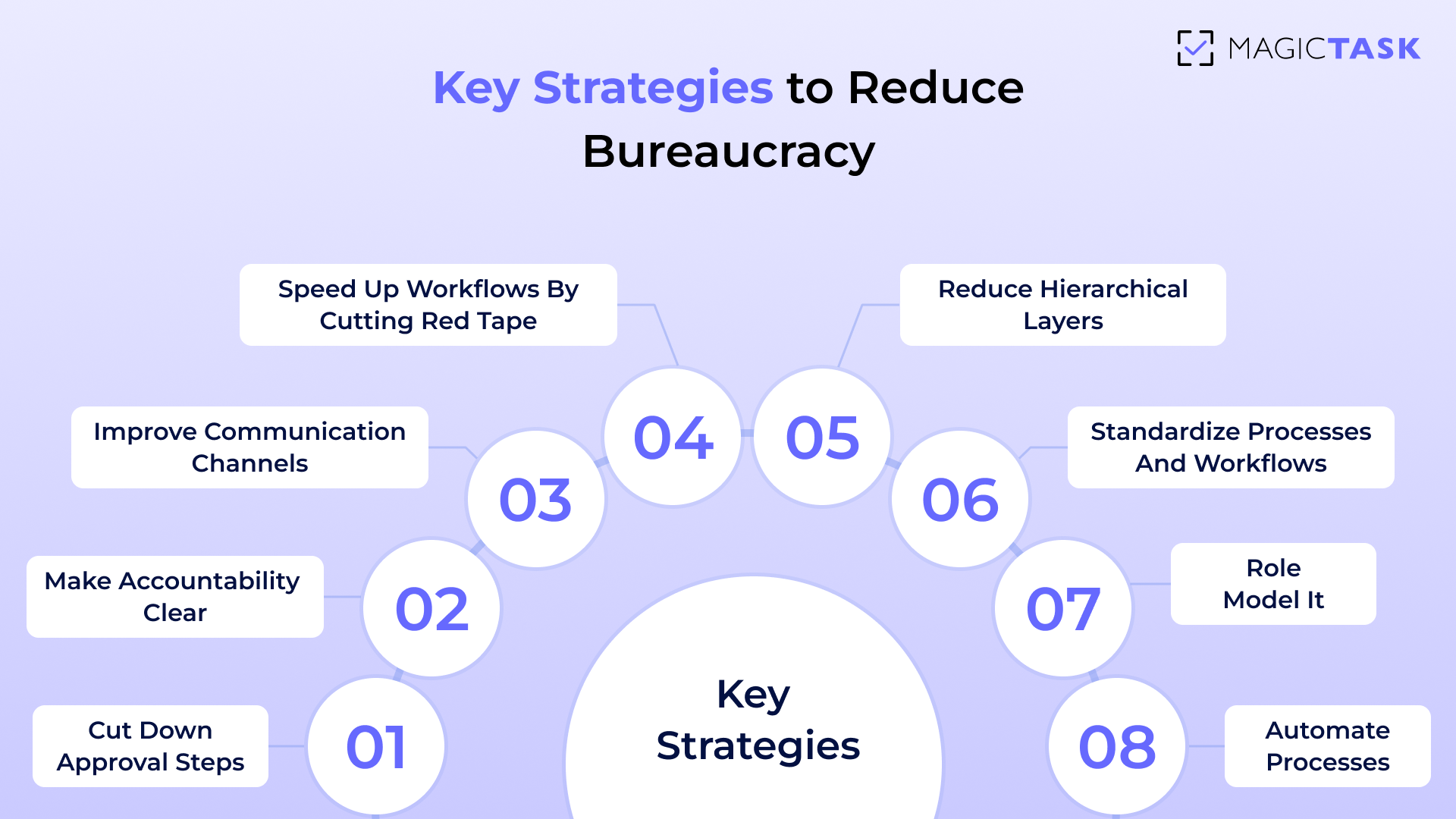
Key Strategies to Reduce Bureaucracy

Reducing bureaucracy helps teams work faster and make better decisions. It’s about cutting unnecessary steps, giving people clear responsibilities, and keeping work flowing smoothly.

Here are some simple and effective ways to make that happen:

1. Cut Down Approval Steps

I get why leaders fear cutting approval steps—it feels like losing control. But in my experience, that’s not the case.

A flat organizational structure combined with simple systems allows decisions to happen faster while maintaining accountability. By focusing on results rather than excessive formalities, teams can work with greater autonomy and still achieve their goals efficiently.

Take the example of a SaaS company preparing for a product installation. A customer urgently needs the product set up, but internal regulations and rigid approval requirements cause significant slowdowns. Every step—technical changes, legal compliance, and budget approvals—requires sign-off from different departments.

How to Fix It

  • Set clear boundaries: Define which decisions require executive approval and which can be handled at the team level.
  • Empower mid-level managers: Trust managers to approve routine tasks without escalating everything upward.
  • Create fast-track processes: For time-sensitive projects, develop a streamlined approval process that bypasses unnecessary steps.

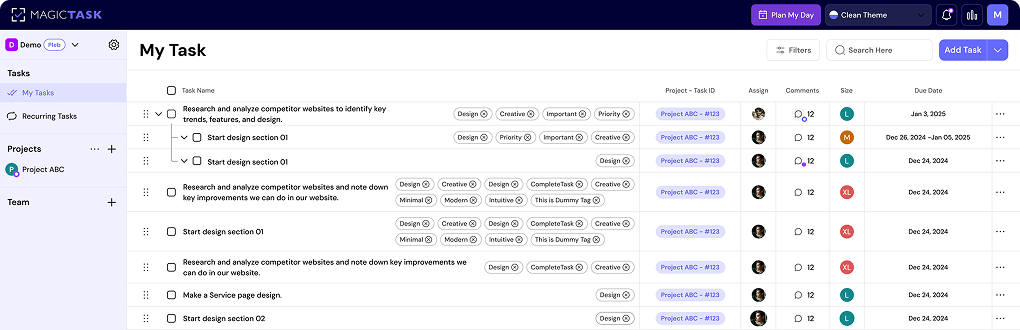
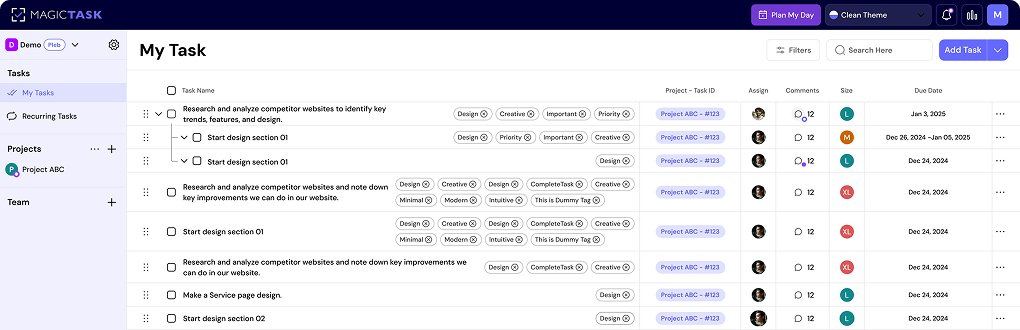
Platforms like MagicTask eliminate these bureaucratic slowdowns by creating what I call “organized chaos.” The interface is clean and simple, but don’t mistake that for basic — it keeps teams aligned without adding a layer of complexity.

Tasks get assigned, tracked, and finished without the usual waiting. And those real-time updates cut down the constant check-ins and follow-ups. Finally, work moves at the pace it’s meant to.
Strategies to reduce bureaucracy

2. Make Accountability Clear

When accountability is unclear, projects stall and important decisions get delayed. Teams waste time figuring out who’s responsible, and tasks slip through the cracks. This often happens in larger organizations where overlapping roles and complex hierarchies blur ownership.

For example, in a product launch, if no one takes clear ownership of timelines or deliverables, departments may wait on each other, assuming someone else is handling critical steps. As a result, deadlines are missed, and productivity suffers.

The solution lies in assigning clear responsibility for every task and decision. When accountability is clear, teams move faster, collaboration improves, and there’s less need for repeated check-ins or follow-ups. It keeps projects on track and decisions on time.

3. Improve Communication Channels

Studies have shown that effective communication can lead to a 25% increase in team performance, while poor communication contributes to project delays and low morale.

For example, when a product team waits days for feedback from sales or marketing, projects lose momentum. Missed messages cause confusion and setbacks. When priorities are unclear, deadlines get pushed back, and productivity slows down.

To keep decisions moving forward:

  • Centralize project discussions: Use a single platform where all updates, feedback, and decisions are easily accessible.
  • Keep conversations task-focused: Link discussions directly to specific tasks so nothing gets lost in unrelated messages.
  • Minimize unnecessary meetings: Share updates and request input through written channels to avoid excessive time spent on calls.
  • Encourage real-time collaboration: Use tools that offer live comments and notifications for faster responses.

Streamlined communication keeps teams aligned, reduces back-and-forth, and ensures quicker workflows without sacrificing clarity.

4. Speed Up Workflows by Cutting Red Tape

Unnecessary bureaucracy slows down progress, creating frustrating roadblocks that stall productivity.

Excessive documentation, multiple approval layers, and redundant formalities drain valuable time that could be spent executing high-impact work. Cutting red tape isn’t about eliminating structure—it’s about removing inefficiencies that slow down tasks.

Start by pinpointing where processes get stuck. 

  • Are approvals taking too long? 
  • Do projects require excessive sign-offs?


By mapping out workflows, teams can identify areas where unnecessary steps add little value and remove them strategically.

Replace long email chains and unnecessary meetings with centralized platforms that provide instant updates and clear task ownership. Regularly review and remove outdated policies that add complexity without contributing to efficiency or outcomes.

5. Reduce Hierarchical Layers

Excessive layers of management slow down the working and dilute accountability. When every decision must pass through multiple levels of approval, teams spend more time waiting than acting. This results in missed opportunities and delayed execution.

A flatter organizational structure speeds up workflows by enabling faster communication and quicker decisions. It reduces the need for constant oversight while giving teams more autonomy.

Key steps to reduce hierarchical bottlenecks:

  • Delegate decision-making authority: Trust team leads and subject matter experts to make informed choices.
  • Simplify reporting lines: Minimize the number of managers involved in routine approvals.
  • Encourage direct collaboration: Allow cross-functional teams to communicate and make decisions without always going through higher management.

Reducing unnecessary management layers creates a more agile environment where teams can focus on execution rather than waiting for permissions.

6. Standardize Processes and Workflows

Inconsistent processes often lead to confusion, delays, and repeated back-and-forth. Without a clear framework, teams waste time figuring out how to approach tasks instead of executing them. 

Standardizing workflows reduces this friction by establishing clear steps for common activities. It ensures that everyone follows the same approach. Clear processes also help identify and eliminate unnecessary steps, keeping only what’s essential.

When teams know exactly how to move from task initiation to completion, they can make decisions faster and with greater confidence.

7. Role Model It

Leadership behavior sets the tone for how decisions are made across an organization.

When leaders prioritize efficiency, minimize unnecessary approvals, and trust their teams to make informed choices, it encourages a culture of productivity.

Conversely, leaders who micromanage or delay decisions through excessive caution create an environment where bureaucracy thrives.

The truth is, cutting red tape isn’t just about policies — it’s about example.

When leaders make clear, thoughtful decisions and empower others to do the same, they set a standard. They show that productivity matters more than formality.

Delegating authority, being transparent about priorities, and simplifying processes — that’s how you build a team that moves forward with confidence, not one stuck waiting for permission.

8. Automate Processes

The best leaders have one thing in common: they never stop learning. In a world where new technology pops up every day, staying informed is a necessity.

The right tools can simplify operations, cut through bureaucracy, and help teams focus on what really matters. When leaders embrace innovation, they show their teams that change isn’t something to fear but something to harness.

Adapting to new solutions keeps businesses flexible, responsive, and ready for whatever comes next. 

What used to take hours can now happen in minutes, thanks to automation. Management tools bring everything into one system, cutting down on manual work and mistakes. The result?

Smoother, faster, and more efficient workflows with more time to focus on what really matters.

The Role of Smart Task Management Tools in Eliminating Bureaucracy

Smart task management tools play an important role in cutting through bureaucracy and keeping teams focused on execution.

These tools simplify workflows, reduce unnecessary steps, and provide real-time visibility into project progress. They eliminate the need for constant status meetings and long email chains by offering a centralized platform. 

The most effective task management tools share a few common characteristics:

  • Simple, intuitive design: A clean and easy-to-use interface ensures teams spend less time figuring out the tool and more time getting work done.
  • Clear task ownership: Assigning responsibilities directly within the platform prevents confusion and holds team members accountable.
  • Real-time updates: Instant visibility into task progress keeps everyone aligned without the need for frequent check-ins.
  • Effortless delegation: Tasks can be assigned quickly, reducing delays in getting work started.

How MagicTask Can Help

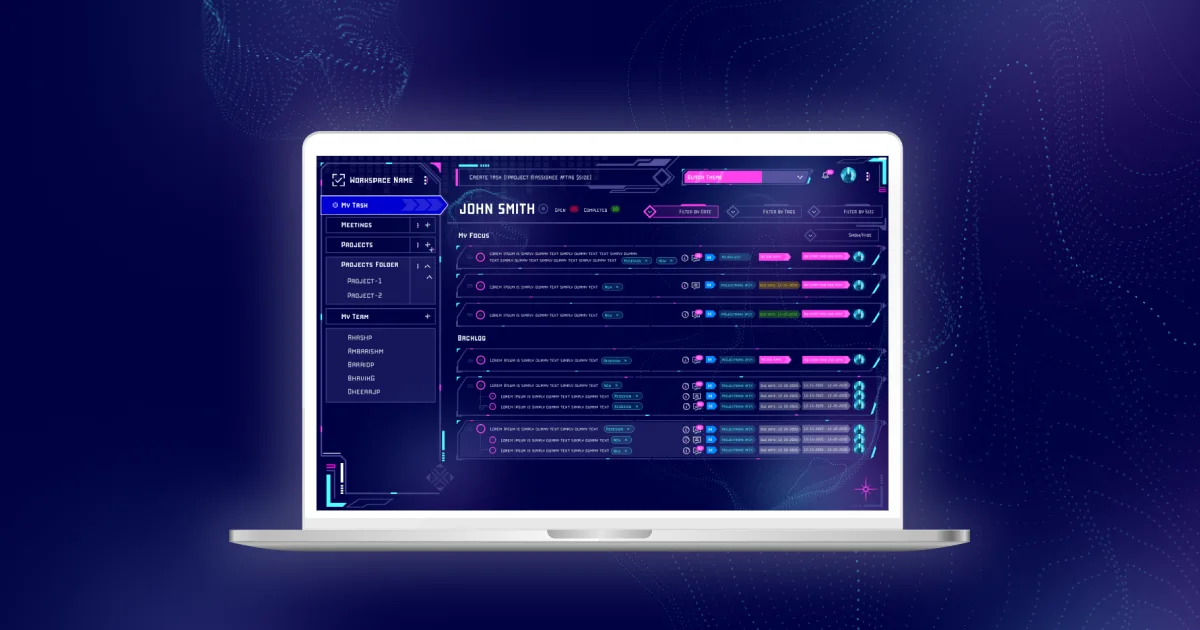
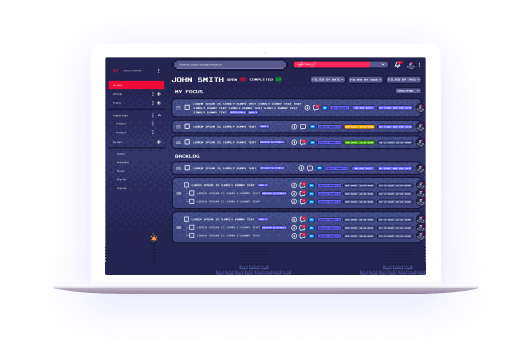
MagicTask takes this a step further by combining smart task management with a gamified experience. Its hyper-simplified design minimizes distractions and keeps the focus on productivity.
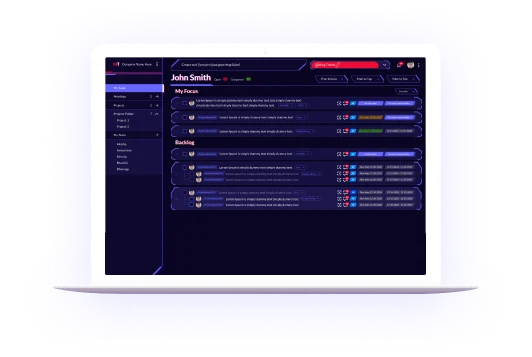
MagicTask

Features like quick task addition, seamless delegation, and clear progress tracking reduce the friction often associated with traditional project management tools.

The gamified approach introduces an element of engagement rarely seen in workplace tools. By turning task completion into a rewarding experience, MagicTask keeps teams motivated and proactive. This not only speeds up the course of action to be taken but also ensures teams remain focused and driven.

With MagicTask, teams experience organized workflows without the burden of excessive formalities, helping them stay agile and results-oriented.

Conclusion

Reducing bureaucracy is essential for creating a workplace where decisions happen quickly, projects move forward without delay, and teams stay engaged and accountable.

When teams are empowered to make informed decisions without being slowed down by excessive approvals, the entire organization benefits from faster execution and higher-quality outcomes.

Adopting the right tools and practices makes this shift easier. A well-structured task management platform like MagicTask brings order without complexity, helping teams stay organized and productive. 
Preventing Team Burnout Without Losing Productivity: A Leader’s Guide

preventing team burnout

Workplace burnout has become a growing concern, affecting both individual well-being and overall team productivity.

In fact, 77% of employees experience burnout at least once in their lifetimes. While productivity is essential, pushing teams too hard can lead to exhaustion, disengagement, reduced accountability, and declining efficiency. The challenge for leaders here is to balance high-performing teams without impacting their productivity.

And, with the right tools in place, your teams will be able to stay more focused, engaged, and productive without reaching a breaking point.

Let's discuss the practical strategies to prevent burnout while maintaining efficiency. 

Understanding Team Burnout and How It Impacts Productivity

Burnout is a state of emotional, physical, and mental exhaustion caused by prolonged stress. It often goes unnoticed, but the effects can be severely damaging. Burnout leads to decreased motivation, higher turnover, and reduced performance at work as well as in personal life. 

Leaders may mistake burnout for a temporary slump, assuming things will improve on their own. However, ignoring the warning signs can have lasting consequences for both employees and business outcomes. So, how can leaders spot team burnout before it’s too late?

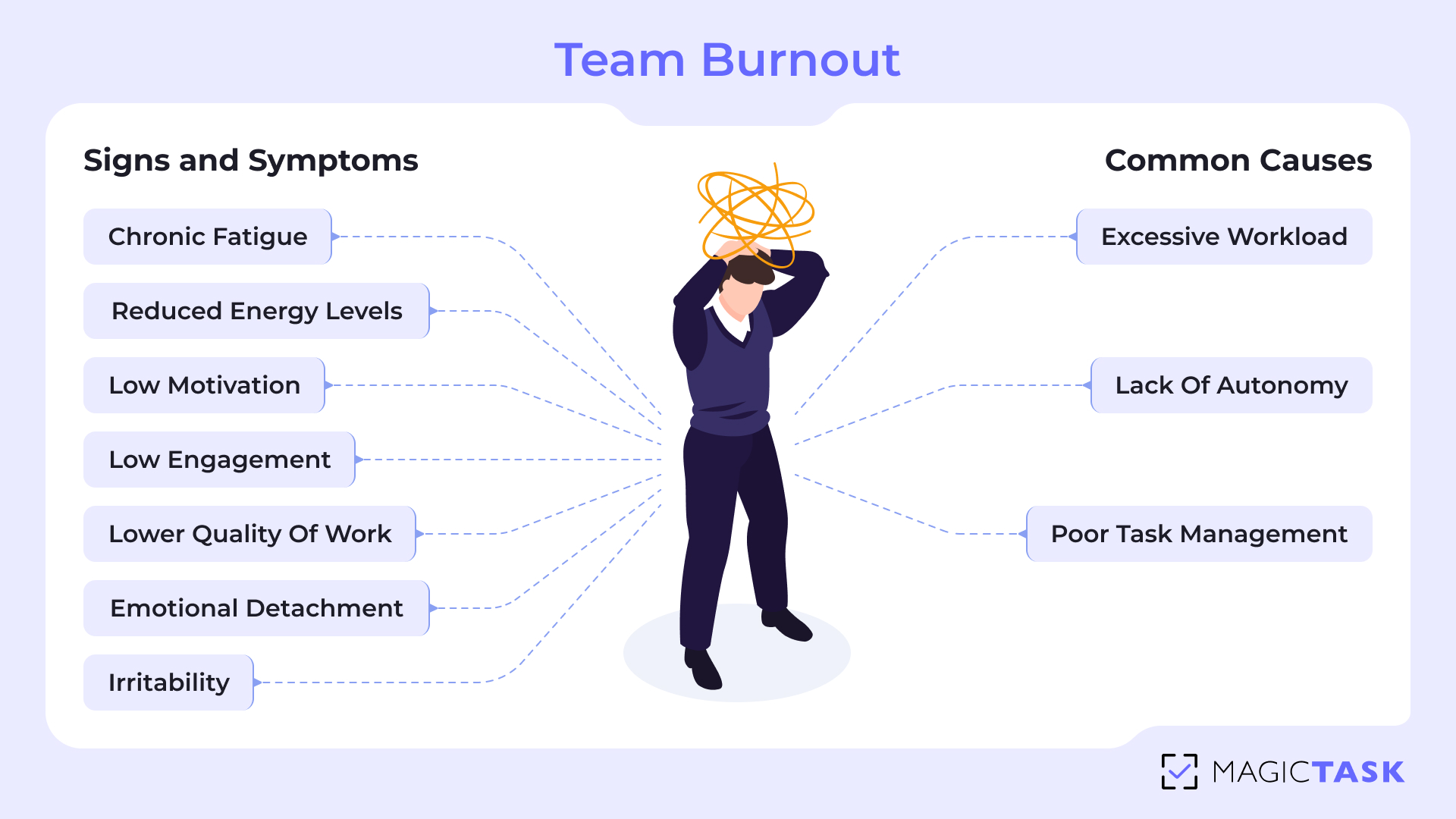
burnout symptoms

Recognizing Burnout: Signs and Symptoms

One of the major reasons for team burnout is persistent stress and unmanageable workloads. Common signs include: 

  • Chronic fatigue and reduced energy levels – Employees appear constantly drained, struggle to concentrate, or take longer to complete routine tasks.
  • Decreased motivation and engagement – A noticeable drop in enthusiasm, hesitation to take initiative, or a lack of interest in new projects.
  • More mistakes and lower quality of work – An increase in errors, missed deadlines, or inconsistent performance due to mental exhaustion.
  • Emotional detachment and irritability – Employees become withdrawn, avoid collaboration, or react negatively to feedback.

These signs are often overlooked, especially in high-performing teams, where meeting deadlines and delivering results can mask underlying burnout. But remember, a burned-out team may continue producing results today while silently heading toward disengagement.

Why Burnout Is Bad for Your Business

A team suffering from burnout doesn’t just struggle individually—it affects the entire organization. How?

The consequences of team burnout include:

  • Decreased efficiency – Fatigue leads to slower work, more errors, and diminished creativity.
  • Disengagement – Employees lose interest in their tasks, reducing collaboration and innovation.
  • Higher turnover costs – Burned-out employees are more likely to quit, increasing hiring, training, and lost productivity expenses.

Ignoring burnout in pursuit of higher productivity creates a cycle of stress and inefficiency. In the long run, it can do more harm than good.

So why does burnout happen in the first place? Let's see.

Common Causes of Team Burnout

Burnout isn’t just about heavy workloads—it’s often a result of workplace culture and management practices. Some key contributors include:

  • Excessive workload – Unrealistic deadlines and high-pressure environments leave employees feeling constantly overwhelmed.
  • Lack of autonomy – Employees who feel micromanaged or have little control over their work often experience frustration and disengagement.
  • Poor task management – Disorganized workflows and unclear priorities create unnecessary stress, forcing employees to spend more time figuring out what to do rather than actually doing it.

Preventing burnout starts with addressing these root causes and creating a sustainable work environment where teams can stay productive without sacrificing well-being.

The Hidden Danger: High Performers May Hide Burnout

Burnout often goes unnoticed, especially in high-performing teams. Many employees push through exhaustion, assuming that productivity and timely delivery mean everything is under control. However, a burned-out team may produce results today while silently heading toward disengagement.

For example, imagine a top performer who always meets deadlines but starts working late nights, skipping breaks, and avoiding team discussions. On the surface, their output may seem fine—but internally, they could be struggling with stress and exhaustion. If left unaddressed, this can lead to a sudden drop in performance or even an unexpected resignation.

A Quick Self-Check for Leaders

To assess if burnout may be affecting your team, ask yourself:

  • Have I noticed a drop in team morale or enthusiasm?
  • Are employees frequently making small mistakes or missing deadlines?
  • Do team members seem exhausted even after breaks or time off?
  • Is there a shift in communication—are people becoming withdrawn or irritable?

If you answered “yes” to any of these, it may be time to step in and address potential burnout before it escalates.

How Leaders Can Prevent Team Burnout While Maintaining Productivity

I get it. Maintaining productivity is challenging for teams as well as leaders. With fewer resources and heavier workloads, the risk of burnout increases. Therefore, leaders must take proactive steps to create balance for themselves and their teams.

Here’s how:

1. Rethinking Productivity: Focus on Outcomes, Not Just Effort

Shifting to an outcome-based approach helps teams stay effective without feeling overwhelmed. Instead of measuring productivity by hours worked, leaders should focus on impact and results. This ensures high performance without unnecessary stress.

  • Work smarter, not harder – Encourage deep work sessions and minimize unnecessary meetings. This helps employees stay focused, complete tasks efficiently, and avoid mental fatigue.
  • Distribute workloads fairly – Overloading high performers can lead to burnout, while underutilizing others reduces engagement. A balanced workload keeps motivation and efficiency high across the team.
  • Set realistic deadlines – Unachievable deadlines create pressure and rushed work, often leading to mistakes. Clear, realistic timelines allow teams to maintain high-quality output without excessive stress.

2. Smarter Workflows & Task Management

Unclear tasks lead to confusion and frustration, making teams work harder than necessary. When expectations are vague, more time is spent figuring out what needs to be done rather than completing the work itself. Clear task definitions with well-defined objectives reduce mental strain and improve focus.

Not every task requires immediate attention, but employees may feel pressured to handle everything at once without clear priorities. Leaders can prevent this by categorizing work into "must-do" and "nice-to-have," ensuring that essential tasks are completed without overwhelming the team.

Strict deadlines often create unnecessary stress. Introducing flexibility, such as buffer periods or staggered due dates, helps maintain efficiency without constant pressure. A structured yet adaptable approach to deadlines allows teams to stay productive while reducing burnout risk.

3. Selecting the Right Tools

The right tools can simplify workflows, but the wrong ones can add unnecessary complexity.

Many productivity apps offer endless customization, allowing users to tweak every detail to suit their preferences. While this flexibility seems beneficial, it often leads to frustration and inefficiency.

For example, Notion is a highly customizable project management platform. However, many users find themselves spending more time organizing their workspace than actually completing tasks. This constant need for refinement can create a cycle of inefficiency, ultimately leading to burnout.

A simpler, more structured task management system eliminates these distractions. MagicTask is designed with this philosophy in mind. It keeps task management simple yet powerful by allowing teams to focus on work rather than tool configurations. It reduces cognitive overload and promotes a clear workflow.

4. Delegate Tasks and Communicate Often

Burnout often stems from uneven workload distribution, where some team members take on more than they can handle. Effective delegation ensures tasks are spread out fairly, preventing individuals from feeling overwhelmed.

Leaders must recognize team strengths and assign work accordingly, allowing everyone to contribute without unnecessary stress.

Clear and frequent communication is equally important. Uncertainty about expectations or project status can lead to anxiety and mental fatigue.

Regular check-ins, open discussions, and transparent workflows create an environment where employees feel supported. Encouraging feedback also helps leaders identify signs of burnout early and make necessary adjustments before it impacts productivity.

5. Evaluate and Reset Expectations

Unrealistic goals and constant pressure to deliver can quickly lead to burnout.

Leaders must regularly assess whether performance expectations align with available resources and team capacity. If deadlines are consistently causing stress, it may be time to adjust timelines or redefine success metrics.

A culture of continuous evaluation allows teams to stay agile and adapt to changing workloads. Instead of focusing solely on output, leaders should emphasize progress, quality, and sustainable performance.

Setting realistic goals and celebrating small wins keeps motivation high while preventing exhaustion from unrealistic demands.

6. Automate Repetitive Work with AI

Repetitive tasks drain energy, consume valuable time, and contribute to burnout.

When teams spend hours on manual data entry, report generation, or status updates, they have less capacity for high-impact work. Automating these processes with AI-powered tools can reduce cognitive overload and improve efficiency.

AI-driven task management systems can streamline workflows by handling routine follow-ups, prioritizing tasks, and even predicting deadlines based on workload patterns.

For example, automation can assign tasks based on team availability, send reminders, or generate reports without manual input. This not only minimizes errors but also allows employees to focus on more meaningful work.

Embracing AI doesn’t mean replacing human effort, it means optimizing it. With the right automation tools, businesses can maintain high productivity without overloading their workforce.

7. Encourage Employees to Set Boundaries

Work can easily spill into personal time if there aren’t clear boundaries. Many employees feel pressured to stay connected after hours, respond to emails immediately, or take on extra tasks beyond their capacity.

Over time, this lack of separation between work and personal life results in reduced motivation, increased stress, and lower overall productivity.

Leaders play an important role in promoting a culture where setting boundaries is not only accepted but encouraged. This can be done by promoting clear work hours, discouraging after-hours communication unless necessary, and respecting employees’ time off.

Simple policies like “no email after 7 PM” or designated focus hours help create a healthier work environment.

Additionally, leading by example is essential. When managers demonstrate healthy boundaries, such as taking breaks, unplugging after work, and prioritizing well-being, employees feel more empowered to do the same. Encouraging regular check-ins on workload and mental health also makes sure that no one feels overwhelmed.

How MagicTask Can Help Prevent Burnout

Burnout stems from mental overload of unfinished tasks. Many task management tools, while powerful, add to this problem by requiring excessive setup.

how magictask prevents burnout

MagicTask takes a different approach by offering a clean, distraction-free interface that simplifies work without unnecessary complexity.

One of MagicTask’s strengths is its ease of use. Unlike platforms like Notion, which can overwhelm users with limitless customization, MagicTask is designed for immediate productivity.

There’s no need to spend hours configuring workflows—teams can start managing tasks effectively immediately. This simplicity prevents administrative fatigue and allows leaders and employees to focus on getting work done.

Another way MagicTask combats burnout is by helping users declutter their minds. A long, unorganized to-do list can feel overwhelming even when you begin working on it. MagicTask encourages a one-task-at-a-time approach, reducing mental overload and making it easier to maintain focus. This structured method helps employees stay engaged without feeling constantly behind.

Additionally, MagicTask uses gamification, a unique feature that keeps motivation levels high. Completing tasks triggers small rewards, streaks, and achievements that provide a sense of progress and accomplishment. This dopamine boost makes even repetitive work feel more satisfying. It reduces the emotional drain often associated with daily tasks.

MagicTask offers a balanced solution where efficiency and well-being go hand in hand to ensure that high performance doesn’t come at the cost of burnout.

Creating a Sustainable Work Environment for Long-Term Success

Leaders need to promote an environment of honesty, sincere empathy, and shared accountability. It is the duty of every leader to encourage the growth of their team members and demonstrate commitment to their work. This means creating a sustainable work environment for long-term success.

1. Work-Life Balance Strategies That Actually Work

Leaders must find ways to promote work-life balance without compromising results. Encouraging intentional breaks and respecting non-working hours can reduce burnout. Simple strategies, like prioritizing clear tasks, help employees recharge without affecting productivity.

For hybrid and remote teams, work fatigue is a major challenge. Without a structured office environment, work can blend into personal life, making it harder to disconnect. 

Leaders should support flexible yet structured schedules, ensuring employees maintain clear start and stop times for their workday. A well-rested team is more engaged, innovative, and productive, leading to sustained success for both employees and the business.

2. Cultivating a Culture of Recognition and Support

A workplace that values and appreciates its employees instills long-term motivation and reduces burnout. Leaders can build a culture of recognition by regularly acknowledging individual and team achievements. Even small gestures, such as a simple thank-you or public appreciation, can go a long way in boosting morale.

Encouraging peer recognition is equally important. When employees celebrate each other’s efforts, it creates a positive and supportive work environment. Implementing structured recognition programs, such as monthly awards, shout-outs in team meetings, or bonuses for outstanding contributions, reinforces a sense of value and belonging.

Beyond recognition, emotional and professional support play a key role in preventing burnout. Leaders should provide employees with mentorship opportunities, clear career growth paths, and resources to manage stress effectively. When employees feel appreciated and supported, they stay engaged, productive, and motivated to perform at their best.

Conclusion

A sustainable work environment is where employees feel motivated, supported, and empowered to do their best work. Leaders who prioritize well-being while maintaining clear expectations create teams that thrive in the long run.

MagicTask helps businesses achieve this balance by simplifying task management with the twist of gamification.

MagicTask turns daily workflows into a fun experience that keeps teams focused and engaged. Investing in the right tools and strategies today leads to long-term success.

Create your free MagicTask account now

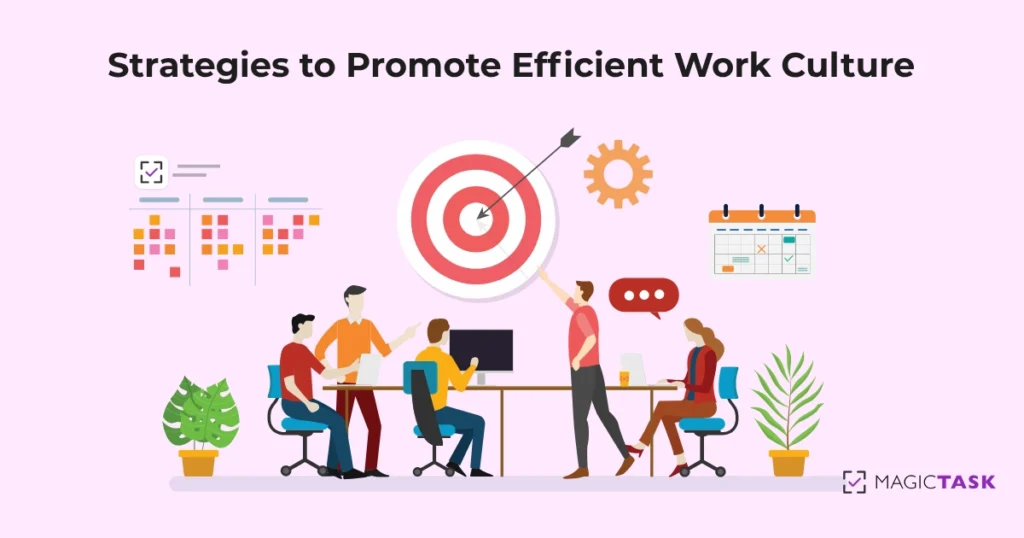
10 Strategies to Promote Efficient Work Culture

Promote efficient work culture

Is your team truly making the most of their workday? Or are they busy without really being productive?

No matter your industry or business size, one thing remains constant: the need for greater productivity. At the core of that is work efficiency—helping employees work smarter, not harder.

Yet, despite its benefits, a study found that the average worker is productive for less than three hours per day. Various factors can hinder work efficiency, but identifying the root cause is the first step toward improvement.

Through our experience building MagicTask—a productivity tool loved by everyone—we've discovered key strategies for fostering an efficient work culture and reclaiming valuable hours each week.

Let’s read on and, explore those strategies and learn the concept of working efficiently.

What is Work Efficiency?

Work efficiency involves completing tasks and goals with minimal time, effort, and resources, maximizing productivity. It ensures higher productivity without negatively impacting individuals' well-being and measures how effectively your team works.

To achieve this, focus on essential activities and eliminate unnecessary tasks or delays from the work process.

As an example of work efficiency, let's say you typically spend three to four hours compiling and preparing a monthly update report. Then, one day, you find ways to improve the work process with the help of new automation software and some new strategies.

As a result, you can now complete the same report in just two hours. This reduction in time for accomplishing the same task showcases an increase in your work efficiency.

Why Does Efficiency Matter at the Workplace?

Have you ever wondered how some teams accomplish more in less time while maintaining quality? The secret lies in work efficiency—but why is it so important?

Here’s why working efficiently matters at the workplace:

1. Accomplishing more – Efficient workflows help teams complete more tasks in less time, boosting overall productivity.

2. Increased profit margins – Inefficient processes, wasted time, and resources cost businesses money. Streamlining tasks reduces inefficiencies, in turn leading to less expenditure.

3. Improved Employee Satisfaction – Do your employees feel overwhelmed? When workflows run smoothly, employee stress goes down. This leads to higher job satisfaction and retention.

4. Better Quality Output – Working efficiently isn’t just about speed. It’s also about fewer errors and enhanced work quality.

5. Positive work culture – Efficiancy fosters a positive culture where employees feel motivated, collaborate effectively, and maintain a healthy work-life balance.

6. Competitive Advantage – In a fast-paced market, efficiency helps businesses stay agile, adapt to trends, and outperform competitors.

How efficient is your workplace? Identifying and improving inefficiencies can transform productivity, morale, and success.

Key Challenges in Maintaining Efficiency at Work

Every organization looks forward to improving work efficiency, and employees want to be more productive and do meaningful work. Yet, despite this, achieving work efficiency can feel challenging. Constant distractions disrupt focus and lead to unfinished projects and fragmented workflows.

The first step to improving efficiency is recognizing the key challenges that hinder productivity. Here are some of the most common obstacles in maintaining work efficiency.

1. Inefficient or no tool.

Your team can't be truly efficient even with the best intentions if your organization lacks the right tools.

Managing multiple stakeholders, processes, and projects requires digital tools designed for seamless collaboration. Without them, work remains fragmented, slowing productivity.

2. Lack of clear directions.

Unclear employee roles, targets, and timelines create confusion. They may lead to delays, missed deadlines, and wasted time correcting mistakes. Without clear direction, teams struggle to prioritize effectively.

Conflicting work priorities further result in poor time and resource management. This ultimately reduces efficiency and impacts overall output.

3. Insufficient support and guidance.

Employees still need ongoing support and guidance even when work expectations are clear. However, some may hesitate to ask for help, fearing they’ll seem incompetent.

This leads to wasted time, mistakes, and decreased efficiency. The solution? Foster a culture of continuous learning where employees feel encouraged to ask questions, seek guidance, and grow on the job.

4. Slow, inefficient work processes.

If your team spends too much time on administrative tasks instead of their core responsibilities, inefficient internal processes may be the reason for low productivity.

Complex rules, too many steps for simple tasks, and a cumbersome approval process can all slow productivity and hinder efficiency. Streamlining workflows is key to keeping your team focused on what truly matters.

5. Frequent endless meetings monopolizing work timing.

Modern workplaces are filled with distractions—open office spaces, endless app notifications, and an often-overlooked culprit: meetings.

Some days are packed with back-to-back meetings, leaving little time for meaningful work and a waste of valuable resources. Besides, short 30-minute gaps between meetings aren’t enough to dive back into tasks, making productivity slip away.

6. Multitasking.

While multitasking is a valuable skill, it can reduce efficiency. Constant task-switching creates mental lag, making it harder to focus. When employees feel pressured to respond to every email or notification, they get distracted by less important tasks—shifting focus away from high-impact, strategic work.

7. Employee disengagement.

Disengaged employees are less productive because they lack a strong connection to the company. In contrast, highly engaged teams see 21% higher productivity, according to Gallup.

Without a strong attachment to company goals, employees are less likely to put in their best effort, resulting in missed deadlines, decreased collaboration, and overall lower performance.

10 Strategies to Promote Efficiency at Work

While the best approach varies by person and situation, certain strategies consistently enhance work efficiency.

Improving efficiency requires strategic planning, technology, and a positive work culture. Here are 10 simple yet effective ways to boost productivity in your organization.

1. Develop Effective Collaboration.

Collaboration plays a key role in workplace efficiency but can disrupt productivity without structure. A quick request from a coworker can be as distracting as a notification, especially in remote settings.

Ensure everything is defined clearly—work expectations, communication channels, and mutual respect for each other’s time—to enable smooth teamwork. Without clear collaboration guidelines, employees are left to navigate teamwork on their own, leading to inefficiencies.

2. Stay Organized with the help of Task Management Tool.

Managing tasks through email and meetings is time-consuming and often leads to information loss and inefficiency. A task management tool keeps everything organized by providing an overview of task progress accessible anytime and anywhere.

With a centralized task management system like MagicTask, teams can track assignments, deadlines, and discussions without sifting through emails or messages. Moreover, such tools offer a visual workflow, ensuring accountability and smooth collaboration—whether in the office or remotely.

3. Use Asynchronous Communication to Eliminate Unnecessary Meetings.

Asynchronous video sharing helps explain tasks without scheduling meetings. Such pre-recorded videos work well for onboarding, presentations, and tutorials, allowing employees to watch, pause, and take notes at their own pace.

Tools like Zoom let teams record, share, and comment on videos, improving clarity and reducing repetitive explanations. Organizing these videos on a task board streamlines access, ensuring efficient collaboration without constant meetings.

4. Push back low-priority Tasks.

Just because you can do something doesn’t mean you should. Protecting your team’s time by pushing back on low-priority requests is key to meeting KPIs.

When you are overloaded with tasks that align with company goals, prioritize. Focus on what’s most impactful, say no to non-urgent tasks, and communicate openly with other stakeholders. Clear, timely responses help manage expectations and maintain efficiency.

5. Review and Refine Processes regularly.

Regularly reviewing and refining processes is key to maintaining efficiency. Simplify where possible—eliminate unnecessary steps, limit decision-makers, and ensure only essential stakeholders are involved.

If meetings or projects don’t add value to your team, speak up and focus on higher-impact work. While some processes, like legal or safety protocols, must remain thorough, efficiency can still be optimized through automation, team feedback, and better workload distribution.

6. Help Employees Set Clear Boundaries.

Saying no can be difficult, but taking on too much leads to inefficiency. Encourage employees to set boundaries and decline tasks that don’t align with priorities or capacity.

Whether they are already tackling a busy week or need time for personal development, there’s nothing wrong with turning down opportunities if they’re not helpful. This improves time management, reduces burnout, and allows them to focus on delivering quality work.

7. Plan for Success.

A solid project plan provides clarity on scope, KPIs, methods, and timelines. Documenting it in clear terms helps secure stakeholder buy-in and guides team execution.

Project management tools streamline planning by enabling real-time updates, centralized feedback, and quick stakeholder communication. Strategic resource allocation strengthens execution, keeping projects on track and within budget. Regularly reviewing your plan ensures alignment with KPIs, allowing timely adjustments for success.

8. Encourage Regular Breaks.

Encourage regular breaks to sustain productivity and prevent burnout. Short rest periods recharge energy, improve focus, and enhance performance.

Working longer doesn’t always mean better results—without rest, efficiency drops. Just like a muscle, the brain needs downtime to stay sharp. A well-rested team fosters a healthier, more productive work culture.

9. Use Technology to Automate Processes.

Using the right technology makes work easier and more efficient. Automate repetitive tasks like data entry and payroll to reduce errors and free up time for more valuable work.

Use project management, communication, and analytics tools to improve collaboration, decision-making, and organization. However, technology is only effective if employees know how to use it—proper training ensures teams maximize its benefits.

10. Keep Meetings Structured & Short.

Limit unnecessary meetings to keep work moving. Too many meetings can lead to rushed tasks and more mistakes. To stay efficient, only meet when necessary and always have a clear agenda shared in advance.

This ensures that the right people are present, everyone is prepared, and discussions stay focused. Agendas should include action items, key updates, discussion points, and relevant files. Sending them 24–48 hours ahead saves time and makes meetings more productive.

How Can MagicTask Help You Work Efficiently?

MagicTask

Is your team struggling with low productivity, duplicate efforts, or wasted time? Imagine a simple tool that helps you work more efficiently, even on complex projects.

With MagicTask, you and your team can maximize productivity and stay on track. It can help you turn chaotic workdays into structured, productive ones.

Here’s how it can help you work smarter.

1. Hyper-simplicity.

Companies tired of complicated productivity tools that slow down their teams find MagicTask just the right platform for their task management needs.

Why?

  • MagicTask is built by eliminating cluttered interfaces and unnecessary features. This keeps things effortless and distractions-free.
  • Unlike complex platforms, MagicTask allows your team to stay focused, collaborate easily, and get more done—faster. Users get to start quickly on a task, track it, and finish it off.
  • With an intuitive UI and minimal features, task management becomes smooth, efficient, and even fun.

2. Centralized task management.

Understanding the difficulty of juggling between multiple platforms, MagicTask offers a centralized platform.

Benefits?

  • It brings tasks related to sending emails, chats, sharing documents, task management, to-do lists, project management, notifying teams, etc, all under a single umbrella.
  • With MagicTask, you can track projects, tasks, and files in real-time, ensuring your team has everything they need at their fingertips.
  • No more lost information or miscommunication—just a seamless workflow.

3. Increased accountability.

If your team regularly misses deadlines and is unclear about their responsibilities, this can bring down efficiency.

  • MagicTask boosts accountability by assigning clear tasks, tracking progress, setting deadlines, and ensuring everyone knows what needs to be done and when.
  • MagicTask’s real-time updates eliminate the need for constant follow-ups, while task comments enable seamless feedback.
  • So, there is no more guesswork—just a structured, efficient workflow.

4. Gamification features.

Gone are the days when fear and discipline drove productivity. Today, motivation is key—and that’s where MagicTask comes in.

  • MagicTask makes work feel like a game.
  • MagicTask uses instant feedback and rewards to keep your employees motivated. Just as in video games, completing tasks triggers a satisfying loop of progress and gratification, making productivity both engaging and addictive.
  • With MagicTask's gamification features, work becomes competitive but engaging and rewarding. Employees earn points on task completion, level up, and achieve milestones, making even the most routine tasks exciting.

Conclusion.

Work efficiency isn’t about doing more—it’s about working smarter. Staying organized with the right tools creates a productive environment and keeps your team focused. Juggling multiple platforms for tasks and communication only slows you down. It wastes time, creates confusion, and kills momentum.

MagicTask simplifies everything with a centralized task management system. No more switching between tools or losing track of important work.

Just seamless collaboration, better productivity, and a smoother workflow. Ready to level up your team’s efficiency? Sign up today and see the difference!

How to Keep Your Team on Track Without Micromanaging? Key Strategies Explained

How to Keep Your Team on Track Without Micromanaging

Keeping your team on track without resorting to micromanagement requires a delicate balance. As a leader, you must build trust in your team, encourage open communication, and give them the freedom to make strategic decisions.

As Harvard Business Review points out, micromanagement often leads to frustrated leaders and disengaged employees.

For leaders, the real challenge is holding everyone accountable without dampening productivity or morale. Many managers believe maintaining tight control can lead to success. However, too much oversight can stifle productivity and weaken team cohesion.

So, how do you stay on top of teams without constantly checking in?

Let's see.

Why Leaders Struggle to Let Go of Micromanagement

Micromanagement is a management style where leaders check in so frequently that employees feel restricted and unable to perform at their best. A micromanaging supervisor meddles in every aspect of a project, insists on regular status updates, and ultimately causes subpar results.

So why do leaders find it difficult to step back?

Fear of Failure and Accountability Gaps

The tendency to micromanage often comes from fear of failure. Leaders worry that if they don’t stay heavily involved, tasks won’t meet their standards. This fear grows when there is no clear ownership within the team.

When accountability is lacking, managers feel the need to step in and fill these gaps. However, this lack of trust can prevent the team from growing, making them dependent on constant oversight instead of developing autonomy.

The Struggle Between Visibility and Control

Another reason leaders find it hard to let go is the confusion between visibility and control. It’s important to monitor progress and keep projects on track, but too much oversight can hinder creativity and problem-solving.

This creates the productivity paradox—where excessive supervision, meant to improve efficiency, actually slows down execution by increasing bottlenecks and limiting team initiative.

How to Keep Your Teams on Track without Micromanaging?

Now that we understand the downsides of micromanagement let’s explore expert-backed strategies to keep teams on track, boost productivity, and foster a culture of accountability.

1. Transparency in Task Management

When teams lack clarity on their tasks, miscommunication becomes inevitable. A well-structured system with clear accountability and streamlined processes is essential because overly complex manuals or scattered instructions only add to the confusion.

Micromanagement becomes unnecessary when employees:

  • Clearly understand their roles and expectations
  • Have a solid grasp of the project’s objectives and deliverables
  • Are aware of deadlines and responsibilities

One way to ensure transparency without constant oversight is by using efficient project management tools. This is where MagicTask comes in. Managers or even individual employees can use its "Commenting" feature to add context or additional details to specific tasks. This ensures that everyone, including team members and leaders, has access to the necessary information, creating overall transparency and reducing the need for excessive follow-ups.

MagicTask

2. Set SMART Goals to Drive Accountability

One of the most effective ways to keep teams on track without micromanaging is by setting clear, structured goals. When employees understand exactly what they need to achieve and why it matters, they require less oversight and can take ownership of their work.

A proven method for setting clear objectives is the SMART framework, which ensures goals are:

  • Specific – Clearly defined with no ambiguity
  • Measurable – Quantifiable so progress can be tracked
  • Achievable – Realistic given the resources and constraints
  • Relevant – Aligned with broader business objectives
  • Time-bound – Set within a defined timeframe

To make this approach even more effective, consider adding one more element: Strengths. Aligning goals with employees' core strengths enhances motivation and productivity.

For example, if your goal is to increase revenue through innovative marketing, and your marketing team thrives on creativity, here’s how a SMART+S goal might look:

  • Specific: Increase quarterly revenue from our e-commerce store.
  • Measurable: Achieve a 20% rise in sales revenue compared to last quarter.
  • Achievable: Focus on partnerships and invest in targeted marketing campaigns.
  • Relevant: Increased revenue will allow reinvestment in product development and overall business growth.
  • Time-bound: Achieve a 20% increase within the next three months.
  • Strengths: Leverage the marketing team’s creativity by organizing an innovation-focused design sprint.

By setting SMART+S goals, you provide clear direction without micromanaging. Employees know what success looks like, can measure their own progress, and feel empowered to work independently—reducing the need for constant check-ins.

3. Role Clarity & Accountability Structures

Setting clear goals is essential, but even the best goals can fall apart without defined roles and ownership.

When employees know what is expected of them, they work confidently and require less oversight. However, when roles are ambiguous, confusion arises, leading managers to step in too often—resulting in micromanagement.

How Role Clarity Reduces the Need for Micromanagement

A well-defined structure ensures that every team member understands their responsibilities, reducing overlap, miscommunication, and the risk of tasks slipping through the cracks. When ownership is clear, employees feel a stronger sense of purpose and direction, leading to better productivity and higher engagement.

Building an Accountability System Without Micromanaging

Instead of constant check-ins, leaders should implement systems that naturally encourage accountability, such as:

  • Regular check-ins with a purpose – Focus on progress and roadblocks, not just status updates.
  • Performance metrics – Clear, measurable indicators of success that allow employees to track their own progress.
  • Feedback loops – Constructive feedback that empowers employees to improve rather than feel monitored.

With these structures in place, teams can stay on track without the need for excessive oversight. Employees take ownership of their work, while leaders gain confidence that projects are progressing as planned.

4. The 70/30 Rule: Balancing Autonomy and Leadership

Many leaders want to empower their teams but hesitate to give full autonomy. The fear is understandable—what if employees diverge too much? How will they make decisions? How do you ensure resources are allocated properly without losing control?

The key is to establish clear boundaries that provide structure while still allowing flexibility. This is where the 70/30 Rule comes in:

  • Give your team 70% autonomy to make decisions, innovate, and take ownership of their work.
  • Step in for the remaining **30%**—focusing on critical areas that require leadership oversight, such as strategic direction, risk management, and major course corrections.

By following this approach, leaders can maintain alignment without micromanaging, ensuring employees have the freedom to perform while still keeping projects on track.

5. Encourage an Atmosphere of Honesty And Trust.

Teams thrive when there is mutual trust between leaders and employees. However, if micromanagement has been the norm, team members may hesitate to make decisions without seeking approval first.

As a leader, it’s important to gradually shift control back to your team and foster a culture where they feel confident taking ownership.

Start by delegating small decisions and reinforcing that you trust their judgment. At the same time, set clear expectations so they understand when to proceed independently and when to seek input.

Avoid the temptation to stay overly involved in daily operations. A simple step is to request not being tagged in every chat or CC’d on every email, signaling that you trust them to handle tasks without constant oversight.

By creating an environment where employees feel empowered yet supported, you encourage accountability without micromanagement.

6. Use the Right Project Management Tools

The right project management tools help teams stay aligned, maintain transparency, and take ownership of their work—without the need for micromanagement. A well-structured tool ensures that tasks, deadlines, and responsibilities are clearly defined, reducing confusion and unnecessary check-ins.

Platforms like MagicTask provide a visual roadmap, allowing teams to track progress, set priorities, and manage dependencies in one place. This streamlined approach minimizes miscommunication and enables leaders to monitor workflows without constant oversight.

Beyond organization, accountability should be built into the tool itself. MagicTask incorporates gamification features, such as leaderboards, to encourage employees to stay engaged and proactive in updating their tasks.

Pete Peranzo, co-founder of Imaginovation, shared the impact of using MagicTask in their organization:
"Upon deploying MagicTask, we observed a staggering 400% increase in adoption rates. While Jira managed 6,000 tickets from December 2017 to July 2020, MagicTask handled an impressive 30,000 tickets between January 2020 and February 2022."

Choosing the right project management tool isn’t just about organization—it’s about empowering teams to work independently while giving leaders visibility without micromanaging.

How to Ensure Progress Without Constant Check-Ins

Now, the next step is to ensure progress using the right tools and strategies we discussed. Let’s take a look at how to do this effectively.

1. Use the Right Tracking & Reporting Methods

Even with the best project management system, it’s important to have task-tracking and reporting features. These help you stay on top of your team’s progress and get clear performance insights through dashboards without the need for constant check-ins.

With MagicTask, leaders can easily see project updates, task completions, and team performance in one place. Its reporting features provide the clarity managers need, so they can stay informed without personally checking in on every employee.

By using the right tracking tools, you create a transparent and stress-free workflow where teams stay focused and leaders have visibility without disrupting progress.

2. Foster a Culture of Self-Accountability

A team that takes ownership of its work doesn’t need constant monitoring. Employees who feel responsible for their tasks are more likely to stay on track, meet deadlines, and solve problems independently.

To encourage self-accountability, leaders should set clear expectations, provide visibility into progress, and ensure that employees have the tools to manage their work effectively. Instead of stepping in frequently, managers can create an environment where employees take initiative and track their performance.

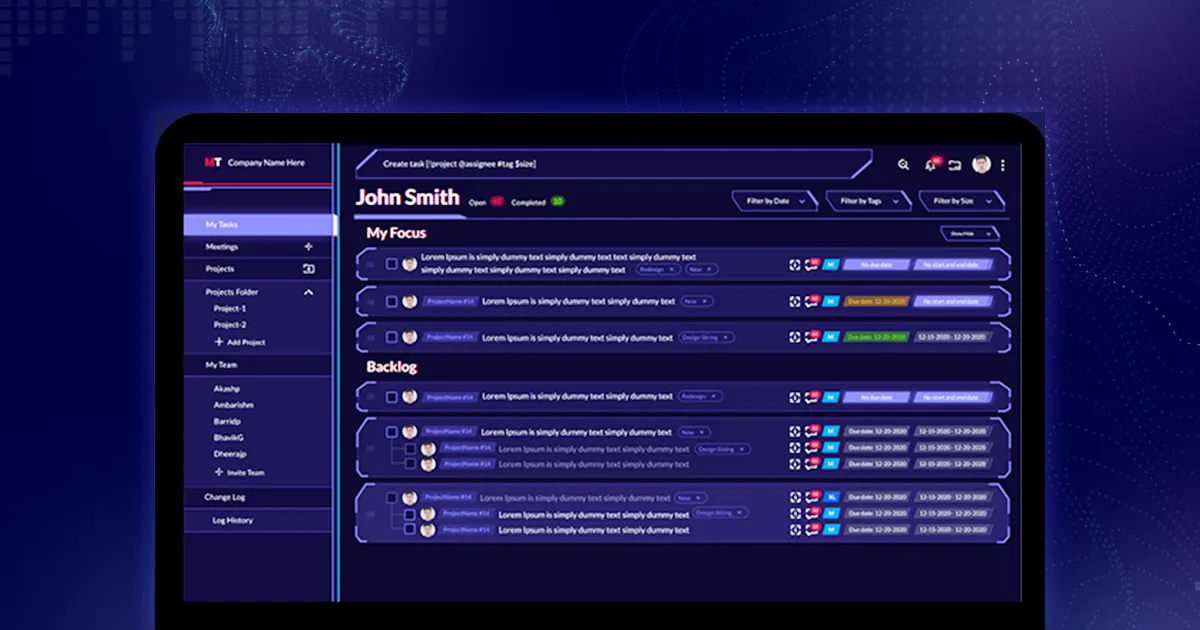
A tool like MagicTask supports this by offering a "My Tasks" or "Projects" view, where employees can see their tasks, prioritize work, scope out the size, and stay organized without relying on constant direction.

This built-in transparency helps teams stay accountable without the need for excessive follow-ups, leading to a more self-sufficient and motivated workforce.

3. Delegation Done Right: Giving Teams Responsibility & Authority

Delegation isn’t just about assigning tasks—it’s about giving teams both responsibility and the freedom to make decisions. When done effectively, it prevents bottlenecks, fosters independence, and reduces the need for constant oversight. However, when delegation lacks clarity, it can lead to confusion and micromanagement.

A key principle of effective delegation is the "What, Not How" rule. Instead of dictating every step, leaders should define clear goals and let employees figure out the best way to accomplish them. This builds trust and allows teams to work with more autonomy.

To implement a strong delegation framework, leaders should:

  • Define clear goals – Ensure teams understand objectives, priorities, and success criteria.
  • Use non-intrusive progress tracking – Check in periodically without disrupting workflow.
  • Empower decision-making – Give employees the flexibility to solve problems on their own.

MagicTask makes delegation seamless by allowing leaders to create high-level tasks, while employees can break them down into subtasks, add relevant details in comments, and prioritize their work accordingly. This structured yet flexible approach gives teams the freedom to manage their workload effectively while ensuring overall project alignment.

4. Managing Low Performers Without Resorting to Micromanagement

Low performance can be frustrating for leaders, but excessive oversight won’t fix the root cause. It only creates dependency. When employees become too reliant on managers for direction, they struggle to grow, and leaders end up overworked.

If an employee isn’t meeting expectations, start by identifying the real issue. Is it a lack of clarity? Insufficient training? A motivation problem? Without understanding the cause, adding more supervision will only make things worse.

Addressing Performance Issues Constructively

Rather than assuming an employee is disengaged, have an open conversation to uncover what’s holding them back. Many managers avoid these discussions because they fear conflict, but coaching opportunities.

Instead of stepping in constantly, provide the right level of guidance and resources to help them succeed. With clear communication, goal alignment, and a culture of accountability, low performers can improve without micromanagement.

Conclusion

Micromanagement is a lose-lose situation—it overwhelms managers, demotivates employees, and slows down progress. Instead of driving better results, it often creates more problems than it solves.

Applying the strategies covered in this guide lets you keep your team on track, foster accountability, and ensure progress without constant oversight. The right tools, such as MagicTask, help streamline delegation, task tracking, and reporting—allowing leaders to stay informed without micromanaging.

Ready to transform the way you manage your team? Sign up for MagicTask today and experience a more efficient, transparent, and stress-free work environment.

Creating A Culture of Accountability: A Practical Guide for Leaders

Creating A Culture of Accountability

Accountability isn’t just a corporate buzzword. It’s the foundation of a high-performing team. But the problem is you can’t force accountability. You can’t simply demand it. It has to be built into your company’s culture, starting with leadership and extending to every team member.

Real accountability happens when employees take ownership, not because they’re being watched, but because they genuinely care about their work and how it impacts the organization.

That’s when you know you’ve built something special.

But how do you get there? How do you create a culture where accountability is not just expected but embraced?

In this guide, we’ll break down what a culture of accountability really means, why it’s essential, and how you, as a leader, can cultivate it within your team.

What is a Culture of Accountability?

So, what is a culture of accountability? Is being "responsible" and "accountable" not the same thing?

Let's start with the basics.

Understanding Accountability

At its core, accountability means taking responsibility for one’s actions and outcomes. In the workplace, this translates to employees understanding their roles, owning their work, and being answerable for good and bad results.

Culture of Accountability

A culture of accountability is more than just individuals being responsible for their tasks. It’s about creating an environment where:

  • Commitments are taken seriously: If someone says they’ll deliver, the team knows they will.
  • Mistakes are learning opportunities: Instead of pointing fingers, people ask, “What can we do better next time?”
  • Trust is strong: Employees feel empowered to make decisions, knowing they’ll be supported.

A culture of accountability in the workplace is one in which each person does their part and acknowledges that all employees may contribute to the organization's overall success. It is about accepting responsibility for your task and taking initiative.

This may sound a lot like "responsibility," right? Well, not really, and here's why.

Responsibility vs. Accountability

A lot of leaders mix up responsibility and accountability. Here’s a simple way to think about it:

  • Responsibility is about being assigned a task.
  • Accountability is about owning the outcome.

For example, a junior software engineer in the organization might be responsible for writing code, but if that code doesn’t meet quality standards or causes project delays, the accountability for that still lies with them.

Why Accountability Matters in the Workplace

Why Accountability Matters

A strong culture of accountability isn’t just about keeping people on task. It shapes the entire work environment, influencing team morale and productivity. It also impacts the overall business success.

When accountability is ingrained in your company’s culture, employees feel a sense of ownership over their work. This, in turn, leads to higher performance, better communication, and stronger team dynamics.

Here's why building a culture of accountability matters:

1. Improves Performance

When employees know they’re accountable for their work, they step up their game. They take deadlines seriously, pay attention to detail, track progress carefully, and consistently put in their best effort.

No one wants to be the weak link on a high-performing team.

Accountability also minimizes the need for constant supervision. Instead of managers spending time chasing updates or correcting mistakes, teams proactively manage their own work. This leads to on-time project completion, higher-quality results, and a more self-sufficient team.

2. Trust Becomes the Norm

Trust is the foundation of any great workplace, and accountability strengthens it.

When employees consistently follow through on commitments, it creates a work environment where colleagues can rely on each other. There’s no second-guessing whether someone will deliver on their tasks because accountability is a given.

On the flip side, a lack of accountability can breed frustration. When some team members don’t pull their weight while others pick up the slack, resentment naturally builds.

Over time, this reduces trust between team members and creates a toxic work culture. Therefore, setting clear accountability expectations can prevent this and ensure everyone contributes fairly.

3. Communication Improves

Accountability encourages open, honest communication.

When team members take ownership of their work, they’re more likely to:

    • Provide regular updates on their progress.
    • Speak up when challenges arise instead of staying silent.
    • Ask for help or feedback without fear of looking incompetent.

This level of transparency keeps projects on track and prevents misalignment between teams. Instead of last-minute surprises, issues are addressed early, and everyone stays on the same page.

4. Employees Feel More Engaged

Lack of accountability creates a culture of disengagement. If employees see that effort doesn’t matter and underperformers aren’t held accountable, then motivation will drop, and team morale will suffer.

On the other hand, accountable employees feel a sense of purpose in their roles. They are naturally more invested in their work when they know their contributions matter and are trusted to make decisions.

This engagement leads to:

  • Higher work satisfaction: Employees take pride in their accomplishments.
  • Greater motivation: They push themselves to exceed expectations.
  • Lower turnover rates: When employees feel valued, they stay longer.

5. Problem-Solving Gets Faster

Accountable employees don’t wait for someone else to fix a problem—they step up. Instead of passing blame or avoiding tough situations, they actively seek solutions.

This means:

  • Roadblocks are addressed early, preventing minor issues from becoming major problems.
  • Decision-making becomes more efficient because employees feel empowered to take action.
  • Teams become more resilient, adapting quickly to unexpected challenges.

By fostering a culture where employees own their mistakes and take initiative, companies create proactive rather than reactive teams—a key advantage in today’s fast-paced business world.

6. Business Goals Stay on Track

A company’s success is ultimately tied to how well its employees execute their responsibilities. When accountability is deeply embedded in the culture, goals aren’t just talked about—they are achieved.

Every department, team, and individual understands:

  • Their role in driving company objectives
  • The expectations set for them
  • How their performance impacts the bigger picture

As a result, business growth becomes more predictable and sustainable. Instead of struggling with missed deadlines, misalignment, or inconsistent performance, leadership can confidently scale operations, knowing they have a reliable, accountable team in place.

How to Create a Culture of Accountability

Now that you know why the culture of accountability is so important, let's take a look at how to build it in your organization.

1. Hire People Who Already Value Accountability

Remember, accountability isn’t something you can force. It has to be in a person’s nature. That’s why hiring the right people is step number one.

When interviewing candidates, ask questions like:

  • “Tell me about a time when you made a mistake. How did you handle it?”
  • “Have you ever challenged a process or system at work? What was the outcome?”

Look for candidates who own their past decisions and actively seek ways to improve. These are the people who will naturally fit into an accountable culture.

2. Trust Your Team, But Verify

Trust is crucial, but blind trust can backfire. A strong leader trusts their team while also ensuring accountability.

Pete Peranzo, co-founder of Imaginovation, says: “Trust is built over time. But if things start slipping, if processes aren’t followed, you need to verify more often. If you keep reminding someone 3–4 times and nothing changes, it’s time to replace them. **Hire slowly, fire quickly.**”

Accountability doesn’t mean endless chances. If someone isn’t following through despite feedback, it might be a sign they’re not the right fit.

3. Set Clear Expectations from Day One

Accountability starts with clarity. If employees don’t know what’s expected of them, how can they be accountable?

  • Define roles and responsibilities clearly.
  • Set measurable goals and deadlines.
  • Make sure everyone understands the why behind their work.

4. Encourage Open Communication (Even When It’s Uncomfortable)

A culture of accountability thrives when employees feel safe speaking up. Encourage them to:

  • Ask questions about unclear expectations.
  • Challenge outdated or inefficient processes.
  • Admit mistakes without fear of blame.

The best employees don’t just follow orders—they think critically and push for improvement.

5. Lead by Example

If leadership isn’t accountable, why should anyone else be?

Michael Georgiou of Imaginovation says – “Sometimes you tell people to do something, but if you’re not doing it yourself, how can you expect them to?”

Accountability has to start at the top. Leaders should be the first to own their mistakes, meet deadlines, and follow through on commitments.

Setting a good example also fosters trust inside your company, which is essential when it comes to holding your team members accountable. Employees who trust their leaders are 24% more inclined to report unethical activities.

6. Recognize and Reward Accountability

Accountability should be celebrated. Publicly recognize employees who consistently take ownership of their work. This can be:

  • A shoutout in a team meeting.
  • A bonus for exceeding expectations.
  • A promotion is when someone consistently steps up.

7. Provide the Right Tools for Accountability

Last but not least. Providing your team with the right tools is one of the most important steps when it comes to building a culture of accountability.

Why?

A strong culture is built on the right habits, and tools can help reinforce those habits.

Some tools you can use for building an accountability culture include:

  • Microsoft Excel or Google Sheets can be used as the simplest task-tracking tool. You can add a list of tasks, add due dates in the next column, assignee, etc, and other details if needed.
  • JIRA / Asana are some popular project management tools. Now, although these are some of the top project management tools in the market, they are pretty complex to use. Managing tasks in these tools is often time-consuming.
  • MagicTask – A simple task management tool that removes clutter and simplifies task management, and infuses accountability in the team. While traditional tools focus on task tracking, MagicTask takes accountability to the next level by making work engaging and motivating.

Instead of feeling like just another management tool, it introduces game-like elements that encourage employees to take ownership naturally.

Here’s how MagicTask helps teams stay accountable:

MagicTask

  • Clear Task Assignments: Everyone knows exactly who is responsible for what. Employees can add their own tasks and assign projects and due dates.
  • Real-Time Progress Tracking: No need to chase updates; everything is transparent.
  • Gamification Elements: By incorporating game-like features, MagicTask motivates team members to stay engaged.
  • Visibility:The platform makes it easy to see who’s responsible for each task, reinforcing team accountability.
  • Feedback Mechanism: Task comments and progress updates create seamless feedback loops.

With MagicTask, accountability isn’t about micromanaging, it’s about engagement. By making task management feel rewarding, teams stay on track because they want to, not because they have to.

Final Thoughts: Accountability is a Culture, Not a Rule

A culture of accountability doesn’t happen overnight. It’s something that must be hired for, modeled, reinforced, and celebrated—not just expected.

For leaders who are passionate about building strong, motivated teams, accountability is the glue that holds everything together. Tools like MagicTask provide a structured and engaging way to foster accountability, making it easier for teams to track responsibilities, collaborate efficiently, and stay motivated.

By integrating MagicTask into daily workflows, organizations can reinforce accountability in a way that feels natural and rewarding—ultimately driving higher performance and team success.

Try MagicTask now.


How to to Keep Your Cross-Functional Teams Motivated?

Cross-Functional Team Collaboration

Cross-functional teams are essential in today’s organizations—but here’s the challenge: more than 75% of them fail to meet their objectives.

Your success as a leader depends on keeping these diverse teams motivated and aligned.

Whether your cross-functional teams include developers, marketers, product specialists, or all of the above, one thing remains crucial: keeping operations running smoothly across departments while ensuring everyone is focused on the same big-picture goals.

The good news? With the right tools and strategies, you can transform cross-functional collaboration from a frustrating bottleneck into a real competitive advantage.

In this guide, you’ll find proven tactics to energize your teams, streamline workflows, and foster a culture of seamless collaboration.

Let’s get started.

What is Cross-Functional Collaboration?

what is cross functional collaboration

Cross-functional collaboration happens when people with different skills and roles come together to work toward a shared goal.

Most workers report spending 80% of their time collaborating with cross-functional teams. In other words, the workplace has evolved—from rigid, siloed hierarchies to flexible, dynamic teams that adapt to changing needs.

This shift has been powered by cloud computing, digital tools for remote collaboration, and the rise of project-based work.

Despite their variety, cross-functional teams share some common traits: standardized tools, clear communication frameworks, and team members with well-defined roles.

Together, these traits enable something remarkable: giving team members the autonomy to take initiative and self-organize—a hallmark of successful cross-functional collaboration.

What are the Challenges of Cross-Functional Teams?

Cross-functional teams face significant challenges that can hinder their effectiveness and success. A staggering 75% of cross-functional teams are dysfunctional, failing to meet at least three out of five key performance criteria.

Below are some key challenges that cross-functional teams experience:

1. Too Many Tools, Not Enough Alignment

From my experience, one of the biggest barriers to smooth collaboration is when teams rely on different tools. If marketing uses Asana while development prefers Jira, it creates unnecessary friction. Instead of focusing on the actual work, people waste time translating between systems, duplicating efforts, or figuring out how to stay aligned.

When everyone works within the same toolset, it’s like speaking the same language—it simplifies workflows, reduces confusion, and helps teams focus on delivering results. Standardization isn’t just convenient; it’s critical for success.

2. No Consistency Across Teams

When every department has its own style of working, chaos follows. Mismatched processes and tools lead to fragmented workflows, redundant tasks, and poor project visibility.

It’s like building a house with no blueprint—nothing fits quite right.

3. Communication That Doesn’t Connect

Ever been stuck in endless meetings that solve nothing? You’re not alone—78% of leaders call this "collaboration drag."

Teams struggle with unclear decisions, different jargon, and clashing communication styles. The result? Misunderstandings and a lot of wasted energy.

4. Lack of Trust

Silos aren’t just annoying; they’re damaging. Trust breaks down when teams keep information to themselves or adopt an "us vs. them" mindset.

Without trust, people hesitate to share ideas or ask for help, and collaboration suffers.

5. Red Tape Everywhere

In big organizations, approvals, hierarchies, and endless paperwork can slow even the most straightforward decisions. These bureaucratic barriers leave teams spinning their wheels instead of moving projects forward.

The good news? These challenges aren’t permanent.

By using the right tools and creating clear processes, you can break through these barriers and turn your cross-functional teams into true powerhouses. The payoff is worth it—smoother projects, faster results, and a culture where collaboration thrives.

Best Practices to Enhance Collaboration and Team Motivation

cross-functional team collaboration best practices

Cross-functional teams work best when they have the right support: clutter-free systems, shared tools, and straightforward processes. These are the building blocks that turn disjointed efforts into seamless collaboration.

Whether you’re working with developers, marketers, product specialists—or all of the above—having these fundamentals in place ensures everyone is moving in sync toward the same goals.

Here’s a closer look at the key practices that can help your teams not just function but truly thrive.

1.    Single Platform Approach

When teams share a single platform, everything flows smoothly. With one system for task management, document sharing, communication, and progress tracking, everyone knows exactly where to go for what they need. It’s not just about streamlining workflows—it’s about creating clarity and reducing friction.

Imaginovation, a premium software development company, embraced this concept with MagicTask. MagicTask provides teams with visibility into ongoing work and simplifies collaboration across departments.

Over time, the team at Imaginovation observed that using one consistent system saved time and significantly boosted team efficiency.

It’s proof that collaboration can become second nature with the right platform in place.

2. Documentation Standards

Your documentation system serves as the foundation for frictionless cross-functional collaboration. A well-structured system eliminates the frustrating hours teams waste searching for information or recreating existing documents.

Think of your documentation system as a well-organized library where every team member can quickly find what they need. This looks like creating intuitive folder structures that make sense across departments.

You can set up standardized templates for standard documents like project briefs, status reports, and meeting notes. When every team uses the same formats, you'll see faster document creation and better information comprehension across departments.

 Overall, you want to make information access straightforward and democratic. Your system should allow team members to find critical documents without asking multiple people or wading through complex folder hierarchies.

3. Clear Communication Channels

Establishing clear pathways for information flow is critical. When teams know exactly how and where to communicate, productivity increases by nearly five times.

Start by creating a consistent meeting schedule that keeps teams aligned without causing meeting fatigue. Hold regular cross-functional check-ins at key project milestones and use daily stand-ups for quick updates.

For urgent matters, set up a clear system that everyone understands. For example, use specific email subject tags like "IMMEDIATE ACTION REQUIRED" to flag priority issues. Create dedicated Slack channels for time-sensitive topics, and define clear escalation paths for situations that need immediate attention.

Remember, effective communication isn’t just about having the right tools—it’s about fostering a culture where information flows naturally and effortlessly between teams.

4. Establishing Clear Visibility

For cross-functional teams, visibility is essential. Every team member should have insight into who’s working on what, ensuring tasks are balanced and time is respected. When everyone can see priorities, deadlines, and workloads across departments, it’s easier to stay aligned and avoid bottlenecks.

Transparency helps teams focus on what matters most, adjust quickly when priorities shift, and collaborate more effectively. It’s not about monitoring—it’s about enabling more competent teamwork.

5. Empowerment and Accountability

Successful cross-functional teams thrive when they have the freedom to make decisions within clear frameworks. Empower your teams to take ownership of their work without excessive oversight. This autonomy fosters creativity, boosts motivation, and encourages proactive problem-solving.

At the same time, establish clear accountability by setting measurable expectations and ensuring transparency. Team members should understand how their work contributes to larger goals and feel confident discussing priorities or workloads with their managers.

By balancing empowerment with accountability, you create an environment where natural leaders emerge, innovation flourishes, and results improve. Recognize and celebrate individual contributions to reinforce this culture and inspire others to step up.

6. Celebrating Successes

Don’t forget to celebrate wins—big or small. Recognizing team achievements boosts morale and helps build a stronger collaborative culture.

Whether it’s a simple shoutout in a meeting, a team-wide email, or a celebratory event, taking the time to acknowledge hard work motivates teams to keep pushing forward.

How Can MagicTask Help With Cross-Functional Team Collaboration?

MagicTask transforms cross-functional collaboration with features designed to simplify teamwork and inspire motivation. Here’s how MagicTask empowers your teams to perform at their best:

  • Unified Visibility: MagicTask provides a clear view of ongoing projects and tasks across departments. Teams can track progress in real-time, identify bottlenecks before they escalate, and understand workloads to maintain balance and avoid overburdening anyone.
  • Task Organization: MagicTask streamlines project management by breaking down complex workflows into precise, actionable tasks. Teams can prioritize their work, monitor progress, and meet deadlines without the hassle of juggling multiple tools.
  • Workload Distribution: Visual indicators and resource allocation features make assigning tasks, balancing responsibilities, and monitoring performance easy. MagicTask ensures no team member is overloaded and everyone is contributing effectively.
  • Points-Based Engagement: Encourage participation by rewarding team members with points for key activities—such as completing tasks, adding new team members, and organizing projects. This system turns everyday work into a motivating experience.
  • Gamification Features: Keep teams motivated with engaging elements like achievement badges, performance leaderboards, and regular challenges. These features add a fun, competitive layer that inspires team members to stay focused and productive.

By combining practical functionality with motivational tools, MagicTask transforms cross-functional collaboration into a seamless, engaging, and efficient process. It helps teams overcome challenges, stay aligned, and achieve their goals faster and more confidently.

Final Thoughts

Transforming cross-functional collaboration isn’t just about addressing challenges—it’s about creating a unified, motivated workforce ready to achieve more. MagicTask is designed to simplify this process by providing the tools your teams need to work smarter, stay aligned, and stay motivated.

With features like unified visibility, streamlined task management, and gamification, MagicTask can help your organization achieve seamless collaboration faster.

Ready to empower your teams and see the results for yourself? Try MagicTask today.

Best New Year Resolution Ideas and Action Plan

new year resolution ideas and action plan

Ever fall short of your New Year’s resolution by the end of January? 

You’re not alone.

Many people rely solely on willpower to achieve their resolutions. It’s all about grit, grit, grit.

But they couldn’t be more wrong.

You need a change in mindset, strategies, and tools to turn your New Year’s resolutions into everyday achievements.

But the question is, where do you start?

In this blog post, we’ll explain everything you need to know about achieving your New Year’s Resolutions—from goal-setting techniques to the tools that can help.

Let’s start.

What Are New Year Resolutions?

Let's start with the basics.

New Year’s resolutions are promises you make to yourself at the start of every new year. They are generally focused on making improvements to your lifestyle or career. Imagine them as your personal guide to help navigate through the ups and downs of your self-development journey.

Setting resolutions is a great way to start the new year with a clean slate and purpose. However, these promises are not just random promises. Instead, they are meant to change your life drastically.

Studies have shown that if you set resolutions thoughtfully, you’ll likely achieve them compared to those with just regular goals. And, being more inspired is one of the primary reasons why.

For instance, when you inch closer to your resolutions, you’ll receive more dopamine—a brain chemical behind feelings of motivation and pleasure. With more motivation, you will have added oomph to focus on accomplishing your objectives. This creates a positive cycle for you that keeps making positive change after positive change.

Another reason resolutions work is that they make you honest and humble. You will perform reflective tasks, like writing in a journal or following a strict schedule, that make you think about what works and what doesn’t.

Benefits of Setting Resolutions

If you think New Year’s resolutions are empty promises you make to yourself once a year—think again. When applied correctly, resolutions can be powerful catalysts for personal transformation and growth.

Let’s explore some of the most important benefits.

1. Improved Workplace Performance

Setting work-related goals can sharpen your professional edge. 

For example, refining your public speaking skills might not only enhance your presentations but also open doors to leadership roles. 

Consider using platforms like Toastmasters to practice in a supportive environment or setting quarterly KPIs for specific skills you want to master, such as advanced Excel functions or persuasive writing.

Health-related goals can rejuvenate your energy and focus, improving your workplace performance.

Your commitment to your resolutions can transfer to improved discipline and goal setting in your professional life, helping you meet weekly, monthly, and quarterly objectives.


Simply put: when you experience success with your resolutions, the positive effects will ripple into your workplace.

2. Better Decision Making

Studies show that if you excel at making decisions, you’re likely paid a lot more.

When setting resolutions, you sharpen your ability to make better choices. You establish clear and intentional goals. 

When faced with a conundrum of choices, you’ll align them based on your objectives, asking yourself questions like “Does this support my goals?”. As a result, you’ll become more self-aware and strategic thinking-oriented.

Which are prerequisites for higher salaries—and a higher quality of life.

3. Increased Resilience

Why do you fall down? So you can shake it off and get back up. 

When committing to your resolutions, you’ll encounter this motto more often than you think. This is not a bad thing, though, because achieving your goals develops mental and emotional resilience. 

Every time you face a difficulty and push on, you become tougher. And before long, you’ll find that you’re better able to cope with stress, deal with change, and recover from disappointments—in all areas of your life.

In general, overcoming obstacles while chasing your goals will set you up to take down future obstacles.

4. Greater Self-Awareness

Personal development and self-exploration are connected.

When you work toward your goals, you will create a series of practices that will compel you to be honest and humble.

You will learn more about what you truly want to achieve through documenting activities.

You will discover beliefs and behaviours that you are not aware of that could be obstacles.

You will gain a better understanding of your biological cycles and their changes. You will also become more self-aware, setting more realistic goals and creating better strategies.

5. Improved Time Management

Face it, you have limited time to accomplish your resolutions. 

When you are serious about your resolutions, you start seeing and using your time differently. You’ll learn to prioritize and schedule your work.

You’ll learn to identify and let go of activities that waste your time. Thus, you will greet high-value activities by being able to refuse commitments that do not support your purpose.

What’s not to like about less stress and more productivity?

Keeping these advantages in mind, let’s check out some practical New Year’s resolution ideas you can implement today.

Practical New Year Resolution Ideas

As you read through this list, make sure you choose resolutions that matter to you and align with your values. 

Why? Because the only thing that’s guaranteed is the struggle.

And without having goals you truly resonate with, you won’t have the endurance to persevere through the constant ups and downs.

With that said, let’s dive into 10 practical resolution ideas to start your new year.

1.    Personal Growth Ideas

A good mind is the best investment, one that pays lifetime dividends in terms of personal development.

Resolutions for personal development can include learning something new, becoming more emotionally intelligent, or developing new skills.

Explore these goals if you want a push in self-awareness and confidence to help with everyday challenges.

  • Start journaling daily to boost mental wellness.
  • Use online platforms to learn a new language or skill.
  • Stimulate your imagination by reading at least one full novel a month
  • Meditate twice a day, as soon you wake up and before you sleep
  • Take up a new creative hobby, whether it’s dance, improv theatre or painting
  • Designate 1 hour every week to self-reflect by journalling

2.    Career Development Ideas

The course of your career or future does not rest solely on promotions or salary hikes.

It’s more important to have a career that you find meaningful, and your values inform that. A place where you develop constantly.

  • Consider these resolutions if you want to take control of your career.
  • Revise your CV and online presence every quarter.
  • Build your corporate connections and attend events every month.
  • Assume leadership positions in team projects.
  • Obtain relevant certificates to improve skills.
  • Develop public speaking abilities.
  • Write a five-year career growth plan.

3.    Health and Wellness Ideas

 If your physical well being and mental health are not in place, then what’s the use in chasing goals? In simpler terms, your body and mind are fundamental for everything else you do.

And you shouldn’t settle for quick fixes—instead, focus on long-lasting wellness changes.

Consider these health resolution ideas:

  • Try to exercise for at least 30 minutes five days.
  • Keep a consistent sleeping schedule for better sleep.
  • Eat more whole foods, or reduce processed foods.
  • Regular meditation helps you manage stress.
  • Schedule regular health check-ups.
  • Keep yourself hydrated every day by drinking water.

4.    Financial Health Ideas

Tired of having money be your overriding goal? We get it.

Life isn’t cheap, and in many cases, we don’t have the choice not to have money on our minds.

But money shouldn’t be an end itself. Instead, see it as a vehicle for more life options.

That’s why improving your financial health at the start of the year can pave the way for significant, lasting change.

Try these resolutions to grow your bank account:

  • Set up a savings goal, and try to stick to it monthly.
  • Download applications and software tools to help manage your expenses effectively.
  • Have an emergency fund that has 3 months’ expenses.
  • Keep a budget you can stick to.
  • Put money into your retirement accounts.
  • Get rid of extra expenses.

5.    Lifestyle Change Ideas

When making resolutions, don’t opt for dramatic overhauls. Instead, set yourself up for lasting positive change by aiming for small wins.

That’s the value of lifestyle change resolutions—they focus on gradual improvements that naturally fit into your daily routine.

These resolutions focus on building new daily habits that, in the long run, compound into drastic positive changes.

  • Make decluttering your living space a monthly event.
  • Frequently participate in community activities.
  • Plan weekly family time to promote bonding.
  • Set daily limits to reduce screen time.
  • Practice better time management.
  • Establish and keep nice boundaries.


6.    Environmental Ideas

It’s easy to feel like tackling environmental issues is beyond your control.

The truth is that every sustainable choice, however small, helps make our world more liveable for future generations.

But sustainable choices are about more than helping the planet; they also foster a deeper connection to one's home, community, and the world around one.

Here are some eco-friendly resolution ideas:

  • Join the community clean-up every month.
  • Establish a more sustainable routine. 
  • Establish appropriate recycling systems in your home.
  • Reduce single-use plastic consumption.
  • Support local environmental initiatives.
  • Choose eco-friendly transportation options.


7.    Social Relationships

Making a resolution to build stronger relationships is an investment that impacts everything, from your immune system to your longevity to your mental health.

It’s even more important if you're immersed in the surface-level interactions that reign supreme through technology.

By making resolutions that focus on your social connections, you’ll invest in lasting relationships with family, friends, and community members that will truly enrich your life.

  • Schedule individual hangout time with close friends monthly.
  • Focus on what others say.
  • Find and join social groups that interest you.
  • Regularly check in with old friends.
  • Create family traditions and regular reunions.


8.    Adventure and Comfort Zone Ideas

Looking to expedite your personal development journey?

By setting resolutions that push beyond familiar boundaries, you create new neural pathways that take your personal growth to new heights.

However, the key to setting goals outside your comfort zone isn’t recklessness but building upon your last growth experience.

Explore these resolutions if you want to create a foundation for continued growth.

  • Every month, experiment with a new activity.
  • Take on classes that are new to you.
  • Become a member of adventure groups or clubs.
  • Join community contests and local events.
  • Try an extreme sport or difficult activity.
  • Travel alone to explore new places.

9.    Cultural Exploration Ideas

By setting a resolution of exploring new cultures, you tackle many personal development goals at once—from improving your emotional intelligence to broadening your perspective to making long-lasting personal and professional friendships.

But if you think traveling is the only way to achieve this—think again.

You can set New Year resolutions to learn right in your own community. Whether through food, art, language, or traditions.

  • Travel to different places every three months.
  • Explore various cultural traditions.
  • Go to multicultural festivals or events.
  • Try delicious foreign dishes from local restaurants.
  • Understand the history of the world through documentaries.
  • Take part in cultural exchange programs.

10. Practical Life Skill Ideas

By setting resolutions to learn practical life skills, you reduce your reliance on external services, you become more confident, and you save money.

Whether it's basic home repairs, financial management, or emergency preparedness, these resolutions help create a foundation for independent living.

And in turn, you become not only more self-sufficient but you transform into someone who can produce and help your community.

  • Learn how to do your own oil changes and tire rotation.
  • Grow your own Vegetable garden and maintain it.
  • Learn how to sew and make repairs.
  • Learn to prepare for emergency situations.
  • Domestic and travel emergency kits should be full and maintained.
  • Learn how to create compost and manage soil.

With plentiful ideas to help trigger your 2025 resolutions in mind, let’s explore how you can achieve them by breaking them down into manageable and actionable steps.

Actional Steps to Achieve Resolutions

Let’s be clear: hoping your resolutions come to fruition isn’t a plan or a technique.

A famous poet, journalist, and aviator once said, “A goal without a plan is just a wish.”

Not only is this idea supported by beautiful rhetoric, but studies also show that you’re far more likely to accomplish your goals if you seriously plan with goal-setting techniques.

In this section, we’ll do just that by applying the SMART goals technique to a common New Year’s resolution: “Getting healthier through exercise.”

Let’s begin.

What are SMART Goals?

SMART goals provide a clear framework that transforms resolutions into actionable plans.

When you use it, you create accountability, set expectations, and clarify your direction.

Here’s what SMART stands for:

  • Specific: Define exactly what you want to achieve
  • Measurable: Establish concrete tracking metrics
  • Achievable: Make sure goals are within reach
  • Realistic: Set practical objectives that match your capabilities
  • Time-bound: Create clear deadlines and milestones

Now, let’s see the SMART technique in action.

Transforming Your Resolution into SMART Goals

Original Resolution:

“Regularly exercise and become healthy.”

Step 1. Specific

Break down the general goal so it’s more actionable.

●       For 3 days a week, I will exercise at my local gym.

●       I’ll rotate between lifting weights for 45 minutes and jogging for 15 minutes

●       I’ll explore the use of workout applications to measure my progress.

Step 2. Measurable

Create precise measurements to follow so you can determine your progress.

●       I will finish 12 workouts every month.

●       I will Lift 5% more weight every month.

●       I will monitor my heartbeats during my workouts.

●       I will take body measurements every month.

Step 3. Achievable

Design goals that meet your fitness level.

●       I’ll begin with light weights and increase gradually.

●       I’ll start with 20 minutes, then build up to 50.

●       I’ll take a break day between training sessions.

●       I’ll make sure to add flexibility.

Step 4. Relevant

Link your purpose behind going to the gym to bigger life aims.

●       I’m doing this to boost my energy levels at work so I can be more productive.

●       I want to improve overall health indicators.

●       I want to add strength to daily Activities.

●       I want to prevent myself from relying on future healthcare costs


Step 5. Time-bound

Set specific deadlines and milestones for your exercise resolution.

●       Create a steady workout schedule every month.

●       I’ll increase workout intensity by 25% in month 3.

●       By month 6, I’ll examine and modify initiatives according to my progress.

Using SMART goals, you can turn even the vaguest resolution into a clear, actionable plan with measurable milestones, setting yourself up for meaningful progress.

This way, you’ll set yourself up for everlasting success.

However, planning is only one piece of the goal-setting puzzle. Just as important is using the right tools to take your execution to the next level.

How MagicTask Can Help

MT for new year resolutions

To turn your SMART goals into reality, having the right platform can make all the difference.

Enter MagicTask—through its innovative features and gamified approach, MagicTask transforms your New Year’s resolutions from simple goals into achievable milestones.

If you’re looking to truly streamline your way to meeting your resolutions, here are some of the platform’s features you don’t want to miss:

Task Organization and Planning: Create dedicated project spaces for different resolutions, break down large goals into manageable tasks, and set clear priorities and deadlines.

Progress Monitoring: The platform’s built-in analytics help you monitor achievements, visualize your progress, and adjust strategies based on performance data.

Motivation Through Gamification: Stay engaged with your resolutions by earning points for completing tasks, leveling up to unlock themes, and climbing the leaderboards.

Collaborate With Others: When you need accountability for your resolutions, you canshare goals with accountability partners, share project spaces with groups and overall, develop an interactive support system.

By leveraging these features, MagicTask becomes your task management tool and personal resolution achievement partner, helping you maintain momentum and stay committed to your goals throughout the year.

Final Thoughts

With clear goals, actionable plans, and the MagicTask platform, you can make 2025 your year of meaningful transformation.

However, the journey ahead is far from easy, so to help set you up for success, here are our guide’s most important takeaways:

  • Choose resolutions that genuinely align with your values and long-term vision
  • Break down larger goals into manageable, actionable steps
  • Focus on creating sustainable habits rather than dramatic changes
  • Maintain consistency in your efforts, even when facing challenges
  • Celebrate small victories along your journey
  • Stay flexible and willing to adjust your approach when needed
  • Use tools like MagicTask to track progress and maintain motivation

Looking to make your New Year’s resolutions a reality?

MagicTask turns your resolutions from ambitious goals into achievable milestones.

Our innovative platform combines task management with engaging gaming features, making your journey toward personal transformation both productive and enjoyable.

Sign up now and make 2025 your year of meaningful change.


How to Turn New Year Resolutions into Achievable Goals

Every year, millions of people set New Year’s resolutions with the hope of improving their lives—whether it’s getting fit, advancing in their careers, or picking up new habits.

Yet, studies show that nearly 80% of these resolutions fail by February, leaving many feeling frustrated and discouraged. The problem isn’t a lack of ambition but rather the absence of a clear plan to turn these aspirations into achievable goals.

In this blog, we’ll focus on practical, actionable steps to help you transform your New Year’s resolutions into attainable goals. By breaking them down, prioritizing effectively, and tracking progress, you’ll learn how to create a realistic roadmap to success—and stick to it.

Steps to Turn New Year Resolutions into Achievable Goals

Step 1: Find the Best Task Management Tool

To turn your New Year resolutions into achievable goals, you need a system that organizes tasks and keeps you motivated. Using a reliable task management tool—like MagicTask, Trello, or Todoist—can make the process smooth, structured, and engaging.

Why It Helps

  • Keeps You Accountable: Defined tasks and deadlines ensure you stay on track.
  • Breaks Down Goals: Large, intimidating goals become smaller, manageable steps.
  • Boosts Motivation: Gamified and visual progress tracking makes completing tasks more rewarding.

How to Use a Task Management Tool

1. Choose the Right Tool: Select one that fits your workflow and goals:

  • MagicTask: Gamifies task management to make prioritizing and completing tasks fun.

  • Trello: Visualize tasks using boards and drag them through stages like “To-Do,” “In Progress,” and “Done.”
  • Todoist: Organize tasks with priority levels and recurring deadlines to streamline planning.
  • Asana: Use lists, timelines, and project folders to manage tasks with a clear structure.
  • Notion: Customize task databases with flexible views, such as calendars or checklists.

2. Break Goals into Actionable Tasks: Turn your resolution into smaller, achievable steps.

Example: For the resolution “Start a blog”:

  • Choose a blogging platform (by Jan 5).

  • Write the first blog post draft (by Jan 12).

  • Design the blog layout and publish it (by Jan 20).

3. Set Priorities: Label tasks by priority to focus on the most critical ones first (e.g., high, medium, low).

4. Track Progress: Use visual tools like checklists, project boards, or calendars to monitor your progress. Mark off milestones as you complete them to maintain motivation.

By combining tools like MagicTask, Trello, Todoist, or Asana, you can create a system that works for you. These tools ensure your resolutions are organized, actionable, and motivating—transforming goals into reality, step by step.

Step 2: Mind Dump Everything

Before you can turn your New Year resolutions into achievable goals, you need to clear your mind and get all your ideas out on paper (or screen). This process, known as a mind dump, allows you to capture every thought, task, and idea related to your resolution without worrying about organization or filtering.

How to Mind Dump Effectively

1. Set Up Dedicated Brain-Dumping Sessions

  • Block out 2–4 sessions over the next few days. Each session can last 20–30 minutes.

  • Choose a quiet space where you can focus without distractions.

  • Use tools like notebooks, digital apps (e.g., Notion, Evernote), or simple task management tools to record your thoughts.

2. Write Without Filtering

  • Don’t overthink—simply write down everything that comes to mind related to your resolution.

  • Include big-picture goals, small tasks, ideas, concerns, or even random thoughts. For example:
    • “Write two blog posts every month.”
    • “Sign up for a gym membership.”
    • “Learn meal prepping.”
    • “Research beginner’s yoga videos.”

3. Categorize After the Dump

  • Once you’ve listed everything, group similar tasks into categories like:

    • Actions: Tasks you can directly act on (e.g., “Buy running shoes”).
    • Ideas: Concepts or goals that require refinement (e.g., “Start a fitness journal”).
    • Resources: Things you need to research or learn (e.g., “Look for online writing courses”).

Benefits of Mind Dumping

  • Clears Mental Clutter: By getting everything out of your head, you’ll reduce stress and make room for clearer thinking.
  • Provides a Comprehensive View: You’ll have a clear overview of everything that needs attention—no tasks or ideas get forgotten.
  • Eases Prioritization: Once you’ve captured everything, it’s easier to identify priorities and break tasks into manageable steps.

Step 3: Prioritize Your Goals

Once you’ve brainstormed everything related to your resolutions, the next step is to prioritize. Not all tasks hold the same value or urgency, so it’s important to focus your energy where it counts the most.

By organizing your goals strategically, you can ensure consistent progress while avoiding overwhelm.

How to Prioritize Effectively

1. Use the Eisenhower Matrix

This simple yet powerful framework helps you sort tasks based on urgency and importance:

  • Urgent & Important: Do these tasks immediately.
  • Important but Not Urgent: Schedule these tasks for later.
  • Urgent but Not Important: Delegate or minimize these tasks.
  • Neither Urgent Nor Important: Eliminate or defer these tasks.

Example for “Start a Fitness Routine”:

    • Urgent & Important: Buy gym gear, schedule workouts this week.
    • Important but Not Urgent: Research long-term fitness plans.
    • Urgent but Not Important: Reply to a friend’s question about workout apps.
    • Neither Urgent Nor Important: Organize workout playlist (save this for later).

2. Focus on High-Impact Activities

Not all tasks contribute equally to your goals. Identify the activities that will have the biggest impact and prioritize those first.

  • Example: If your goal is to improve writing skills, high-impact activities might include completing a daily writing challenge or attending a writing workshop. Low-impact activities might be redesigning your writing space.

3. Apply “Eat the Frog” Strategy

Mark Twain’s famous productivity strategy suggests tackling your most difficult or daunting task first. By completing the hardest task early, you’ll feel accomplished and set a productive tone for the day.

  • Example: If your resolution is to learn a new skill, start with the most challenging topic or module instead of procrastinating it.

Tips for Staying Consistent

  • Set Priorities Weekly: Spend 15 minutes at the start of each week reviewing and adjusting your priorities.
  • Limit Daily Focus: Choose 3–5 key tasks to complete each day to prevent burnout.
  • Revisit Goals Often: Periodically check if your priorities still align with your overarching resolution.

By prioritizing tasks using frameworks like the Eisenhower Matrix and focusing on high-impact activities, you’ll create a clear roadmap for progress. Starting with the hardest task ensures momentum and keeps procrastination at bay.

Step 4: Break Goals into Manageable Steps

Big, ambitious goals can feel overwhelming if they aren’t broken down into smaller, actionable steps. By defining clear and specific tasks, you make progress more tangible and easier to achieve, building momentum along the way.

How to Break Goals into Steps

1. Start with the Big Picture

    • Write down your overall goal in its broadest sense.
    • Example: “Get fit in 2024.”

2. Define Smaller, Specific Tasks

    • Transform the broad goal into clear, actionable steps that can be scheduled and tracked.

Example:

      • Broad Goal: “Get fit in 2024.”
    • Smaller Steps:
      • Run 3 times a week for 30 minutes.
      • Strength train twice a week.
      • Drink 8 glasses of water daily.

3. Set Milestones

Divide tasks into short-term (weekly), mid-term (monthly), and long-term (quarterly) milestones to measure progress.

Example for Fitness:

      • Week 1: Complete 2 running sessions.
    • Month 1: Run consistently 3x/week.
    • Quarter 1: Lose 5 pounds or increase running endurance.

4. Make Tasks Measurable and Time-Bound

    • Use deadlines and metrics to ensure clarity.
    • Avoid vague tasks like “Eat healthy.” Instead, specify “Meal prep every Sunday for the week.”

Why Clarity Matters

  • Reduces Overwhelm: Smaller, defined steps make even the largest goals feel manageable.
  • Builds Momentum: Completing a small task gives you a sense of accomplishment, encouraging you to move to the next one.
  • Ensures Focus: Clear tasks eliminate ambiguity and allow you to concentrate on specific actions.

Example in Action

Resolution: “Write a Novel.”

  • Broad Goal: Finish a 50,000-word novel by December.
  • Actionable Steps:
    • Write 500 words daily (starting Jan 1).
    • Research plot structure and outline by Jan 15.
    • Complete the first draft by June 30.
    • Edit one chapter weekly starting July.

Pro Tip

Use task management tools like MagicTask or Asana to organize these smaller steps into projects or folders. Tracking progress visually keeps you motivated and ensures no steps are overlooked.

Breaking down your goals into actionable, specific tasks isn’t just about organization—it’s about creating a roadmap that leads to real, measurable success.

Step 5: Schedule Time for Daily Planning

Effective planning is the cornerstone of turning resolutions into achievable goals. Dedicating a small window of time each day to organize and prioritize your tasks can transform your workflow, helping you stay on track and adapt to unforeseen changes.

How to Plan Daily Effectively

1. Dedicate 15–30 Minutes for Planning

    • Choose a time that works best for you:
      • Evening: Reflect on the day and prepare for tomorrow while your priorities are fresh.
      • Morning: Set your focus before diving into the day’s work.
    • Use this time to review tasks, set priorities, and ensure alignment with your larger goals.

2. Apply Time-Blocking

    • Divide your day into focused intervals for specific tasks or activities.
    • Example:
      • 9:00–10:30 AM: Deep work on Project X.
      • 10:30–11:00 AM: Respond to emails.
      • 2:00–3:00 PM: Exercise or personal goal.

3. Account for Buffer Periods

    • Life is unpredictable, so include buffer times between tasks for unexpected delays or last-minute changes.
    • Example:
      • Schedule 15 minutes after meetings or large tasks to catch up on emails, regroup, or take a breather.

4. Review Progress

    • At the end of each day, evaluate which tasks were completed and adjust the next day’s plan if needed.

Why Daily Planning is Crucial

  • Improves Focus: Knowing exactly what to work on eliminates decision fatigue and distractions.
  • Increases Productivity: Time-blocking ensures every task gets attention, reducing wasted time.
  • Reduces Stress: A well-organized plan provides clarity and control, even on busy days.

Example in Action

Daily Plan for Fitness Goal:

  • 7:00–7:30 AM: Morning run (3 miles).
  • 12:00–12:15 PM: Hydration and meal prep check.
  • 6:00–6:30 PM: Strength training session.

Daily Plan for Writing Goal:

  • 9:00–10:00 AM: Write 500 words.
  • 10:00–10:15 AM: Take a short break.
  • 7:00–7:30 PM: Review and edit draft.

Pro Tip

Use digital calendars or planning apps like Google Calendar, MagicTask, or Notion to set reminders and create a visual layout of your day. This ensures nothing slips through the cracks.

A consistent daily planning habit keeps you organized, proactive, and prepared for anything, turning your resolutions into a series of attainable steps.

Step 6: Build and Maintain Habits

Resolutions become reality when they evolve into daily habits. However, building sustainable routines requires gradual changes and consistent effort. By introducing small, manageable adjustments and leveraging tools like the Pomodoro Technique, you can create habits that stick.

How to Build and Maintain Habits

1. Introduce Changes Gradually

    • Avoid overhauling your schedule overnight. Start small and increase commitment over time.
    • Example: If your resolution is to exercise regularly, begin with 10-minute sessions three times a week before increasing duration or frequency.

2. Leverage the Pomodoro Technique

    • This time-management method helps you stay focused while avoiding burnout:
      • Work for 25 minutes (a Pomodoro).
      • Take a 5-minute break.
      • After 4 Pomodoros, enjoy a longer 15–30-minute break.
    • Example for Writing: Write consistently for 25 minutes, take a short stretch break, and repeat.

3. Anchor New Habits to Existing Routines

    • Pair new habits with established ones to create automatic triggers.
    • Example: If your goal is to read more, make it part of your evening routine after brushing your teeth.

4. Track Progress and Celebrate Wins

    • Use a habit tracker to monitor consistency and visualize your streaks.
    • Celebrate small milestones to maintain motivation.
    • Example: Reward yourself with a favorite treat after completing a 10-day streak of morning workouts.

The Importance of Balance in Habits

  • Consistency Over Perfection: Missing a day doesn’t mean failure. Refocus and start again the next day.
  • Balancing Focus and Breaks: Use structured work intervals, like the Pomodoro Technique, to maintain energy and avoid mental fatigue.

Example in Action

Resolution: “Improve Focus at Work.”

  • Gradual Change: Start with 1 daily Pomodoro session for focused work.
  • Incorporate Habit: Schedule the session after your morning coffee to anchor it in your routine.
  • Progress Tracking: Mark completed Pomodoros on a planner or app to visualize your growth.

Resolution: “Adopt a Healthier Lifestyle.”

  • Gradual Change: Begin by replacing one unhealthy snack with a healthy alternative.
  • Habit Building: Prep healthy snacks while making dinner to integrate it into your existing routine.
  • Balance: Allow yourself a “cheat snack” on weekends to maintain flexibility.

By building habits step by step, you create routines that are not only effective but sustainable. Over time, these habits will compound, turning your resolutions into ingrained practices.

Step 7: Implement the Mindful Micro-Momentum Method (MMMM)

Achieving significant change doesn't always require grand gestures; often, it's the small, consistent actions that lead to lasting transformation. The Mindful Micro-Momentum Method (MMMM) emphasizes breaking down your goals into the tiniest, most manageable tasks and committing to them daily.

How to Apply MMMM

1. Identify Micro-Actions

    • Dissect your overarching goal into the smallest possible steps—actions so simple they seem almost trivial.
    • Example: If your goal is to write a novel, start by writing just one sentence each day.

2. Commit to Daily Practice

    • Perform these micro-actions consistently every day, without exception.
    • This daily commitment builds a habit and creates a sense of accomplishment.

3. Gradually Increase Complexity

    • As these micro-actions become habitual, slowly expand their scope or duration.
    • Example: After a week of writing one sentence daily, increase to writing a paragraph each day.

4. Maintain Mindfulness

    • Stay present and fully engage with each micro-action.
    • Mindfulness enhances the quality of your efforts and reinforces the habit.

Benefits of MMMM

  • Builds Success Momentum: Each small win reinforces your belief in your ability to change, creating a positive feedback loop.
  • Rewires the Brain for Success: Consistent micro-actions can reprogram your brain to expect and strive for success, making larger goals more attainable.
  • Reduces Overwhelm: Focusing on tiny, manageable tasks prevents feelings of being overwhelmed, increasing the likelihood of sustained effort.

Example in Action

Resolution: “Adopt a Healthier Diet.”

  • Micro-Action: Eat one piece of fruit each day.
  • Daily Practice: Commit to this action every day for a week.
  • Gradual Increase: In the following week, add a serving of vegetables to one meal daily.
  • Mindfulness: Pay attention to the flavors and how your body feels after eating these healthy additions.

By focusing on these micro-actions, you create a foundation for lasting change. Over time, these small steps accumulate, leading to significant progress toward your larger goals.

Step 8: Leverage Accountability and Support

Achieving goals is often easier when you’re not doing it alone. Sharing your resolutions with supportive individuals or joining communities with similar aspirations creates a system of accountability and encouragement that keeps you on track.

How to Leverage Accountability and Support

1. Share Your Goals with Trusted Individuals

    • Tell friends, family, or colleagues about your goals. Choose people who are genuinely supportive and can provide encouragement without judgment.
    • Example: If your goal is to lose weight, share your fitness plan with a workout buddy who can motivate you to stick to your schedule.

2. Join a Community with Shared Aspirations

    • Look for local or online groups aligned with your goals. Whether it’s a book club for avid readers, a fitness group, or a professional network, being part of a community fosters shared learning and motivation.
    • Example: Join an online writing group if your goal is to write a book, where members share progress, tips, and feedback.

3. Establish Regular Check-Ins

    • Schedule periodic updates with accountability partners or groups. These check-ins ensure you’re staying consistent and provide opportunities to troubleshoot challenges.
    • Example: Have a weekly progress call with a mentor to discuss what you’ve accomplished and identify areas for improvement.

4. Be Open to Feedback

    • Constructive criticism from others can help refine your approach and improve outcomes. Ensure your accountability partners feel comfortable providing honest input.

Benefits of Accountability

  • Consistency: Knowing others are aware of your goals motivates you to stay committed.
  • Encouragement: Support systems celebrate your wins and help you bounce back from setbacks.
  • Mutual Growth: Groups or partners with similar goals often share insights, resources, and strategies that benefit everyone.

Example in Action

Resolution: “Run a Marathon.”

  • Accountability Partner: Share your training plan with a running buddy or a coach who can monitor your progress.
  • Community Support: Join a local running club or an online forum for marathon training to exchange tips and stay motivated.
  • Check-In Routine: Set bi-weekly runs with your buddy and track performance metrics together.

Leveraging accountability and support creates a network of encouragement, ensuring you stay motivated and on track. The journey becomes more rewarding when you share it with others who inspire and challenge you to succeed.

Step 9: Practice Self-Compassion and Flexibility

Embarking on the journey toward your goals requires not only determination but also kindness toward yourself. Embracing self-compassion and adaptability ensures that you maintain motivation, learn from setbacks, and adjust to life's unpredictable nature.

How to Practice Self-Compassion and Flexibility

1. Acknowledge and Celebrate Small Victories

    • Recognize and appreciate your progress, no matter how minor it may seem. Celebrating these achievements boosts morale and reinforces positive behavior.
    • Example: Treat yourself to a favorite activity after completing a week of consistent workouts.

2. Be Kind to Yourself in Case of Setbacks

    • Understand that setbacks are a natural part of any journey. Instead of self-criticism, approach yourself with empathy and view challenges as learning opportunities.
    • Example: If you miss a planned task, reflect on the reasons without judgment and plan how to overcome similar obstacles in the future.

3. Adjust Goals to Accommodate Life's Unpredictability

    • Life can be unpredictable; being flexible with your goals allows you to adapt without feeling defeated. Modify your plans to fit changing circumstances while keeping your end objectives in sight.
    • Example: If a busy work schedule hinders your daily exercise routine, adjust by incorporating shorter, more intense workouts or rescheduling them to less hectic days.

Benefits of Self-Compassion and Flexibility

  • Sustained Motivation: Celebrating small wins and practicing self-kindness keeps you motivated over the long term.
  • Resilience: Viewing setbacks as learning opportunities builds resilience and reduces the fear of failure.
  • Adaptability: Flexibility in your approach ensures that life's unpredictability doesn't derail your progress.

Example in Action

Resolution: “Learn a New Language.”

  • Celebrate Small Victories: Reward yourself after mastering each new set of vocabulary words.
  • Self-Kindness: If you struggle with pronunciation, remind yourself that making mistakes is a natural part of learning.
  • Flexibility: Adjust your study schedule during particularly busy weeks to shorter, more frequent sessions instead of longer ones.

Practicing self-compassion and flexibility transforms your goal-setting journey into a more forgiving and adaptable process, allowing you to navigate challenges with grace and maintain progress toward your aspirations.

Step 10: Reflect and Adjust Regularly

Reflection is an essential part of achieving any goal. By assessing your progress regularly, you ensure your efforts remain aligned with your objectives and make necessary adjustments to accommodate changing circumstances. This practice keeps your goals relevant and attainable over time.

How to Reflect and Adjust

1. Schedule Monthly Reflection Sessions

    • Dedicate a specific time each month to evaluate your progress. Use a quiet, distraction-free space to think critically about your achievements and challenges.
    • Example: On the last Sunday of each month, review your accomplishments, note any setbacks, and refine your action plan.

2. Ask Key Questions During Reflection

    • What worked well this month?
    • Which tasks or strategies didn’t yield the desired results?
    • Are my current goals still relevant and meaningful?

3. Adapt Goals as Needed

    • Modify your goals based on your reflections. Life evolves, and so should your objectives.
    • Example: If you initially planned to work out five days a week but find it unsustainable, adjust to three days with more intensity.

4. Set Mini Goals for the Next Month

    • Break down your larger resolutions into actionable tasks for the upcoming month.
    • Example: If your goal is to save $5,000 in a year, aim to save $420 in the next month by identifying specific spending cuts.

Benefits of Regular Reflection and Adjustment

  • Ensures Continuous Improvement: Regular check-ins help you refine your approach, boosting your chances of success.
  • Keeps Goals Relevant: Life changes, and periodic adjustments ensure your goals remain aligned with your priorities.
  • Builds Self-Awareness: Reflection deepens your understanding of what motivates or hinders your progress.

Example in Action

Resolution: “Learn Digital Marketing.”

  • Monthly Reflection: Review completed courses, analyze skills gained, and assess knowledge gaps.
  • Adjustments: If video tutorials didn’t work well for you, switch to hands-on workshops or mentorship programs.
  • Mini Goal for Next Month: Write one blog post applying newly learned SEO strategies.

By setting aside time to reflect and adjust regularly, you make goal-setting an evolving process. This approach ensures you stay on track, overcome roadblocks, and keep moving closer to achieving your aspirations.

Conclusion

Turning New Year’s resolutions into achievable goals requires more than just good intentions—it demands structured strategies and consistent effort.

By following steps like breaking down goals, leveraging accountability, and practicing self-compassion, you can transform lofty aspirations into realistic, actionable plans. Each step builds momentum, keeps you motivated, and ensures steady progress.

The journey toward achieving your goals starts with a single action. Whether it’s creating a plan, choosing a task management tool, or simply writing down your ideas, take the first step today.

Commit to your goals, stay flexible, and embrace the process—it’s not just about reaching the destination but growing along the way.

Monotasking Explained: What It Is and How to Master It

monotasking

Feeling overwhelmed with too many tasks and not getting much done?

You’re not alone. In fact, over 50 percent of employees find themselves stuck in the multitasking hamster wheel and realize their productivity isn’t what it could be.

That’s where monotasking comes in—a breath of fresh air for focus and efficiency.

Imagine the clarity and satisfaction of seeing one task through to the end without the constant interruptions of multitasking.

Less distraction, more engaging work and better results—it's no wonder why single-tasking is proven to work for personal productivity and happiness.

And with dedication and a small shift in how you do daily tasks, monotasking can be a part of your daily routine.

Read further as we breakdown what monotasking is, how it truly helps, and how you can master it.

Let’s get started.

What is Monotasking? The Science Behind Monotasking

What is monotasking

Monotasking is focusing on one task at a time. This is different from multitasking, where you try to juggle multiple tasks at once. 

Research shows monotasking can boost productivity because it’s how your brain processes information naturally. The human brain processes tasks sequentially, not simultaneously. 

This means when you focus on one complex task, like reading or problem-solving, the prefrontal cortex performs better. 

Task switching, on the other hand, leaves what’s called “attention residue,” where your focus lingers on the previous task and reduces performance on the current one. 

Cognitive science shows your brain has limited attentional resources, so every time you switch tasks, those resources get depleted faster. You’re using more brain resources like glucose—and as a result, you're left exhausted.

When you monotask, you form deeper neural connections that reduce stress hormones. Your work sessions are calmer and more productive, and you see a boost in how you problem-solve and think creatively. 

As you build your “monotasking muscles,” you’ll see better quality in your work as your attention span increases and decision fatigue decreases over time.

So not only are you more productive with monotasking, but your work sessions are more calm, creative and collected—and this has plenty of trickle-down benefits.

Monotasking Benefits

The proof is in the pudding—monotasking is proven to work with our biology, not against it.

When you monotask your way to completing tasks, you work in alignment with how your brain processes information, you create less stress hormones, and your memory improves

It’s a no-brainer, right?

Let’s explore how single-tasking can have real-world benefits to your personal and professional life.

1. Longer Attention Span

Is our attention span a mere 8 seconds? Falling behind, even, a Goldfish? Although it’s decreasing, the 8-second attention span has been debunked.  

What’s real is that our attention span is dependent on the task we engage in. The more riddled a task is with distractions, the less attention we can pay to it.

So, it’s no surprise that screen tasks are seeing lower and lower attention spans, with some studies estimating our average at 40 seconds.

This is where monotasking prevails. 

By practicing monotasking regularly, you resist the urge to task switch and you retain information better over time.

2. Better Time Management

There just isn’t enough time in a day to accomplish tasks. Let alone a week, a month or a year for bigger projects. 

With monotasking, you’ll become better at time management by prioritizing tasks. 

It’s simple—when you improve your task management, you’ll have more time to do the things you enjoy. 

You’ll focus on the most important things, making you more disciplined and efficient—and that means a much, much better work-life balance.

3. Improved Listening Skills

Listening is critical to just about everything we do—from having healthy relationships to creating quality work.

Studies even show that 70% of employees suffer from poor listening skills.

Misunderstandings, damaged relationships, reduced productivity, lowered morale—the problems caused by poor listening skills are endless.

By single-tasking, you’ll give your full attention when interacting with others. Your listening skills will improve, which will benefit your relationships in just about any setting.

4. Better Workplace Morale

Wondering why you're too tense and stressed at work?

Multi-tasking could be a reason. 

Studies show that dividing your attention among more than one complex task creates fear, sadness, and a more tense work environment.

By monotasking, you’ll experience less mental fatigue and cognitive overload. You’ll have the stamina to be a more positive and empowering force in the workplace.

Monotasking Myths

We’ve all heard a co-worker say this before, “you can get more done if you juggle multiple tasks.”

Think about it: How do extremely productive people like Elon Musk and Richard Branson manage so many big companies?

Well, this is flat-out wrong. 

Studies clearly show that we’re less productive when we task-switch. 

Unfortunately, “getting more done” is just one monotasking myth, among a sea of others. 

Let’s explore more common single-tasking misbeliefs. 

1. Monotasking is Slow and Inefficient

Many people think multitasking is key to getting more done in less time. 

This idea is fuelled by the perception that we’re actually doing more than one task at once.

However, that’s far from reality.

What’s actually taking place is “task-switching”—-meaning we constantly rotate between different tasks, wasting up to 40% of productive time.

So if you think you’re slower with monotasking, think again.

2. You Can Train Your Brain to Multi-task

“I’ll get better at multi-tasking if I just practice more” is a common misbelief.

Scientific research shows your brain can’t process multiple tasks at once without a drop in efficiency—no matter how much you practice.

In reality, if you practice multitasking, all you’re doing is perfecting the sporadic art of switching between tasks, over and over.

Combine that with lower-quality output, and you have a recipe for disaster.

3. Monotaskers are Less Successful

Another myth is that monotaskers are less successful than multitaskers.  

While it sounds impressive to be able to manage multiple tasks at once, research shows otherwise.  

Multitaskers have difficulty learning and recalling information, make more mistakes and are at risk of burnout. So, focusing on one task is likely to lead to better outcomes.

If you think that  “productive gods” like Elon Musk and Richard Branson are multi-tasking their way to uber success—think again. 

They’re known to dedicate long periods of time to specific projects while having a swath of people to rely on.

Practical Tips to Master Monotasking

steps to master monotasking

With monotasking insights to help you be more productive, along with common myths dispelled—now, let’s get into the practical strategies you can use to make monotasking work for you.

You’ll learn how to set up your digital workspace, manage your time, and track your progress—all while staying engaged through proven gamification techniques.

Let’s dive in. 

1. Organize Your Physical Space

If your office setting is filled with physical clutter, you’ll find it challenging to do deep work on a single task. Here are some tips to declutter your physical space for monotasking:

  • Create a clean, minimal desk setup with only the essentials visible.
  • Have a clear desk policy where everything goes back in its box after use.
  • Use physical barriers or room dividers if you’re in a shared space to block out visual distractions.
  • Keep the things you use most often within arm’s reach so you don’t have to move, and separate areas for different activities like focused work, reading or creative tasks.

2. Optimize Your Digital Workspace

You can’t monotask without a tidy digital workspace. No ifs, ands, buts or maybes. 

Here’s how you can start your journey into a new and improved digital workspace that’s built for monotasking:

  • Uninstall never-used desktop shortcuts and close irrelevant browser tabs
  • Create folder and file hierarchy by organizing your files into appropriate folders
  • Reduce context switching by creating a dedicated workspace for each project
  • Configure your notification settings to block out during focused work periods
  • Use browser extensions that block distracting websites during work hours, and consider a second monitor setup with a clear purpose for each screen.
  • Perform a seasonal cleaning of your digital workspace—for example, every 4 months if you are a power user.

How MagicTask Optimizes Your Digital Workspace-

Your digital workspace is the foundation for deep-focused work and MagicTask makes this easy. 

From text shortcuts to full-screen mode, here’s how MagicTask can help:

  • Organize Tasks with Text Shortcuts: When you need to organize your work, you can quickly create and arrange project folders with simple text inputs. This keeps your workflow streamlined and efficient.
  • Dedicated Project Templates: You can use engaging and visually stimulating project templates for repeatable workflows to help you maintain an organized digital workspace.
  • Engaging Elements (Points System and Virtual Rewards): When you’re rewarded for completing tasks, you’ll be motivated to keep your digital space tidy.
  • Clean and Lightweight Interface: This removes the visual noise that fragments attention—no more cluttered screens or overwhelming menus.
  • Full-Screen Mode: Block out visual distractions, like multiple windows and apps, with full-screen mode.

3. Improve Your Time Management

91% of employees say they could benefit from better time management at work.

It’s likely this same group of people aren’t practicing monotasking. 

The connection is clear: Without better time management, your monotasking efforts are to no avail.

Here are some critical time management strategies to make monotasking a reality:

  • Try time blocking, where you dedicate specific time slots to single tasks
  • Use the Pomodoro Technique with 25-minute focused work sessions followed by short breaks. As you get more comfortable, try extending the sessions.
  • Schedule your most challenging tasks during your peak energy hours.
  • Build buffer time between tasks to allow for proper mental transitions.
  • Set realistic deadlines for task completion, and don’t overcommit to multiple projects at once.

How MagicTask Benefits Your Time Management-

MagicTask makes managing your time engaging by combining project management and gamification features in one central platform. 

The platform is designed to help you engage in deep work. Whether it’s the point system rewards, unlocking achievements, or dedicated themes, here’s how MagicTask can keep you focused for longer:

  • Earn Points for Good Time Management: Bigger tasks earn more points, so you’ll tackle the hard projects and break them down into smaller tasks.
  • Unlock Achievements and Level Up: As you complete tasks, you’ll unlock achievements and level up, creating a progression system that encourages good time management habits.
  • Flag Priority Tasks: The priority flagging feature adds another layer of fun, you can visually highlight important tasks and earn bonus points for completing high-priority tasks on time.
  • Custom Project Templates: Dedicated and custom templates save you time and reward you for keeping your processes organized.
  • Think of MagicTask as Building Your Productivity Kingdom: Each task you complete, whether it’s a quick small task or a complex project broken down into subtasks, contributes to your overall progress and unlocks new themes and rewards.

4. Better Focus

Monotasking and better focus go hand-in-hand. 

Without the ability to concentrate for long periods of time, you’ll be prone to cognitive switching costs that keep you from reaching the deep creative state of flow. 

So here are some important focusing tips that will help you on your journey toward monotasking enlightenment:

  • Book your calendar for meeting-free days for focused work
  • Reduce background noise with noise-cancelling headphones
  • Don’t let notifications on your desktop and mobile dictate your day. Turn them off.
  • Keep the day’s main priorities at a minimum. Start with two per day.

How MagicTask Helps You Focus-

Focus sessions turn into an engaging and rewarding experience with MagicTask. 

Through our unique mix of productivity and gamification features, you’ll have an environment and toolset that’s optimized for you to concentrate for longer periods. 

Here are some of the platform’s standout features when it comes to improving your focus:

  • Prioritize Essential Tasks: By creating a dedicated, engaging workspace for different teams, along with flagging important tasks, you can concentrate on what matters most.
  • Get Rewarded For Focusing: As you maintain your focus and complete tasks, you’re rewarded with points and achievements, creating a positive feedback look that encourages sustained attention.
  • Engaging Environment: MagicTask’s virtual world environment, complete with animations, sounds and engaging graphics, acts as a shield against external distractions.
  • Less Like Work, More Like Fun: You can level up, unlock new themes and climb up the leaderboards by completing each task, making you focus on work that feels less like a chore and more like a productive journey.

5. Tracking and Adjusting

If you can’t track and measure, then you can’t improve. Not only is it simple, but tracking and adjusting is critical for monotasking. 

Here are some measuring tips for getting the most out of your single-tasking efforts:

  • Keep a focus journal to note when and why you drift.
  • Document what works and what doesn’t to fine-tune your approach.
  • Set specific, measurable goals for focused work sessions and review regularly.
  • Use time-tracking tools to see how you spend your time and what patterns emerge in your productivity.

MagicTask Takes Your Tracking To New Heights-

Equipped with detailed analytics and roll-up reports, your journey for sustained monotasking will never be easier with MagicTask.

Here’s how the innovative platform can help you track and optimize your previous task performance:

  • Document Status: Comment on each task and project while having the option to upload 10GB file attachments so you can fully record your progress. This keeps your documentation organized for insights.
  • Detailed Analytics: Use the analytics in MagicTask V3 to see team performance, task completion percentages and project timelines.
  • Data Analysis: This shows you where to improve, where to allocate resources and where to mitigate risks
  • Develop Strategies: Once you see the data patterns, decision-making becomes easy, and you can develop monotasking strategies that work.
  • Find Insights: Using the platform’s tracking tools to give you analytics and metrics to improve completion rates, resource allocation and project health

Implementing Monotasking in Daily Life

Improved memory, better relationships, more work/life balance, higher quality work—it’s clear that monotasking’s benefits change lives. 

But, big positive change don’t come easy. 

Making monotasking part of your daily routine is no different. It requires daily practice and perseverance.

However, with the right planning, tools and guidance, you can train to monotask like it’s second nature. 

Here’s how you can start:

Morning Habits

To start monotasking in your daily life, focus on defining specific time blocks for different daily tasks. 

For example, In the morning, dedicate 15 minutes to planning your day. 

Prioritize your tasks and move only 2-3 of them to a focused block to avoid feeling overwhelmed.

  1. Emails: 30 minutes strictly for emails. Respond to urgent messages, and don’t check them outside this window. Magic Task’s full-screen mode can help with this.
  2. Task Planning: Spend a short time planning your tasks using a tool like MagicTask.  Its “focus area” feature will help you prioritize what needs attention now and store the rest for later.

Workday Tips

  • Deep Work Blocks: 90 minutes for main projects. Turn off notifications to keep distractions out. Use tools, like MagicTask, that support this structure and allow you to focus on one task.
  • Task Transition: Finish or reach a natural break point before switching tasks. This will prevent mental fatigue and increase productivity.

Meeting Etiquette

Pre-meeting preparation: Review materials beforehand. During meetings, stay engaged by closing other apps and taking notes by hand, which will prevent mind wandering.

Evening Routine

Make time in the evening to wrap up.  Review what you’ve achieved and update your task list for tomorrow. 

With MagicTask, you can tally your points for the day and week, unlocking new themes as you go.

End the day with a calming activity like meditation so you transition from work to personal time.

By following this routine optimized for monotasking, you can focus and be more productive while reducing stress and making your workflow more efficient.

Tools and Resources for Monotasking

Monotasking isn’t a solo journey, nor can it be achieved on willpower alone. 

You need the right mix of tools and resources to set yourself up for single-tasking success.

From easy-to-use focus timers to project management platforms, these resources can help you optimize for deeper work that creates better outcomes.

MagicTask

Built specifically for monotasking, MagicTask stands out by adding gamification to how you manage projects. 

With its custom themes, points system, and virtual world environments, you can immerse yourself in a unique, engaging world of project management. 

Pomodoro Timers

Pomodoro timers like Focus Keeper help you manage your work sessions by breaking tasks into smaller chunks. You work for 25 minutes and take a 5-minute break. 

This keeps you refreshed and focused.  Another option is Forest, an app where you “grow” virtual trees and turn your concentration into a game.

Time Timers

For distraction-free focus, Time Timer is a great tool. Its visual countdown helps you stay focused, and the simple design supports multiple time-blocking sessions. 

Meanwhile focus apps can block distracting websites, manage notifications and offer custom intervals to fit your needs.

Project Management Tools

Use tools like Notion to organize your space. Task management, database and customizable views will keep your environment clutter-free. 

With these, you can make monotasking more effective than juggling multiple tasks and increase your productivity and happiness in life.

Conclusion

The research doesn’t lie–-monotasking prevails over multitasking in just about every context, from personal health to social life to workplace productivity. 

When you focus on one task at a time, you engage in deeper work and, as a result, complete your tasks with better care and precision.

However, monotasking requires discipline. So to help expedite your journey towards monotasking sainthood, here’s a recap:

  • Monotasking is concentrating on one task at a time. It works because our brains are designed to process tasks sequentially.
  • Monotasking is proven to improve your productivity, listening skills and work/life balance.
  • Multi-tasking is a myth. In reality, what happens is task switching, where you constantly switch between tasks. This depletes your brain resources and induces recovery time every time you switch.
  • Set yourself up for monotasking success by optimizing your digital workspace, improving your focus and your time management, and measuring your progress. Tools like MagicTask are dedicated to this.
  • You can make monotasking part of your daily routine with the right tools, tips and guidance.

Ready to try monotasking out? 

Explore MagicTask, the innovative platform that mixes project management with engaging gaming features like custom graphics, animations and a points rewards system. 

With our platform, designed for monotasking, you’ll start your journey towards better productivity the right way.

One task at a time.


12 Proven Strategies to Improve Collaboration in the Workplace

improve collaboration in workplace

Knowing how to improve collaboration in the workplace is the key to building a productive and successful team. Strong collaboration leads to higher productivity and innovation and creates a more connected and engaged work environment.

However, many teams struggle with common challenges like poor communication, siloed departments, and conflicting priorities. The good news? These obstacles can be overcome with the right strategies in place.

In this guide, we’ll explore proven strategies to help you break down barriers, improve collaboration between teams, and create an environment where everyone works together to achieve their goals.

Whether you’re leading a team or looking to improve how your colleagues work together, these tips will give you the tools you need to succeed.

12 Strategies to Boost Collaboration in the Workplace

Creating a collaborative workplace doesn’t have to be overwhelming. These 12 strategies are designed to address common challenges, inspire teamwork, and help your teams work smarter together. Whether you’re tackling communication gaps or fostering trust, these tips will set your team up for success.

1. Foster a Collaborative Culture

A collaborative culture doesn’t happen overnight—it requires deliberate effort to create an environment where teamwork thrives. At its core, a collaborative culture encourages employees to share ideas openly, work together towards shared goals, and support one another’s success.

Here’s how you can foster such a culture in your workplace:

Key Components of a Collaborative Culture

Aspect Why It Matters
Psychological Safety Employees feel safe to express ideas without fear of judgment or retaliation.
Trust and Respect Teams function better when members trust and respect one another.
Open Communication Clear and transparent communication builds stronger relationships.
Aligned Values A shared mission and values unify teams and foster collaboration.


Practical Steps to Foster a Collaborative Culture

  • Lead by Example: Leaders should model collaborative behavior, such as sharing credit, seeking input, and showing appreciation for team efforts.
  • Encourage Cross-Functional Collaboration: Break down silos by creating opportunities for employees from different departments to work together on projects.
  • Implement Peer Recognition Programs: Celebrate collaborative achievements with peer-nominated awards or team shoutouts during meetings.
  • Provide Collaboration Spaces: Design physical or virtual environments (like brainstorming rooms or collaboration platforms) that encourage teamwork.
  • Host Regular Team Check-Ins: Use brief, structured meetings to align team members on progress, challenges, and goals.

Action Plan

  1. Evaluate Current Culture: Use surveys or focus groups to assess whether employees feel encouraged to collaborate.
  2. Create Collaboration Guidelines: Develop a set of principles for teamwork, such as openness, respect, and shared accountability.
  3. Train Managers: Equip leaders with skills to foster collaboration, such as active listening and conflict resolution.
  4. Monitor Progress: Use key performance indicators (KPIs), like team satisfaction scores or project completion rates, to measure improvements.

By intentionally building a culture that values collaboration, you set the foundation for lasting success. This strategy not only enhances teamwork but also contributes to higher employee morale and innovation across your organization.

2. Implement Clear Communication Channels

Effective collaboration begins with clear communication. Without well-defined channels, messages can get lost, misunderstood, or delayed, leading to confusion and inefficiency. By implementing structured communication channels, teams can ensure that everyone stays informed, aligned, and empowered to contribute effectively.

Why Clear Communication Channels Are Essential

Challenges Without Clear Channels Benefits of Clear Communication
Miscommunication leads to missed deadlines Improved efficiency and timely decision-making.
Duplication of work due to lack of clarity Clear ownership of tasks reduces redundant efforts.
Frustration over missed updates Enhanced trust and collaboration with transparency.


Types of Communication Channels to Consider

a. Synchronous Channels (Real-Time):

    • Video conferencing tools (e.g., Zoom, Microsoft Teams).
    • Instant messaging platforms (e.g., Slack, WhatsApp).
    • In-person meetings or huddles for quick alignment.

b. Asynchronous Channels (Non-Real-Time):

    • Email for formal and detailed communication.
    • Project management tools (e.g., MagicTask, Trello, Asana) to track updates.
    • Recorded videos or written updates for team-wide messages.

Best Practices for Clear Communication Channels

  • Define Communication Protocols: Create guidelines for when and how to use specific channels. For example:
    • Slack for quick updates or questions.
    • Email for formal communications or detailed reports.
  • Centralize Information: Use a shared platform where all team members can access important files, schedules, and updates (e.g., Google Workspace or SharePoint).
  • Leverage Visual Tools: Use visuals like flowcharts or diagrams to communicate complex ideas more effectively.
  • Encourage Regular Updates: Schedule daily stand-ups, weekly check-ins, or monthly reviews to keep everyone aligned.
  • Monitor Noise: Reduce unnecessary communication clutter by discouraging overuse of channels for irrelevant updates.

Action Plan to Improve Communication Channels

  1. Audit Existing Channels: Identify gaps in your current communication methods.
  2. Select the Right Tools: Choose platforms that suit your team’s needs (e.g., instant messaging for quick updates or project management tools for tracking progress).
  3. Train Team Members: Ensure everyone understands how to use the tools effectively.
  4. Create Feedback Loops: Regularly gather feedback on how well the communication channels are working and adjust as needed.

By establishing clear communication channels and protocols, you not only improve workplace collaboration but also create a foundation of trust, transparency, and efficiency. The result? A more aligned and productive team.

3. Define Roles and Responsibilities Clearly

Clear roles and responsibilities are critical for effective collaboration. When everyone understands their specific tasks and how they contribute to the bigger picture, teams can work more efficiently and avoid conflicts or redundancies. This clarity minimizes confusion, ensures accountability, and fosters a stronger sense of purpose among team members.

Steps to Define Roles and Responsibilities

a. Start with a Team Role Assessment:

    • List all tasks or deliverables required for the project or team function.
    • Map out the skills and expertise of team members.

b. Use a Responsibility Assignment Matrix (RACI):

    • Define who is Responsible, Accountable, Consulted, and Informed for each task.
    • Example:
Task Responsible (R) Accountable (A) Consulted (C) Informed (I)
Design Draft Designer Creative Lead Marketing CEO
Project Timeline Project Manager Team Lead Development Team All Stakeholders


c. Align Roles with Goals:

    • Connect each role to team objectives so members understand how their work contributes to the overall success.

d. Document and Communicate Roles:

    • Use a shared document or project management tool to make roles visible and accessible.

e. Regularly Review and Adjust:

    • Reassess roles during milestones or when team dynamics change to ensure continued alignment.

Action Plan for Teams

  • Kickoff Meeting: Host a meeting to outline each member’s role and expectations clearly.
  • Role Cards: Create simple "role cards" that summarize key responsibilities for each position.
  • Feedback Mechanism: Encourage team members to share if they feel overburdened or if responsibilities need adjustment.

By defining roles and responsibilities clearly, you create an environment where each team member understands their value and how their contributions drive success. This strategy reduces inefficiencies, boosts accountability, and allows for smoother collaboration.

4. Encourage Regular Feedback

Feedback is the backbone of effective collaboration. When team members consistently share insights, suggestions, and constructive criticism, they create a continuous improvement cycle. Regular feedback helps identify roadblocks, enhance individual and team performance, and strengthen relationships within the workplace.

Benefits of Regular Feedback

Challenge Without Feedback Benefit of Regular Feedback
Small issues escalate into larger problems Problems are addressed early and resolved.
Employees feel undervalued or overlooked Team members feel heard and appreciated.
Performance stagnates due to lack of guidance Skills and processes improve consistently.


How to Incorporate Feedback Effectively

a. Build a Feedback-Friendly Culture:

    • Foster an environment where feedback is viewed as a tool for growth, not criticism.
    • Lead by example by welcoming feedback from your team.

b. Establish Feedback Mechanisms:

    • One-on-One Meetings: Personalized sessions to address individual performance and goals.
    • Team Debriefs: Group discussions after projects to reflect on successes and areas for improvement.
    • Anonymous Surveys: Encourage honest feedback through tools like Google Forms or SurveyMonkey.

c. Train Team Members on Giving Feedback:

    • Encourage the use of constructive frameworks like the "Start-Stop-Continue" model:
      • Start: Actions the person should begin doing.
      • Stop: Actions that may hinder progress.
      • Continue: Positive behaviors worth maintaining.

d. Act on Feedback:

    • Show that feedback is valued by implementing suggestions where feasible.
    • Communicate how feedback has influenced changes to reinforce trust.

Action Plan to Encourage Feedback

  • Schedule Feedback Sessions: Include structured feedback opportunities in team calendars, such as bi-weekly check-ins or quarterly reviews.
  • Use Technology: Tools like 15Five or Officevibe can facilitate ongoing feedback loops in a digital workspace.
  • Celebrate Growth: Highlight examples where feedback has led to positive outcomes, reinforcing its importance.

Example Feedback Formats

Format Purpose Frequency
One-on-One Meetings Discuss personal development and goals Monthly
Team Retrospectives Reflect on project successes After projects
Anonymous Surveys Gather team-wide feedback Quarterly


By embedding feedback into your team’s culture, you create an adaptable, inclusive, and continuously evolving workplace. This strategy builds trust, fosters personal and team growth, and ensures collaboration is as effective as possible.

5. Provide Collaboration Tools and Technology

Collaboration thrives when teams have access to the right tools. Whether your team is in the office, remote, or hybrid, having effective technology can bridge gaps, enhance communication, and keep everyone on the same page. The key is selecting tools that align with your team’s needs and using them to simplify—not complicate—workflows.

Choosing the Right Tools for Your Team

The market is saturated with collaboration tools, so how do you pick the right ones? Consider these factors:

  • Ease of Use: Tools should be intuitive enough for everyone to adopt without frustration.
  • Integration Capabilities: The tool should integrate seamlessly with existing platforms (e.g., Slack with Google Drive).
  • Team-Specific Needs: For example:
    • Remote teams may prioritize video conferencing (Zoom).
    • Cross-functional teams may need project management software (MagicTask, Trello).
  • Cost vs. Value: Ensure the investment aligns with the tool’s benefits for your team.

Top Collaboration Tools and Their Features

Category Tool Example Features
Communication Slack, Microsoft Teams Instant messaging, file sharing
Project Management MagicTask, Asana Task assignments, progress tracking
Document Collaboration Google Workspace Real-time editing, cloud-based storage
Visual Collaboration Miro, Figma Virtual whiteboards, design collaboration


Implementing Tools Effectively

  1. Start Small: Introduce one or two tools at a time to avoid overwhelming your team.
  2. Provide Training: Host workshops or tutorials to help team members maximize the tool’s potential.
  3. Set Guidelines: Define how and when to use each tool. For example:
    • Use Slack for quick questions and updates.
    • Use Asana for tracking project deadlines.
  4. Monitor Adoption: Review how tools are used and adjust based on team feedback.

Common Pitfalls and How to Avoid Them

  • Overloading Teams with Tools: Too many tools can create confusion. Consolidate wherever possible.
  • Ignoring Feedback: Regularly ask for input to ensure tools meet your team’s needs.
  • Neglecting Updates: Outdated tools can slow workflows; stay on top of version updates and new features.

By investing in tools that streamline communication, task management, and collaboration, you empower your team to focus on what matters most: achieving goals efficiently and effectively.

6. Promote Diversity and Inclusion

Diversity and inclusion are the cornerstones of a truly collaborative workplace. A diverse team brings together unique perspectives, experiences, and problem-solving approaches, while inclusion ensures every team member feels valued and empowered to contribute.

Together, they create an environment where innovation flourishes and collaboration becomes second nature.

How to Foster Diversity and Inclusion in the Workplace

  1. Cultivate Inclusive Leadership:
    • Leaders should model inclusive behavior by listening actively, valuing different viewpoints, and creating a safe space for dialogue.
    • Example: Start meetings by inviting input from quieter team members.
  2. Enhance Recruitment Practices:
    • Broaden your hiring pipeline to include diverse talent pools (e.g., through partnerships with underrepresented groups).
    • Use blind resume screening to reduce unconscious bias.
  3. Celebrate Differences:
    • Host cultural appreciation days or encourage employees to share stories about their backgrounds during team meetings.
    • Example: Highlight cultural holidays with team-wide events or newsletters.
  4. Offer Training and Education:
    • Provide workshops on unconscious bias, cultural sensitivity, and inclusive language.
    • Example: Conduct monthly sessions to build awareness about diversity and inclusion best practices.
  5. Create Equal Opportunities:
    • Develop mentorship programs that connect employees from different backgrounds to leadership opportunities.
    • Regularly assess pay equity and promotion criteria to ensure fairness.

Metrics to Measure Inclusion

Metric How to Track It
Employee Engagement Scores Conduct anonymous surveys to gauge inclusion.
Diversity in Leadership Roles Track the representation of diverse groups.
Retention Rates Across Demographics Compare retention rates among diverse groups.


Action Plan to Promote Diversity and Inclusion

  1. Conduct an Audit: Review current policies and practices to identify gaps in diversity and inclusion.
  2. Set Specific Goals: For example, aim to increase diverse hires by 15% over the next year.
  3. Establish Accountability: Create a committee or appoint leaders responsible for tracking progress.
  4. Celebrate Milestones: Share progress with the team to build momentum and show commitment.

7. Offer Team-Building Activities

Team-building activities are essential for fostering trust, strengthening relationships, and enhancing collaboration among team members. These activities go beyond just fun—they create shared experiences that improve communication, break down barriers, and help teams work better together in the long run.

The Role of Team-Building in Collaboration

Challenge Without Team-Building Benefit of Team-Building
Lack of trust leads to conflicts Builds trust and a sense of camaraderie.
Poor communication slows progress Encourages open dialogue and active listening.
Siloed teams miss opportunities to collaborate Brings people together to solve problems creatively.


Types of Team-Building Activities

  1. Problem-Solving Challenges:
    • Activities like escape rooms, hackathons, or puzzles encourage critical thinking and teamwork.
    • Example: Divide the team into small groups and have them solve a mystery or complete a task under a time limit.
  2. Outdoor Adventures:
    • Hiking, team sports, or obstacle courses build trust and cooperation in a non-work environment.
    • Example: Organize a "team hike and picnic" to encourage casual interactions and connection.
  3. Workplace Games and Simulations:
    • Office trivia, role-playing scenarios, or board games can promote collaboration in a low-pressure setting.
    • Example: Use games like "Two Truths and a Lie" to help team members learn more about each other.
  4. Skill-Sharing Workshops:
    • Team members share a hobby or skill, such as photography, cooking, or coding, to foster appreciation and knowledge sharing.
    • Example: Host a "lunch and learn" where employees can teach their peers something new.

How to Make Team-Building Effective

  • Know Your Team: Choose activities that align with your team’s preferences and comfort levels. Not everyone may enjoy physical activities, so include a mix of options.
  • Focus on Collaboration, Not Competition: Avoid activities that overly emphasize winning, as they can alienate some participants.
  • Set Clear Objectives: Define what you hope to achieve—improved communication, trust-building, or conflict resolution.
  • Incorporate Reflection: After the activity, hold a brief discussion about what worked, what didn’t, and how lessons learned can be applied to work scenarios.

Action Plan for Incorporating Team-Building

  1. Survey Your Team: Collect input on what activities they would enjoy and find meaningful.
  2. Plan Regular Events: Schedule team-building at least quarterly to maintain momentum.
  3. Collaborate on Planning: Involve team members in organizing activities to increase participation and engagement.
  4. Track Outcomes: After each event, evaluate its impact on team morale, communication, and collaboration.

8. Set Shared Goals and Objectives

Shared goals are a unified force within teams, giving members a clear sense of purpose and direction. When everyone understands what they are working toward—and why—it’s easier to align efforts, maintain focus, and foster collaboration. Shared objectives also reduce misunderstandings, minimize duplication of work, and ensure that all team members are moving toward the same outcomes.

Steps to Set Shared Goals

  1. Start with the Big Picture:
    • Define overarching organizational goals and communicate how team objectives support them.
    • Example: If the company’s goal is to increase customer retention, a shared team goal might focus on improving onboarding experiences.
  2. Collaborate on Goal-Setting:
    • Involve team members in creating goals to ensure buy-in and alignment.
    • Example: During a brainstorming session, allow team members to suggest metrics they believe reflect success.
  3. Make Goals SMART:
    • Goals should be:
      • Specific: Clearly define the desired outcome.
      • Measurable: Use metrics to track progress.
      • Achievable: Set realistic expectations.
      • Relevant: Ensure goals align with organizational priorities.
      • Time-bound: Assign deadlines to drive urgency.
  4. Break Goals into Milestones:
    • Divide larger goals into smaller, manageable tasks with clear deadlines.
    • Example: A product launch goal might include milestones like completing market research, finalizing prototypes, and running marketing campaigns.
  5. Review and Adjust Regularly:
    • Hold periodic check-ins to evaluate progress and make adjustments as needed.
    • Example: Use bi-weekly meetings to assess whether the team is on track or if priorities need to shift.

Example of a SMART Goal

Goal SMART Breakdown
Increase customer retention by 15% Specific: Focus on retaining existing customers.
Measurable: Track retention rate increase.
Achievable: Target is based on historical data.
Relevant: Supports the company’s growth strategy.
Time-bound: Achieve by the end of the next quarter.


Best Practices for Aligning Goals

  • Visualize Progress: Use tools like dashboards or progress trackers to keep goals visible.
  • Foster Accountability: Assign clear owners for each goal or milestone.
  • Celebrate Milestones: Acknowledge and reward achievements along the way to maintain motivation.
  • Connect to Individual Roles: Help team members understand how their responsibilities contribute to the bigger picture.

Action Plan for Setting Shared Goals

  1. Host a Goal-Setting Workshop: Dedicate time for the team to collaborate on defining objectives.
  2. Create a Goal Tracker: Use a shared document or software to make progress transparent.
  3. Incorporate Goals into Meetings: Regularly revisit shared goals during team check-ins to maintain focus.
  4. Evaluate Outcomes: After achieving a goal, review what worked, what didn’t, and apply those lessons moving forward.

9. Encourage Knowledge Sharing

When team members share their expertise and insights, it strengthens the organization's collective intelligence. Encouraging knowledge sharing not only improves collaboration but also prevents silos, accelerates problem-solving, and fosters innovation.

How to Foster Knowledge Sharing

  1. Create a Central Knowledge Hub:
    • Use Notion, Confluence, or Google Workspace to store documents, guides, and best practices.
  2. Host Knowledge-Sharing Sessions:
    • Schedule regular "lunch and learn" events where team members present insights or skills.
  3. Implement Mentorship Programs:
    • Pair senior employees with juniors to transfer knowledge and build relationships.
  4. Reward Sharing Behavior:
    • Recognize team members who contribute valuable insights during meetings or in knowledge hubs.

Action Plan

  • Conduct a Knowledge Audit: Identify gaps in documentation or expertise.
  • Leverage Technology: Adopt tools that make knowledge sharing easy and accessible.
  • Encourage Open Dialogue: Create a safe space for team members to share ideas without fear of judgment.

10. Provide Training and Development Opportunities

Teams that invest in learning and development build stronger collaboration skills and perform better overall. By upskilling employees, organizations enable them to communicate effectively, manage conflicts, and work together more cohesively.

Benefits of Training for Collaboration

Skill Developed Impact on Collaboration
Communication Skills Improves clarity, reducing misunderstandings.
Conflict Resolution Techniques Ensures smoother interactions.
Project Management Skills Enhances teamwork and task coordination.


Training Ideas

  1. Soft Skills Workshops:
    • Topics: Active listening, emotional intelligence, or conflict resolution.
  2. Technical Training:
    • Tools like MagicTask or Asana to improve project management.
  3. Team Dynamics Courses:
    • Workshops on effective collaboration techniques or personality assessments like DISC or MBTI.

11. Recognize and Reward Collaborative Efforts

Acknowledging teamwork reinforces the value of collaboration and motivates employees to keep contributing. Recognition can be as simple as a public shoutout or as formal as a team award ceremony.

Ways to Recognize Collaboration

  1. Public Acknowledgment:
    • Highlight contributions during team meetings or in company newsletters.
  2. Tangible Rewards:
    • Gift cards, extra vacation days, or team outings to celebrate milestones.
  3. Team Recognition Platforms:
    • Use tools like Bonusly or Motivosity to allow peer-to-peer recognition.

Action Plan

  • Set a Recognition Schedule: Weekly or monthly acknowledgment of collaborative achievements.
  • Gather Feedback: Ask employees how they prefer to be recognized.
  • Celebrate Together: Ensure recognition feels inclusive by focusing on team efforts.

12. Establish Conflict Resolution Mechanisms

Disagreements are inevitable, but how teams handle conflict can either strengthen or weaken collaboration. Having clear conflict resolution mechanisms ensures issues are addressed constructively and don’t derail teamwork.

Steps to Establish Effective Conflict Resolution

  1. Create Clear Policies:
    • Develop guidelines for addressing conflicts, such as escalating issues to managers when necessary.
  2. Train Teams in Conflict Management:
    • Conduct workshops on mediation, active listening, and empathy.
  3. Encourage Open Communication:
    • Promote a culture where employees feel comfortable voicing concerns early.
  4. Designate Neutral Mediators:
    • Assign HR or team leads as mediators for unresolved disputes.

Conflict Resolution Framework

Step Action
Identify the Issue Allow all parties to share their perspectives.
Focus on the Problem Keep discussions centered on the issue, not personal attacks.
Explore Solutions Brainstorm options that address everyone’s needs.
Agree on a Resolution Ensure all parties commit to the chosen path forward.


Conclusion

Effective collaboration drives productivity, innovation, and stronger teams. By applying these strategies and leveraging tools like MagicTask, you can simplify workflows, enhance communication, and keep your team aligned on shared goals. Start today, and let MagicTask help your team collaborate smarter and achieve more.