





Effective project management and task delegation are crucial aspects of ensuring a project's success.
A properly managed project keeps team members on track, ensures resources are used efficiently, and helps achieve the project goals within the set timeline.
One of the main aspects of project management is delegating tasks to the team members.
In this article, we’ll be talking about exactly that – delegating tasks. We'll be discussing what it means, and its importance. We'll also discuss a couple of best practices to effectively delegate tasks.
What Does Delegating Mean?
Delegating, in simple terms, means assigning someone to do a part of your work. In project management, this means dividing the entire project into tasks and assigning them to one or more team members.
Every organization will have people with diverse skill sets and experience. And they'll all be working on unique projects. They will have their own requirements, deliverables, and delivery dates. And they all will need different sets of resources.
The role of a project manager is to deliver the project on time and to specification, using all the resources available, both people and tools.
And a key part of this is delegating the tasks.
When you delegate a task, the person you assign it to becomes responsible for doing the work. But you’re still accountable for the outcome. As far as the organization or the client is concerned, the project is still yours.
This means that ultimately the manager is responsible for completing the project. Maybe the assigned person had to deal with a personal emergency. Or maybe they were pulled into other tasks. Either way, it is the responsibility of the manager to ensure that the work is delivered.
For instance, consider a content manager charged with posting weekly articles on the organization’s blog. They may have a team of content writers, graphic designers, and other marketing professionals.
Maybe the writer took a leave of absence. Or they didn't have the expertise to do it. Either way, the manager has to assign the work to someone else and ensure that the articles are posted on time.
While it sounds simple enough in principle, in practice, delegating tasks can be complicated. Delegation is more than writing a task and sticking a name and date on it.
Project managers have to consider team members' availability, dependencies with other tasks, and other factors. They may even have to consider the project timeline as well as client feedback before delegating.
Why is Delegating Tasks Important?
Delegating tasks confers many benefits for the organization, the manager, and their team members. Here are a few of them.
1. Better resource utilization
This is one of the more obvious benefits of delegating tasks. Effective delegation ensures that the team members are all contributing to the project and that nobody is sitting idle. If you’re not delegating tasks, the limited talent in your organization may be overworked and not available for other projects.
Another aspect of this is that every time a person switches from one task to another, productivity goes down. And if a single person is handling all the tasks, the productivity will go down significantly. By putting different people on a project, the team can carry out multiple tasks at the same time. And the project can be completed faster.
2. Improving the team’s skills

Without adequate work, the skills of your team members are bound to atrophy. But instead, if you delegate some of your work to them, they can learn and practice more skills.
For example, imagine an HR manager delegates one of their tasks – preparing the payroll – to one of their teammates. The teammate will get to learn that additional skill on the job.
Or imagine a project manager asking an assistant to conduct a meeting. The assistant will learn how to take a team through an agenda, follow up on the progress of a project, and become a better leader.
By delegating tasks, you’ll be offering your team the chance to learn more and grow professionally.
3. Improved morale
Anyone who has ever worked for a micromanager knows that it is one of the most demoralizing feelings. But by delegating, you’re trusting your team and their skills to get the task done well and on time. It tells them that you’re willing to teach them and that there’s an opportunity to grow by working with you.
Too many tasks can make your team feel like they’re being overworked. But effective delegation assures your team that you’re there to support them if they face any difficulty. This will certainly improve morale among your teammates and colleagues.
Delegating tasks will create a culture of supporting each other and helping your teammates grow in your organization.
4. Gives you time to focus on more important tasks
Trying to do everything yourself is setting yourself up to fail. By delegating tasks, you’ll have more time to focus on important tasks and look at the bigger picture.
Imagine you’re tasked with leading a large construction project. You'll have to ensure that you have all the resources, that every stage is completed on time, and that everyone is aware of their roles. You simply cannot afford to spend your time picking the interior decor for every room. And you cannot oversee the procurement of individual construction equipment.

Delegating the simpler tasks and letting people do what they’re good at lets you do what you’re good at. It helps you ensure the project is on the right track and that the team members are completing their tasks on time. And it will give you time to overcome any roadblocks on the way.
5. Creates a better team
A team that delegates effectively better understands each others’ skills and talents. If someone has a doubt or gets stuck with a problem, they’ll know who to approach and how to best use each other’s talents. They’ll be able to quickly troubleshoot problems and finish their projects easily.
Delegation offers team members an opportunity to grow, it helps them polish and show off their skills. Team members will also learn to trust and communicate well with each other. They’ll start to believe in themselves and the capabilities of their teammates.
6. Makes sure nobody is overworked
Without effective delegation, the team may face unrealistic deadlines and too much workload. Individuals may have to face multiple tasks of equal priority at the same time. Too much pressure can also lower the work quality, resulting in reworks and delays.
When the team has more time to do their tasks, the quality of their output will improve. They’ll also have more time to come up with ideas that improve how they work or that will benefit the organization.
7. Prevents knowledge gaps
Organizational knowledge is one of the most valuable assets of the company. It is not easy to document, nor is it easy to transfer. So if a single person handles a lot of different tasks, the entire stack of knowledge is with them. And if they leave the organization or are not available for a period of time, there’s no one else to replace them or perform the tasks they were handling.
This creates a knowledge gap. But by delegating the tasks to many people, everyone knows what has to be done and how it can be done. And the loss of a single individual therefore won’t create a huge knowledge gap.
How to Delegate Tasks Like a Pro?
Effectively and efficiently delegating tasks is an acquired skill. It takes a while to figure out how to coordinate with all the parties, plan projects, and make sure it sticks to the timeline. But here are a couple of pointers to get you started.
Step #1. Make sure that the assigned person has all the information they need
This may seem obvious, but in many organizations, a lot of time is wasted because of this. When the responsible person doesn't have all the information, it creates a lot of back-and-forths.
When delegating a task to someone, make sure that they are clear on the deliverables and that they know how to perform the task. Ensure that they have all the information, tools, and other resources they’ll need for the task.

For example, imagine you’re assigning someone to develop the UI for a mobile app. They’ll need to know what kind of app it is, and the platform it will be launched on. They'll also have to know the target audience, the branding guidelines, and the app's features.
It might also be a good idea to ensure they know who to get in touch with for more information.
What they need will vary from task to task. A good test: could they start the work today without coming back to you with questions? If not, add what’s missing, but keep it focused, because a wall of detail can hide the parts that matter.
Step #2. Follow up
When delegating a task, it's important that you follow up on it regularly. The assigned personnel may be stuck somewhere, may have other tasks, or may take a couple of days off. By following up, you can be sure that the task is completed and the deliverables are ready on time.
Agree on check-in points when you hand the task over, such as a quick update halfway through or a heads-up if anything is blocking them. That way, following up feels like support, not micromanagement.
Step #3. Prioritize the tasks
Tell people which tasks matter most, and why. When someone is juggling work across several projects, a clear priority (and the reason behind it) helps them decide where their time goes without having to check with you.
Step #4. Always set dates to complete
Due dates help your teammates to gauge their own workload and prioritize the different tasks in their work schedule. And it ensures that the project timelines are met.
While deciding the due dates, make sure that the assigned person has enough time to complete the task. It may be a good idea to discuss with them to figure out how much time they’d need before setting the dates.
In case of any sudden work with a short deadline, make sure your teammate is informed about prioritizing the new task. And adjust the deadlines for the rest of the tasks.
Step #5. Use a task management tool
Task management tools like MagicTask make delegation easier to manage. Instead of tracking who’s doing what in chats and spreadsheets, you get one place where every task has an owner, the details they need and a due date.
How to Delegate a Task in MagicTask
MagicTask is a gamified task and project management platform for individuals and teams. Here’s how delegation works in it:
- Create the project. Start from scratch or from a project template with your usual sections and default members.
- Add the task and assign it. Pick the teammate, and add a start and due date.
- Give it a size. S, M, L or XL shows how much effort the work needs, so nobody gets a pile of XLs at once.
- Put the details on the task. Add the description, attachments and any links, so the brief lives with the work. Use comments for questions and updates instead of side chats.
- Check each person’s load. Open a member’s tasks to see everything assigned to them before you add more.
- Track progress. Project analytics show how work is moving across the team, so you can spot what’s stuck and follow up early.

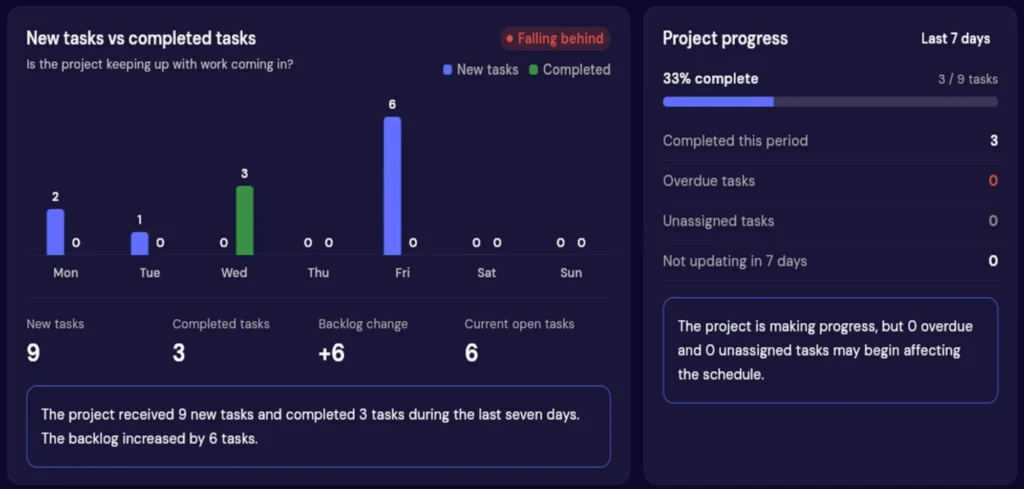
Delegate Tasks and Assign Projects with MagicTask
You can use MagicTask in your browser or on the iOS and Android apps. Alongside projects, sizes and analytics, finishing tasks fills your progress bar and moves you through your Dungeon toward the next chest, so the work you hand out, and the work you get done, feels rewarding.
Start your 14-day free trial, with no credit card required.


