

Most teams start with the best intentions when they adopt a big all-in-one tool like ClickUp. It feels like the answer to everything, with dashboards, subtasks, and endless features all neatly packed into one platform. But somewhere along the way, that “everything tool” quietly turns into one more thing to manage.
Instead of streamlining work, it starts slowing you down. The daily log-ins feel heavier, projects get buried under layers of settings, and before long, the tool itself becomes part of the problem.
I’ve seen this happen firsthand, and it’s frustrating when the very thing meant to keep you organized becomes a source of friction.
That’s usually the point when teams start looking around. And lately, a lot of them have landed on MagicTask, a gamified task and project management platform.
It takes a very different approach: lightweight, fast, and even a little fun, without forcing you through a steep learning curve.
In this post, we’ll dig into why so many people are rethinking ClickUp in 2026 and how MagicTask is carving out a place as a serious alternative.
Why Are Users Switching Away from ClickUp in 2026?
ClickUp has a lot of features packed into one, but for many users, it’s become more of a burden than a benefit.
Teams drawn in by its flexibility often find themselves bogged down by configuration, lag, and features they never fully use. What begins with excitement fades into fatigue, and adoption quietly drops off.
Here’s what users are struggling with most:
- Too complex and bloated — most teams don’t need 50 features and 10 views per project
- High learning curve — non-technical users get lost before they even get started
- Slower performance — speed drops as you scale projects, killing momentum
- Team adoption declines — after the initial rollout, usage often flatlines
- Motivation disappears — when a tool feels like “just more work,” people avoid it
These frustrations don’t just slow productivity; they damage morale and make task management feel like a chore. That’s where MagicTask enters with a very different philosophy. Let’s look at why it’s quickly becoming the go-to ClickUp alternative in 2026.
What Makes MagicTask a Better Alternative to ClickUp?
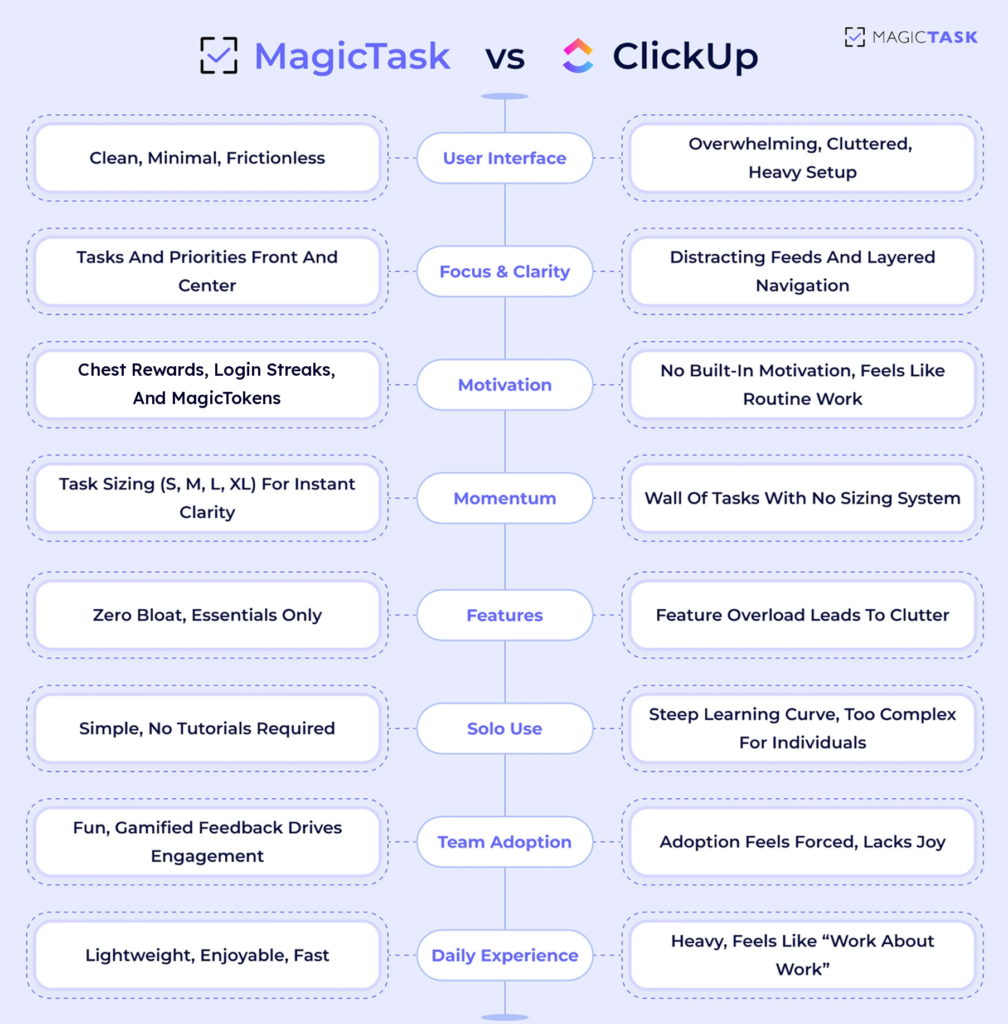
When teams look for a change, they want better focus, faster workflows, and a tool that doesn’t feel like work.
MagicTask strips away the noise and replaces it with clarity, momentum, and just enough structure to keep everyone moving.
1. Clean and Intuitive UI
MagicTask is designed to be frictionless from the moment you log in. Where tools like ClickUp overwhelm with sidebars, dropdowns, and nested menus, MagicTask gives you a clean workspace that feels light and fast. No endless configuration. No digging through layers just to update a task.
Everything you need and only what you need is visible at a glance. Your tasks, sizes and due dates are front and center, without noisy team feeds or redundant settings distracting you. Work in List or Board view, whichever suits you.
As a result, you spend less time managing your tool and more time actually doing the work. It’s a UI that respects your time and your focus, especially on days when energy is low and clarity is everything.
2. Gamified Experience That Drives Consistency
ClickUp has powerful features, but let’s be honest, it lacks joy. It’s a workhorse, not a motivator. MagicTask changes that by transforming your daily planning into a rewarding, game-like experience, designed to keep you coming back.
Instead of treating productivity as a chore, MagicTask provides you with visual and motivational signals every time you complete a task, plan your day, or stay on track. These aren’t just gimmicks; they’re grounded in behavioral science.
Gamification works because it taps into how humans are wired: we respond to feedback, rewards, and visible progress.
Here’s how MagicTask builds those habits without the burnout:
- Realms and Dungeons: Pick a Realm, and every task you finish fills your progress bar and moves you through your Dungeon toward the next chest.
- Chest Rewards and Boss Fights: Take on the boss to open the chest and win skins, pets and backgrounds for your avatar.
- Daily Login Streaks: Show up each day to keep your streak going and earn MagicTokens.
- Instant Feedback: Small animations and satisfying sounds reinforce progress.
- Zero Bloat: No badges for badge’s sake. Everything ties back to productivity.
This turns MagicTask into a system that wants you to succeed, one rewarding click at a time.
3. Built for Momentum
When every task feels the same, it’s hard to know where to start. Should you knock out a quick email or dive into a project update? Without clarity, you either overcommit your time or delay getting started altogether.
MagicTask solves this with a simple yet powerful system: task sizing. Every task is assigned a size — S, M, L, or XL — so you can instantly understand the effort required and plan your day accordingly.
This isn’t about time estimates. It’s about reducing mental load, improving follow-through, and creating momentum.
Here’s how it works:
| Size | What it usually means |
|---|---|
| S | Quick and simple. Little thinking needed, like replying to an email or updating a file. |
| M | Needs some focus or a few steps, like drafting a short brief or reviewing a design. |
| L | Takes real concentration or several parts, like writing a report or planning a campaign. |
| XL | Big or complex work that’s worth breaking into subtasks, like launching a feature or rebuilding a page. |
This structure helps you:
- Plan your day around energy
- Break down large tasks into doable chunks
- Finish what you start and feel good doing it
Instead of staring at a wall of to-dos, you get a visual system that nudges you into action. That’s how real progress gets built: one clear decision at a time.
4. Zero Bloat With Only the Features You Need
ClickUp tries to cover every use case: docs, goals, dashboards, whiteboards, mind maps, chat, sprint planning, automations, CRM features… the list never ends. But that’s exactly the problem.
Instead of clarity, you get clutter.
MagicTask takes a different approach. Every feature is intentional and focused on helping you get tasks done without creating more overhead. No hidden menus, no nested views, and no dozens of feature tabs waiting to distract you from your actual work.
You’ll find:
- A streamlined interface built for speed
- A task system that prioritizes doing, not configuring
- Built-in sizing, sorting, and planning
- Visual rewards to make progress satisfying, not stressful
That way, you actually use the tool. Daily. Without dreading it.
MagicTask is for teams who’ve outgrown complexity, not because they can’t handle it, but because they don’t need it to work better. The bloat has been stripped away, leaving only what helps you finish more with less friction.
5. Simple for Solo Users & Engaging for Teams
Most tools either feel too technical for solo users or too dry for teams to rally around. MagicTask strikes the right balance. It’s frictionless enough that individuals can dive in without a tutorial, yet dynamic enough to keep entire teams motivated and aligned.
There’s no complex onboarding, no steep learning curve, and no rigid hierarchy of spaces and subtasks to decipher.
Instead, users get an interface they can pick up instantly, plus gamified feedback that turns daily progress into something people actually enjoy.
This is how MagicTask moves beyond “just another tool.” It becomes a system your team wants to use, not one they need to be pushed into. And when adoption comes naturally, productivity follows.
How Does MagicTask Keep Users Productive Without Overwhelm?
It’s easy to get buried under a mountain of tasks, especially when your system adds friction instead of reducing it. MagicTask is designed to keep you moving forward, not second-guessing your next step.
Beyond the UI and gamified structure, here’s what continues to keep users consistently productive:
1. Daily Mind Dump + Drag-to-Plan Workflow
Most task tools leave you with a stale to-do list by midday.
MagicTask keeps it dynamic. Create tasks the moment they come to mind, or paste in a whole list at once. Then drag them into the order you’ll work on them, or use Time Blocking (with Google Calendar sync) to give each one a slot. It brings clarity without having to rewrite your whole list.
2. Realms That Make Work Feel Like an Adventure
Instead of themes, MagicTask gives you Realms to choose from, such as Retro, Futuristic or Minimalistic, each with its own Dungeons to clear. It turns an ordinary to-do list into something that feels like progress through a world, not a spreadsheet.
3. Built-In Positive Reinforcement Loops
MagicTask isn’t shouting notifications at you all day. It rewards progress quietly but meaningfully. Every task checked off moves you closer to the next chest, and your daily login streak rewards you for coming back. This keeps you showing up, even on the slower days.
These details aren’t just “nice-to-haves”; they’re the behavior design decisions that make MagicTask an execution tool, not just a list.
Is MagicTask Right for Teams That Tried ClickUp and Gave Up?
Absolutely, especially if your team hit a wall with ClickUp’s complexity.
MagicTask was built for those who want to stay productive without needing a user manual.
If ClickUp felt like too many layers, too many features, or just too much of everything, you’re not alone.
Many teams set it up, push for adoption, and then quietly abandon it because it takes too much effort to maintain. MagicTask flips that experience.
It keeps things light, visual, and genuinely enjoyable without sacrificing structure. You can plan your day in minutes, not meetings.
Your team doesn’t need tech-savvy training or onboarding checklists to start using it. And thanks to the built-in gamification, engagement doesn’t just spike at the beginning; it actually sustains.
If your team needs:
- Higher daily usage and fewer drop-offs
- A simple, visual way to stay aligned
- Less clicking and context-switching
- A system that motivates people to want to use it
…then MagicTask is the next step. It doesn’t try to replace your work, it makes your work feel manageable again.
What Can’t Clickup Offer That MagicTask Does?
ClickUp is powerful, but its strengths become drawbacks for many teams. When every feature, view, and toggle is turned on, it’s easy to lose what’s essential: ease of use, motivation, and clarity. MagicTask fills in those gaps.
Here’s how the two compare on the things that matter most for day-to-day use.
| Feature / Experience | MagicTask | ClickUp |
|---|---|---|
| Effort sizing | S, M, L, XL on every task, built in | Time estimates and sprint points, added as ClickApps |
| Gamification | Realms, Dungeons, boss fights, chest rewards and login streaks | No built-in gamification |
| Feature set | Focused on tasks, projects, time blocking and analytics | Very broad: docs, whiteboards, goals, chat, automations and more |
| Quick capture | Web plus iOS and Android apps | Web, desktop and mobile apps |
| Planning your day | Drag-and-drop sections plus Time Blocking with Google Calendar sync | Priorities, drag-and-drop and many views |
| Learning curve | Pick up and go | More setup, more to learn |
Conclusion
ClickUp has the power, but too often, it brings the overwhelm with it. Complex configurations, steep learning curves, and bloated dashboards turn a promising tool into just another source of friction.
MagicTask takes a different path.
It’s built for people who want to enjoy getting things done without getting lost in setup, spreadsheets, or nested subtasks. With its lightweight interface, gamified feedback, and habit-friendly flow, it’s more than just a task manager. It’s a system you’ll actually want to use every day.
If ClickUp didn’t work for your team, MagicTask might be exactly what you’ve been looking for.
Ready to switch from complexity to clarity?
Start your 14-day free trial, with no credit card required, and experience a task system that feels like progress.