
Change Realm Skip to main content

Why Most Productivity Systems Fail After Setup and How to Make Them Stick

Why Most Productivity Systems Fail

Most productivity systems feel incredible at the beginning. You block off an afternoon. You organize tasks. You create categories, workflows, tags, and maybe even color codes. Everything suddenly feels clear. Calm. Under control.

And then… a few weeks later, you stop opening the system.

The lists go stale. Tasks pile up. The tool that once made you feel productive now feels heavy, even slightly guilt-inducing. Eventually, you abandon it altogether and tell yourself you’ll “try again later.”  

If that sounds familiar, you’re not bad at productivity. You’ve just experienced something most systems are quietly built to cause.

This post is about why productivity systems fail after setup and what actually makes them stick in real life.

Why Setup Feels Productive but Rarely Leads to Execution
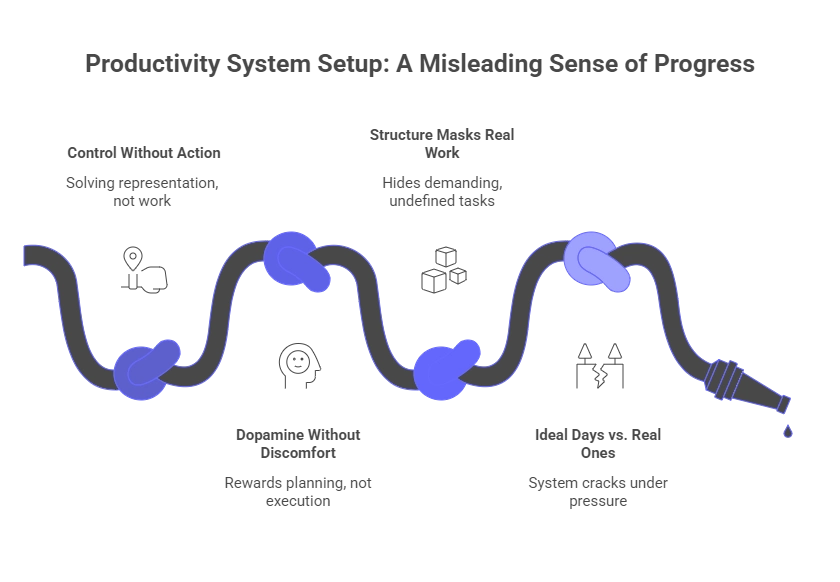
Why Setup Feels Productive but Rarely Leads to Execution

Setting up a productivity system can feel like a breakthrough moment. Your tasks are organized, your workflow looks clean, and for the first time in a while, work feels manageable. That feeling is real, but it’s also misleading. What feels like progress during setup often has very little to do with actually getting work done.

Here’s why that happens.

Setup Gives You Control Without Requiring Action

During setup, you’re solving a representation problem, not a work problem. You’re deciding where things go, not moving them forward. That distinction matters.

Organizing tasks creates a sense of control because uncertainty is reduced. You know what exists. You know where it lives. Your brain interprets that clarity as productivity, even though no execution has taken place yet. It’s satisfying because it’s safe. There’s no risk of failure, no hard thinking, no resistance to push through.

Control feels productive. Action is productive. The two just aren’t the same thing. 

Planning Delivers Dopamine Without Discomfort

Planning rewards the brain quickly. You get the mental payoff of “being responsible” without the discomfort of starting difficult work. There’s no ambiguity, no judgment, and no chance of getting stuck. 

Execution is different. It involves uncertainty, effort, and the possibility of doing something poorly. Setup lets you delay that moment while still feeling like you’re moving forward. 

That’s why it’s easy to keep refining a system instead of using it. The reward loop is immediate and low-risk, and the brain learns to prefer it.

Structure Masks the Real Work Ahead

A well-organized system can hide how demanding the actual work is. Large, complex tasks look manageable once they’re neatly categorized, even if they haven’t been broken into actionable steps. 

This creates a dangerous gap:

  • The system looks calm and under control
  • The work itself is still heavy and undefined

When it’s time to execute, that gap becomes obvious. Starting feels harder than expected, and the system that once felt helpful suddenly offers no support for how to begin.

Setup Happens on Ideal Days But Execution Happens on Real Ones

Set up usually happens in a quiet moment. You have time, focus, and energy. Execution rarely does.

Once normal work resumes, meetings, interruptions, and low-energy afternoons, the system has to survive conditions it wasn’t designed for. If it relies on sustained motivation or perfect focus, it starts to crack immediately.

That’s when engagement drops. Not because the system is wrong, but because it was built for a version of your day that doesn’t exist most of the time.

The Transition From Setup to Execution Is Where Systems Are Tested

A productivity system isn’t proven by how good it looks when everything is organized. It’s proven by how it behaves the moment you’re busy, distracted, or tired.

If the system doesn’t help you:

  • Start small
  • Choose what matters now
  • Feel progress quickly

Execution is where productivity lives. And most systems stop supporting you right before you get there.

The Most Common Reasons Productivity Systems Break Down

Productivity systems rarely fail in dramatic ways. They don’t crash or suddenly stop working. Instead, they slowly lose relevance. You open them less often. Tasks stop moving. Eventually, the system feels disconnected from how you actually work, and you drift away.

These breakdowns are predictable. They happen for the same reasons, again and again.

  • Complexity grows faster than usefulness: What starts as a simple setup accumulates views, rules, tags, and exceptions. Each added layer increases the mental effort required to use the system, until maintaining it feels heavier than the work itself.
  • Tasks aren’t defined clearly enough to act on: Vague or oversized tasks create hesitation. When it’s unclear how to start or how much effort is required, the brain delays action, especially on busy or low-energy days.
  • Everything competes for attention at once: Without a clear way to surface what matters now, urgent but low-impact work crowds out important tasks. The system lists work but doesn’t help you choose.
  • The system collapses on imperfect days: Many systems assume steady motivation and focus. When energy drops or schedules change, consistency breaks, and restarting feels harder than quitting.
  • Progress becomes invisible: When completed work simply disappears, effort feels unrewarded. Without visible momentum, engagement fades over time.

None of these failures mean that the user “did it wrong.” They mean the system wasn’t designed to support real-world execution.

Productivity systems break down when they stop helping you move forward, especially on the days when moving forward is hardest.

Why Systems Fail Without Feedback and Momentum

Even when tasks are clear and priorities are set, another problem emerges: progress becomes invisible.

Traditional systems are transactional. You complete a task, it disappears. There’s no accumulation, no sense that effort is adding up. Over time, this disconnect erodes motivation.

Without feedback:

  • Effort feels unnoticed: Work doesn’t feel acknowledged once it’s done.
  • Consistency feels pointless: Showing up daily doesn’t feel different than showing up occasionally.
  • Momentum fades: There’s no reinforcement loop to keep engagement alive.

Momentum matters more than perfect organization. Systems that fail to create it are eventually abandoned.

What Makes a Productivity System Stick Over Time
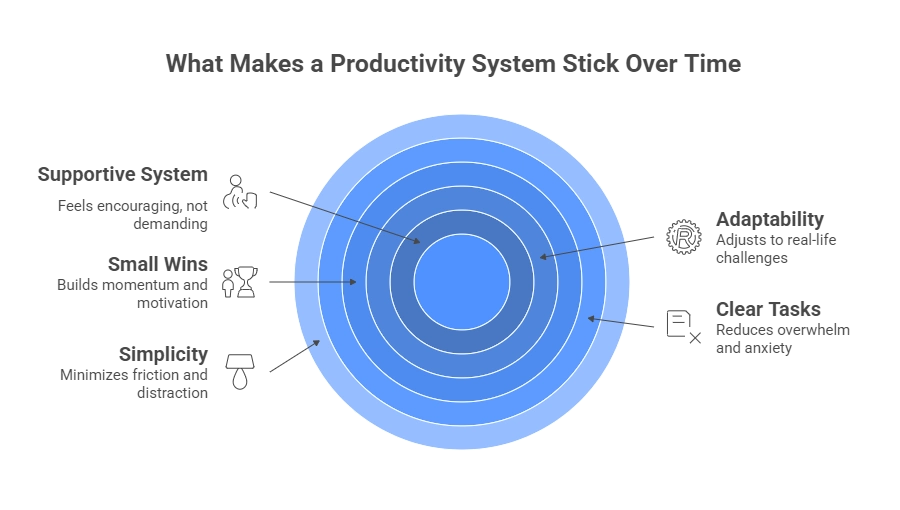
What Makes a Productivity System Stick Over Time

Once you move past why systems fail, the real question becomes simpler: what actually lasts? Not what looks impressive during setup, not what promises total control, but what survives busy weeks, low-energy days, and shifting priorities.

Systems that stick don’t demand more discipline. They quietly remove the reasons people stop using them.

Simplicity Keeps the System Out of Your Way

The systems people return to are almost always the simplest ones. Not because simplicity is trendy, but because it lowers the mental cost of starting.

Think about the tools you’ve abandoned. Chances are, you didn’t stop using them because they were too basic. You stopped because they asked too many questions before you could begin: Which view? Which priority? Which filter?

A system that sticks feels obvious the moment you open it. You know where to look. You know what matters. There’s no setup tax before the work starts. When simplicity reduces cognitive load, starting something new becomes the default.

Clear Tasks Make Starting Feel Safe

Resistance often has nothing to do with motivation and everything to do with uncertainty. When a task feels vague or oversized, starting feels risky. You don’t know how long it will take, where to begin, or whether you have enough energy to finish.

Systems that stick replace ambiguity with clarity. Instead of “Work on proposal,” you see something like “Outline section two” or “Review client feedback.” The task tells you exactly what to do next.

That clarity changes behavior. Starting feels manageable, even on busy days. And when starting feels safe, progress happens more often than not.

Small Wins Create Momentum You Can Feel

Consistency isn’t built through big breakthroughs. It’s built through small wins that happen often enough to matter.

When effort is acknowledged, even in small ways, people keep going. Seeing progress accumulate reinforces the idea that showing up counts. That’s especially important during long projects where results aren’t immediate.

Think of the difference between finishing a task and seeing it disappear versus finishing a task and feeling like you’ve added something to your progress. One feels empty. The other feels motivating.

Systems that stick make progress visible, so effort never feels wasted.

Adaptability Keeps the System Alive on Real Days

The biggest test of any productivity system isn’t how it performs on a perfect day. It’s how it behaves when things go wrong.

Meetings run long. Energy drops. Plans change.

Systems that demand consistency collapse under those conditions. Systems that adapt survive them. They allow for smaller efforts on hard days. They make restarting feel normal instead of discouraging. They treat progress as cumulative, not fragile.

When a system bends instead of breaking, people trust it. And trust is what keeps them coming back.

The Systems That Stick Feel Supportive, Not Demanding

In the end, productivity systems that last don’t feel like something you have to keep up with. They feel like something that’s there for you.

They reduce friction instead of adding it. That’s what makes a system stick. Not perfection, but persistence.

How MagicTask Helps Productivity Systems Stick in Real Life

Most productivity systems fail not because people stop caring, but because the system stops supporting them once real work begins. MagicTask is designed around that exact gap. Instead of rewarding planning or perfect routines, it focuses on helping people keep going, especially on busy, imperfect days.

Here’s how MagicTask supports sustained use rather than short-lived setup excitement:

  • Execution over configuration: You don’t need elaborate workflows or constant maintenance. Tasks are easy to add, easy to understand, and ready to act on immediately.
  • Task sizing that respects real energy: S/M/L/XL task sizing helps you choose effort that fits the day you’re having, not the day you planned for. Smaller efforts still move progress forward.
  • Visible progress that doesn’t disappear: Completed tasks contribute to XP and momentum, so effort feels cumulative rather than fleeting.
  • Consistency without punishment: Missing a day doesn’t erase progress or break motivation. Restarting feels normal, not discouraging.
  • A system that adapts instead of breaking: Whether days are busy, interrupted, or low-energy, the system continues to support forward movement.

Productivity systems stick when they feel supportive. MagicTask works because it’s designed around execution, momentum, and real life.

If your current system only works when everything goes right, it may be time to try one built for how work actually happens.

Conclusion

Productivity systems don’t fail because people lack motivation or discipline. They fail because they’re designed for ideal days, the quiet, focused ones that don’t reflect how work actually unfolds. Real days are busy, interrupted, and unpredictable, and most systems simply aren’t built to survive that reality.

Systems stick when they support execution instead of just planning, when progress is visible instead of fleeting, and when momentum is protected even on imperfect days. Clarity, adaptability, and reinforcement matter far more than complexity or feature depth.

If your current setup looks good but rarely gets used, it’s worth rethinking what you’re optimizing for. Choose MagicTask, which is designed for consistency and helps you keep going when motivation fades, and real work begins.
The Fresh Start Effect: Why Starting Small Helps You Build Better Habits

The Fresh Start Effect

Have you ever felt a sudden urge to get your life together just because it was a Monday? Or the first day of a new month? That feeling isn’t random. Researchers at Wharton studied this phenomenon, called the Fresh Start Effect, and found that people feel more motivated to pursue goals right after moments that feel like a reset, such as a new week, birthday, or missed streak. Those moments help us mentally separate who we were from who we want to be

And that explains a lot. We wait for clean slates because they feel hopeful. They give us permission to try again without carrying yesterday’s mess into today. But if you’ve ever started strong and then quietly slipped back into old habits, you already know the problem. Motivation spikes fast, but it doesn’t stick on its own.

This post is about what actually makes fresh starts work. Not big promises or dramatic changes, but small, repeatable actions that turn “starting over” into real progress.

The Psychology Behind a Fresh Start

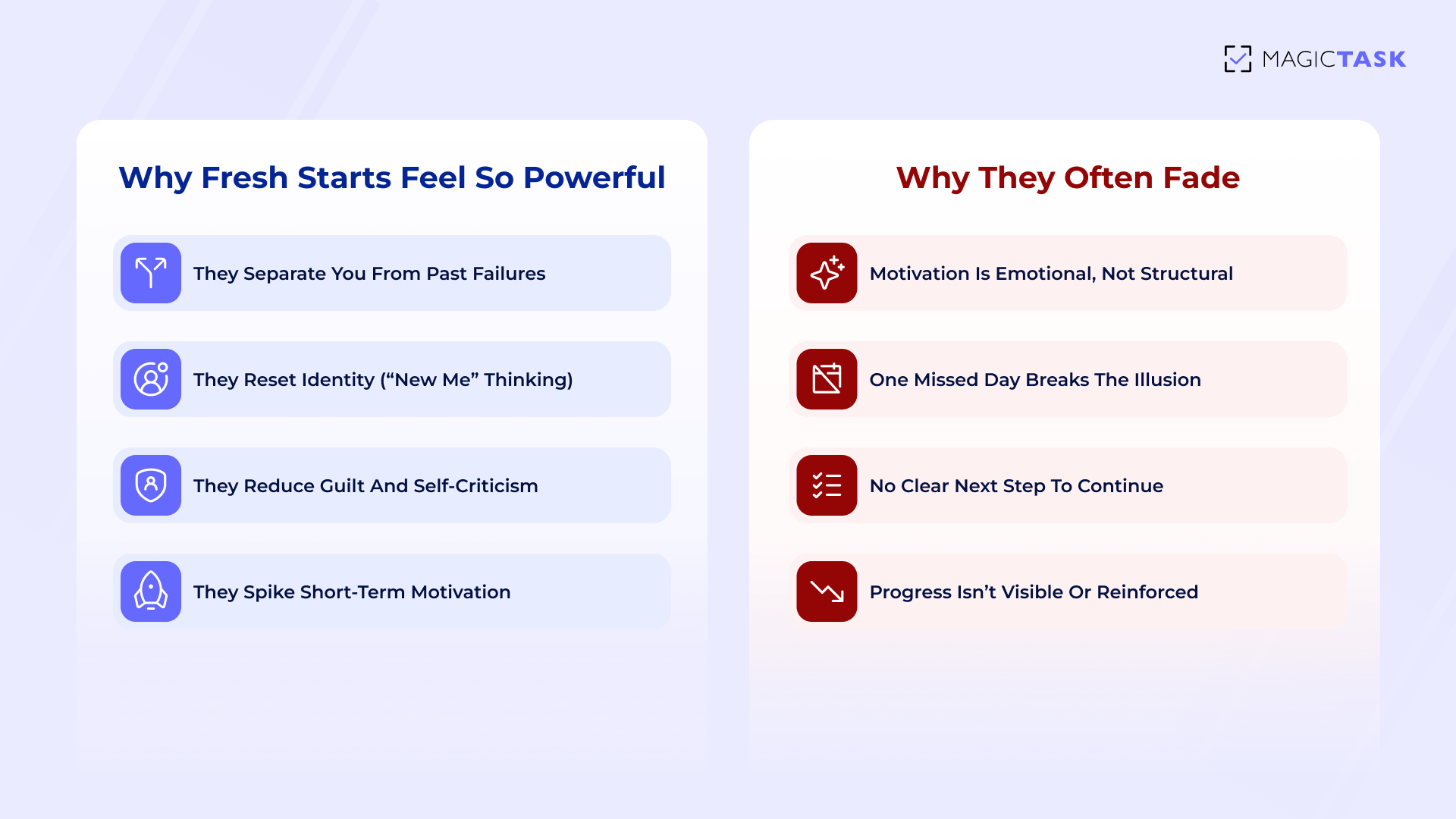
Fresh starts feel powerful because they tap into how the mind processes identity, time, and motivation. But that power comes from a few specific psychological shifts, and understanding them explains both why fresh starts feel so good and why they so often fade.

The Psychology Behind a Fresh Start

Fresh Starts Create Distance from Past Failures

When you decide to “start fresh,” your brain does something important: it puts space between you and your past behavior. Missed habits, broken streaks, and unfinished goals stop feeling like proof of who you are and start feeling like things that happened before this moment.

That distance matters. Guilt and self-criticism drain motivation quickly. A fresh start softens that internal pressure by mentally closing one chapter and opening another. You’re stepping into something new. That emotional reset makes action feel lighter and more possible.

They Help You Separate Your ‘Old Self’ from Your ‘New Self’

Fresh starts also work because they allow identity to reset. Instead of thinking, “I’m someone who never sticks to habits,” the mind shifts toward, “I’m becoming someone who’s trying again.”

This separation is subtle but powerful. Behavior change is easier when it aligns with who you believe you are becoming. A fresh start gives you permission to rewrite that story, even if nothing else has changed yet. The problem is that identity alone doesn’t carry behavior forward. Without follow-through, the new self never fully forms.

Motivation Spikes but It’s Fragile

The motivation that comes with a fresh start is real. It feels energizing, hopeful, even exciting. But it’s also temporary. Motivation is an emotional state, not a system. It’s strongest at the beginning, when everything feels clean and full of possibility.

As soon as effort is required, especially repeated effort, motivation begins to wobble. A missed day, a busy schedule, or a low-energy moment can quickly puncture that initial high. Without support, people interpret that drop as failure, even though it’s completely normal.

Without Structure, the Effect Fades Quickly

This is where most fresh starts fall apart. The feeling is there, but there’s nothing holding it in place. No clear next step. No scale that makes the habit feel doable. No feedback that reinforces progress.

Without structure, the mind drifts back to familiar patterns, not because the fresh start “didn’t work,” but because it wasn’t anchored. Motivation needs something to attach itself to. When fresh starts are paired with small, repeatable actions, they turn into momentum. When they aren’t, they turn into another reset waiting to happen.

The psychology is that fresh starts open the door, but systems decide whether you walk through it.

The Habit-Building Mistakes That Turn Fresh Starts Into Failures

Fresh starts often fail because the approach was too heavy. Right after a reset, motivation is high, and optimism takes over. That’s when people tend to aim big and unknowingly set themselves up for pressure they can’t sustain.

Here are some of the most common mistakes that quietly undo fresh starts:

  • Trying to change everything at onceBig overhauls feel inspiring at first, but they create overwhelm fast. When too much depends on perfect execution, even one slip feels like the whole effort is broken.
  • Treating missed days as failureSkipping a habit once isn’t a problem. Interpreting it as proof you “can’t stick with things” is. This mindset turns normal interruptions into emotional setbacks.
  • All-or-nothing thinkingWhen progress only counts if it’s perfect, momentum disappears. One missed workout, one off-day, or one unfinished task can derail the entire habit.
  • Starting at an unsustainable intensityHabits built on peak motivation rarely survive low-energy days. If the first step is too demanding, repetition becomes unlikely.

Fresh starts don’t fall apart because people lack discipline. They fall apart because the bar is set too high, too quickly. When the first step feels heavy, repeating it becomes harder, and the reset quietly fades.

The real key isn’t starting strong. It’s starting in a way you can return to, even on your worst day.

The Power of Small, Repeatable Actions

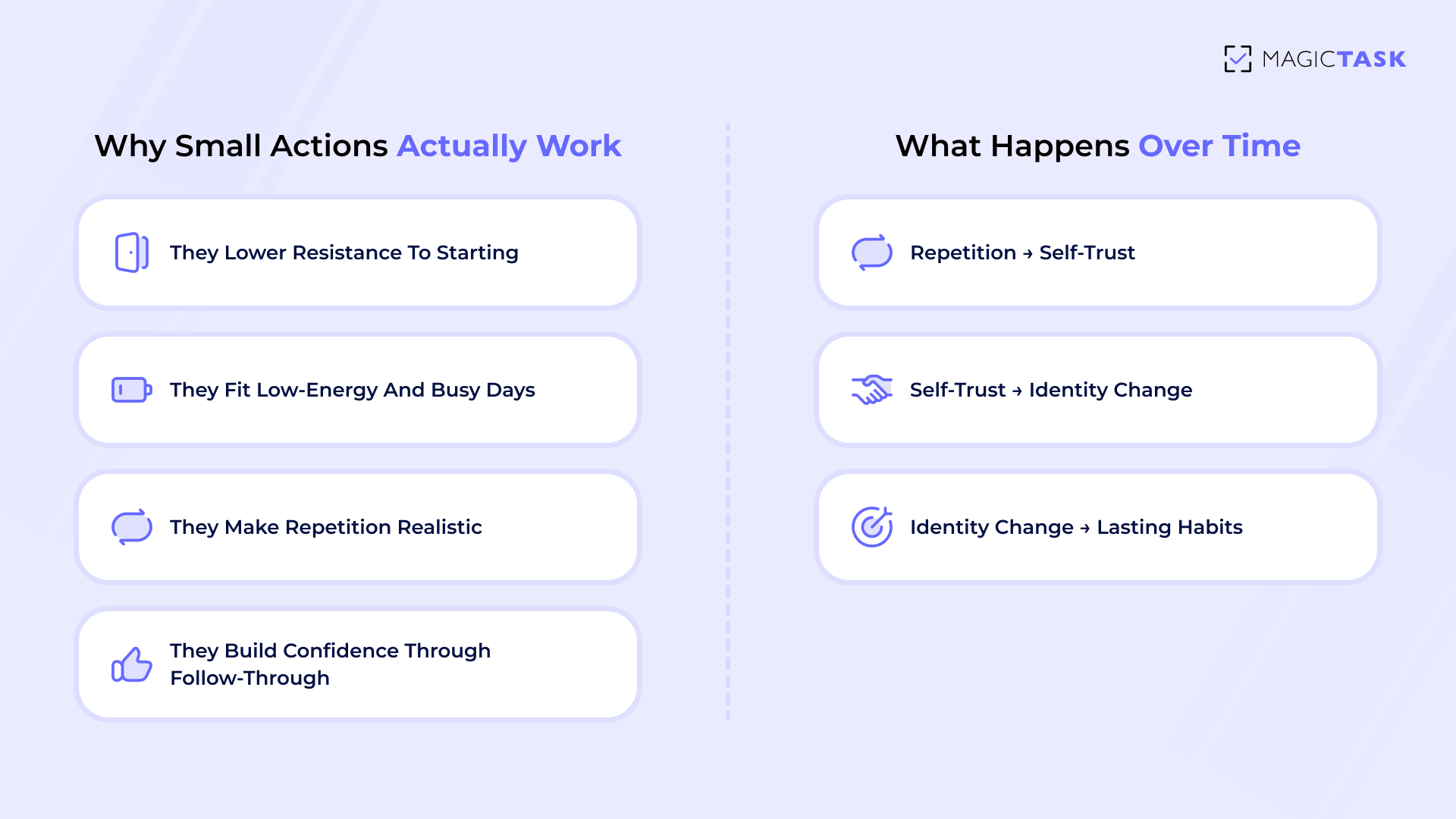
Big change feels exciting. Small change feels doable. And when it comes to building habits that actually last, doable wins every time. Small actions lower the mental barrier to starting. They just require showing up. And when showing up feels easy, repetition becomes possible.

This is where real momentum begins. Not with intensity, but with consistency.

The Power of Small, Repeatable Actions

Small Actions Lower Resistance and Make Starting Easy

The hardest part of any habit is starting. Small actions shrink that resistance to almost nothing. A five-minute walk doesn’t trigger the same internal debate as an hour-long workout. Writing one paragraph doesn’t feel as heavy as “finish the entire draft.”

Because the step feels manageable, your brain stops pushing back. You don’t need to negotiate with yourself. You just begin. And once you begin, continuing becomes much easier.

Small actions remove the drama from progress. They turn “I should” into “I can.”

Repetition Builds Confidence and Identity

Confidence comes from keeping promises to yourself. Each time you complete a small action, you reinforce a quiet belief: I follow through.

Over time, that repetition reshapes identity. You stop seeing yourself as someone who “tries” to build habits and start seeing yourself as someone who simply does. That identity shift matters more than motivation ever could.

Repetition turns behavior into self-trust. And self-trust is what makes habits stick.

Early Wins Create Motivation Through Progress

Motivation follows action. Early wins provide proof that effort leads somewhere. Even little progress feels encouraging when it’s visible and consistent.

Those wins don’t need to be dramatic. They just need to be real.

  • You showed up today
  • You completed the task
  • You moved forward, even slightly

That sense of progress fuels the next action. Momentum grows because progress feels tangible, not hypothetical.

Momentum Survives Low-Energy Days When Habits Feel Achievable

The true test of a habit is on your worst day. Small, repeatable actions are powerful because they still fit when energy is low, time is tight, or life gets messy.

When habits are designed to be achievable:

  • Missed days don’t feel catastrophic
  • Restarting feels natural
  • Consistency survives imperfect weeks

Momentum doesn’t depend on feeling inspired. It depends on having a habit small enough to repeat, even when motivation is quiet.

That’s how habits stop breaking. And how progress keeps going.

How MagicTask Helps With The Fresh Start Effect

MagicTask is developed around the reality of habit-building, not the ideal version of it. Instead of demanding perfection, it helps you restart with clarity and momentum. Small actions feel valid. Progress feels visible. And showing up, even imperfectly, is still rewarded.

The result is a system that doesn’t just allow fresh starts, but actively supports them. Fresh starts stop being dramatic resets and start becoming something quieter and more powerful: a reliable way to keep going.

1. Starting Small With S/M/L/XL Tasks

One of the biggest reasons fresh starts fail is that the first step feels too heavy. Motivation might be high, but when the task itself feels overwhelming, resistance shows up fast. MagicTask’s S/M/L/XL task sizing solves this by helping you choose a starting point that actually fits your energy and context.

Instead of committing to an all-or-nothing habit, you decide the size of today’s effort. A habit can be as small as an S task on a low-energy day or scale up to L or XL when momentum builds. That flexibility makes starting feel safe instead of intimidating.

By validating small actions, MagicTask removes pressure from the beginning. You’re building consistency. And when consistency feels achievable, fresh starts stop feeling fragile and start turning into habits that last.

2. XP and Progress That Reward Showing Up

Fresh starts fall apart when progress feels invisible. You show up, put in effort, and yet it feels like nothing changed. MagicTask approaches motivation differently by rewarding presence and effort, not just perfect streaks or big outcomes.

Every time you complete a task, even a small one, you earn XP and see your progress move forward. That feedback matters. It tells your brain, this counts. Showing up today wasn’t wasted, even if it wasn’t your best day.

This approach shifts motivation away from pressure and toward encouragement:

  • The effort is acknowledged immediately
  • Small wins feel meaningful
  • Progress builds even on imperfect days

Instead of waiting for motivation to return, progress itself becomes the motivator. By rewarding showing up, MagicTask helps fresh starts turn into steady momentum, one completed action at a time.

3. Streaks Without Punishment

Streaks can be motivating until they become a source of pressure. In many systems, missing a day feels like failure. One break, and the streak resets to zero, taking motivation down with it. That all-or-nothing framing is exactly what turns fresh starts into quiet exits.

MagicTask treats streaks differently. They’re designed to encourage consistency, not punish imperfection. Missing a day doesn’t erase your progress or undo the effort you’ve already put in. Instead of framing consistency as fragile, the system keeps momentum intact and makes it easy to continue.

This approach changes how streaks feel:

  • They highlight patterns, not perfection
  • They encourage returning, not quitting
  • They support real life, not ideal routines

By removing punishment, streaks become a gentle nudge rather than a hard rule. And when restarting feels safe, people are far more likely to keep going.

4. Progress Cues That Reward Effort

One of the quiet reasons people abandon habits is that effort often goes unnoticed. You put in the work, but there’s no signal that it mattered. MagicTask solves this with progress cues that make effort visible.

Each completed task moves something forward. XP accumulates. Progress indicators change. Visual feedback confirms that your time and energy had an impact, even if the task itself was small. That recognition helps your brain connect effort with progress, which is essential for motivation to stick.

These cues make progress feel tangible. They reduce the urge to quit after slow days

When effort is consistently acknowledged, habits stop feeling fragile. Progress cues remind you that showing up counts, and that’s often all you need to keep going.

Conclusion

Fresh starts don’t fail because people lack motivation. They fail because the first step is often too big, too rigid, or too unforgiving to repeat. When restarting feels heavy or punishing, momentum disappears before it has a chance to build.

Starting small changes everything. Small actions lower resistance, reduce pressure, and make it easier to show up again tomorrow. When effort is acknowledged, missed days aren’t treated as failure, and progress stays visible, habits become something you return to.

MagicTask is built around this reality. It supports fresh starts without guilt, rewards effort over perfection, and helps small beginnings turn into steady progress.

Choose one tiny habit today. Start where you are. And let MagicTask help you turn that fresh start into something that finally lasts.

How to Use Leaderboards to Improve Team Performance

How to Use Leaderboards to Improve Team Performance

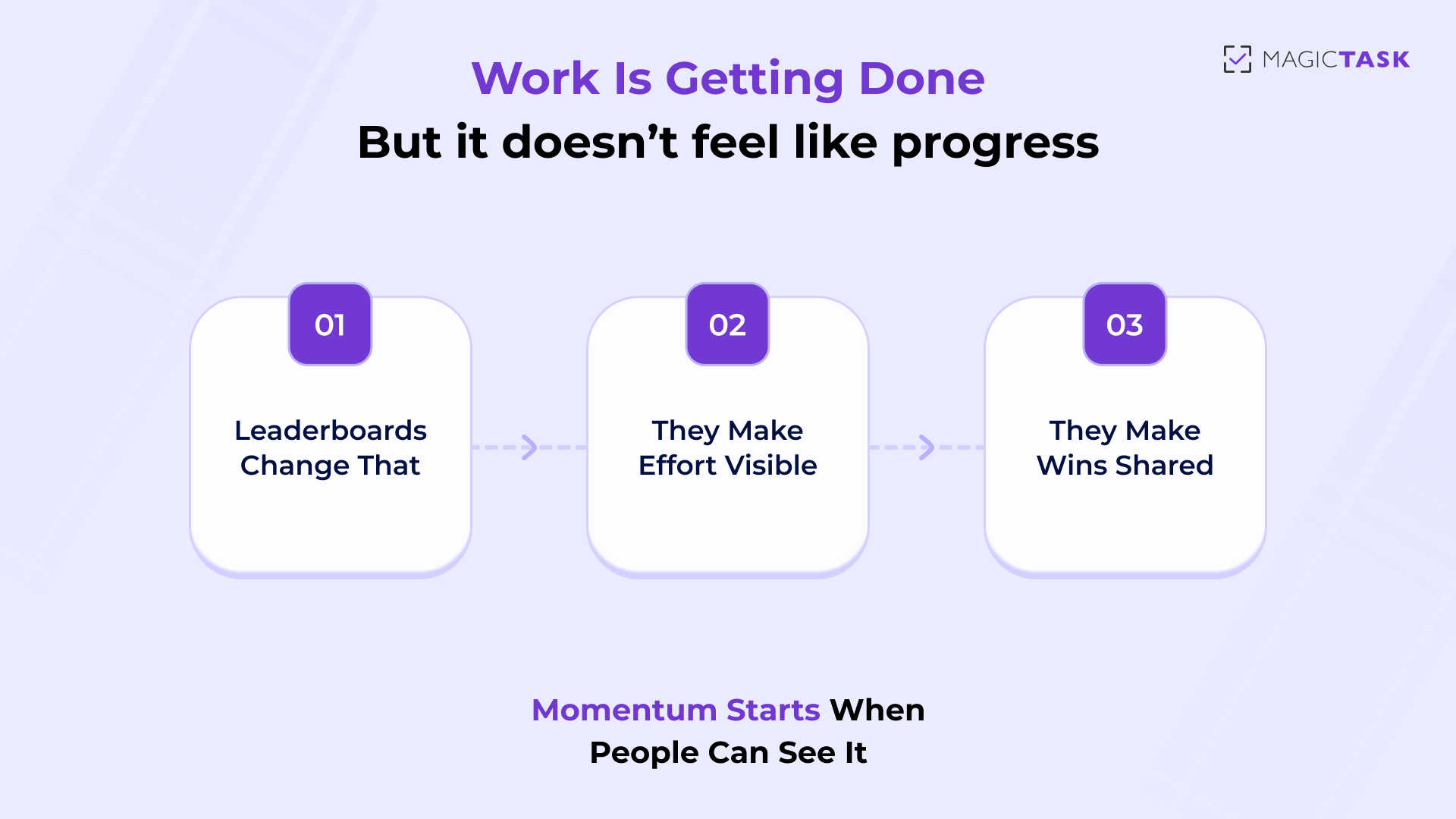
I’ve worked with enough teams to notice a pattern. People are doing great work, deadlines are met, tasks are completed, but it never really feels like progress. There’s no shared moment of “Hey, we’re moving.” And when progress feels invisible, motivation slips. Which makes sense, considering 83.6% of employees say they feel more motivated when they receive regular recognition.

That’s why leaderboards matter. They make progress visible. They make wins feel real. And they give teams something to rally around together.  

How to Use Leaderboards to Improve Team Performance

What Are Leaderboards in the Workplace?

Leaderboards in the workplace are simple, visual systems that show progress, achievement, or performance in a way the entire team can see. Think of them as a shared scoreboard to make effort visible. Instead of wondering who’s moving the work forward, everyone can see it at a glance.

Leaderboards aren’t one-size-fits-all. They can be built around different goals or team dynamics, and they don’t always need to track the same metrics. Some teams use them for productivity; others use them for milestones, streaks, or skill-building progress. 

Common types of leaderboards include:

  • Individual leaderboards: highlight personal progress, great for motivation and ownership.
  • Team leaderboards: track collective momentum, perfect for collaborative goals.
  • Short-term leaderboards: refresh weekly or monthly to keep engagement high.
  • Long-term leaderboards: show overall growth, progress, and consistency across months or quarters.

The purpose is simple: leaderboards help teams see progress, care about it, and stay connected to it.

Common Pitfalls of Traditional Performance Tracking

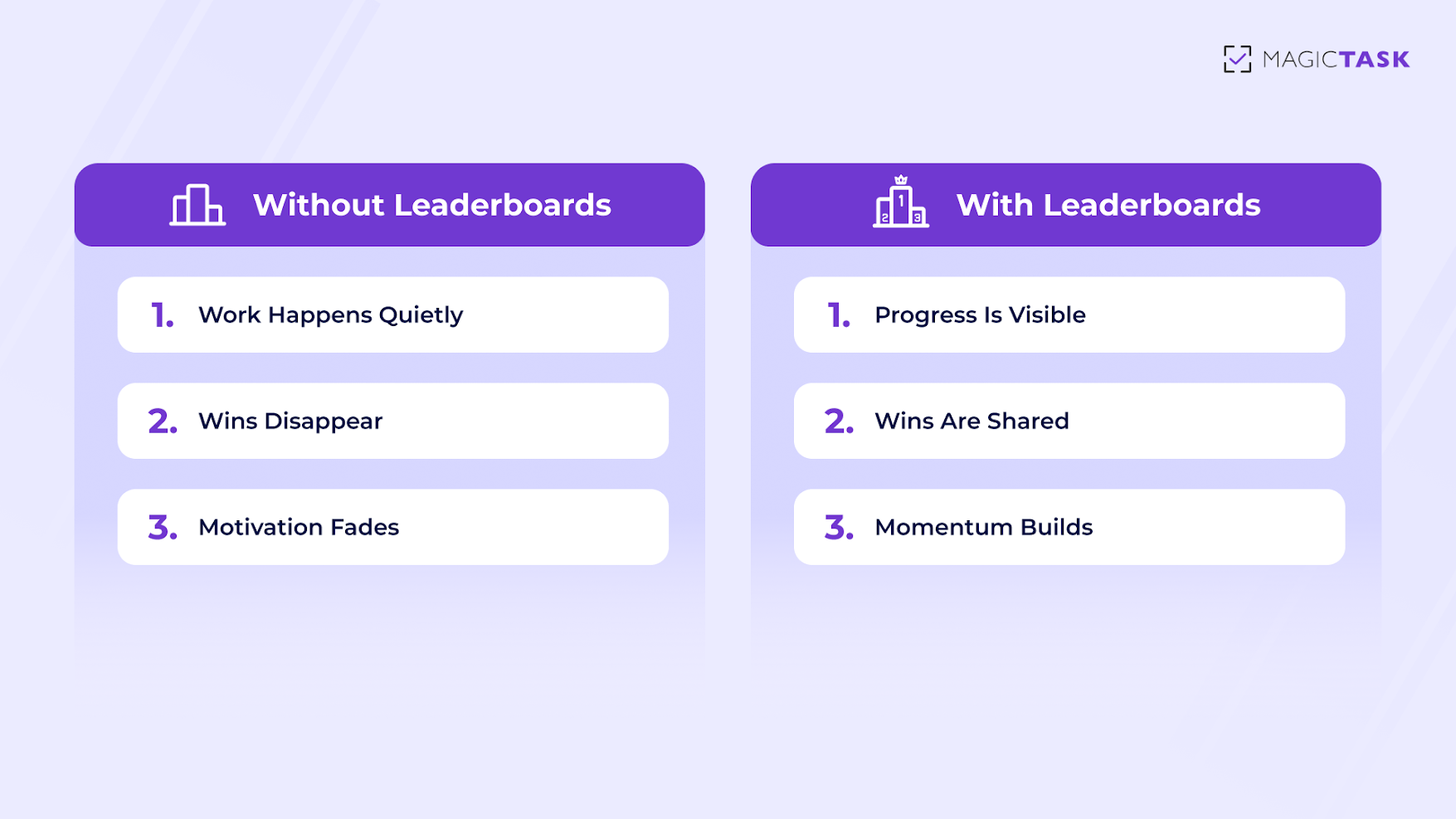
Traditional performance tracking tools look helpful on the surface. They’re organized, structured, and make leaders feel like they have control. But for the people actually doing the work, these tools often lead to disengagement over time.

The issue isn’t the data. It’s the way the data lives, hidden, delayed, or so flat that no one feels anything when progress happens. And when progress doesn’t feel meaningful, motivation doesn’t stick.

What Are Leaderboards in the Workplace

Here are the biggest ways traditional systems fall short:

1. Lack of Transparency

In many organizations, performance tracking lives in dashboards that only managers review. The team does the work, but the visibility stays locked away. And while leaders feel informed, employees feel disconnected from the bigger picture. There’s no shared sense of progress, just silent reporting.

When people can’t see their impact, they can’t feel proud of it. And when progress is hidden, motivation has nowhere to anchor. Over time, updates become something people do because they have to, not because they care.

As a result, a quiet gap grows between effort and recognition. Work gets done, but no one experiences the satisfaction of seeing the needle move, and that’s where engagement starts to fade.

2. Numbers Without Meaning or Emotion

Traditional performance tracking often reduces progress to raw data, where you can see tasks completed, hours logged, and percentage bars creeping forward. Is it useful for reporting? Yes. Is it motivating? Not usually. 

Numbers alone don’t create connection or pride. People don’t stay motivated because they see a percentage go from 42% to 47%. They stay motivated when they can see their contribution and feel momentum building. Without that emotional layer, tracking becomes routine, and routine eventually becomes ignored.

3. Flat Experience With No Recognition or Momentum

In most traditional tracking systems, completing a task feels the same as not completing one — flat. You check a box, update a cell, or mark something as “done,” and… nothing happens. There’s no visible shift in progress. The system records it, but it doesn’t respond to it.

And that lack of response matters. Think about the last time you finished a big task, clicked “complete,” and the platform simply removed it from view. It felt more like it disappeared than like something meaningful happened. There was no moment of satisfaction, just the next task waiting.

Over time, this flat experience dulls motivation. When progress doesn’t feel rewarding, people stop caring about tracking it, and eventually, they stop showing up in the tool at all.

How Leaderboards Improve Team Performance

Some teams run on deadlines. Others run on caffeine. But the best-performing teams run on visibility because small wins feel bigger. That’s what leaderboards bring to the table. Just a clearer way for teams to see the story unfolding as they build it.

Let’s break down why they work so well.

1. Motivation Through Visibility

When people see their name on a board, moving up, contributing, and earning points, something clicks. It’s the same feeling you get when closing your last Apple Watch ring for the day. You don’t have to do it… But now you kind of want to.

Visibility isn’t about showing who’s “best.”  It’s about reminding everyone: “Hey, what you’re doing matters.”

2. Friendly Competition Creates Accountability

A well-designed leaderboard doesn’t pit people against each other, but it sparks healthy momentum.

It’s the difference between: “Ugh… I need to update my tasks,”  versus  “Oh, I’m two points behind Sarah? Game on.”

Competition feels fun when the stakes are simple and the feedback is instant. In fact, for 78.3% of people, it gives the nudge they didn’t know they needed.

No guilt. No pressure. Just a gentle, playful push to keep going.

3. Micro-Achievements Keep Teams Consistent

Leaderboards don’t wait for big milestones to celebrate progress. They celebrate the tiny steps along the way.

Leaderboards create micro-moments of success:

  • Finishing a task
  • Logging progress
  • Keeping a streak alive
  • Moving up one spot

Each small win signals progress, and progress fuels consistency. Leaderboards aren’t about scoring, ranking, or comparing. They’re about energy. They turn everyday work into something that feels active, alive, and shared.

And when work feels like that, performance grows naturally. 

How MagicTask Uses Leaderboards to Boost Engagement

Leaderboards often get a bad reputation because so many tools implement them the wrong way. There’s harsh ranking, public shame, or a system where one “winner” sits at the top while everyone else silently falls behind. That kind of leaderboard divides teams.

MagicTask was built differently. Instead of treating leaderboards as a scoreboard, it treats them as a shared motivation engine, something that brings clarity, energy, and momentum into the workday. It doesn’t reward only speed or volume. It rewards effort, consistency, progress, and participation, the things that actually shape high-performing teams. 

MagicTask leaderboards aren’t about competition. They’re about engagement, identity, and shared forward motion.

Let’s break down how it works.

1. Streaks: Encouraging Habits, Not Hustle

In many tools, progress is only recognized when something big happens, like when a major task is completed, a project is closed, or a milestone is delivered. But productivity isn’t built on occasional big pushes. It’s built on repeatable habits.

MagicTask’s streak system reinforces daily consistency, even if the progress is little. Completing tasks daily adds to a streak, giving users a visible reminder: “I’m someone who shows up.”

This design lowers pressure while still building momentum.

Streaks help teams:

  • Stay accountable to daily habits
  • Avoid the “start strong, fade later” cycle
  • Build a rhythm of continuous progress
  • Feel rewarded for showing up, not just finishing big tasks

And mainly, missing a streak isn’t punished. There’s no shame mechanic. The system encourages engagement without weaponizing failure.

2. Levels: Turning Growth Into a Story

While streaks focus on consistency, levels focus on progress over time. Every task completed earns XP (experience points). Over days, weeks, and months, those points accumulate, showing long-term growth.

This transforms the experience from a list of finished tasks into a trackable upward journey.

Levels tap into a simple human truth: We love seeing ourselves improve.

Here’s how levels shift motivation:

Without Levels With Levels
Progress disappears once a task is finished Progress accumulates and becomes visible
No emotional connection to effort Users feel they’re advancing and evolving
Hard to see long-term growth Growth is documented, celebrated, and clear

Levels make productivity feel like a personal adventure that you can enjoy completing. 

3. Achievement-Based Leaderboards

Most leaderboards track whoever does the most, which benefits certain roles (like sales) while penalizing others who do fewer tasks but more important ones. MagicTask avoids that trap by using achievement-based metrics, not raw-volume metrics.

That means the leaderboard prioritizes:

  • Impact
  • Consistency
  • Contribution
  • Milestones
  • Completion ratios
  • Personal growth

Not just speed.

This makes the leaderboard feel inclusive, not competitive in a cutthroat way. 

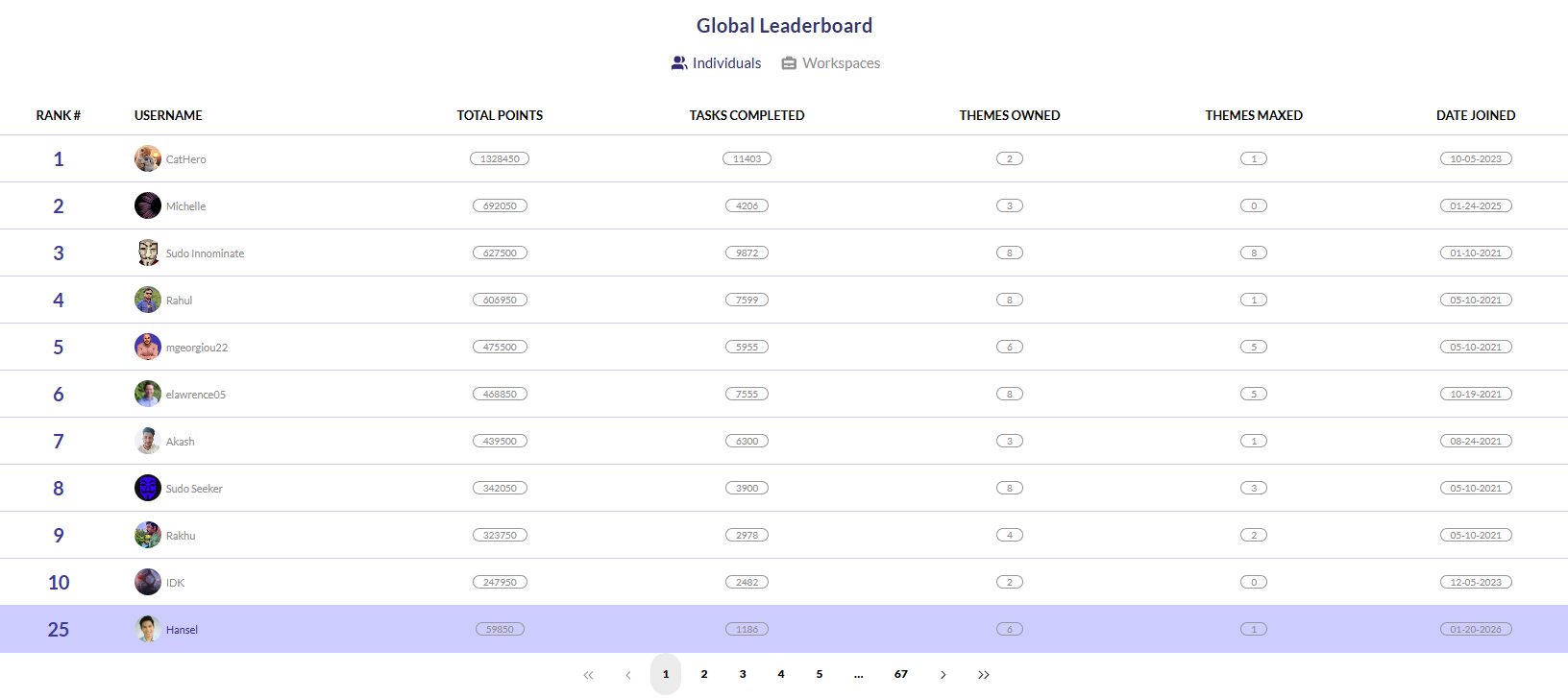
A typical MagicTask leaderboard snapshot might look like this: 

MagicTask leaderboard

There’s more to celebrate here than just “number of tasks.”

4. Collaboration Over Competition

This is where MagicTask stands out the most. Leaderboards are designed to bring teams closer, not divide them.

MagicTask shifts the psychology from “I need to beat everyone” to “We’re all moving forward together.”

It does this through features like:

  • Shared boards where teams see progress collectively
  • Team streaks that reward group consistency
  • Milestone unlocks that belong to the whole team
  • Theme unlocks that become a shared visual celebration

This creates a feeling of: “We’re part of something.”

Competition exists, but it’s supportive, energizing, and rooted in community. 

5. Reward Mechanics That Make Engagement Feel Good

MagicTask pairs leaderboards with subtle but meaningful emotional rewards:

  • Visual animations
  • XP bursts
  • Unlockable themes
  • Milestone badges
  • Progress celebrations

They trigger small dopamine hits that reinforce the habit loop:

Task → Feedback → Satisfaction → Repeat

Over time, the system trains teams to enjoy completing tasks, which means engagement becomes natural.

MagicTask’s leaderboard system works because it’s about recognizing progress, reinforcing consistency, and making productivity feel rewarding.

It aligns with how humans stay motivated: through visibility, momentum, and shared celebration.

Conclusion: From Tracking to Thriving With Leaderboards

Performance tracking shouldn’t feel like a chore, and it shouldn’t live in a dashboard no one opens. When progress is invisible, motivation fades. When recognition is missing, engagement drops. And that’s how tools, even the well-intentioned ones, eventually collect dust.

Leaderboards make progress feel meaningful. They turn effort into something visible. They help teams see momentum, celebrate wins, and stay connected to the work they’re doing.

And with MagicTask, leaderboards are a shared motivation system designed to build consistency, confidence, and culture. Teams don’t need more tracking. They need to feel progress.

If your team is ready for that kind of shift, it may be time to see what leaderboards can do when they’re designed with motivation in mind — not measurement alone.

Try MagicTask and experience the difference to inspire your team.

Deep Work, Simplified: Cut the Noise and Focus on What Matters

Deep Work, Simplified: Cut the Noise and Focus on What Matters

Have you ever sat down at your desk, ready to get into the zone, only to find your attention pulled in a dozen directions before you even start? You probably got a ping from Slack or a new email, and suddenly the thought of deep, focused work feels like a distant dream.

You’re not imagining it. Our brains simply aren’t built for constant distraction. Every time we switch tasks, we pay a cognitive price. Research shows that after an interruption, it can take up to 23 minutes and 15 seconds just to regain full focus on the original task.

That constant state of reaction is the enemy of deep work. But it becomes possible the moment you clear the noise, define what matters, and build systems that protect your attention instead of scattering it.

In this post, we’ll simplify deep work so you can cut through the chaos, reclaim focus, and do meaningful work without burning out.

Why Deep Work Is Hard in Today’s World

If deep work feels out of reach, it’s not a personal failure. It’s the environment. Modern work is engineered for speed, visibility, and constant response. Even with the best intentions, the conditions most of us work in make sustained attention incredibly difficult.

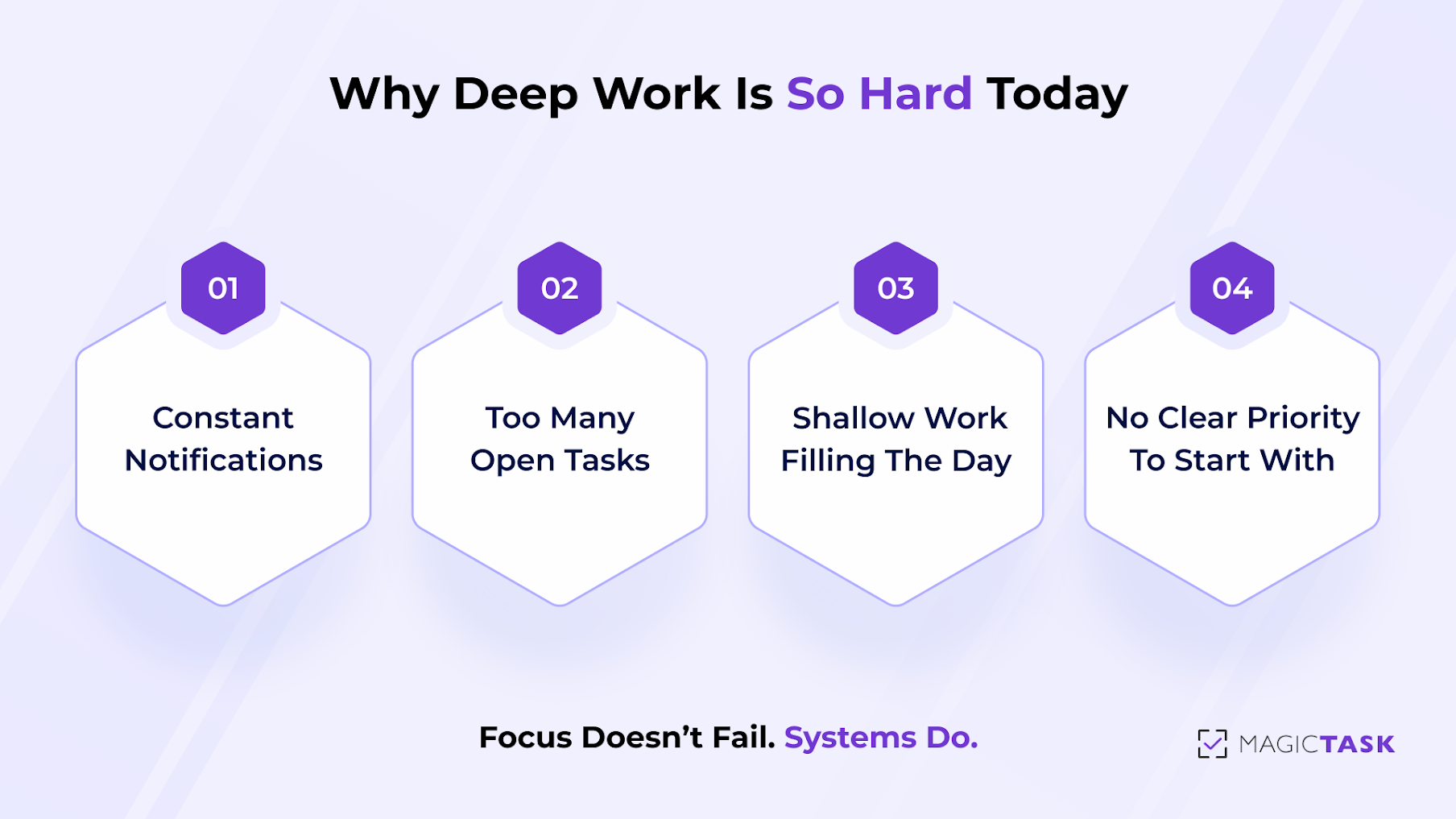
Why Deep Work Is Hard Today

Constant Digital Noise Breaks Focus Before It Starts

Focus disappears because it never gets a chance to settle. The moment you sit down to work, the noise begins in the form of a notification you didn’t ask for but somehow feel obligated to check. Even when you ignore it, your attention still shifts. Your brain takes note, and the thread breaks.

What makes this especially draining is how subtle it is. You don’t feel interrupted in a dramatic way. Instead, your focus gets chipped away in tiny pieces until deep thinking becomes impossible. You’re technically working, but your mind is constantly resetting, trying to remember where it left off.

Deep work needs uninterrupted stretches to form momentum. Digital noise prevents that momentum from ever building. Without quiet mental space, focus stays shallow and exhausting. And by the end of the day, it’s not that you didn’t work hard, it’s that your attention never had a chance to fully engage.

Once noise sneaks in, the next habit shows up almost automatically, that is, trying to do everything at once.

Multitasking Creates the Illusion of Productivity

There’s a long-standing myth that humans use only a small portion of their brain, with the rest just sitting there, waiting to be unlocked. If that were true, multitasking wouldn’t feel so exhausting, and focus would simply be a matter of trying harder.

But that belief doesn’t hold up. Research shows that nearly two-thirds of the American public and even more than a quarter of science teachers still believe the “10% brain” myth. That misconception fuels the idea that we should be able to juggle multiple tasks at once if we just apply enough willpower.

The reality is far less forgiving. The brain has no unused reserve waiting to step in. Attention is limited, and when it’s stretched too thin, performance suffers.

Here’s what multitasking quietly does to deep work:

  • Fragments attention so focus never deepens
  • Increases cognitive load, making work feel harder than it should
  • Reduces quality, even when tasks are completed
  • Creates mental residue that slows you down long after the switch
  • Trains the brain to crave interruption, not concentration

What makes multitasking especially dangerous is how normal it feels. We’ve been conditioned to believe that constant switching is just part of modern work. But deep work requires fewer inputs, fewer decisions, and a single thread of attention.

Overloaded Task Lists Drain Mental Energy

When everything sits in front of you at once, your brain has to work overtime deciding what deserves attention. That constant decision-making burns mental fuel that should be spent on doing the work itself.

Instead of starting, you scan. You reorder. You hesitate. Each choice, this task or that one? now or later? important or urgent?, adds friction. Over time, that friction turns into avoidance, not because the work is hard, but because the list feels heavy.

Overloaded task lists create a few hidden problems:

  • Decision fatigue sets in early, leaving less energy for focused thinking
  • Important work gets buried under easier, more urgent tasks
  • Starting feels harder than finishing, so progress stalls
  • Focus fractures as attention jumps between too many options

Deep work needs a short list, a clear priority, and a single starting point. When your task list is simplified, your mind relaxes. And when the mind relaxes, focus finally has room to deepen.

Lack of Structure Makes Focus Feel Optional

Focus does not stay still because nothing in your day protects it. When tasks, priorities, and time all float loosely, deep work becomes something you intend to do.

Without structure, focus competes with everything else. Urgent messages feel louder than important work. Shallow tasks sneak in because they’re easier to start. And deep work keeps getting postponed until “later,” a time that never quite arrives.

A lack of structure creates subtle but powerful friction:

  • No clear starting point, so work gets delayed
  • Important tasks are lost to urgent interruptions
  • Focus time gets squeezed out, not scheduled
  • Progress feels random, not intentional

Deep work thrives inside clear boundaries. When structure is in place, focus stops feeling optional and starts feeling automatic.

What Deep Work Really Requires

Deep work isn’t about superhuman discipline or locking yourself away for hours. It’s about setting the right conditions, so focus can actually happen. When those conditions are in place, deep work feels natural. When they’re missing, focus feels forced.

Let’s break down what deep work truly needs and give you something practical to use right away.

Clear Goals and Defined Focus Blocks

Deep work starts with knowing exactly what you’re working on and when you’re working on it. Vague intentions like “work on the project” invite distraction. Specific goals create direction.

Instead of blocking time and hoping focus shows up, pair each focus block with a clear outcome:

  • “Draft the first two pages”
  • “Solve one core problem”
  • “Design one screen”

Clarity removes hesitation, and hesitation is where distractions sneak in.

A Clutter-Free Mental and Digital Environment

Focus doesn’t like clutter. Open tabs, scattered notes, and half-finished tasks quietly compete for attention, even when you’re not actively looking at them.

Before deep work, clear the runway:

  • Close unnecessary tabs
  • Silence notifications
  • Write down distracting thoughts so your brain doesn’t hold onto them

When your environment is calm, your thinking follows.

One Clearly Defined Task

Deep work breaks the moment you ask your brain to choose between multiple tasks. One session, one task. That’s all it takes.

When your brain knows there’s only one thing to focus on, it stops scanning for alternatives and settles into the work itself.

Momentum Through Visible Progress

Focus strengthens when effort feels rewarding. Seeing progress, even little progress, tells your brain it’s worth staying engaged. Feedback doesn’t have to be big or loud; it just needs to be visible.

Checkmarks, progress bars, XP, or a simple “done” list all reinforce momentum.

Try This: The 10-Minute Deep Work Reset

Before your next focus session, do this quick reset:

  1. Define one task. Write it down clearly.
  2. Set a timer for 25 minutes. No multitasking allowed.
  3. Clear your space. Close tabs. Silence notifications.
  4. Work until the timer ends. Don’t stop early.
  5. Mark visible progress. Note what you completed.

That’s it.

Deep work requires intention. When goals are clear, the environment is quiet, and progress is visible, focus stops feeling elusive and starts feeling achievable.

Simple Systems to Reduce Noise and Build Focus

When everything feels urgent, and everything demands a response, deep work never gets a clear path. The good news is that you don’t need a complicated system to cut through the noise. A few intentional changes can dramatically improve how easily you settle into focused work.

Here are practical, low-effort ways to reduce distraction and build focus into your day.

  • Prioritize tasks by impact, not urgencyBefore starting your day, identify one or two tasks that will make the biggest difference if completed, even if they aren’t the loudest. Deep work lives in impact, not in inboxes.
  • Remove or batch low-value activitiesNot every task deserves immediate attention. Group emails, messages, and small admin work into designated windows so they don’t interrupt your focus. When shallow tasks are contained, deep work gets space to breathe.
  • Use simple focus ritualsRepetition signals your brain that it’s time to focus. This can be as simple as setting a timer, putting on the same background sound, clearing your desk, or opening a specific document. Over time, these cues make focus easier to access.
  • Declutter digital spacesFewer tabs. Fewer lists. Fewer open tools. Each open item pulls at your attention, even if you’re not actively using it. Close what you don’t need, keep one task visible, and let your screen support focus instead of scattering it.

When your systems reduce friction instead of adding it, focus becomes something you return to naturally, not something you have to chase.

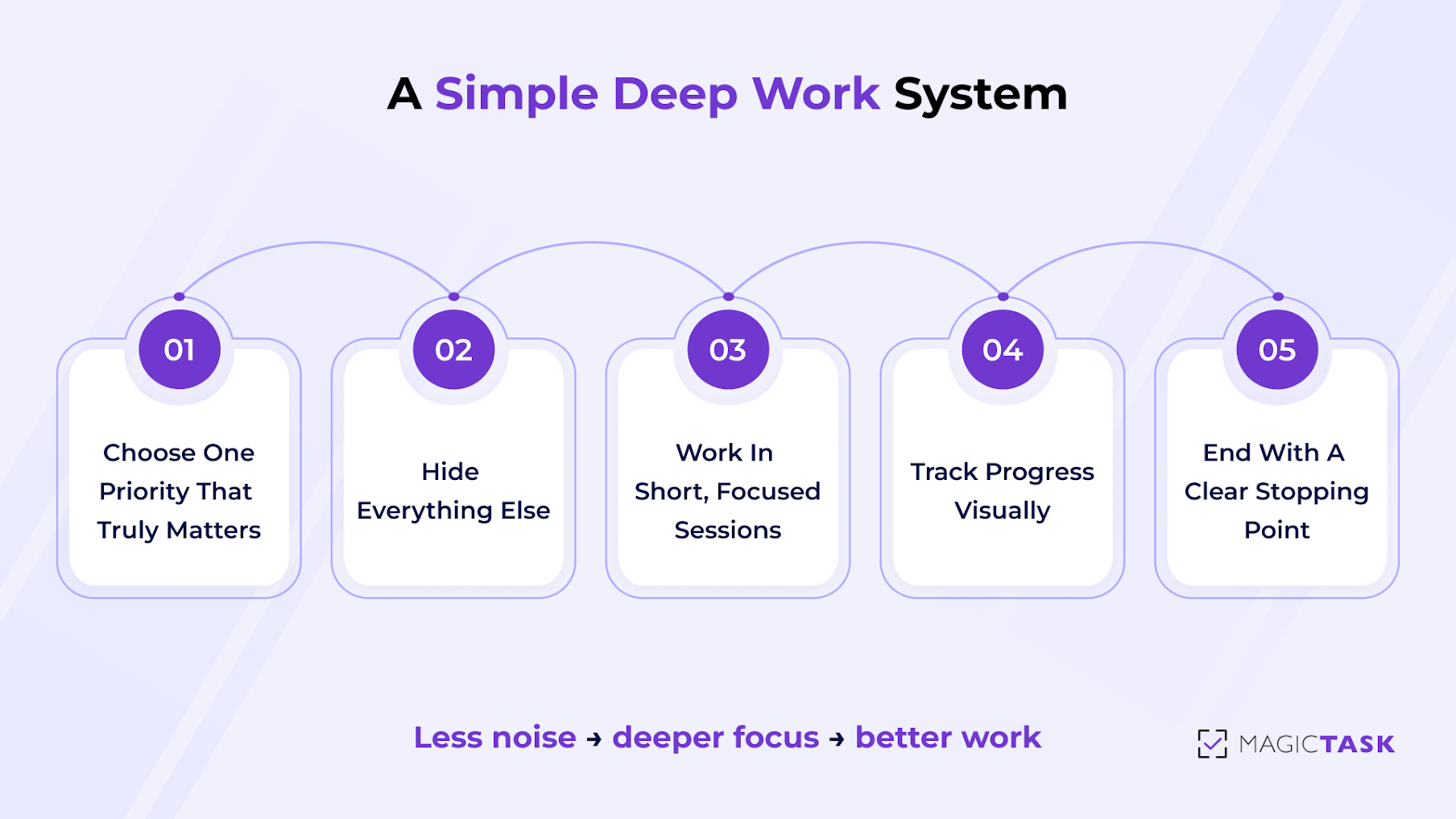
A Simple Deep Work System

Turning Deep Work into a Consistent Habit With MagicTask

Deep work becomes powerful when it stops being a one-off effort and starts becoming part of your routine. The goal is to make focused work something you return to regularly, even when energy is low or distractions are high. Consistency turns deep work from a productivity technique into a habit.

MagicTask supports this shift effectively. Instead of asking you to rely on motivation, it helps you build repeatable focus rituals, track progress, and reinforce the satisfaction that keeps you coming back. Over time, deep work stops feeling like a special event and starts feeling like your default mode.

1. Schedule Focus Sessions Like Real Commitments

You often think, “I’ll get to it when things calm down,” but it’s the first thing to disappear once the day fills up. This is where structure makes all the difference.

MagicTask’s Backlog holds everything that has to be done, like coming up with ideas, upcoming tasks, and long-term projects, without demanding your attention all at once. It keeps mental clutter out of the way, so focus doesn’t have to compete with a hundred other thoughts.

When it’s time to work deeply, you don’t scan a long list. You intentionally pull one meaningful task from the Backlog into My Focus. That simple action turns deep work into a commitment. My Focus becomes your protected lane, the work you’ve already decided deserves your attention.

This approach does two important things:

  • It removes the pressure to choose what matters in the moment.
  • It signals to your brain that this time is reserved for something important.

Deep work thrives when it’s planned ahead of time. By separating everything you need to do from what you’re focusing on right now, MagicTask helps you show up for concentrated work with clarity.

2. Use Task Sizing to Match Focus to Energy Levels

Not every deep work session needs the same amount of intensity. Some days you’re sharp and energized. Other days, focus is available in small doses. One of the easiest ways to keep deep work consistent is to match the size of the task to the energy you actually have, not the energy you wish you had.

MagicTask’s S / M / L / XL task sizing makes this decision effortless. Instead of guessing whether a task fits your current focus level, you size it ahead of time. That clarity removes friction and helps you start faster.

Here’s how task sizing supports sustainable deep work:

Task Size Focus Intensity Best Used For Example Deep Work
S Light focus Short sessions, low-energy days Outline ideas, review notes
M Moderate focus Standard deep work blocks Write a section, design a screen
L High focus Peak-energy sessions Draft a full document, solve a complex problem
XL Extended focus Planned, multi-session work Major project or deep research

Instead of skipping deep work on low-energy days, you adjust the scope. You still show up, still focus, and still make progress, just at the right scale.

This flexibility is what keeps deep work from turning into an all-or-nothing habit. When the work fits your energy, consistency becomes much easier to maintain.

3. Build Momentum Through Visible Progress and Feedback

Deep work needs reinforcement. When effort disappears into a void, it’s hard to stay engaged. Momentum builds when your brain can see that time spent concentrating actually moved something forward.

MagicTask makes progress visible in small but powerful ways. Each completed task adds XP, nudges your level forward, and reinforces the sense that focused effort pays off. Instead of wondering whether a deep work session was “worth it,” you get immediate feedback that confirms it was.

That feedback loop matters more than it seems. Visible progress does a few important things:

  • Signals completion, which gives your brain permission to rest
  • Reinforces consistency, making it easier to return to focus tomorrow
  • Turns effort into satisfaction, not just relief
  • Creates forward momentum, even when progress feels incremental

By pairing focused sessions with visible progress markers, MagicTask helps you feel the impact of your work in real time.

4. Reduce Decision Fatigue Before Focus Begins

Deep work usually fails before it starts. The moment you sit down and have to decide what to work on, how long to work, or whether the task is worth your energy, focus slips away.

Preparing tasks in advance removes that friction.

When you size tasks ahead of time, place them in your Backlog, and intentionally move a small set into My Focus, you eliminate decision-making at the moment focus is required. Your brain doesn’t need to negotiate. It already knows the plan.

This preparation allows your mind to settle faster:

  • No scanning long lists
  • No second-guessing priorities
  • No mental energy wasted choosing where to begin

Focus thrives when decisions are already made. The less your brain has to choose, the more it can concentrate.

5. Reflect Weekly to Strengthen the Deep Work Identity

Consistency sticks when it becomes part of how you see yourself. Weekly reflection helps shift deep work from something you try to do into something you are known for, even to yourself.

Taking a few minutes each week to review completed focus tasks, streaks, or progress changes how you interpret your effort. You’re no longer guessing whether deep work is happening. You can see it.

That visibility reinforces a powerful identity statement: “I’m someone who works deeply.”

Reflection doesn’t need to be complicated. A simple weekly check-in can ask:

  • What focused work did I protect this week?
  • Where did I stay consistent, even briefly?
  • What helped me focus the most?

Over time, these small reflections anchor deep work into your routine. It stops feeling like a productivity technique and starts feeling like your default way of working.

Conclusion

Deep work isn’t about doing more or pushing harder. It’s about creating the conditions where focus can actually exist. When noise is reduced, decisions are simplified, and progress is visible, meaningful work stops feeling out of reach and starts feeling natural.

By protecting focus sessions, matching tasks to energy, and building momentum through small wins, deep work becomes something you return to consistently, not something you chase on your best days. Over time, that consistency changes how you work and how you see yourself.

If your days have felt busy but scattered, this is your invitation to try MagicTask. Create one focused session. Choose one meaningful task. Let everything else wait.

Using MagicTask for Life Goals: Beyond Work/Professional Tasks

Turn life goals into daily wins

Most productivity systems stop at work. But life doesn’t. You have deadlines and deliverables, sure, but you also have goals like getting fitter, learning a language, fixing your sleep routine, or finally finishing that book you started three months ago. The fact of the matter is that  92% of people never achieve long-term goals.

And that’s the gap I wanted to close. So I started using MagicTask, a gamified productivity app that turns tasks into progress you can see and feel. Suddenly, “work out,” “practice Spanish,” and “read 10 pages” weren’t vague intentions. They lived right next to my work tasks, with points, streaks, and visible progress pushing me forward.

If you’re looking to do the same, learn how to turn life dreams into daily wins with MagicTask.  

Turning Life Goals into Quests

Turn life goals into quest

A lot of us have that “someday” list. Someday I’ll get fit. Someday I’ll learn guitar. Someday I’ll become a morning person.

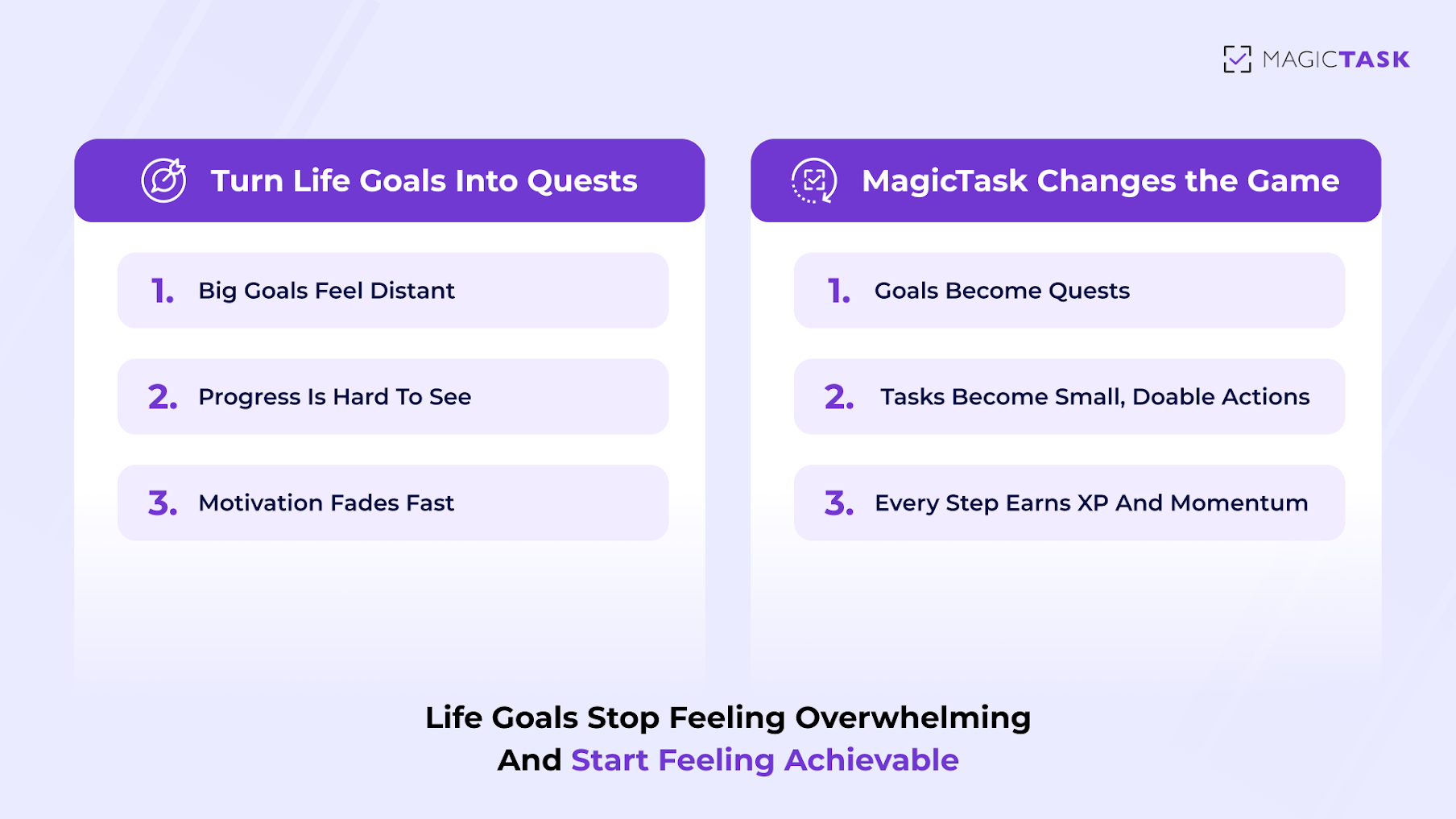
But “someday” has a bad habit of turning into never because we can’t see progress day to day. When nothing feels like a win, motivation fades fast. That’s what pushed me to try something different.

Instead of treating goals like distant destinations, MagicTask lets you treat them like quests, the kind you’d actually be excited to complete. You take the big task and break it into tiny, doable steps, each categorized into a size (S, M, L, XL), that reward you every time you follow through. 

Here’s how task sizing in MagicTask turns big goals into everyday wins:

Size Task Type Example Why It Works
S Tiny actions you can do daily Practice one chord for 5 minutes Builds streaks + removes resistance
M Slightly bigger effort, a few times a week Learn a new strumming pattern Feels meaningful without pressure
L Milestone achievements Learn and record one full song Shows visible progress + XP boost
XL The whole mission Play a song confidently for others Defines the long-term win + direction

Suddenly…

  • “Work out” becomes: 15 push-ups (S), full routine (M), weekend run (L)
  • “Learn Spanish” becomes: one lesson (S), short conversation practice (M), complete a module (L)
  • “Learn Guitar” becomes:
    • Practice chords (S — daily)
    • Learn a new strumming pattern (M — 3x/week)
    • Master a song (L — weekends)
    • Hit record and celebrate progress

And the best part is that every small action gives you XP and levels you up. Now, you chase your goal with excitement. Because once life goals stop feeling like long homework assignments, and start feeling like the game you’re meant to win, you actually show up. 

Building Motivation Through Gamified Rewards

How gamified rewards build consistency

Let’s be honest for a moment here. We all have that Monday morning motivation to get things done. So, motivation is not the real problem; consistency is. Every big goal starts strong… until the excitement wears off and the results take too long to show.

That’s exactly where gamification makes the difference.

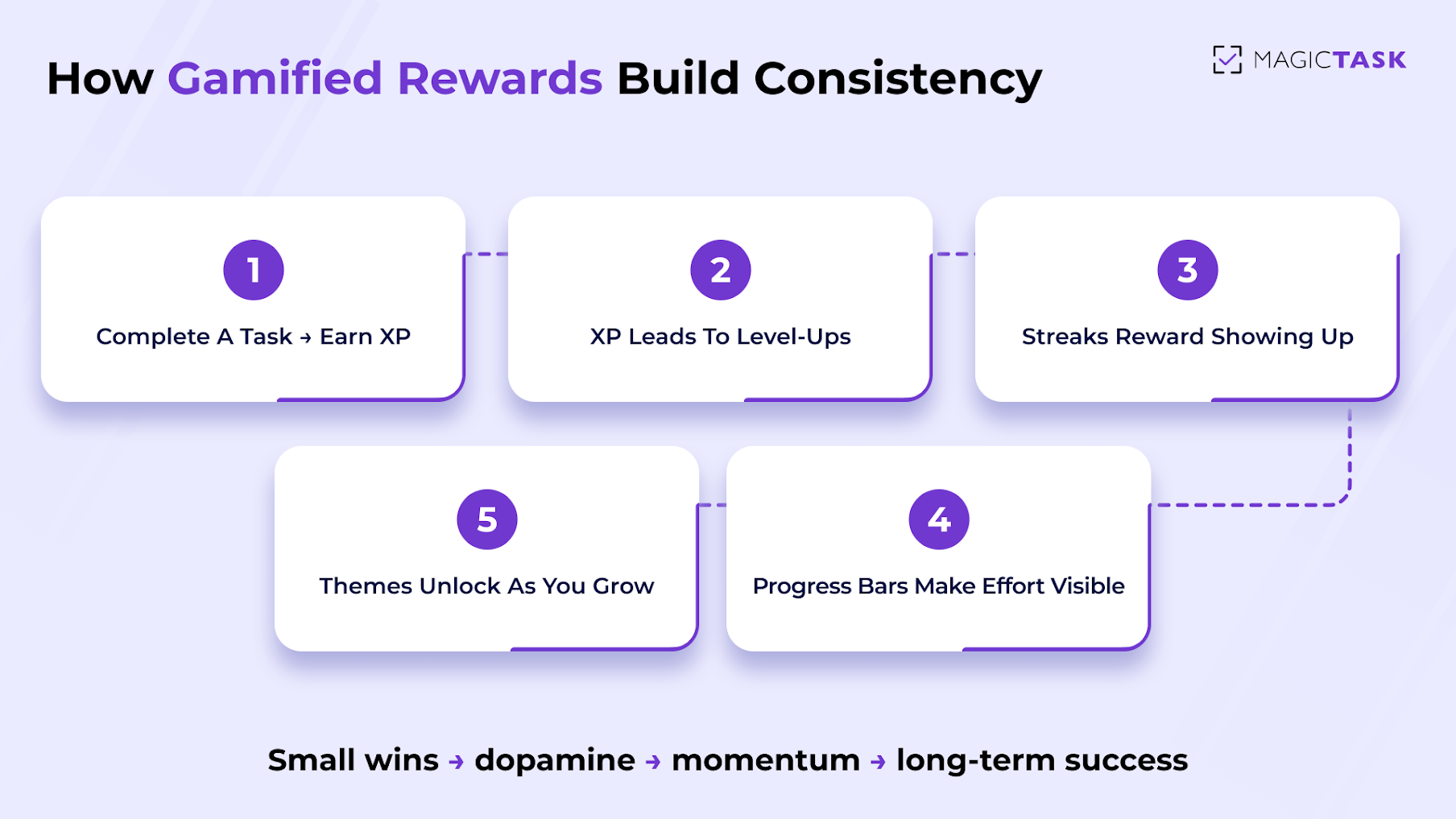
MagicTask gives you instant feedback for taking action:

  • XP for every task completed
  • Level-ups that visually celebrate progress
  • Themes and streaks that reward consistency
  • A progress bar that keeps you chasing that next “almost there” moment

Each little reward triggers a burst of dopamine, the brain’s “do that again” signal. And that chemical high builds the habit long before the big results show up.

Just like in video games, you don’t grind for hours because the final boss is exciting. You keep going because the next level is right there. It’s the same psychology on a different playground.

Real Example You Can Try Today

Goal: Run a 5K

Quest Setup in MagicTask:

  • Day 1 — Walk 10 minutes (S)
  • Day 2 — Run 1 minute + walk for 10 minutes (S)
  • Day 3 — Repeat five cycles (M)
  • Weekend — Run 2km without breaks (L)

By week three, you’re not thinking, “Ugh, I have to run.” You’re thinking, “I’m 40 XP away from leveling up, let’s go!”

Progress stops being invisible as the brain sees evidence, and your effort feels worth it. You’re no longer relying on willpower to reach a distant finish line because you’re being rewarded along the way.  

Small wins → dopamine → momentum → long-term success

That’s how you stay committed when goals are still miles out of sight.

Balancing Work and Life with One System

Everyone loves a reward, but when you're trying to push through a never-ending workday, those rewards often feel distant. You’ll finish the big project next month. You’ll hit the revenue target next quarter. You’ll “finally relax” sometime after that. It’s no wonder motivation fizzles.

That’s where gamified rewards make a difference.

Visible progress gives your brain a hit of dopamine in the present, not some hazy, far-off future. MagicTask taps into this exact psychology:

  • XP = tangible evidence that the work actually counts
  • Streaks = micro-accountability that makes consistency feel exciting
  • Unlockable themes = personalized progress that upgrades your workspace
  • Achievements = reminders that every small win gets you closer

The system keeps you coming back through anticipation. 

Say you’ve been stuck rewriting a proposal for days. The moment you finally mark that task complete… confetti pops, XP jumps, and boom, you’re one step away from unlocking a new theme you’ve been eyeing all week. That tiny celebration can make you think: “Hey, maybe I’ll knock out one more task while I’m on a roll.” 

It’s the same psychology that keeps gamers chasing the next level. The journey matters just as much as the destination.

MagicTask users often go one step further: they connect real-life treats to their streaks.

  • 3 days consistent? Treat yourself to a great coffee.
  • 10 tasks done? Order that book you saved.
  • Hit a full XP milestone? Weekend getaway unlocked.

Gamified productivity reminds you of something we tend to forget as adults:Work can actually feel good.

Tracking Progress and Celebrating Growth

A funny thing happens when progress becomes visible: we start believing in our own momentum.

In traditional productivity systems, tasks just disappear. You do the work, tick a box, and poof, it’s gone. No evidence that you even showed up. No reminder that today was a win.

Gamification changes that narrative.

Every XP boost and every streak earned becomes a proof point, a receipt for your effort. Over time, those receipts reshape identity:

“I’m someone who follows through.” “I’m consistent.” “I show up for my goals.”

Psychologists call this identity-based reinforcement, and it sticks far longer than the “rah-rah motivation” we often rely on.

Make Reflection Part of the Game Loop

Gamification isn’t only about action. It’s also about awareness. Adding “checkpoint quests” such as:

  • Journaling after major milestones
  • Weekly self-assessments (“What did I learn?”)
  • Monthly quest mapping (“What’s the next adventure?”)

…helps convert progress into personal growth. The reflection itself becomes a reward, a chance to acknowledge effort instead of racing past it.

Momentum Today → Mastery Tomorrow

Visible progress builds consistency, which is where real change lives. When users always see how far they’ve come, sticking with goals becomes less about pressure and more about pride.

Because the story you’re writing is in the person you’re becoming, one completed quest at a time.

Conclusion

Life goals have a bad habit of getting trapped inside notebooks, forgotten notes apps, or vague promises to “start next week.” And that’s not where dreams belong. They deserve a system that cheers you on, rewards your effort, and reminds you that growth is happening, even on the days it feels slow.

MagicTask elevates your everyday life into an adventure with XP boost, streaks, and animations. No more waiting on motivation or relying on willpower alone. You get a game loop built to keep momentum alive.

Pick one personal quest this week. Add it to MagicTask. Give it a streak. Celebrate the smallest wins. The game to level up your life has already begun!

How to Use Daily Micro Habits in MagicTask To Achieve Your Big Goals

How to Use Daily Micro Habits in MagicTask To Achieve Your Big Goals

Did you know you can completely change your results just by changing what you do for five minutes a day? It’s true! Research found that about 45% of our daily actions are not conscious decisions, but a result of habits. That means success is built on what you consistently do without thinking.  

That’s why I stopped chasing big goals and started focusing on micro habits to achieve them. And with MagicTask, tracking and managing those habits become easier. 

If you’ve ever felt stuck between ambition and follow-through, micro habits coupled with a little gamification might be exactly what you’ve been missing.

Why Micro Habits Outperform Motivation

Motivation feels great, but only if you have an endless supply of it. You wake up some mornings ready to conquer the world, and others barely ready to conquer your inbox. That’s normal. The problem is that most goal-setting systems depend on motivation to work.

Micro habits remove that dependency. They’re built on action, not emotion. By keeping progress small, consistent, and measurable, they help you move forward even when you don’t feel like it.

Why Micro Habits Outperform Motivation

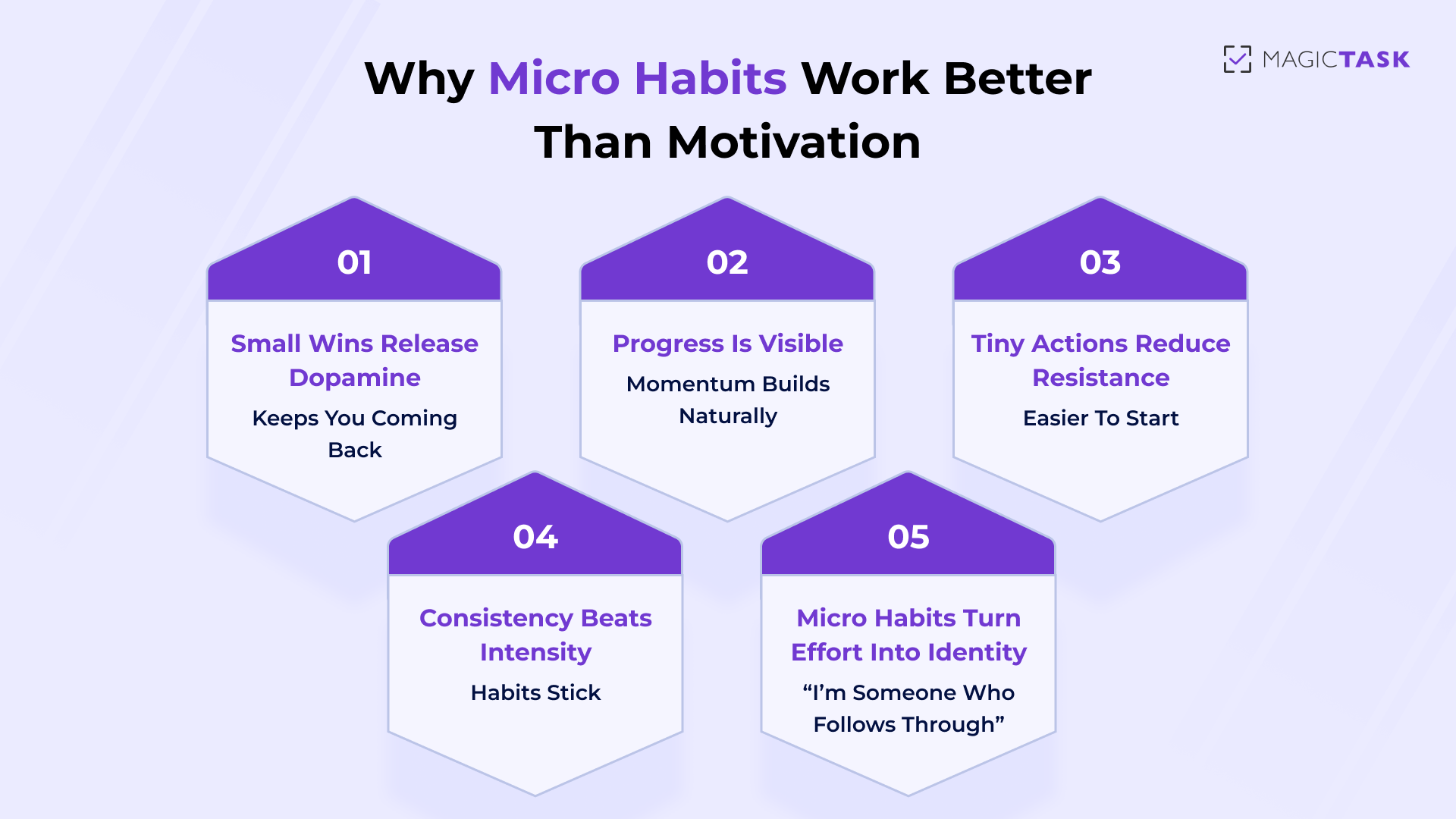
1. Small Wins Build Real Momentum

Big goals might inspire you, but it’s the small wins that keep you going. Every time you complete a tiny task, like sending one email, doing ten push-ups, or reading a single page, your brain gets a hit of dopamine. That chemical reward tells your brain, “Hey, this feels good, let’s do it again.”

Psychologists call this the progress principle, the idea that people feel the most motivated when they can see tangible progress, no matter how small. The real secret to long-term success isn’t intensity; it’s consistency fueled by visible wins.

You can start building momentum right away by:

  • Breaking big goals into daily actions: Replace “get fit” with “walk for 10 minutes.”
  • Tracking your completions: Whether on paper or in an app, seeing streaks form matters.
  • Celebrating micro milestones: Finishing one part of a project? Acknowledge it and reward it with a small treat for yourself.
  • Ending the day with proof of progress: Write down three things you actually completed without focusing on what’s left undone.

Momentum doesn’t come from doing everything at once. It comes from doing something again and again until it becomes who you are. 

2. Micro Habits Reduce Overwhelm

You know that feeling when your goals feel too big to even start? That’s your brain trying to protect you from something it sees as overwhelming. It’s why “write a book,” “get fit,” or “start a business” sound inspiring at first, but quickly become intimidating.

Here’s a simple exercise:

Tomorrow morning, instead of telling yourself you’ll “go for a 5K run,” try this — just put on your shoes and step outside. Don’t promise yourself the run. Just the shoes. Just the door.

Sounds small? That’s the point. Once you’re out there, momentum does the rest. You might walk a block, maybe jog a little and suddenly, you’ve already started. That tiny moment of action rewires your brain to associate starting with success, not fear.

That’s how microhabits work. They shrink resistance down to a single, easy step, and once you start, consistency naturally follows. 

3. Consistency Beats Intensity

James Clear, author of Atomic Habits, said it best: “You do not rise to the level of your goals. You fall to the level of your systems.”

That single line explains why most people never reach their big goals. Ambition sets the direction, but systems keep you moving. Consistency, not intensity, is what builds real progress. It’s not about how hard you work on your best days, but how reliably you show up on the average ones. 

Anyone can crush one productive day. But the people who actually hit their goals are the ones who keep going when motivation fades. They’ve built a rhythm around small, repeatable actions that eventually compound into something big.

As Muhammad Ali says, "start counting when it hurts". The real work and progress begin when things get difficult, and those are the repetitions that truly count towards making you a champion or achieving your goal. 

Here’s what that looks like in practice: 

  • Big effort burns fast: You go all in for a week, then burn out because it’s not sustainable.
  • Small effort compounds: You commit to 10 focused minutes a day, and that turns into hours of progress over time.
  • Consistency builds identity: When you show up every day, even for small wins, your brain starts to believe “I’m someone who follows through.”
  • Momentum multiplies: Each small win creates confidence and makes the next step easier to take.

In the end, it’s about creating a system that makes showing up effortless. 

Setting Up Micro Habits in MagicTask

So how do you take all this and actually apply it to your daily life?

MagicTask turns the science of micro habits into something you can see, track, and feel rewarded for every single day. Instead of relying on willpower, you build momentum through small, visible progress.

Let’s look at how you can set up micro habits inside MagicTask and turn your daily routine into a system that practically runs itself.

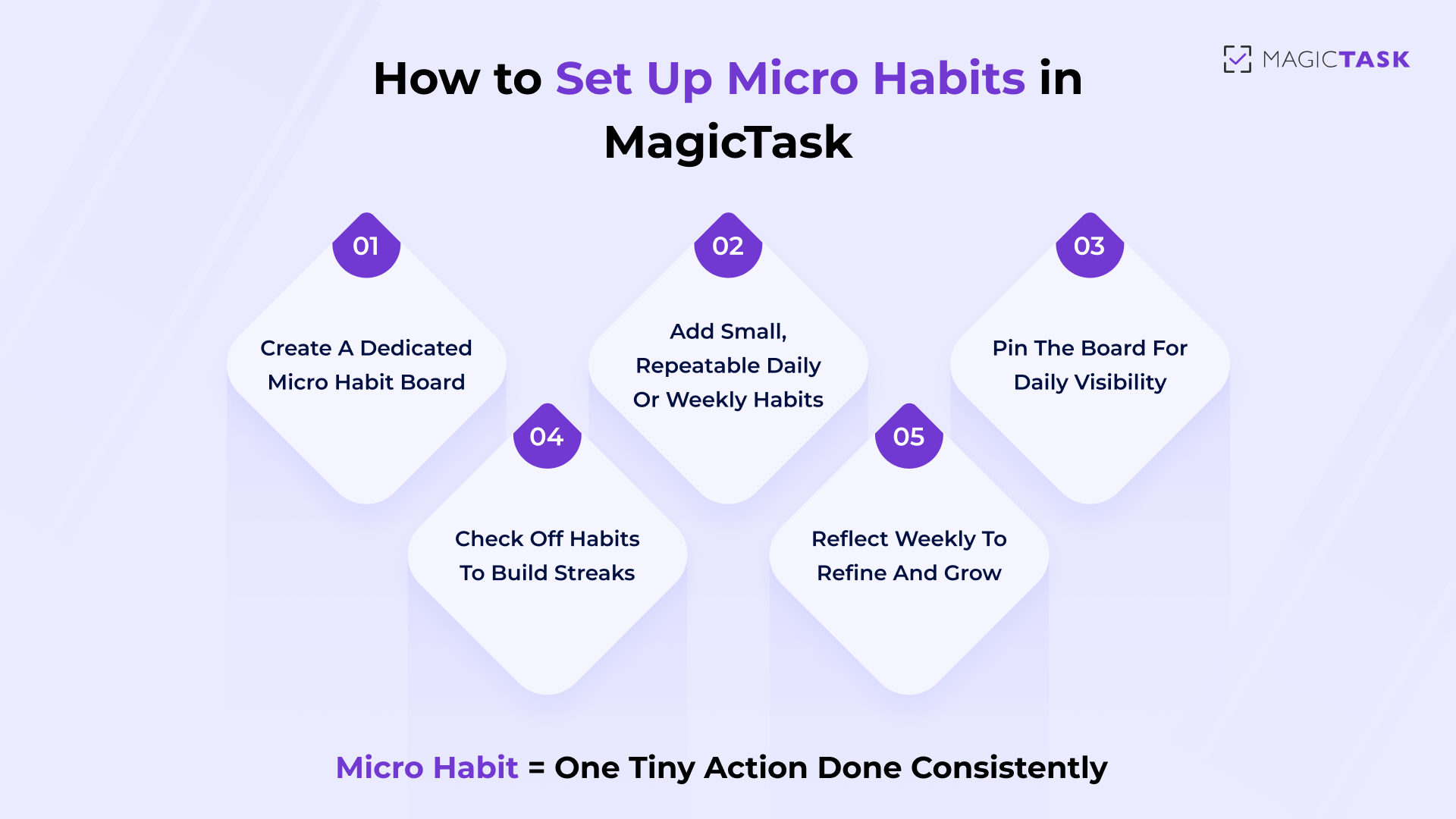
1. Create Your Micro Habit Board

Start by creating a dedicated Micro Habit Board inside MagicTask, a space just for small, repeatable actions that move you forward every day. Think of it as your personal training ground for consistency.

Here’s how it works:

  • List your recurring habits: Add daily or weekly actions.
  • Keep it visible: Pin the board to your dashboard so it’s the first thing you see each morning.
  • Mark progress daily: Check off each habit as you complete it. The visual feedback keeps your streak alive.
  • Reflect weekly: Review what stuck and what slipped to fine-tune your habits.

Over time, this board becomes a visual record of your consistency. Each checkmark tells a story of small wins stacking up, day after day, until progress starts to feel automatic. 

Create Your Micro Habit Board

2. Size Your Habits Smartly

One reason habits fail is that they start too big. You don’t need an hour-long workout or a full chapter written every morning; you just need a realistic starting point. That’s where task sizing comes in.

MagicTask uses a simple sizing system — S, M, L, XL — to help you match your effort to your energy. When you size habits correctly, you remove the guilt of “not doing enough” and focus on doing what’s sustainable.

Here’s how to size your habits effectively:

Size Effort Level Example Habit
S Takes 2–5 minutes Stretch for 3 minutes or drink a glass of water before coffee
M Takes 10–20 minutes Read 10 pages or go for a short walk
L Takes 30–45 minutes Journal deeply or complete a full workout
XL Takes 1 hour+ Work on a side project or skill practice session

Start small and scale up as your consistency builds. Progress is about how often you show up.

3. Track Progress and Build Streaks

Each completed habit, each checked task, adds a small piece to a much bigger picture of growth.

Inside MagicTask, every time you complete a habit, you earn XP and keep your streak alive. That daily streak rewires your brain to want to stay consistent. The more you see your progress build, the less likely you are to break the chain.

To make this work:

  • Check in daily: End your day by marking what you completed. It takes 2 minutes, but reinforces the loop.
  • Celebrate streaks: A 5-day streak feels great. A 15-day streak feels unstoppable.
  • Review weekly: Look at your XP and completed tasks to see how small actions are compounding into real progress.


Consistency becomes its own reward when progress is visible. What starts as checking boxes turns into building momentum, and eventually, a habit you don’t want to break. 

Turn Daily Effort into Achieving Long-Term Results

Every big goal is just a collection of small, consistent actions, stacked day after day. The problem is, most people focus only on the end result and lose steam before they get there. The secret lies in connecting those everyday habits to something bigger. 

Start by breaking your goals into milestones, and then turn those milestones into daily actions. For example:

“Write 10 minutes daily” → “Publish weekly” → “Grow audience.”

This laddered approach helps you see how today’s small effort contributes to tomorrow’s bigger achievement. Inside MagicTask, you can visualize this process using tags or quests, grouping related habits and milestones under one long-term mission. 

Over time, these micro actions create a compounding effect. Each completed task is momentum toward the bigger picture you’re building. 

Staying Consistent Through Gamification

Gamification keeps habits alive long after motivation fades. It transforms routine actions into rewarding experiences. Each checkmark, streak, or level-up becomes proof of progress. With MagicTask, every completed task adds a spark of achievement through XP, streaks, and visual feedback. 

This creates a powerful loop: you act, you get rewarded, and you naturally want to act again. That’s the secret behind lasting consistency. Your brain begins to associate progress with enjoyment instead of effort.

How MagicTask gamifies micro habits

Celebrate Daily Wins with XP and Visual Progress

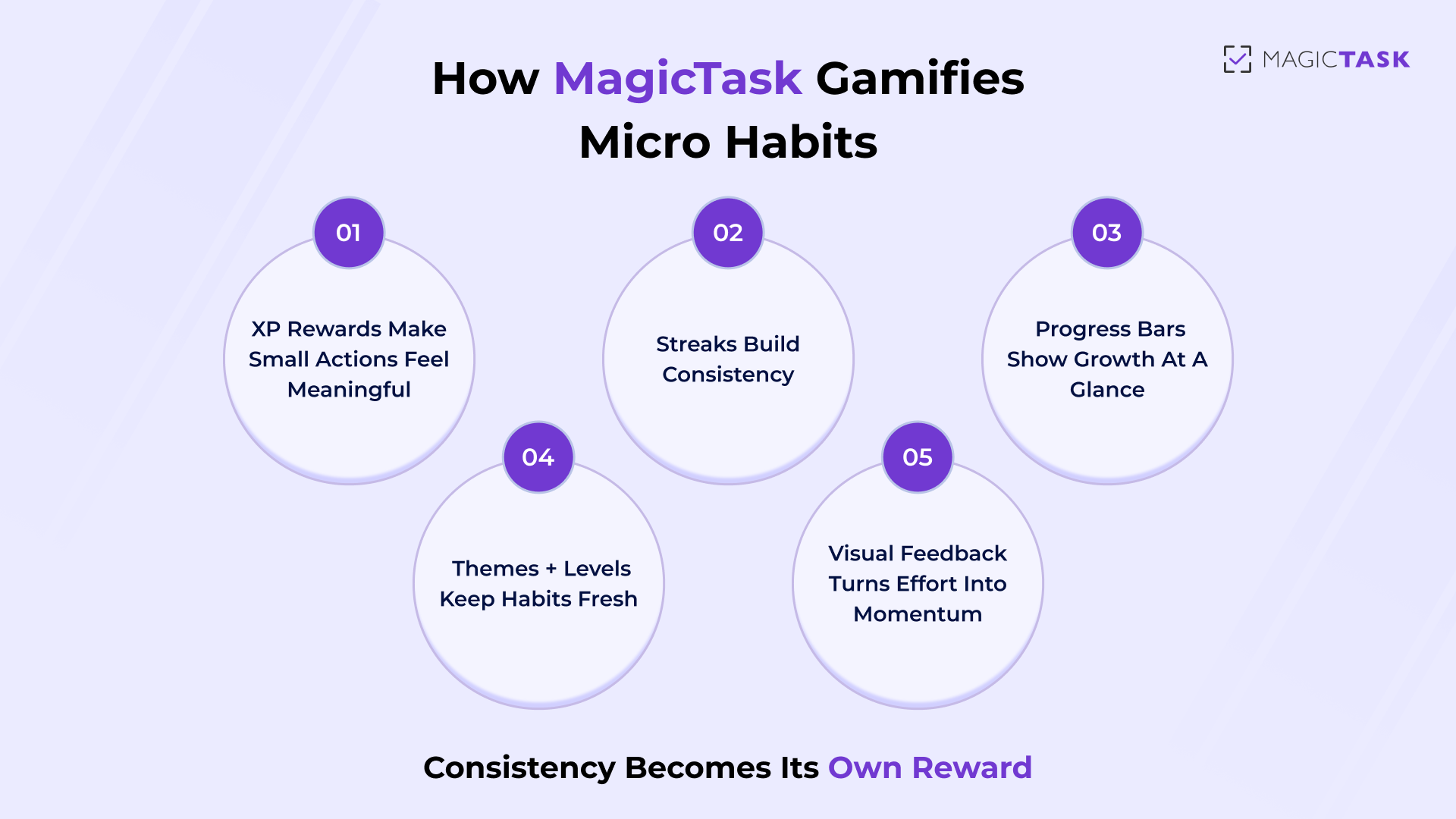
Small wins deserve recognition. When you earn XP or see your progress bar climb, your brain releases dopamine, the “feel-good” chemical tied to motivation. These micro-rewards are what keep you showing up every day, even when energy dips.

  • XP: Reinforces that effort pays off.
  • Progress bars: Offer visual satisfaction of growth.
  • Themes and levels: Keep things fresh and rewarding.

Each visual cue reminds you that consistency matters more than perfection. Over time, this turns effort into habit, and habit into growth.

Stay Accountable with Weekly Habit Challenges

Accountability keeps momentum alive. MagicTask helps you set weekly habit challenges and small goals that stretch your limits just enough to keep things interesting. These challenges prevent stagnation by giving your progress a rhythm: every week brings a fresh start, new points to earn, and streaks to maintain.

By reviewing your results at the end of the week, you build a clear sense of accomplishment. Reflection becomes a built-in motivator as you see how much you completed. And when consistency feels rewarding, showing up becomes second nature.

Conclusion

Every big win starts with one small, consistent step. The difference between people who dream and people who achieve isn’t motivation; it’s momentum.

MagicTask helps you build that momentum in the most natural way possible. It turns those small, repeatable steps into something you actually look forward to. Each habit earns points, builds streaks, and shows visible progress, so your growth feels real.

Your goals don’t have to stay “someday” plans. They can start today, with one micro habit, one task, one win at a time.

Create your first Micro Habit Quest in MagicTask and start leveling up your goals today.

New Year, New Habits: Stick to Your Goals with MagicTask

New Year, New Habits: Stick to Your Goals with MagicTask

Every January feels the same, doesn’t it? We start the year with bold plans and a full tank of optimism. This will be the year we finally get fit, learn the language, fix our routines, read more books, sleep better, eat healthier… the list goes on. 

But by February, most of that excitement slips. In fact, 80% of New Year’s resolutions fail before the second month, because motivation was doing all the heavy lifting. And motivation, as we all know, is a terrible long-term strategy. Life gets busy, and even the best intentions start to wobble.

What you needed was a structure that made the goal easier to follow, one small step at a time. MagicTask brings that structure. It turns daily habits into something visible, rewarding, and surprisingly fun with satisfying progress loops. And when small actions feel meaningful, they stick.

If you’re ready to make this the year your habits finally last, let’s talk about why resolutions fall apart… and how to rebuild them in a way that actually works.

Why Most New Year's Resolutions Fail

By now, you’ve probably learned that it’s not the idea of a resolution that trips you up; it’s everything that happens after the excitement fades. And it usually fades fast because most resolutions are built on a shaky foundation from the start.

A big part of the problem is that resolutions tend to live in our heads as fantasy versions of our future selves. We imagine the outcome, the healthier, calmer, more organized us, but we don’t build a bridge between today and that version. The goal is clear, but the path is not.

Why Most New Year's Resolutions Fail

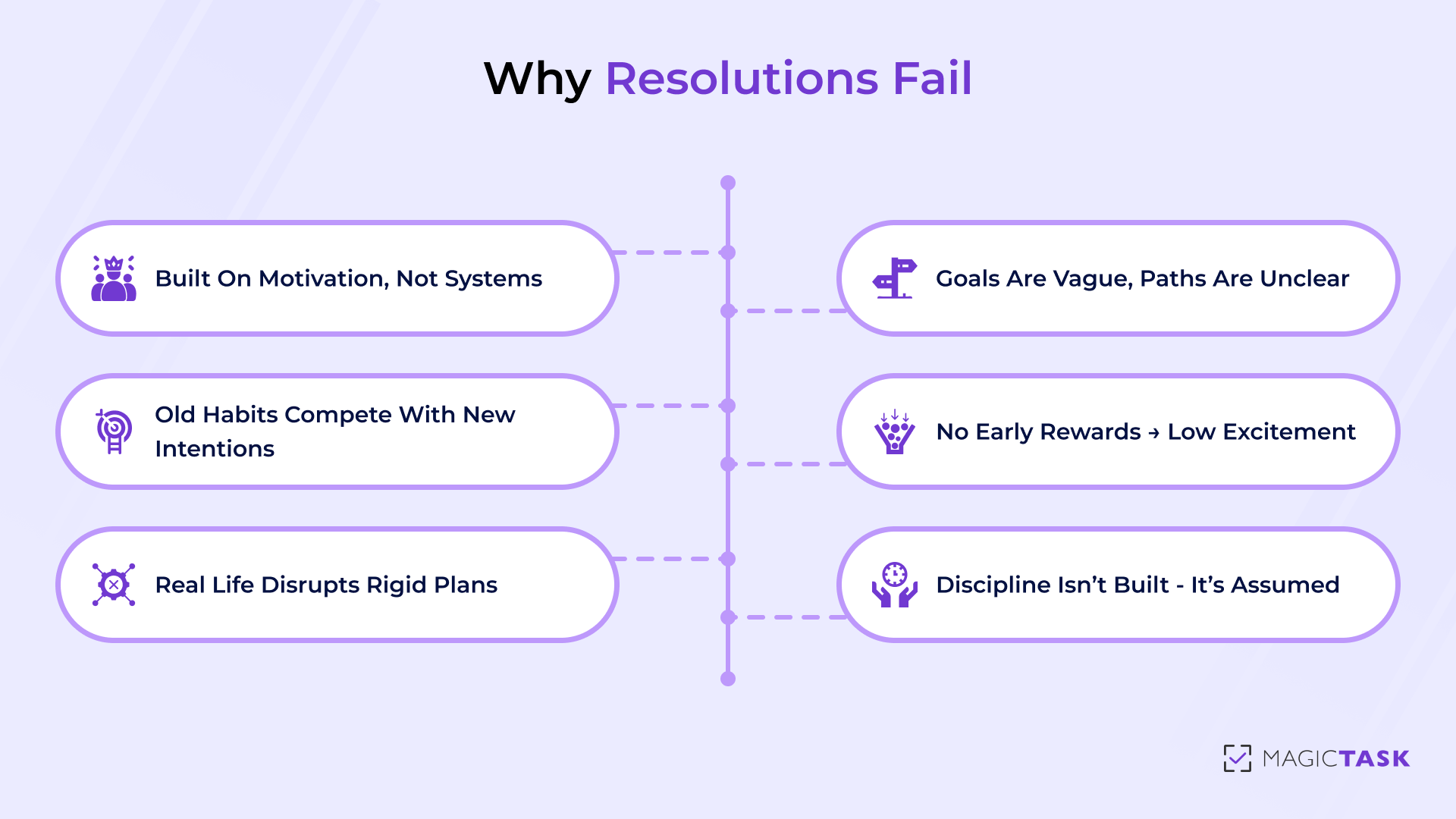
There are a few less obvious reasons resolutions slip through your fingers:

  • They rely on a “new year, new me” burst of energy that simply isn’t sustainable.
  • They compete with old habits that are far more ingrained and easier to follow. It’s your consciousness that needs to change before your behavior can change.
  • They rarely include immediate rewards, so there’s nothing that feels good in the beginning when it matters most.
  • They don’t account for real life with the sick days, the busy days, the low-energy days.
  • They assume discipline will magically appear, instead of being something built slowly over time.

So when February shows up with normal schedules, normal stress, and normal energy levels, the resolution that once felt exciting now feels like another heavy obligation.

But when you replace big, blurry resolutions with small actions, and you pair those actions with feedback, momentum, and tiny wins, habits start to feel surprisingly doable. And that’s where micro-habits come in.

Turning Resolutions into Micro-Habits

Big goals sound inspiring, but they rarely fit into the rhythm of everyday life. “Get fit,” “be more organized,” “read more,” “sleep better” are identities, not actions. And identities don’t change in one leap. They change through tiny, repeatable steps that feel almost too easy to ignore.

Micro-habits shrink your resolution into something small enough to start, simple enough to repeat, and satisfying enough to stick. Instead of demanding huge effort, micro-habits focus on creating momentum, the kind that makes you think, “Okay, I can do that again tomorrow.”

When you build your habits this way, consistency becomes something you grow into, not something you force.

Now let’s look at how to turn your big January vision into small daily actions you can actually follow through on.

1. Break the Big Goal Into Its Smallest Possible Action

Most resolutions fail because the goal is too big to act on in a single step. “Get in shape,” “be more productive,” or “learn a new language” sound great on paper, but your brain doesn’t know what to do with something that broad. Micro-habits solve that by shrinking the goal into the smallest possible action you can complete without negotiation.

Instead of asking, “How do I overhaul my entire routine?” you ask, “What’s the smallest step I can take today?” That tiny step becomes the seed of the habit.

For example:

Big goal: “Get fit this year.”

Micro-habit: “Do 10 squats after brushing my teeth.”

It’s so small you can do it half-asleep. And strangely, that’s the point. When a habit is small enough to start instantly, you’re far more likely to repeat it.

Small actions are the only actions that reliably compound.

2. Make the Habit So Easy You Can Do It on Your Worst Day

Anyone can keep a habit going on a good day when you’re rested, motivated, and everything goes as planned. The real test is what happens on the days that don’t cooperate: the long workdays, the low-energy mornings, the evenings when your brain feels like oatmeal. Most resolutions collapse here, not because the goal wasn’t meaningful, but because it required more effort than a tough day could handle.

That’s why micro-habits should feel almost laughably easy. Easy enough that even the tired, stressed, unmotivated version of you can still pull it off without thinking.

Here’s what that looks like in practice:

Big habit: “Read more books this year.”

Worst-day habit: “Read one page.”

One page sounds tiny… and that’s exactly why it works. On your best days, you’ll read more. On your worst days, you’ll still show up to keep the habit alive.

The goal isn’t perfection. It’s survival. If a habit can survive your worst days, it will flourish on your best ones.

3. Attach the Habit to Something You Already Do

One of the easiest ways to make a habit stick is to anchor it to something you already do every day. This method, often called “habit stacking,” works because it removes decision-making entirely. You don’t have to remember the habit, motivate yourself into doing it, or find the right moment. The cue is already built into your routine.

Think of your day as a row of hooks. Your current habits, like brushing your teeth, making coffee, opening your laptop, and washing your face, are already hanging there. All you’re doing is adding a new, tiny habit onto a hook that already exists.

Example:

Existing habit: Make morning coffee.

New micro-habit: Take one mindful breath while the coffee brews.

The brilliance of this approach is its simplicity. You’re not creating time; you’re piggybacking on time that already exists. That means fewer excuses, fewer steps, and far less friction. They start feeling like natural extensions of your day.

4. Turn Vague Intentions Into Clear, Daily Tasks

A major reason habits don’t stick is that the intention is vague.

“I want to be healthier.”“I want to be more organized.”“I want to stress less.”

These are desires, not actions.

Your brain doesn’t know where to start, so it delays, negotiates, or forgets. Clarity removes all that friction. When you turn a fuzzy resolution into a concrete daily action, you replace uncertainty with direction, and direction is far more powerful than motivation.

Instead of asking yourself, “How do I become healthier?” ask, “What does ‘healthier’ look like today?”

This is where tools like MagicTask can quietly support you. Instead of holding the entire resolution in your head, you translate it into clear, actionable daily tasks, the kind that actually get done because they’re visible and specific. You just add your daily tasks into the backlog, drag them to the main focus section, and then watch yourself climb the leaderboard as you finish them. 

Examples:

Vague: “Eat better.”
Clear: “Add one vegetable to today’s lunch.”

Vague: “Be more productive.”
Clear: “Complete one S-size task before noon.”

Clarity beats motivation every single time. When the step is obvious, the habit becomes repeatable.

5. Celebrate Every Completion to Reinforce Identity

Habits aren’t just about what you do but about who you’re becoming. Every small completion is evidence that supports a new identity. When you finish a micro-habit, even something tiny, your brain registers it as proof:

“I’m someone who shows up.”“I’m someone who takes care of myself.”“I’m someone who follows through.”

Identity changes with consistent, tiny wins.

This is why celebrating your completions matters. You’re not cheering for the size of the action; you’re reinforcing the identity behind it. Even the smallest success deserves acknowledgment, because acknowledgment fuels repetition.

MagicTask’s habit loops, like XP boosts, streaks, check-offs, and theme progress, are built around this psychology. They don’t just mark something as done; they make the moment feel good. And when completing a habit feels good, your brain wants to experience that feeling again.

Celebration doesn’t have to be loud. Sometimes it’s a checkmark. Sometimes it’s a visual cue. Sometimes it’s the quiet satisfaction of noticing your streak grow. But every celebration, no matter how small, builds the identity that keeps the habit alive.

How MagicTask Helps You Stay Consistent

Even the best micro-habits need a support system that reminds you to show up, rewards you when you do, and keeps you moving when motivation dips. That’s the real magic of habit-building tools: they make consistency feel easier, lighter, and a little more enjoyable. MagicTask was designed with that exact idea in mind.

Instead of relying on willpower (which fades) or memory (which fails), MagicTask gives you visible progress and a workspace that makes habits feel like wins. Let’s look at how it does that.

How MagicTask Helps You Stay Consistent

XP and Streaks Reinforce Daily Progress

Most habits fall apart because the early days don’t feel rewarding. You stretch for five minutes, drink more water, or read one page, and there’s no immediate payoff. Nothing changes yet. Your brain doesn’t get a “good job” signal, so sticking with the habit feels harder than starting it.

MagicTask fixes that by rewarding every completion.

When you finish a task, no matter how small, you earn XP. You see progress added instantly. The visual feedback tells your brain: “That effort mattered.” This tiny hit of satisfaction is exactly what keeps habits alive in the early weeks.

Streaks add another layer of motivation. Every day you show up, your streak grows, creating a sense of momentum you don’t want to break. And the best part? The pressure is gentle. It nudges you without making you feel punished on off days.

  • XP = immediate reward.
  • Streaks = ongoing identity.

Together, they help you stay consistent even when your motivation is running on fumes.

Task Sizing Helps You Choose Realistic Habit Steps

One of the biggest reasons habits fail is that we choose steps that are too big for real life. On a good day, they’re fine. On a busy, low-energy, or stressful day? They’re the first thing to go.

MagicTask solves this by letting you size your habits before you commit to them. Each task gets an S, M, L, or XL label, a simple visual cue that helps you understand the effort involved and choose the version of the habit that actually fits your day.

This turns habit-building into a flexible system rather than an all-or-nothing commitment.

Here’s what that looks like:

Task Size Effort Level Example Habit When to Use
S Very small Read 1 page, stretch for 5 minutes Low-energy days; keep the streak alive
M Moderate Read 5–10 pages, walk 15 minutes Normal days; steady progress
L Focused effort Gym session, 30 min study block High-energy days; deeper work
XL Multi-step Weekly meal prep, long workout Weekend routines; intentional planning

Now your habit is a spectrum. You can scale up when you feel strong, scale down when you don’t, and still stay consistent.

This kind of adaptability is what transforms habits from something you “try to do” into something you keep doing, no matter what the day looks like.

Level-ups and Visual Rewards Make Habits Feel Satisfying

There’s a reason games keep you hooked: they show you progress. Every time you advance to the next level, unlock a new skin, or hit a milestone, you feel a small rush because your effort has become visible.

MagicTask brings that same sense of satisfaction into your daily habits.

Each time you complete tasks, you’re literally leveling up your theme, unlocking animations, sound cues, and small visual changes that signal momentum. It’s a subtle but powerful feedback loop that keeps your habits emotionally rewarding rather than mechanically repetitive.

And emotional rewards matter. Research shows that visible progress triggers the brain’s dopamine pathways — the same ones responsible for motivation and satisfaction. The more you feel your progress, the easier it is to return to the habit tomorrow.

To make this even more tangible:

Here’s what a habit might feel like with MagicTask:

  • You finish your micro-habit for the day.
  • XP pops up instantly with a quick hit of “nice, I did it.”
  • Your streak number climbs, reinforcing your identity.
  • Your theme levels up, unlocking a new visual flourish.
  • Suddenly, a tiny habit feels like a small win, not something to check off as fast as possible.

These little emotional “yes moments” accumulate. You start to crave showing up. You begin looking forward to the next win.

And that’s how habits stick through satisfaction.

The Minimalist Interface Eliminates Friction

Most habit trackers and productivity tools fall apart because they add more work to the work. There are too many buttons, dashboards, and places to click before you actually do the thing you set out to do. And when you’re already short on time or energy, that extra friction is enough to break the habit before it begins.

MagicTask was built to eliminate that problem entirely.

The interface is clean, calm, and intentionally distraction-free. No clutter. No noise. No complicated setup. When you open the app, you see exactly what needs your attention. Your habits live right alongside your daily tasks, so you don’t have to jump between apps or remember which tool tracks what.

This simplicity matters more than it seems. In behavior psychology, the harder something is to start, the less likely you are to return to it. But when you remove even tiny friction, starting becomes automatic.

Here’s what that looks like in real life:

  • You open MagicTask and immediately see your micro-habits for the day.
  • You tap once to complete the action.
  • You get instant feedback (XP, streak, progress).
  • You move on with your day.

No mental load. No searching. No overwhelm.

Habits survive when they’re easy to begin. MagicTask makes starting feel effortless, which is exactly why staying consistent becomes easier too.

Building Momentum Beyond January

Starting a new habit is easy. Keeping it alive after January takes something different: visibility, small wins, and a system that reminds you why you began in the first place. Motivation fades, and momentum is what carries you forward.

MagicTask helps you build that momentum by making your progress impossible to miss. When you can see your streaks growing, your XP climbing, and your themes leveling up, you naturally reinforce the identity that keeps habits going:

“I’m someone who follows through.”

A simple way to stay consistent is to create monthly challenges or “Habit Quests.” Instead of aiming for a perfect year, aim for a focused 30-day mission. It feels lighter, more doable, and more satisfying to complete.

Pair that with a quick weekly review,  just a minute or two to look at your completed tasks and acknowledge your progress:

  • What did you show up for this week?
  • Which small wins made you proud?
  • Where did your streak stay alive?

These little check-ins matter. When progress stays visible and rewarding, consistency stops feeling like effort and starts feeling natural.

Conclusion

Sticking to your goals has never been about the burst of willpower you feel on January 1st. It’s about the tiny actions you choose, repeat, and celebrate. Big resolutions fade. Small, meaningful habits stay.

MagicTask makes those small actions easier to show up for by giving you clarity, rewards, and momentum you can actually feel. Each checkmark, each streak, each level-up turns consistency into something satisfying, something you look forward to, not something you push yourself through.

If you’re ready to make this the year your habits finally last, start simple. Pick one habit. Add it to MagicTask. Celebrate the win each day.

Start your first habit in MagicTask today, and watch how quickly your resolutions begin to stick.

ADHD in the Workplace: An Employer’s Guide to Boost Team Performance

ADHD in the Workplace: An Employer’s Guide to Boost Team Performance

ADHD in the workplace is more common than many employers realise, and it directly affects performance, engagement, and team cohesion. 

Around 5% of adults live with ADHD globally, which means in any average-sized team, at least one person is likely navigating work with difficulty.

While these individuals often bring creativity, innovation, and high-intensity problem-solving, traditional task systems tend to work against their strengths. When project workflows aren’t built to support neurodiversity, it leads to missed deadlines, dropped tasks, and team friction.

So how do you support ADHD minds without lowering the bar for performance, focus, or accountability?

That’s what this guide is for. You’ll gain a clear understanding of how ADHD manifests at work, what strategies are actually effective, and why a tool like MagicTask is designed to support neurodivergent teams without adding extra work.

What Challenges Do Employees with ADHD Face at Work?

Workplaces thrive on structure, prioritization, and consistency, yet those same elements can create hidden barriers for employees with ADHD. These individuals bring immense creativity, energy, and problem-solving ability, but often hit roadblocks in environments not built for neurodiverse thinking.

What Challenges Do Employees with ADHD Face at Work

Difficulty Prioritizing Tasks and Deadlines

Employees with ADHD often struggle with executive functioning, which affects their ability to prioritize. When everything feels equally urgent, it becomes difficult to decide where to begin. This can lead to either hyperfocus on low-priority tasks or decision paralysis that delays all progress.

Some common challenges include: 

  • Overestimating small tasks and spending too much time on low-impact work.
  • Underestimating large tasks, leading to last-minute rushes or missed deadlines.
  • Difficulty sequencing tasks, unsure which steps need to come first.
  • Getting distracted by novelty, diverting attention from important priorities.
  • Feeling overwhelmed by lists, making it hard to choose a starting point.

Without visible priority cues, important deadlines may slip—not due to carelessness, but because internal urgency signals that neurotypical employees often rely on naturally are harder to generate.

Overwhelm When Projects Aren’t Broken into Smaller Steps

Large projects with vague goals can feel insurmountable to someone with ADHD. Without a clear breakdown into manageable tasks, they may freeze or procrastinate because the task feels too mentally ambiguous. 

For example, “Create client report” offers no guidance on where to start or how to measure progress. Breaking it into steps like “Gather sales data,” “Draft analysis,” and “Design slides” makes it more approachable and achievable. 

Sensitivity to Distractions

ADHD brains are often described as having a “racecar engine with bicycle brakes.” In today’s workspaces, filled with notifications, open office chatter, and multitasking demands, this sensitivity becomes a daily challenge. 

Every ping, conversation, or visual clutter becomes a new stimulus to process. This makes it hard to stay in a productive state, especially for tasks requiring sustained focus or attention to detail. Even a well-intentioned Slack message can derail 20 minutes of deep work.

Struggles with Motivation During Repetitive Tasks

Routine tasks can quickly feel dull or draining for ADHD employees. Their brains are wired to seek novelty and stimulation. As a result, tasks that others find easy, like updating spreadsheets or processing similar tickets, can feel unbearable over time. 

Motivation dips, and the task is either delayed or abandoned altogether. Without some form of positive reinforcement or novelty, the repetition becomes a mental roadblock. 

Inconsistent Progress Tracking

Many employees with ADHD rely heavily on external structure to stay on track. Without visual progress markers or reminders, they may lose sight of what’s done, what’s next, and what’s important. This can lead to skipped steps, incomplete handoffs, or frustration when it’s time to report progress. 

While neurotypical employees may be able to “hold the plan in their head,” ADHD team members often benefit from visual, structured systems that externalize priorities and milestones. 

How Employers Can Improve Focus and Productivity (with MagicTask)

Understanding the challenges is only the first step. The next and most critical move is to take intentional action that supports how ADHD employees think and work best. MagicTask helps with this. 

Break Work into Smaller, Clearer Tasks

Large, ambiguous tasks are a hidden productivity killer, especially for employees with ADHD. A task like “Work on campaign” or “Fix website issues” doesn’t provide enough clarity to trigger action. It leaves too much room for interpretation, which can result in procrastination, anxiety, or missed expectations.

That’s where task decomposition comes in. Instead of treating a deliverable as a single to-do, you break it down into main tasks and subtasks. This method offers two powerful benefits:

  • Cognitive Relief: When a task is broken down into clear, specific steps, it instantly becomes more approachable. Employees no longer have to juggle all the pieces mentally; the structure does the heavy lifting.
  • Actionable Visibility: Subtasks show exactly what needs to happen next. This helps ADHD team members maintain forward momentum, especially when switching contexts or resuming work after interruptions.

In MagicTask, breaking work into subtasks is fast and frictionless. You can:

  • Create a main task (e.g., “Prepare Product Launch”)
  • Add subtasks like “Write email copy,” “Design launch banner,” “Schedule posts,” etc.
  • Mark off each subtask for visible progress and a sense of achievement

This approach turns ambiguity into action. It makes projects feel doable, keeps your team aligned, and ensures no detail slips through the cracks, especially for those who think differently.

Visualize Priorities as a Team

Clear priorities can make or break productivity, especially for team members with ADHD, who often struggle to decide what to tackle next when faced with a wall of tasks. Without a visual system to guide focus, even the most capable employees can lose momentum or fall behind.

In MagicTask, teams can drag and drop tasks into a clear, ranked order, making priorities instantly visible to everyone. No digging through layers of dashboards. No second-guessing what’s urgent.

This simple yet powerful interaction helps in three ways:

  • Real-Time Alignment: Managers and team members can collaborate on the same view, quickly adjusting task order as deadlines shift or new blockers emerge. Everyone stays on the same page, without needing long status meetings.
  • Mental Clarity for ADHD Brains: Seeing tasks laid out from top priority to low urgency helps reduce decision fatigue. ADHD team members know exactly where to direct their attention, which helps lower stress and increase follow-through.
  • Frictionless Flexibility: With a quick drag-and-drop, tasks can be re-prioritized without rewriting or reshuffling complex lists. The interface stays clean and minimal, which reduces the clutter that often overwhelms neurodivergent users.

Visualizing priorities isn’t just good project hygiene; it’s how you turn daily work into focused progress for every mind on your team. 

Clarify Complexity With Task Sizing

For employees with ADHD, the size of a task isn’t just a planning detail; it’s a psychological cue. A vague or oversized task like “Finish report” can feel insurmountable and trigger procrastination or mental fatigue. On the other hand, a well-scoped, appropriately sized task helps clarify effort, reduce overwhelm, and make progress feel possible.

MagicTask solves this with a simple but powerful feature: task sizing. 

Every task can be marked as S, M, L, or XL, giving team members a visual sense of how much time and energy it will take. This sizing system helps ADHD employees pace their workload more effectively, balance high-effort tasks with lighter ones, and avoid burning out on hidden “time bombs.”

It also helps managers assign work more equitably. Instead of giving someone five tasks that look equal but feel wildly different in scope, you’re aligning expectations and removing ambiguity. 

Here’s a quick way this plays out:

Task Size Time Needed Example
S (Small) 5–10 minutes Reply to an email
M (Medium) 30 minutes Write a short status update
L (Large) 1–2 hours Draft a blog post
XL (Extra Large) Half a day or a full day Build a product roadmap

This structure turns task planning into a confidence-building process and helps ADHD team members stay productive without mental overload. 

Track Progress Easily with a Clear Hierarchy

ADHD minds often thrive with structure, not in the form of rigid rules, but as visual systems that reduce mental clutter and make progress visible. One of the biggest challenges in managing projects is seeing how the parts fit together. That’s why a clean hierarchy is essential.

MagicTask uses a simple but effective project → task → subtask structure that breaks down complexity into digestible layers. At the top, projects hold your high-level objectives. Within them, tasks represent actionable items. If a task is too big, you can split it further into subtasks — each with its own owner, size, and deadline.

This approach gives ADHD team members several advantages:

  • No more overwhelm: When work is broken down visually, it’s easier to focus on the next small step instead of the entire mountain.
  • Instant context: You can see what each task contributes to, helping employees connect daily work to larger goals — which boosts motivation.
  • Better accountability: Managers can glance at a project and understand what’s moving and what’s stuck, without chasing updates.

Instead of relying on memory or scattered notes, your team has a clear visual roadmap, one that respects different working styles and keeps progress transparent at every level. 

Why MagicTask Helps ADHD Minds Focus Better?

Many task tools are built for structure but not necessarily for focus. For professionals with ADHD, the biggest challenge often is staying engaged with the process of doing it. Overloaded interfaces, confusing navigation, and uninspiring task lists can quickly lead to frustration, avoidance, or inconsistent follow-through.

Why MagicTask Helps ADHD Minds Focus Better

MagicTask takes a different approach. It’s intentionally designed to reduce friction and increase motivation, two things that ADHD brains thrive on when supported properly.

  • Clean, distraction-free interface: Employees aren’t bombarded with options, tabs, or hidden menus. The layout is visually simple and intuitive, which helps eliminate cognitive overload and lets users focus on what matters right now.
  • Quick setup, minimal ramp-up time: The platform avoids long onboarding flows and unnecessary complexity. This makes it easier for new users, especially those who feel overwhelmed by traditional tools, to adopt and stick with it.
  • Gamification built for daily motivation: Users earn points for completing tasks and can unlock visual rewards like themes, sounds, and custom skins. This system adds a layer of intrinsic motivation that helps transform repetitive tasks into a more engaging experience.

These aren’t just features. They’re behavioral design elements that align with how neurodivergent minds operate. MagicTask doesn’t force users to change how they work. Instead, it creates a space where focus, momentum, and follow-through feel natural.

Management Practices That Work Better with MagicTask

Introducing a new tool is only effective if it’s paired with intentional practices. MagicTask is a framework for helping teams work smarter, stay engaged, and reduce mental clutter. 

When managers and employees align on workflows and make the most of the platform’s gamification features, the result is a team that moves faster, communicates more clearly, and celebrates progress along the way.

Introduce MagicTask as the Single Source of Task Management

Consistency is crucial. By designating MagicTask as the central hub for all tasks, teams avoid fragmented communication and lost assignments. Managers should communicate that every project, deadline, and update lives in the same system. This establishes clarity, reduces confusion, and gives everyone a shared view of priorities.

Train Managers on Key Workflows

Managers play a pivotal role in making the system effective. Training should focus on workflows that both reduce cognitive load and leverage the app’s gamified structure:

  • Mind Dump Sessions: Encourage team members to clear mental clutter by dumping all tasks into MagicTask before organizing priorities.
  • Task Prioritization and Sizing: Teach managers how to help employees assign task sizes (S/M/L/XL), providing clarity on effort and expected focus.
  • Comments for Centralized Communication: Use task comments to consolidate feedback, questions, and updates—keeping discussions tied to actionable items.

These practices create a rhythm where work feels organized rather than overwhelming, making it easier for employees to stay on track and managers to monitor progress.

Encourage Employees to Engage with Gamification Features

MagicTask’s gamified elements aren’t just for fun. They actively support motivation and focus. Managers can foster adoption by encouraging employees to:

  • Personalize their workspace with themes that energize them.
  • Stay motivated by climbing the leaderboard and celebrating small wins.
  • Turn tasks into achievements using points, streaks, and visual rewards.

When these habits are reinforced, tasks stop feeling like chores and start feeling like challenges you can win, making focus and completion natural outcomes.

Conclusion

Supporting employees with ADHD isn’t just an act of inclusion, but a strategy that elevates team performance. MagicTask brings structure, clarity, and gamification together in a single tool, making it easier for everyone to stay focused, motivated, and organized. 

By fostering an environment that meets diverse working styles, employers empower every team member, ADHD or not, to thrive, achieve goals, and perform at their best.

Ready to see the difference for yourself? Try MagicTask today and experience a task management system designed to work with your brain, not against it. Turn overwhelming lists into achievable wins, stay motivated with interactive progress, and finally enjoy a workspace that keeps you focused and energized, every single day.

Ivy Lee Method: A Simple Routine to Stay Productive Every Day

Ivy Lee Method: A Simple Routine to Stay Productive Every Day

Most professionals end the day with more tasks than they started with. To-do lists sprawl, priorities blur, and the sense of progress slips away in the noise of digital tools. 

Over 100 years ago, an executive coach named Ivy Lee gave business leaders a deceptively simple solution, one that still works today. It was a 6-task system designed to bring focus, momentum, and clarity into every workday.

The method is so timeless, it still shows up in leadership circles, productivity books, and team playbooks. But that method used pen and paper, something that won’t be so effective in today’s digital world.

That’s where MagicTask comes in. It combines the elegance of the Ivy Lee Method with a modern, gamified system that makes it easy to stick to and even enjoyable.

Let’s break down how it works, where traditional routines fall short, and how you can use MagicTask to bring the Ivy Lee Method to life in 2025. 

What Is the Ivy Lee Method?

The Ivy Lee Method is one of the simplest and most enduring productivity techniques still in use, and it dates back to 1918.

It began when Charles M. Schwab, then-president of Bethlehem Steel, asked productivity consultant Ivy Lee for advice on improving his team’s efficiency. Lee gave Schwab a 15-minute coaching session and a single instruction: at the end of each workday, have your executives write down the six most important tasks they needed to complete the next day, and then rank them in order of priority.

Lee's advice was as follows:

  1. Write down six (and only six) tasks for tomorrow.
  2. Rank them in order of true importance.
  3. Start with task #1 the next day and work your way down — no multitasking.
  4. Move any unfinished tasks to the next day’s list.

After a few weeks of using the system, Schwab was so impressed by the results that he reportedly sent Lee a check for $25,000, the equivalent of over $500,000 today.

It worked then because it was simple, focused, and easy to repeat. And over 100 years later, that clarity still cuts through the noise.

What Is the Ivy Lee Method

Why It Falls Short Today

The Ivy Lee Method was built for a world with fewer interruptions, slower communication, and static priorities. In 1918, six handwritten tasks could carry you through an entire day without much change. Today’s work reality looks very different.

1. Multiple Tasks Compete for Attention

The Ivy Lee Method assumes a linear workday, one where you can calmly move through six prioritized tasks in sequence. But modern workflows rarely operate like that. You’re pulled into meetings, asked to review something “quickly,” or hit with last-minute fire drills. Suddenly, your #2 tasks get bumped by five unplanned requests.

Even worse, most professionals today don’t have just six tasks — they have dozens, scattered across emails, chat apps, project dashboards, and sticky notes. Picking six feels impossible when everything feels urgent.

This overload leads to:

  • Decision fatigue about what deserves to make the list.
  • Missed priorities as reactive tasks take over.
  • Mental stress from knowing there’s more than six items waiting in the background.

Without a flexible, visible system, the Ivy Lee Method can feel like a nice idea that collapses under the weight of modern work chaos.

2. Digital Distractions Disrupt the Flow

When the Ivy Lee Method was created in 1918, there were no Slack messages, calendar pings, or app notifications pulling your focus every five minutes. Today, most professionals operate in environments saturated with digital noise. Every time your phone buzzes or your browser flashes a new tab, your focus breaks, and with it, the flow you need to work through a prioritized list.

Even if you start your day with a clear list, staying on task is another challenge entirely.

Common digital distractions include:

  • Incoming emails that feel urgent (but rarely are)
  • Chat notifications from teammates
  • Calendar events breaking up your work blocks
  • Temptation to check social media or refresh dashboards

These distractions fragment your attention and weaken your ability to move through tasks with intention. Without a system that reinforces focus and rewards progress, even the best list can become background noise. 

3. Team Visibility & Shifting Priorities

The Ivy Lee Method works best in a world where your priorities stay stable from one day to the next. But in modern team environments, priorities can change by lunchtime, and without real-time visibility, your carefully ranked list can quickly become outdated.

When tasks are planned on paper or in a private system, teams face two major problems:

  • No shared visibility: Teammates can’t see what you’re working on or where they can support you.
  • Lack of alignment: Project priorities shift, but your to-do list doesn’t — causing delays, missed expectations, and duplicated work.

In fast-moving teams, static systems don’t reflect dynamic reality. Without a way to re-prioritize collaboratively or adjust based on shared goals, even a focused method like Ivy Lee starts to break down.

That’s why a modern task system needs to bridge personal focus with team visibility. In the next section, you’ll see how MagicTask does exactly that — adding the flexibility, transparency, and motivation the Ivy Lee Method needs to thrive in 2025. 

How MagicTask Supercharges Ivy Lee

MagicTask brings structure, visibility, and motivation to the classic six-task routine. Instead of relying on pen and paper or hoping you'll remember to reprioritize throughout the day, MagicTask gives you a digital flow that makes this method sustainable.

How MagicTask Supercharges Ivy Lee

1. Mind Dump: Clear Your Mental Cache

The first step in modernizing the Ivy Lee Method with MagicTask is a full mind dump, getting every task, idea, or loose end out of your head and into a trusted system.

Mental clutter drains your focus. Studies show that people spend nearly 47% of their waking hours thinking about something other than what they’re doing, while physical and mental clutter split their attention, making it harder to concentrate. If your brain is juggling reminders, priorities, and half-finished thoughts, productivity suffers.

MagicTask turns the mind dump into a frictionless habit:

  • Tap into the “Add Task” flow and unload everything — work, personal, urgent, unclear.
  • Don’t worry about structure yet. Just get it out.
  • Use voice or keyboard, whichever feels faster in the moment.

Once your mental cache is cleared, you’re ready to bring focus back to what really matters — your priorities for the day. 

2. Task Sizing for Realistic Planning

One of the biggest reasons the Ivy Lee Method can fall apart in modern workflows is that not all tasks are created equal. Writing down six things without understanding their complexity leads to burnout, skipped tasks, or an unrealistic day plan.

That’s where MagicTask’s task sizing system adds depth without adding friction.

MagicTask uses a simple sizing system — S, M, L, XL — to help you gauge how much time and focus each task demands. Here’s how that typically looks:

Task Size Effort Level Time Needed Examples
S Quick, no setup Under 10 minutes Reply to email, set calendar reminder
M Moderate, focused 20–30 minutes Draft client update, run report
L Deep work 45–60 minutes Write article, prep presentation
XL High effort / multi-step 90+ minutes Build proposal, fix bugs, onboard hire

When you’re using the Ivy Lee Method inside MagicTask, sizing your tasks gives you clarity on:

  • How many you can realistically complete
  • Where to place deep work
  • Which tasks might need to be split or deferred

It’s about finishing what matters without overcommitting. Task sizing keeps your list honest. 

3. Drag-and-drop Reprioritization

Reprioritization is inevitable in modern work. While the Ivy Lee Method encourages a clear starting point, it assumes that priorities remain static from morning to evening, but real life doesn’t work that way. Clients call. Urgencies change. Your energy dips mid-afternoon. And suddenly, your sixth task needs to become your first.

With MagicTask, you don’t have to abandon the method — you just make it fluid. The drag-and-drop functionality lets you instantly reorder your daily six as new information comes in. There’s no rewriting, no breaking focus, no need to open a different tool.

You stay anchored to your plan, but now you have the freedom to pivot when it matters. That flexibility turns a rigid method into a living system, one that moves with your day instead of resisting it. 

Gamification Keeps the Routine Engaging

The Ivy Lee Method is simple — but simplicity alone doesn’t guarantee consistency. In traditional setups like pen and paper or basic task lists, the initial motivation fades quickly. MagicTask injects staying power into the method by gamifying the routine, turning task completion into a rewarding experience instead of a mental chore.

Here’s how it works, and why it makes such a difference:

  • Visual Progress That Feels Good: Every completed task earns experience points (XP), contributing to visible progress within your MagicTask theme. This visual feedback loop taps into your brain’s reward system, turning small wins into satisfying momentum.
  • Leveling System That Encourages Consistency: As you plan daily, complete tasks, and maintain the routine, you level up. This adds a sense of personal growth beyond just “checking boxes.” It transforms productivity into a game, one you want to keep playing.
  • Theme Unlocks That Keep Things Fresh: Hitting certain milestones unlocks new UI themes, giving your workspace a fresh look. This subtle visual evolution rewards long-term use and reduces routine fatigue, keeping the method engaging over weeks and months.
  • Daily Rewards That Reinforce Habits: Simply showing up and following through becomes part of your streak with rewards for consistency. This makes you more likely to stick with your plan even on low-energy days.
  • Behavioral Design That Drives Focus: MagicTask uses behavioral triggers to encourage daily use, such as nudges, visual streaks, and feedback sounds. These are reinforcements designed to strengthen your planning habit in a low-effort, high-impact way.

Instead of relying on sheer willpower to keep the Ivy Lee Method going, MagicTask builds a feedback loop that sustains you. It makes the process enjoyable, and when productivity feels good, it becomes a lifestyle, not a temporary fix. 

Team Alignment & Visibility

Traditional Ivy Lee routines are built for individual focus, but modern teams need shared visibility to stay aligned. MagicTask expands the method’s solo structure into a collaborative workflow. 

Once each team member sets their daily top six, others can view, comment, and coordinate around those priorities. It removes ambiguity, prevents overlap, and surfaces blockers before they cause delays. 

Because tasks are sized and ordered, teammates can instantly understand someone’s workload without long check-ins or status meetings. This creates a shared rhythm across departments, one where focus is personal but direction is collective. It keeps teams moving together, not just individually. 

Daily Routine Example (Ivy Lee + MagicTask)

Great systems don’t just help you plan better — they help you show up consistently. That’s where the Ivy Lee Method shines. You decide your priorities today, so tomorrow starts with clarity. And inside MagicTask, this classic method turns into a daily loop you’ll actually look forward to. Here’s how it works in practice.

Here’s how the Ivy Lee Method comes to life inside MagicTask as a repeatable, energising daily workflow:

Evening Reset → Pick and Rank Your SixEnd the day by reviewing everything in your mind dump. Choose the six tasks that matter most for tomorrow. Use task sizing (S, M, L, XL) to avoid overloading yourself, then drag them into order of priority. This closes the day with clarity and sets you up for momentum in the morning.

Morning Kickoff → Start With #1 in MagicTaskLog in and head straight to your #1 task. No overthinking, no scrolling. Just execute. The clean UI and visual structure reduce distractions, so you can get into flow right away.

During the Day → Capture New Tasks Without Losing FocusNew priorities always pop up, but don’t let them derail your focus. Drop them into your mind dump or “inbox” space, then return to your current task. You’ll process them during your next reset, not in the middle of deep work.

End of Day → Review & Carry ForwardWrap up with a quick review. Celebrate what you finished (and enjoy the gamified rewards). Any unfinished tasks? Reassess and re-rank them for tomorrow. This daily loop strengthens consistency and reduces mental fatigue.

Tips to Make It Stick

If six tasks feel overwhelming at first, start with just three. The goal is progress, not pressure. Mix in different task sizes so your day doesn’t get overloaded.  Stacking multiple XL tasks often leads to frustration and burnout. 

Keep your number one task visible and, when possible, share it with your teammates. This signals what you need uninterrupted focus on and helps reduce unnecessary context-switching. Small habits like these make the Ivy Lee Method easier to follow and far more sustainable over time. 

Conclusion

The Ivy Lee Method has lasted over a century for one reason: it works. Its elegance lies in its simplicity, just six tasks, ranked by priority, and tackled with focus. But staying consistent with this system in today’s fast-paced, distraction-filled environment takes more than a notebook.

MagicTask modernises the method without losing its core. You still get the clarity of the original framework, but now it’s enhanced by smart features like task sizing, drag-and-drop planning, and motivating gamification that rewards your progress. It’s everything the Ivy Lee Method promised — made sustainable for modern teams and individuals.

Try setting your first six tasks in MagicTask tonight. See how good it feels to start tomorrow with clarity, focus, and a little bit of fun.

How to Break Project Deliverables into Clear, Actionable Tasks

Break Project Deliverables into Clear, Actionable Tasks

Project deliverables are supposed to drive progress, but too often, they become a source of confusion.

Vague, oversized deliverables, such as “launch campaign” or “rebuild onboarding,” sound ambitious but leave your team stuck asking, “Where do we even start?” 

Without a system to break deliverables into clear, actionable tasks, execution stalls and deadlines slip. Projects that looked promising in planning meetings suddenly feel chaotic. 

The fix isn’t more meetings or tighter oversight. It’s the structure.

In this blog, you’ll learn a simple framework for turning complex deliverables into trackable action steps and how to implement it using MagicTask, a gamified task management system designed to reduce overwhelm and increase team clarity. 

Let’s break it down. 

What Does “Breaking Deliverables into Tasks” Really  Mean?

Deliverables and tasks often get lumped together, but they’re not the same. A deliverable is the outcome you’re trying to produce. A task is a specific, concrete step that someone takes to achieve a goal. 

Think of a deliverable as the destination, and tasks as the directions.

For example, the deliverable is: “Launch new website

So, the tasks will be:

  • Design homepage mockup
  • Write About Us page copy
  • Test contact form functionality
  • Finalize SEO metadata
  • Deploy to production

Without this kind of breakdown, teams tend to either spin their wheels or skip critical steps. A vague deliverable leads to multiple interpretations, resulting in confusion, duplication, and rework.

Clarity is about setting clear expectations and ensuring real accountability. When every task is defined, sized, and assigned, projects move faster because no one is guessing what “done” really means.

This is the heart of project execution: turning big-picture ideas into small, finishable actions.  

Selecting the Right Task Management Tool for Clarity

Even with a well-defined deliverable, your system will fall apart without the right tool to support it.

Most project slowdowns aren’t due to a lack of intent, but rather a lack of visibility, structure, or accountability. The tool you choose either makes work easier to manage or harder to follow through. 

A solid task management tool should make project clarity feel automatic.

That means:

  • A clean, distraction-free interface so nothing gets lost in the noise.
  • The ability to size and prioritize tasks based on effort and urgency.
  • Flexibility to adapt as the scope shifts, without breaking the system.

MagicTask was designed to do precisely this. Instead of dumping all tasks into a single, endless list, it gives you structure through task sizing, drag-and-drop prioritization, and simple project organization.

You can see what needs to happen, when, and who’s responsible without micromanaging or switching between tabs. 

Turning Project Deliverables into Clear Action Items with MagicTask

Turning Project Deliverables into Clear Action Items

If your current tool creates more friction than flow, it’s time to rethink it. MagicTask makes it easier to break big goals into meaningful actions and actually follow through. 

Step 1: Define the Deliverable Clearly

Every strong project starts with a clearly defined outcome. Before assigning tasks or estimating timelines, you need to articulate what exactly needs to be delivered and what “done” looks like.

A deliverable isn’t just a vague idea, such as “website redesign” or “client onboarding.” It’s a specific, tangible outcome your team can work toward. The more precisely it’s defined, the easier it becomes to reverse-engineer into actionable tasks. 

Ask yourself:

  • What is the final output?
  • Who is it for?
  • What problem does it solve?
  • What are the key requirements for it to be considered complete?

Example: Launch new website

Clear definition:

“A fully functional marketing website with five pages (Home, About, Services, Blog, Contact), responsive across all devices, integrated with CMS, and approved by leadership.”

When deliverables are this specific, the path forward becomes much easier to map, and the team can align around a shared understanding from day one.

MagicTask helps capture and document this level of clarity right inside your workspace, ensuring no one’s operating off assumptions. 

Step 2: Break Deliverable into Key Components

Once you’ve clearly defined your deliverable, the next step is to break it down into logical components or phases. This creates structure, turning a large goal into manageable sections that are easier to plan, assign, and execute.

Think of this step as outlining the major “chapters” of the project. If the deliverable is launching a new website, your components might look like:

  • Design: wireframes, mockups, approvals
  • Content: copywriting, asset sourcing, SEO setup
  • Development: front-end build, CMS integration
  • Testing: QA checks, responsiveness testing
  • Launch: domain setup, deployment, stakeholder review


Each component acts as a container for actionable tasks. Without this step, teams often jump straight into task creation, only to end up with a long, chaotic list that lacks context. 

Inside MagicTask, you can create folders or projects to reflect these key components. This keeps your workspace organised, reduces overwhelm, and ensures that every task ties back to a meaningful section of the deliverable. It also makes it easier to delegate ownership and track progress within each phase. 

Step 3: Translate Components into Actionable Tasks

With your project components clearly mapped out, it’s time to convert them into real tasks, the kind that actually get done, not just talked about.

The rule here is simple: every task should be small, specific, and start with a verb. This shifts your team from vague intentions to clear, executable actions.

Let’s take the “Content” component from a website project. Instead of a bulky, unclear task like “Handle content”, break it down into:

  • Write About Us page copy
  • Source product images from the design team
  • Upload blog articles into CMS
  • Add SEO metadata to the homepage and blog

Each of these can be done, tracked, and checked off, reducing procrastination and boosting progress. 

Actionable tasks make it easier to:

  • Assign clear ownership
  • Estimate effort accurately
  • Avoid rework caused by confusion
  • Keep projects moving, even across handoffs

Inside MagicTask, this kind of granularity fits perfectly. You can input tasks quickly, add task sizing (next step), and drag them into priority order, creating momentum without micromanagement.

This is where execution starts to feel doable. 

Step 4: Assign Sizes (S, M, L, XL)

Once tasks are broken down, you need a simple way to gauge effort at a glance. MagicTask utilizes a system of S, M, L, and XL to maintain an intuitive and fast interface.

Sizing gives your team clarity on how much time or energy each task requires, without obsessing over exact time estimates. It also helps balance workloads, spot bottlenecks early, and build realistic daily plans.

Think of sizing as effort-based, and not duration-based. A 15-minute task that requires deep thinking might be Medium, while a repetitive 30-minute task could be Small.

Task Size Description Effort Level Example
S Quick, low-friction task < 15 minutes Fix typo, send email, rename file
M Moderate task with 1–2 steps ~30 minutes Draft short copy, update landing page
L Larger task requiring deep focus or setup ~1 hour+ Create mockup, write blog draft
XL High-effort task or small project on its own 2+ hours or multiple sessions Build deck, design homepage section

MagicTask’s gamified experience is directly tied to sizing. You get more points for finishing larger tasks, which creates momentum instead of burnout, especially when XL tasks are broken into subtasks or complemented with a few Small wins.

This sizing system turns ambiguity into visibility. Everyone knows what to expect and how to make the most of the day. 

Step 5: Prioritize and Sequence Tasks

Once your tasks are clearly defined and sized, the next step is to put them in the correct order. 

Start by identifying any task dependencies. Which tasks must be completed before others can begin? These create a natural order of operations. For example, you can’t “Test Contact Form” before you “Build Contact Form.”

Prioritize and Sequence Tasks

Then look at impact vs. urgency.

Which tasks drive the most value? Which ones are time-sensitive? Prioritizing based on these criteria helps your team focus on what actually moves the project forward, rather than just reacting to whatever feels loudest.

Sequencing tasks helps reduce context-switching and enables flow-state work. Group similar tasks or structure your week around project phases (e.g., design before development).

MagicTask supports this naturally through drag-and-drop task ordering inside folders or projects. The clean layout makes your priorities visible at a glance, and rearranging them takes seconds. When priorities shift, and they will, the system flexes with you. 

Step 6: Assign Ownership and Deadlines

Clarity doesn't stop at defining tasks. It’s just as crucial to assign ownership and timelines. Without a clear owner, tasks fall through the cracks. Without a deadline, they stretch indefinitely. This step turns your plan into real accountability.

Assign one owner per task, even if multiple people are involved in the task. One person should always be responsible for driving the task forward or flagging blockers. This eliminates confusion and prevents the “someone else will do it” trap.

Deadlines should be realistic, based on task size, dependencies, and team availability. Avoid overloading team members with too many large tasks at once.

Here’s how to structure this step effectively:

  • Assign a single task owner – Ensure there's no ambiguity about who’s responsible.
  • Set a deadline – Based on the task size (S, M, L, XL) and priority.
  • Add notes/context – If needed, include links, files, or key instructions.
  • Communicate expectations – Everyone should know what’s due when, and what success looks like.

With MagicTask, assigning ownership and deadlines is seamlessly integrated into the workflow.

You can quickly tag a team member, select a due date, and keep the entire project timeline visible without clutter or chaos. It's delegation without micromanagement.

How MagicTask Simplifies Task Delegation and Team Alignment

Managing project deliverables is about keeping everyone aligned as those pieces move. MagicTask turns delegation and coordination into a lightweight, visual, and habit-forming process that doesn’t require chasing people down or managing a sea of Slack messages.

Once your tasks are structured and sized, MagicTask makes it easy to assign ownership, set deadlines, and give every team member visibility into who’s doing what. Each task clearly indicates who’s responsible, its size (S, M, L, XL), and when it’s due, all at a glance.

There’s no need to dig through cluttered dashboards or nested subtasks. The clean interface allows teams to focus on execution, not project administration. And because it’s gamified, completing tasks becomes intrinsically motivating, not just another checkbox.

You get:

  • Clear accountability without micromanagement
  • Real-time visibility without status meetings
  • Teamwide motivation through points, streaks, and progress themes

As a result, everyone knows what to do, when to do it, and why it matters. MagicTask doesn’t just organize work. It organizes teams around progress. 

Common Mistakes to Avoid

Even with the right tools and a solid framework, small missteps can derail project momentum.

Many teams rush the breakdown process or oversimplify it, leading to confusion, delays, or missed deadlines. These errors create real execution risks that ripple across your team.

Here are a few mistakes to watch out for:

  • Creating vague tasks: A task like “Work on design” doesn’t give clear direction. Use action verbs and specificity (e.g., “Create homepage wireframe in Figma”).
  • Leaving tasks too large: If a task can’t be completed in a single focused work session, it’s likely too big. Break it down into smaller chunks that can actually be scheduled and finished.
  • Skipping dependencies or sequencing: Without mapping task order, teams often start the wrong task too early or get blocked because a critical step is not yet complete.
  • Not refining the task breakdown when scope changes: Projects evolve. When they do, revisit your task structure. Outdated or misaligned tasks quickly lead to wasted time and duplicate efforts.

Avoiding these mistakes builds the kind of clarity and flow that high-performing teams rely on.

Conclusion

Breaking significant project deliverables into clear, actionable tasks isn’t just a best practice; it’s the foundation for team clarity, accountability, and momentum. When your task structure aligns with the proper workflow, your team spends less time second-guessing and more time making genuine progress.

MagicTask makes this entire process smoother. From sizing tasks for better planning to visual sequencing, drag-and-drop prioritization, and effortless team assignments, it’s built to turn complexity into clarity.

If your current task system feels chaotic or overwhelming, try breaking your next deliverable down in MagicTask. You’ll instantly see the difference in alignment, energy, and execution.